



The share market can look intimidating when you are new. Prices move every second, financial news uses unfamiliar terms, and everyone seems to have an opinion about what will happen next. But underneath the noise, the share market is built on a simple idea: it helps people buy and sell ownership in companies.
For new investors, the goal is not to predict every price movement. It is to understand the system well enough to make calm, informed decisions. Once you know what shares represent, how orders are matched, why prices change, and where the main risks come from, the market becomes much easier to navigate.
What the share market actually is
The share market is a network where investors buy and sell shares of publicly listed companies. A share is a small unit of ownership in a company. If you buy shares of a company, you become a shareholder, which means you may benefit if the company grows in value or pays dividends.
Companies list shares on stock exchanges, such as the New York Stock Exchange, Nasdaq, London Stock Exchange, or other regulated markets around the world. Investors usually access those exchanges through a broker or investment platform.
If you are still learning what ownership really means, Greek Shares has a simple guide that explains shares in plain English for beginners.
The share market is not one physical place anymore. Most trading happens electronically, with orders routed through systems that match buyers and sellers. The exchange provides rules, transparency, and a regulated environment so trades can happen efficiently.
Why companies sell shares
Companies sell shares mainly to raise capital. Instead of borrowing money from a bank or issuing debt, a company can sell part of its ownership to investors. That money can be used to expand operations, develop products, hire staff, pay down debt, or fund long-term projects.
This usually begins in the primary market, where a company sells shares to investors for the first time through an initial public offering, commonly called an IPO. After that, those shares trade between investors in the secondary market. Most buying and selling that regular investors do happens in the secondary market.
| Market type | What happens | Who receives the money? | Example |
|---|---|---|---|
| Primary market | New shares are issued | The company | A company sells shares in an IPO |
| Secondary market | Existing shares are traded | The selling investor | You buy shares from another investor through your broker |
This distinction matters because when you buy shares on an exchange, you are usually not giving money directly to the company. You are buying from another investor who has decided to sell.
The main players in the share market
The share market works because several participants perform different roles. Understanding who they are helps explain why trades can happen quickly and why prices change throughout the day.
Companies issue shares and report financial results. Their business performance is one of the main factors investors study.
Investors buy and sell shares. They include individuals, pension funds, mutual funds, hedge funds, insurance companies, and other institutions.
Stock exchanges provide marketplaces where listed shares can be traded under clear rules.
Brokers connect investors to the market. When you place an order in your brokerage account, your broker sends it to a trading venue where it can be executed.
Market makers and liquidity providers help keep trading active by quoting buy and sell prices. This can make it easier for investors to enter and exit positions.
Regulators set and enforce rules designed to protect investors and support fair markets. In the United States, for example, the Securities and Exchange Commission provides investor education through Investor.gov.
Modern markets also depend heavily on information, data, and automation. Investors react to earnings reports, economic data, interest rate expectations, and company news. This is not unique to finance. In other industries, software also uses signals to identify opportunities, such as an AI-powered B2B prospecting platform that helps sales teams detect buying signals and prioritize outreach. The lesson for investors is similar: information changes behavior, and behavior moves prices.
What happens when you buy a share
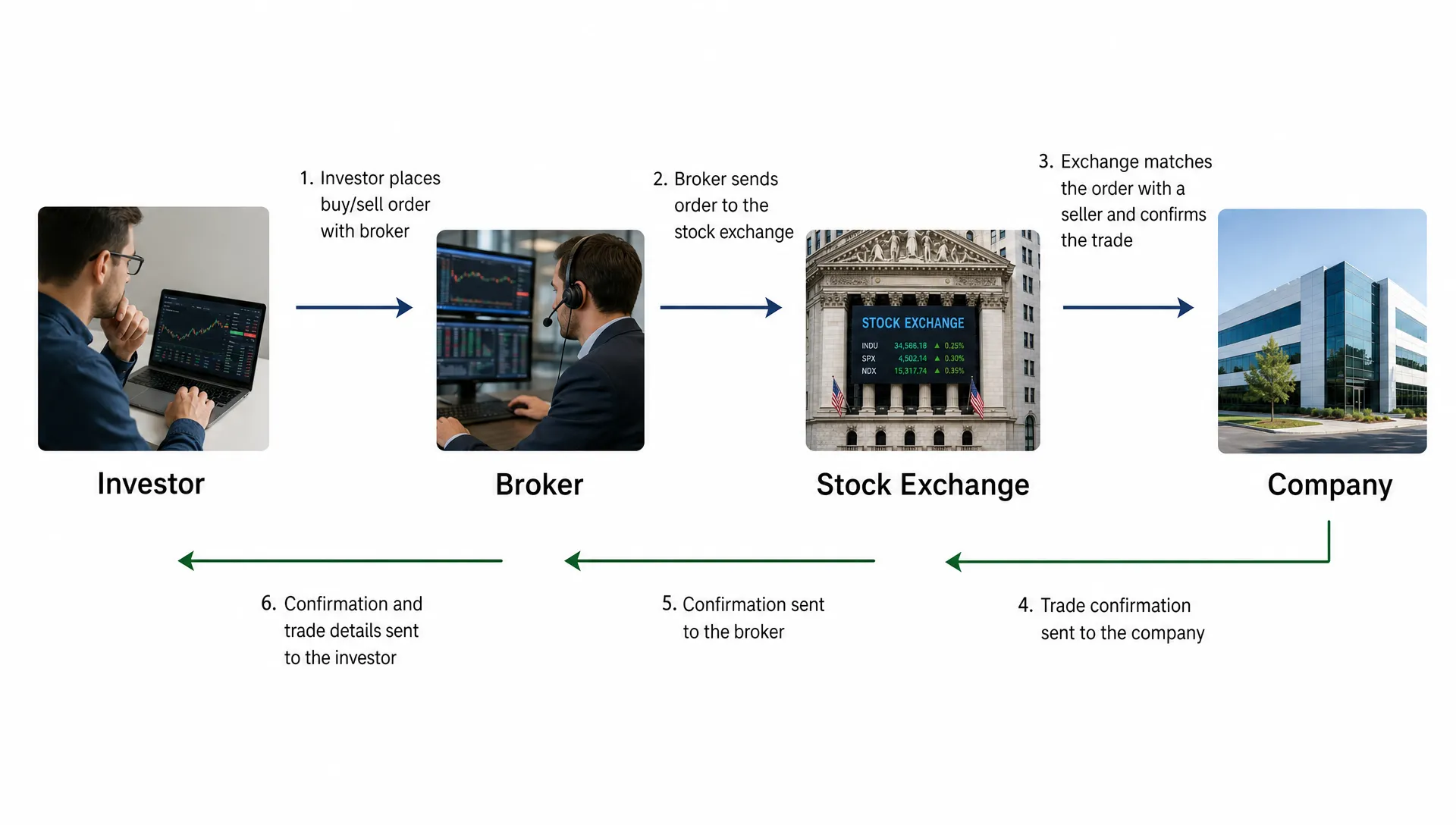
When you click “buy” in a brokerage account, several things happen behind the scenes. The process is usually fast, but it is not magic.
- You choose the investment: You decide which share or fund you want to buy.
- You enter an order: You select the number of shares and the order type, such as a market order or limit order.
- Your broker routes the order: The broker sends it to an exchange or other trading venue.
- The order is matched: A buyer and seller agree at a price.
- You receive a confirmation: Your account shows that the trade was executed.
- The trade settles: Ownership and cash officially transfer after the trade date according to the market’s settlement rules.
In the U.S., the standard settlement cycle for many securities moved to T+1 in 2024, meaning settlement usually occurs one business day after the trade date. The SEC explains this rule in its T+1 settlement information for investors. Other markets may follow different rules, so always check the market and broker you use.
For a closer look at execution, order matching, and what happens during a trade, you can read this Greek Shares guide on how shares in market trading actually work.
Market orders, limit orders, and the bid-ask spread
New investors should understand two common order types before placing trades.
A market order tells your broker to buy or sell immediately at the best available price. It is simple and usually executes quickly, but the final price can differ from the quote you saw, especially in fast-moving or low-liquidity shares.
A limit order tells your broker the maximum price you are willing to pay when buying, or the minimum price you are willing to accept when selling. It gives you more price control, but it may not execute if the market does not reach your limit.
You will also see the bid and ask prices. The bid is the highest price buyers are currently willing to pay. The ask is the lowest price sellers are currently willing to accept. The difference between them is the bid-ask spread.
| Term | Meaning | Why it matters |
|---|---|---|
| Bid | Highest current buyer price | Shows demand from buyers |
| Ask | Lowest current seller price | Shows where sellers are willing to transact |
| Spread | Difference between bid and ask | Wider spreads can increase trading costs |
| Liquidity | How easily a share can be traded | Higher liquidity often means smoother execution |
For heavily traded companies, spreads are often narrow. For smaller or less popular companies, spreads can be wider, which means buying and selling may be more expensive than it first appears.
Why share prices go up and down
A share price changes because buyers and sellers constantly update what they believe a company is worth. If more investors want to buy than sell at the current price, the price tends to rise. If more investors want to sell than buy, the price tends to fall.
The important point is that prices do not move only because a company is “good” or “bad.” Prices move when expectations change.
Common drivers include company earnings, revenue growth, profit margins, debt levels, management decisions, dividend changes, interest rates, inflation, industry trends, political events, and investor sentiment. A strong company can fall in price if investors expected even better results. A struggling company can rise if results are less bad than feared.
This is why investing is partly about understanding businesses and partly about understanding expectations. The market is always asking: what is this company likely to earn in the future, and how much are investors willing to pay for that future?
Investing is different from trading
Many beginners confuse investing with short-term trading. Both involve buying and selling financial assets, but the mindset is different.
Investing usually focuses on long-term wealth building. An investor may hold shares, index funds, or exchange-traded funds for years, aiming to benefit from business growth, dividends, and compounding.
Trading focuses on shorter-term price movements. A trader may buy and sell within days, hours, or even minutes. Trading requires more time, discipline, risk control, and emotional resilience. It can also involve higher transaction costs and tax complexity.
Neither approach is automatically better, but new investors often benefit from starting with long-term investing principles before considering active trading. Long-term investing gives you more time to learn and reduces the pressure to react to every market move.
Common ways new investors participate
You do not have to buy individual shares immediately. Many investors start with diversified funds because they spread risk across many companies.
| Investment option | What it is | Potential benefit | Main risk |
|---|---|---|---|
| Individual shares | Ownership in one company | Direct exposure to a business you choose | Company-specific risk can be high |
| Index funds | Funds that track a market index | Broad diversification and simplicity | Still falls when the overall market falls |
| ETFs | Funds traded on an exchange | Diversified, flexible, usually easy to buy and sell | Prices can fluctuate throughout the day |
| Dividend shares | Shares that may pay regular dividends | Potential income plus long-term growth | Dividends are not guaranteed |
A beginner does not need to master every product immediately. It is often better to understand a few simple tools well than to chase every opportunity.
If you are starting from zero, Greek Shares also offers a broader stock market basics guide for complete beginners that can help you build the foundation before choosing investments.
Risk is part of the share market
The share market offers the possibility of long-term returns, but it also involves real risk. Prices can fall. Companies can disappoint. Economic conditions can change. Even diversified portfolios can lose value during broad market downturns.
The goal is not to eliminate risk completely. That is impossible. The goal is to understand risk and manage it in a way that matches your financial situation, time horizon, and goals.
Diversification is one of the most important risk management tools. It means spreading your money across different companies, sectors, regions, or asset classes so that one bad outcome does not damage your entire portfolio. FINRA’s investor education resources explain why diversification can help manage investment risk.
Other practical risk controls include keeping an emergency fund, avoiding money you will need soon, using position sizes you can tolerate, and not borrowing heavily to invest. Emotional risk matters too. If a normal market decline causes panic selling, your portfolio may be too aggressive for your comfort level.
A simple framework before your first investment
Before placing your first trade, slow down and answer a few basic questions. The share market rewards preparation more than impulse.
- What is your goal? Decide whether you are investing for retirement, a home purchase, education, passive income, or general wealth building.
- What is your time horizon? Money needed in the next few years may not belong in volatile shares.
- How much risk can you handle? Consider both your financial ability and your emotional ability to see losses.
- What will you buy and why? Know whether you are choosing an individual company, a fund, or a broader strategy.
- How will you review progress? Set a schedule for reviewing your portfolio without checking it obsessively.
Writing your reasons down can be surprisingly powerful. If you buy because of a clear long-term thesis, you are less likely to panic during short-term volatility. If you buy only because everyone online is excited, you may be taking more risk than you realize.
Beginner mistakes to avoid
New investors often lose money not because the share market is impossible, but because they rush. A few common mistakes are worth avoiding early.
Buying without understanding the business is one. If you cannot explain how a company makes money, what could help it grow, and what could hurt it, you may not be ready to own it directly.
Chasing hype is another. A rising price can attract attention, but a popular investment is not always a good investment. By the time a story is everywhere, much of the optimism may already be reflected in the price.
Ignoring fees and taxes can also reduce returns. Even small costs matter over time, especially for active traders. Tax rules vary by country and account type, so consider professional guidance when needed.
Finally, avoid treating the share market like a savings account. Cash savings and investments serve different purposes. Savings are for stability and near-term needs. Investments are for long-term growth and come with volatility.
How to keep learning without getting overwhelmed
The share market is broad, but you do not need to learn everything at once. Focus first on the fundamentals: what shares are, how orders work, why prices move, how diversification reduces risk, and how your own goals shape your strategy.
Then build gradually. Read company reports, compare funds, learn basic valuation metrics, and follow market news with a critical mind. The more you understand, the less likely you are to rely on rumors, fear, or overconfidence.
A good new investor does not need to be the smartest person in the market. A good new investor needs patience, a process, and the humility to keep learning.
Frequently Asked Questions
Is the share market the same as the stock market? In everyday language, yes. “Share market” and “stock market” are often used to describe the same system where investors buy and sell ownership interests in publicly listed companies.
Can beginners invest with a small amount of money? Yes, many brokers allow small starting amounts, and some offer fractional shares or low-cost funds. The more important question is whether you have emergency savings and a clear plan before investing.
Can I lose all my money in the share market? With an individual company, it is possible to lose most or all of your investment if the business fails. A diversified fund reduces company-specific risk, but it can still decline in value during market downturns.
Should new investors use market orders or limit orders? Limit orders can be helpful because they give you price control. Market orders may be fine for highly liquid investments, but they can execute at an unexpected price in fast or thin markets.
How often should I check my investments? Long-term investors usually do not need to check prices constantly. A periodic review, such as monthly or quarterly, can help you stay informed without reacting emotionally to daily volatility.
Keep building your investing foundation
Understanding how the share market works is the first step toward becoming a more confident investor. You do not need to predict tomorrow’s price to make progress. You need a clear plan, sensible risk management, and a commitment to learning.
Greek Shares is built to help investors strengthen that foundation with beginner-friendly education, market guides, and practical investing concepts. Continue exploring the resources on Greek Shares as you develop your own long-term approach.