


If you have ever searched “stocks I should buy,” you are not alone. The problem is that the internet usually answers that question with ticker symbols, hot takes, and confident predictions. What it rarely gives you is the context that matters most: your goals, your time horizon, your risk tolerance, and whether the stock actually fits your portfolio.
A stock can be excellent for one investor and completely wrong for another. A fast-growing technology company may suit someone with a 15-year time horizon and high risk tolerance, while a dividend-paying utility might be more appropriate for someone who wants stability and income. Even then, price matters. A great business can become a poor investment if you overpay.
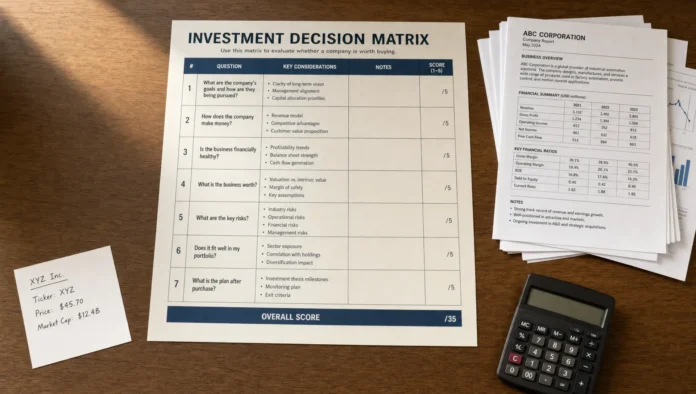
Before looking for the “best” stock to buy, use the seven questions below as a decision filter. This is not personal financial advice. It is an educational framework to help you slow down, research better, and avoid buying based only on hype.
| Question | What it helps you test | Red flag to watch for |
|---|---|---|
| 1. What is my goal? | Whether the stock matches your financial plan | Buying because everyone else is talking about it |
| 2. Do I understand the business? | Whether you know how the company makes money | You cannot explain the company in simple words |
| 3. Is the company financially healthy? | Whether the business can survive difficult periods | Heavy debt, falling sales, or unclear profits |
| 4. Is the valuation reasonable? | Whether the price makes sense compared with fundamentals | Paying any price for a popular story |
| 5. What could go wrong? | Whether you understand the main risks | Ignoring competition, regulation, or cyclicality |
| 6. How does it fit my portfolio? | Whether the stock improves or increases risk | Too much money in one company or sector |
| 7. What is my plan after buying? | Whether you have rules for monitoring and selling | No exit plan, no review schedule, no thesis |
1. What goal am I investing for?
The first question is not about the company. It is about you.
Are you investing for retirement, a future home purchase, passive income, education costs, or long-term wealth building? The answer matters because different goals require different levels of risk. Money you may need in one or two years generally should not be exposed to the same volatility as money you will not touch for 15 or 20 years.
Time horizon is especially important with individual stocks. A company can be fundamentally strong and still fall sharply over a short period because of market sentiment, interest rates, earnings disappointment, or sector weakness. If you cannot tolerate a temporary decline without panic selling, the stock may not match your situation.
Before asking which stocks to buy, write down three things: your goal, the approximate date you need the money, and the maximum loss you could emotionally and financially handle. If you have not built a basic investing plan yet, Greek Shares has a practical guide on how to invest with a simple starter plan before choosing individual stocks.
2. Do I understand how the company makes money?
A stock is not just a symbol on a screen. It represents ownership in a real business. As Investor.gov explains, stocks give shareholders an ownership interest in a company. That means your first job is to understand the business behind the ticker.
You do not need to be an industry expert, but you should be able to explain the company in plain language. What does it sell? Who are its customers? How does it generate revenue? Does it depend on advertising, subscriptions, hardware sales, lending, commodities, licensing, or something else?
A useful test is the “one-minute explanation.” If you cannot explain the company’s business model to a friend in one minute, you may not understand it well enough to invest. This matters because when the stock falls, your conviction should come from research, not from hope.
You should also look for the company’s competitive advantage. Some businesses have strong brands, network effects, cost advantages, patents, high switching costs, or efficient distribution. Others compete mainly on price, which can pressure profit margins over time.
For U.S.-listed companies, annual and quarterly reports can be found through the SEC’s EDGAR company search. For companies listed outside the United States, check the relevant exchange filings and investor relations pages.
3. Is the company financially healthy?
A good story is not enough. Financial health tells you whether the company can fund operations, handle downturns, invest in growth, and reward shareholders over time.
Start with revenue and earnings. Revenue shows whether the company is selling more over time, while earnings show whether those sales are turning into profit. Some growth companies may prioritize expansion over current profits, but beginners should be cautious with businesses that consistently lose money without a clear path to profitability.
Next, look at cash flow. Earnings can be affected by accounting choices, but cash flow shows whether money is actually coming into the business. Free cash flow, which is cash left after operating expenses and capital spending, can be used for reinvestment, debt reduction, dividends, or share buybacks.
Debt also matters. Debt is not always bad, especially if a company uses it responsibly. But too much debt can become dangerous when interest rates rise, sales decline, or credit markets tighten. Compare debt levels with equity, earnings, and cash flow. A company with high debt and declining profits deserves extra caution.
Here are a few basic financial signs to review before buying:
- Revenue trends over the last several years
- Profit margins compared with competitors
- Free cash flow consistency
- Debt levels and interest expenses
- Dividend sustainability, if the stock pays a dividend
- Share dilution, especially for companies issuing many new shares
You do not need to calculate every advanced ratio. But you should understand whether the business is growing, profitable, cash-generating, and financially resilient.
4. Is the stock reasonably valued?
This is where many investors make mistakes. They find a company they like, then assume the stock is automatically a good buy. But business quality and stock valuation are separate questions.
A strong company can be overpriced. A struggling company can look cheap but still be a poor investment. Valuation helps you judge whether the current price offers a reasonable balance between potential reward and risk.
Common valuation measures include the price-to-earnings ratio, price-to-sales ratio, price-to-free-cash-flow ratio, dividend yield, and enterprise value to EBITDA. None of these metrics works perfectly in every industry. For example, banks, software companies, manufacturers, and retailers often require different valuation approaches.
The key is comparison. Compare the stock with its own history, with similar companies, and with its growth prospects. A high valuation may be justified if a company has strong growth, high margins, and durable competitive advantages. A low valuation may be justified if the company faces shrinking demand, weak profitability, or serious debt concerns.
Also ask what expectations are already built into the price. If investors already expect perfect execution, even a small disappointment can hurt the stock. If expectations are too pessimistic, a modest improvement can sometimes create upside.

5. What could go wrong with this investment?
Good investors do not only build a bull case. They also build a bear case.
Before buying, list the main reasons the investment could fail. This does not mean you must avoid every stock with risks. Every stock has risks. The goal is to know which risks you are accepting and whether you are being paid enough for them.
Company-specific risks can include weak management, customer concentration, product delays, declining margins, lawsuits, poor capital allocation, or excessive share dilution. Industry risks can include regulation, disruption, commodity prices, changing consumer behavior, or technological shifts. Market risks can include recessions, higher interest rates, currency movements, or broad valuation compression.
Pay special attention to hype. If your main reason for buying is a social media post, a viral chart, or a friend’s confident prediction, slow down. Beginner investors are often most vulnerable when a stock feels urgent. If you are reacting to a tip rather than doing research, read this Greek Shares guide on stock tips beginners should question before placing an order.
A simple risk exercise is to ask: “What headline would make this stock fall 30%?” If you can imagine that headline clearly, you can decide whether you are comfortable owning the stock if it happens.
6. How does this stock fit my overall portfolio?
A stock can look attractive on its own but still be a poor addition to your portfolio. For example, if you already own several technology stocks, buying another technology company may increase concentration risk. If most of your holdings are in one country, one sector, or one economic theme, your portfolio may be more fragile than it appears.
Diversification does not guarantee gains or prevent losses, but it can reduce the impact of one company or sector damaging your entire portfolio. Investor.gov’s explanation of diversification describes it as spreading investments among different assets to reduce risk.
Think in terms of position size. A speculative stock might be acceptable as a small position, while a stable, profitable company may justify a larger allocation. The exact amount depends on your goals, risk tolerance, and total portfolio.
Also consider overlap. If you own broad market index funds, you may already have exposure to the company you are considering. Buying individual shares on top of an index fund can increase your exposure beyond what you realize.
A helpful question is: “If this stock falls 50%, will it damage my financial plan or just disappoint me?” If the answer is that it would damage your plan, the position may be too large.
7. What is my plan after I buy?
Many investors spend hours deciding what to buy and almost no time deciding what happens next. That is a problem because emotions become stronger after your money is invested.
Before buying, write an investment thesis. It can be short. For example: “I am buying this company because it has recurring revenue, strong free cash flow, manageable debt, and a valuation below its historical average. I will review the thesis after each quarterly report.”
Your plan should include what would make you add, hold, trim, or sell. Selling because the price fell is not always logical if the business remains strong. Holding just because you do not want to admit a mistake is also not logical if the thesis is broken.
Examples of thesis-breaking events include a permanent decline in competitive advantage, worsening debt problems, management behavior that damages trust, repeated failure to meet realistic targets, or a valuation that becomes extreme compared with future growth.
Set a review schedule. For long-term investors, reviewing after quarterly or annual reports may be enough. Checking the stock price every hour usually increases anxiety without improving decision-making.
If you want a broader checklist beyond these seven questions, Greek Shares also covers more questions before buying stocks that can help you deepen your research process.
A simple pre-buy decision rule
After answering the seven questions, you should be able to place the stock into one of three categories.
| Decision | What it means | Possible next step |
|---|---|---|
| Buy candidate | The stock fits your goals, research, valuation, and portfolio | Consider position size and order plan |
| Watchlist | The business is interesting, but price or risk is not attractive yet | Track earnings, valuation, and key developments |
| Avoid | You do not understand it, the risk is too high, or the thesis is weak | Move on and protect your capital |
This structure helps remove pressure. You do not need to buy every interesting stock. Sometimes the best decision is to wait. A watchlist can be powerful because it lets you prepare before opportunity appears.
Frequently Asked Questions
What stocks should I buy as a beginner? There is no universal answer. Beginners often benefit from focusing first on diversified funds or stable, understandable companies with strong financials, reasonable valuations, and risks they can explain. The right choice depends on your goals and risk tolerance.
Is it bad to search for “stocks I should buy”? No. It is a normal starting point. The danger is accepting someone else’s answer without checking whether the stock fits your situation. Use stock ideas as research leads, not automatic buy signals.
How many stocks should I own? There is no perfect number for everyone. Owning too few stocks can create concentration risk, while owning too many can make research difficult. Many beginners use diversified funds as a core and individual stocks as smaller satellite positions.
Should I buy a stock just because it is down a lot? Not necessarily. A falling price can create opportunity, but it can also signal real business problems. Always ask whether the company’s fundamentals remain strong and whether the valuation is attractive for the risk.
When should I sell a stock? Consider selling if your original thesis is broken, the valuation becomes unrealistic, the company’s financial health deteriorates, or the position becomes too large for your portfolio. Selling should be based on rules, not panic.
Keep learning before you buy
The better question is not simply “Which stocks should I buy?” It is “Which stocks fit my goals, my research process, my risk tolerance, and my portfolio?”
If you use these seven questions before every purchase, you will avoid many common mistakes: chasing hype, overpaying for popular companies, ignoring debt, concentrating too much in one sector, and buying without a plan.
Greek Shares is built to help investors improve their financial literacy step by step. Continue exploring the guides, tutorials, and market education resources on Greek Shares so your next stock decision is based on process, not pressure.