


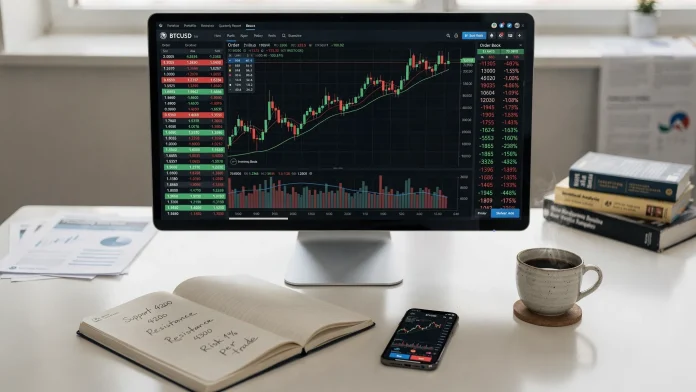
If you are new to shares in market trading, the screen can look more complicated than it really is. Prices flash, charts move, bids and offers change, and a single click can send an order into a global financial system. Yet underneath the speed, every share trade follows a logical process: a buyer wants ownership, a seller is willing to give it up, and the market helps them agree on a price.
Understanding that process is essential before you risk money. It helps you see why prices move, why your execution price may differ from the price you saw a second earlier, and why trading is not the same as investing. This guide explains how shares actually trade in the market, from company ownership to brokers, exchanges, order types, settlement, and risk.
What a share actually represents
A share is a unit of ownership in a company. If a business has 100 million shares outstanding and you own 100 shares, you own a very small fraction of that company. That ownership can give you a claim on future profits, voting rights in some cases, and the possibility of receiving dividends if the company pays them.
The important point is this: when you buy a share in the market, you are usually not buying it directly from the company. You are buying it from another investor who already owns it. The company issued shares at some earlier point, perhaps during an initial public offering or another capital raise. After that, most daily trading happens between investors in the secondary market.
For a broader foundation on the market itself, Greek Shares has a beginner-friendly guide on what the stock market is and how it works.
Primary market vs secondary market
Shares reach investors through two main market layers. The distinction matters because most people think of stock trading as buying and selling on an exchange, but that is only one part of the system.
| Market layer | What happens | Who receives the money | Example |
|---|---|---|---|
| Primary market | New shares are issued | The company selling shares | Initial public offering, rights issue, secondary offering |
| Secondary market | Existing shares trade between investors | The selling investor | Buying shares through your brokerage account |
The primary market helps companies raise capital. The secondary market gives investors liquidity, meaning the ability to buy and sell after shares have been issued. Without the secondary market, investors would be far less willing to fund companies because exiting an investment would be difficult.
What happens when you place a stock trade
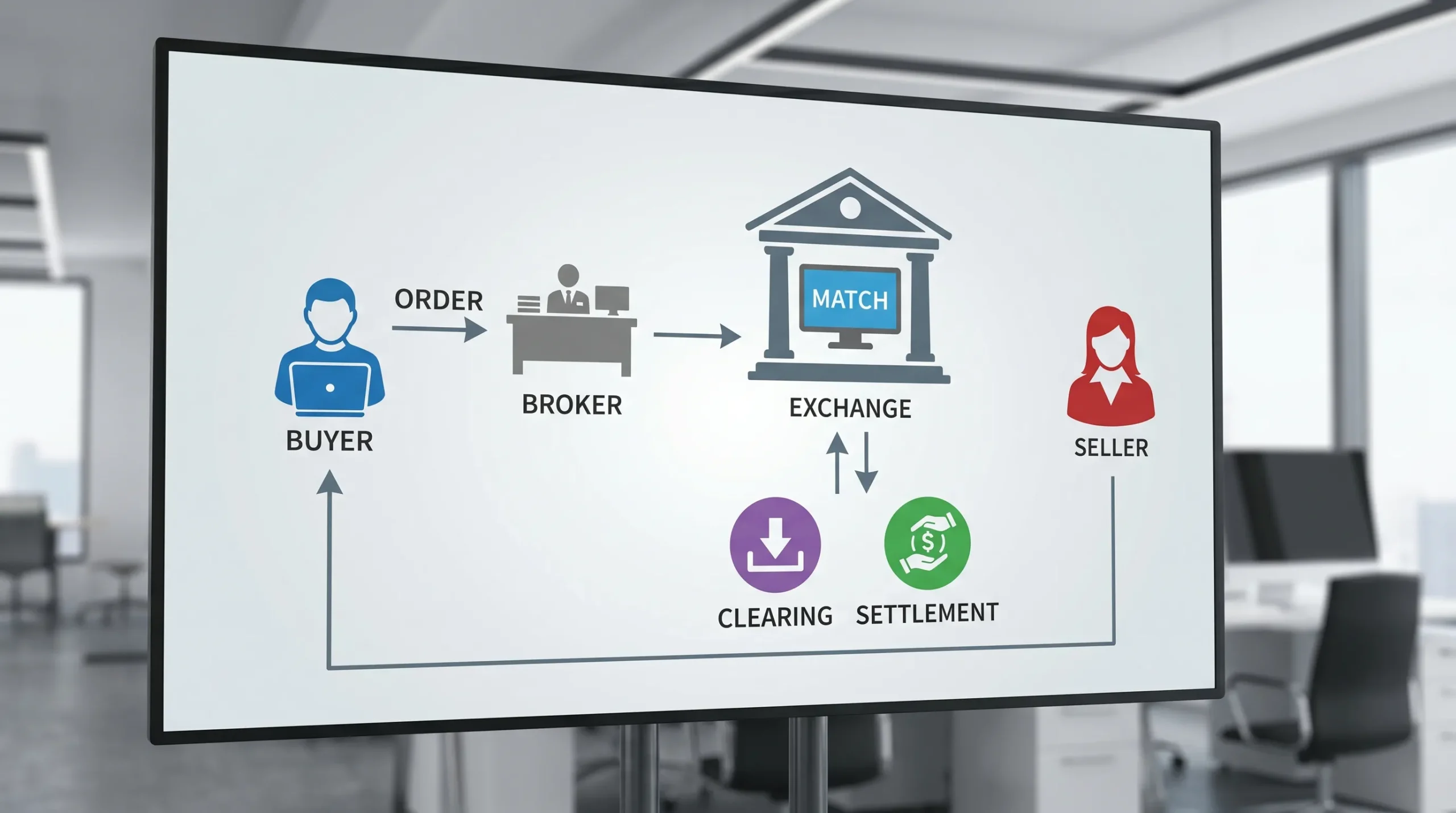
When you click buy or sell in a brokerage platform, you are not magically exchanging shares with the company. Your order moves through a chain of participants and systems designed to match buyers and sellers as efficiently as possible.
A typical trade follows this path:
- You enter an order through your broker.
- The broker checks your account, buying power, and order instructions.
- The order is routed to an exchange, market maker, or another trading venue.
- The order is matched with an opposite order if the price and quantity conditions are met.
- You receive an execution confirmation showing price, quantity, time, and fees if applicable.
- Clearing and settlement complete the legal transfer of shares and cash.
The execution can happen in fractions of a second, but the full post-trade process takes longer. In the United States, equity settlement moved to T+1 in 2024, meaning one business day after the trade date. Other markets may use different settlement cycles, so always check your broker and local exchange rules.
The order book: where prices are formed
A share price is not a fixed label. It is the result of supply and demand at a specific moment. In modern markets, this supply and demand is visible through an order book, which shows buyers willing to purchase at different prices and sellers willing to sell at different prices.
The highest price a buyer is currently willing to pay is called the bid. The lowest price a seller is currently willing to accept is called the ask. The gap between them is the spread.
| Term | Meaning | Why it matters |
|---|---|---|
| Bid | Highest current buy price | Shows what sellers may receive immediately |
| Ask | Lowest current sell price | Shows what buyers may pay immediately |
| Spread | Difference between bid and ask | A hidden cost of fast execution |
| Last price | Most recent trade price | Not always the price you can trade at now |
| Volume | Number of shares traded | Helps indicate activity and liquidity |
| Liquidity | Ease of buying or selling without moving price | Crucial for execution quality |
Imagine a stock has a bid of $50.00 and an ask of $50.10. If you place a market buy order, you will likely buy at $50.10 if enough shares are available at that price. If there are not enough shares available, part of your order may execute at higher prices. That difference is called slippage.
This is why liquid stocks usually trade more smoothly than illiquid stocks. A highly liquid stock often has many buyers and sellers, tighter spreads, and deeper order books. An illiquid stock may have wide spreads and sharp price jumps. If you want to go deeper into that topic, read Greek Shares on stocks and liquidity.
Market orders, limit orders, and stop orders
The type of order you use can affect your result as much as the stock you choose. Many beginners focus only on whether they are buying or selling, but the instruction attached to the order determines how it behaves.
| Order type | What it does | Main advantage | Main risk |
|---|---|---|---|
| Market order | Buys or sells immediately at the best available price | Fast execution | Final price can be worse than expected |
| Limit order | Sets the maximum buy price or minimum sell price | Price control | May not execute |
| Stop order | Becomes active after a trigger price is reached | Can help manage losses or enter momentum trades | Execution can occur at an unfavorable price |
| Stop-limit order | Becomes a limit order after a trigger price is reached | Adds price control after trigger | May not execute during fast moves |
For most beginners, limit orders are often safer when buying individual shares, especially in less liquid stocks. They prevent you from paying more than your chosen price. However, they do not guarantee execution. If the market never reaches your limit price, your order remains unfilled or expires depending on your instructions.
The U.S. SEC provides a useful investor education overview of common stock order types, including the trade-off between execution certainty and price certainty.
Why share prices move
In simple terms, share prices move because investors constantly update what they think a company is worth. That judgment changes with news, earnings, interest rates, inflation, competition, regulations, and sentiment.
A stock does not rise just because a company is good, and it does not fall just because a company is bad. Prices move when expectations change. If a company is already expected to grow quickly, good results may not be enough to push the price higher. If a struggling company performs less badly than expected, the share price may rise.
Common reasons shares move include:
- Earnings results that beat or miss expectations
- Changes in revenue growth, margins, or debt levels
- Interest rate and inflation expectations
- Sector rotation, where investors favor or abandon entire industries
- Large institutional buying or selling
- Market-wide fear, greed, or forced liquidation
- Changes in liquidity, especially during stressful periods
This is why headlines can be misleading. A stock may fall after good news if the news was already priced in. It may rise after bad news if investors expected something worse. For a practical look at downside moves, see Greek Shares on why stocks fall.
Who is on the other side of your trade?
Every trade has two sides. If you buy, someone sells. If you sell, someone buys. The other side may be a long-term investor, a hedge fund, a market maker, a pension fund, an algorithmic trader, or another individual.
Not all participants have the same goal. A long-term investor may care about earnings over the next decade. A day trader may care about price momentum over the next ten minutes. A market maker may be trying to earn the spread while managing inventory risk. A fund manager may be rebalancing a portfolio, not making a judgment about the company at all.
This matters because a trade is not always a pure disagreement about value. Sometimes it is simply a difference in time horizon, risk limits, tax needs, or portfolio construction.
Brokers, exchanges, market makers, and clearing houses
The market is an ecosystem. Each participant has a role.
Your broker gives you access to the market. The exchange or trading venue matches orders. Market makers provide continuous bids and asks in many securities, helping liquidity. Clearing houses stand between buyers and sellers after the trade, reducing counterparty risk and making sure obligations are completed.
Regulators set rules for market conduct, disclosures, custody, capital requirements, anti-money laundering controls, and investor protection. Compliance is not just bureaucracy. It is part of what allows millions of investors to trust that trades, records, and settlement processes will function properly. Many financial organizations now support these responsibilities with specialized systems, including AI-powered compliance workflow tools that help teams assess regulatory risk, collect data, and manage remediation work.
For investors, the key lesson is simple: use regulated brokers, understand the protections and limitations in your jurisdiction, and avoid platforms or schemes that are vague about custody, execution, or regulatory status.
How investors make money from shares
There are two main ways to make money from shares: capital gains and dividends.
A capital gain happens when you sell shares for more than you paid. If you buy at $50 and sell at $70, your gross gain is $20 per share before costs and taxes. A capital loss happens when you sell for less than your purchase price.
Dividends are cash distributions paid by some companies to shareholders. Not every company pays dividends. Younger or faster-growing companies may reinvest profits instead. Mature companies with stable cash flows are more likely to distribute part of their earnings, although dividend policies can always change.
| Return source | How it works | What to watch |
|---|---|---|
| Capital gains | Share price rises above your purchase price | Valuation, business performance, market cycles |
| Dividends | Company pays cash to shareholders | Dividend sustainability, payout ratio, cash flow |
| Reinvestment | Dividends are used to buy more shares | Compounding over long periods |
| Currency effects | Foreign shares move with exchange rates | Extra risk for international investors |
The danger is assuming returns are automatic. Shares can lose value, dividends can be cut, and popular companies can become overpriced. Understanding both reward and risk is central to sound investing.
Trading vs investing: same market, different mindset
Trading and investing use the same market infrastructure, but they are not the same activity. Trading usually focuses on shorter-term price movement. Investing usually focuses on the long-term value of the underlying business.
| Factor | Trading | Investing |
|---|---|---|
| Time horizon | Minutes to months | Years to decades |
| Main focus | Price behavior, momentum, setups | Business quality, valuation, cash flows |
| Decision frequency | Higher | Lower |
| Main danger | Overtrading, costs, emotional decisions | Poor analysis, concentration, impatience |
| Useful skill | Risk control and execution discipline | Business analysis and patience |
Neither approach is automatically superior. The problem begins when people mix them without realizing it. For example, someone may buy a stock as a quick trade, watch it fall, then suddenly call it a long-term investment to avoid admitting a mistake. Or an investor may buy a solid business for long-term reasons, then sell in panic because of a normal market correction.
Before entering a position, define what you are doing. Are you investing based on business value, or trading based on price behavior? Your answer should influence position size, order type, holding period, and exit rules.
A practical example of a share trade
Suppose a stock is quoted at a bid of $50.00 and an ask of $50.10. You want to buy 20 shares.
If you place a market order, your broker will seek immediate execution. If 20 shares are available at $50.10, you pay $1,002 before any commission, fees, or taxes. If only 10 shares are available at $50.10 and the next seller asks $50.20, part of your order may execute higher.
If you place a limit buy order at $50.05, you are saying you will not pay more than $50.05. You may get a better price, but you may also get no shares if sellers remain above your limit.
Now assume you bought at an average price of $50.10. If the stock later trades at $55, you have an unrealized gain. If it trades at $47, you have an unrealized loss. The gain or loss becomes realized only when you sell. The market will not care about your purchase price, your feelings, or your hopes. It will only reflect current supply, demand, and expectations.
Key risks beginners often underestimate
Share trading can look easy because buying is simple. The hard part is surviving uncertainty after the trade. Risk is not limited to the possibility that a company performs badly. It also includes liquidity, execution, valuation, psychology, and time horizon.
| Risk | What it means | Basic defense |
|---|---|---|
| Market risk | Broad markets fall together | Diversification and realistic time horizon |
| Company risk | A specific business disappoints | Research and position sizing |
| Liquidity risk | You cannot trade near your expected price | Avoid oversized positions in thinly traded shares |
| Execution risk | Your order fills at a poor price | Use appropriate order types |
| Behavioral risk | Fear or greed drives decisions | Write rules before trading |
| Concentration risk | Too much money in one idea | Limit exposure to any single stock |
Greek Shares covers the role of probability in decision-making in Risk and Probability, a useful topic for anyone who wants to treat trading as a process rather than a gamble.
A simple checklist before placing a trade
Before you click buy or sell, pause. A few minutes of discipline can prevent many expensive mistakes.
- Do I understand what the company does and how it makes money?
- Am I investing or trading?
- What price am I willing to pay or accept?
- Which order type matches my goal?
- How much of my portfolio is at risk?
- What would make me sell?
- Have I considered liquidity, fees, taxes, and currency risk?
- Am I acting from analysis or emotion?
This checklist will not guarantee profits. Nothing can. But it can reduce avoidable errors and help you build consistent habits.
Frequently Asked Questions
Are shares and stocks the same thing? In everyday investing language, they are often used interchangeably. A stock usually refers to ownership in a company in general, while a share refers to a specific unit of that ownership.
Can I buy shares directly from a stock exchange? Most individual investors cannot access an exchange directly. They use a broker, which routes orders to exchanges, market makers, or other trading venues.
Why is the price I get different from the price I saw? Prices can change quickly, and the last traded price is not always the current available price. Spreads, order size, liquidity, and order type all affect execution.
Is a market order bad? Not always. Market orders can be suitable for highly liquid securities when immediate execution matters. However, they can be risky in volatile or illiquid shares because you give up price control.
Do companies receive money every time their shares trade? Usually no. In secondary market trading, money changes hands between investors. Companies receive money when they issue new shares in the primary market.
What is the safest way for a beginner to start? Many beginners start by learning the basics, using small amounts, diversifying, and avoiding complex strategies until they understand risk. Education should come before speed.
Keep learning before you trade larger amounts
Shares in market trading become far less mysterious once you understand the mechanics. A trade is not just a button click. It is an instruction routed through brokers and venues, matched against other orders, confirmed, cleared, and settled. Prices move because expectations change, liquidity varies, and buyers and sellers compete in real time.
If you are still building your foundation, continue with Greek Shares resources such as How to Buy Stocks and 7 Tips Stock Beginners Should Know Before Buying. The more you understand before placing trades, the less likely you are to confuse market noise with opportunity.