


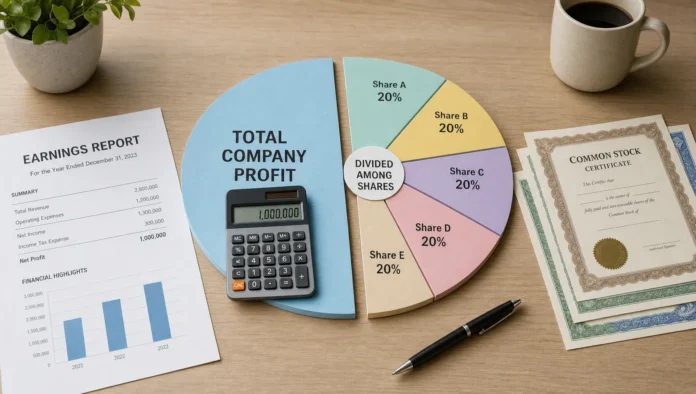
Earnings per share, usually abbreviated EPS, is one of the first numbers investors notice in a company’s earnings report. It sounds technical, but the idea is simple: EPS tells you how much of a company’s profit belongs to each share of common stock.
If you own one share, EPS does not mean the company will hand you that amount in cash. It means that, on paper, each share represents that slice of the company’s profit for the period being reported.
Think of a business like a pie. Net income is the whole profit pie. Shares are the slices. EPS tells you how much profit is attached to each slice.
Earnings per share explained in one sentence
Earnings per share is a company’s profit divided by the number of shares investors own.
A higher EPS often means a company is more profitable on a per-share basis. A lower EPS may mean profits are shrinking, costs are rising, or the company has issued more shares. But EPS is not a full investment decision by itself. It is a starting point.
Before EPS makes sense, it helps to understand what a share actually represents. If you are new to the stock market, Greek Shares has a beginner-friendly guide to shares explained in plain English that covers the ownership basics.
The basic EPS formula
The standard EPS formula is:
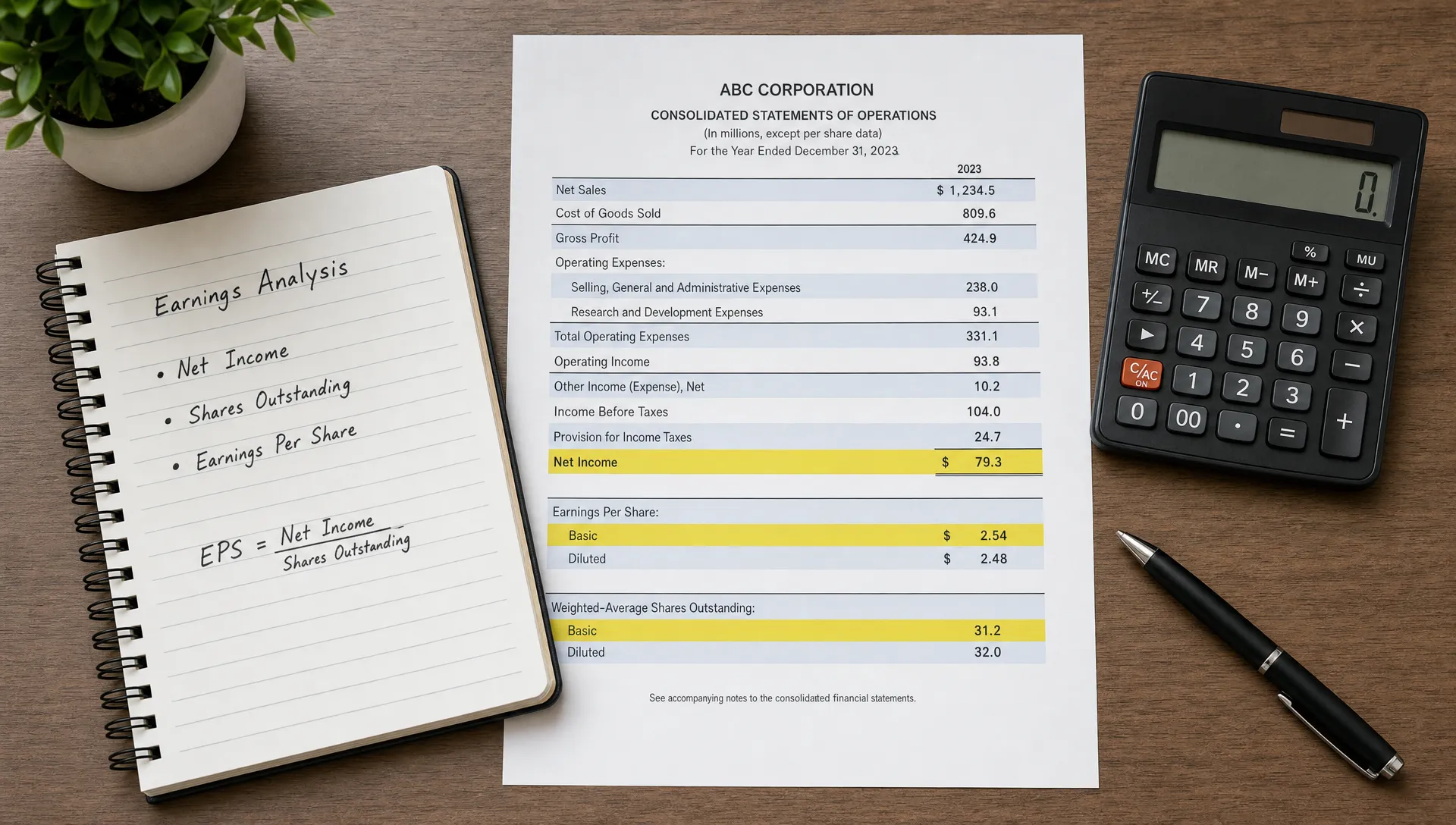
EPS = Net income available to common shareholders ÷ Weighted average common shares outstanding
In simpler words:
EPS = Profit for common shareholders ÷ Average number of common shares
Here is what each part means:
| Term | Plain English meaning | Why it matters |
|---|---|---|
| Net income | The company’s profit after expenses, taxes, and interest | EPS starts with actual profit, not sales |
| Preferred dividends | Payments owed to preferred shareholders, if any | These are subtracted because EPS focuses on common shareholders |
| Weighted average shares | The average number of common shares during the period | Share counts can change during the year |
For many beginners, the “weighted average shares” part is the confusing piece. Companies often buy back shares, issue new shares, or compensate employees with stock. Instead of using only the share count on the final day of the quarter, accounting rules use an average that better reflects the whole reporting period.
A simple EPS example
Imagine a company reports the following numbers for the year:
| Item | Amount |
|---|---|
| Net income | $10 million |
| Preferred dividends | $0 |
| Weighted average common shares | 5 million |
The EPS calculation is:
$10 million ÷ 5 million shares = $2.00 EPS
That means the company earned $2.00 for each common share during the year.
Now imagine the same company earned $10 million, but it had 10 million shares instead of 5 million. The calculation would be:
$10 million ÷ 10 million shares = $1.00 EPS
The company made the same total profit, but each share represents a smaller claim on that profit. This is why EPS is useful: it shows profit in relation to the number of shares, not just profit in total.
Why EPS matters to investors
Investors care about EPS because stock ownership is based on shares. A company can grow total profit, but if it also issues many new shares, each existing share may not benefit as much as you expect.
EPS helps investors answer several practical questions:
- Is the company becoming more profitable per share?
- Is profit growth keeping up with share dilution?
- Can the company potentially support dividends or buybacks?
- Is the stock price expensive compared with earnings?
- Are market expectations realistic or too optimistic?
EPS is also a key input in the price-to-earnings ratio, or P/E ratio. The P/E ratio compares a stock’s price with its earnings per share, helping investors think about valuation. If you want the next step after EPS, read this guide to the P/E ratio explained for stock investors.
Basic EPS vs diluted EPS
Most earnings reports show both basic EPS and diluted EPS.
Basic EPS uses the current weighted average number of common shares. Diluted EPS assumes that potential shares, such as stock options, restricted stock units, or convertible securities, become common shares if they can reasonably do so.
Here is the plain English difference:
| EPS type | What it assumes | Why investors watch it |
|---|---|---|
| Basic EPS | Only existing common shares are counted | Shows current per-share earnings |
| Diluted EPS | Potential future shares are included | Shows what EPS could look like if share count increases |
Diluted EPS is often the more conservative number. If a company uses a lot of stock-based compensation or has convertible debt, diluted EPS may be lower than basic EPS because profits are spread across more possible shares.
When you compare companies, try to compare diluted EPS with diluted EPS, not basic EPS for one company and diluted EPS for another. Consistency matters.
GAAP EPS vs adjusted EPS
You may also see two different versions of EPS in the same earnings release: GAAP EPS and adjusted EPS.
GAAP EPS follows official accounting rules in the United States. Adjusted EPS removes certain items that management believes do not reflect the normal business, such as restructuring costs, large legal settlements, acquisition expenses, or one-time gains.
Adjusted EPS can be useful, but it deserves caution. Sometimes adjustments help investors see the underlying business more clearly. Other times, they make results look better by excluding costs that seem to happen regularly.
A good habit is to ask: “Would I still feel the same about this company if I used GAAP EPS instead of adjusted EPS?”
What rising EPS usually means
Rising EPS is generally a positive sign. It may mean the company is growing revenue, controlling costs, improving margins, buying back shares, or benefiting from favorable market conditions.
But investors should ask why EPS is rising.
If EPS is rising because the company is selling more products, improving profitability, and generating strong cash flow, that may be a healthy sign. If EPS is rising mostly because the company bought back shares while revenue is flat, the picture may be less impressive.
Share buybacks are not automatically bad. A buyback can benefit shareholders if the company buys shares at attractive prices and still has enough cash for operations, debt payments, and growth. But buybacks can also make EPS look better even when the underlying business is not improving much.
What falling or negative EPS means
Falling EPS means the company earned less profit per share than before. Negative EPS means the company lost money during the reporting period.
A negative EPS is not always a reason to avoid a stock. Young growth companies, cyclical businesses, and companies going through restructuring can report losses for a time. The key question is whether the losses are temporary and whether the company has a credible path back to profitability.
For mature companies, a sharp drop in EPS may be more concerning. It could point to weaker demand, rising costs, debt pressure, poor capital allocation, or industry disruption.
Investors should be especially careful when business losses intersect with heavy borrowing. Corporate debt problems can create pressure for shareholders, while personal debt problems can become serious for individual investors who invest with money they cannot afford to lose. If investing losses or borrowing decisions create legal or debt stress, it may be wise to speak with qualified professionals, such as the consumer debt defense and bankruptcy attorneys at Clair Gjertsen & Weathers PLLC for readers in New York or Connecticut.
EPS does not tell the whole story
EPS is useful, but it has limits. A company can report strong EPS and still have problems under the surface.
For example, EPS does not directly show cash flow. A company may report accounting profits while collecting cash slowly from customers or spending heavily to maintain its business. EPS also does not show the quality of management, competitive threats, debt maturity schedules, or whether the company’s growth is sustainable.
Here are common EPS traps to avoid:
- Ignoring revenue: EPS growth is stronger when revenue is also growing.
- Forgetting cash flow: Earnings are important, but cash pays bills and funds dividends.
- Overlooking debt: High interest costs can pressure future earnings.
- Comparing unrelated industries: A bank, software company, and utility can have very different EPS patterns.
- Trusting one quarter too much: One report rarely tells the full story.
EPS should be read alongside revenue, operating income, margins, free cash flow, debt levels, and management guidance. If you want a practical sequence for reviewing these numbers, Greek Shares has a guide on how to read earnings reports clearly.
How to use EPS when researching a stock
A smart way to use EPS is to focus on trends and context instead of one isolated number.
Start by looking at EPS over several years. Is it generally rising, falling, or moving up and down unpredictably? A steady pattern can tell you more than a single quarter.
Next, compare EPS growth with revenue growth. If EPS is growing faster than revenue, that may reflect better margins, lower costs, buybacks, or accounting adjustments. Some of those are good, but you need to know which one is driving the result.
Then compare EPS with analyst expectations, if available. Stock prices often move not just because EPS is good or bad, but because it is better or worse than investors expected. A company can report record EPS and still fall in price if the market expected even more.
Finally, compare the company with peers in the same industry. EPS by itself is not always comparable across companies because share counts differ. Valuation ratios, margins, and growth rates help create a fuller picture.
A simple EPS review can look like this:
| Question | Why it helps |
|---|---|
| Is EPS positive? | Shows whether the company is profitable per share |
| Is EPS growing over time? | Helps identify business momentum |
| Is diluted EPS close to basic EPS? | Shows whether potential dilution is significant |
| Is EPS backed by cash flow? | Helps judge earnings quality |
| Is the stock price reasonable relative to EPS? | Connects earnings to valuation |
EPS and dividends
EPS also matters for dividend investors. Dividends are paid from company resources, and long-term dividend strength usually depends on profits and cash flow.
If a company earns $4.00 per share and pays a $1.00 annual dividend, the dividend may look reasonably covered by earnings. If a company earns $1.00 per share and pays a $2.00 dividend, investors should ask how that dividend is being funded.
That said, EPS is not the same as free cash flow. Some companies, especially those with heavy capital spending needs, may report EPS that looks healthy while free cash flow is weaker. Dividend investors should consider both.
A plain English example of EPS in action
Suppose two companies both trade at $40 per share.
Company A earns $4.00 per share. Company B earns $1.00 per share.
At first glance, Company A looks cheaper because investors are paying $40 for $4.00 of annual EPS, while Company B’s investors are paying $40 for $1.00 of annual EPS. This gives Company A a P/E ratio of 10 and Company B a P/E ratio of 40.
But that is not the final answer. Company B might be growing much faster, have higher profit margins, hold little debt, or operate in a more attractive industry. Company A might be cheap because investors expect earnings to decline.
This is the central lesson: EPS helps you ask better questions. It does not answer every question on its own.
Frequently Asked Questions
What is earnings per share in simple terms? Earnings per share is the amount of a company’s profit assigned to each common share. If a company earns $1 million and has 1 million shares, its EPS is $1.00.
Is a higher EPS always better? Not always. Higher EPS is generally positive, but investors should check whether it comes from real business growth, cost control, buybacks, or one-time accounting items.
Can EPS be negative? Yes. Negative EPS means the company lost money during the period. This can happen with young companies, cyclical businesses, or companies facing temporary or serious challenges.
What is the difference between EPS and dividends? EPS measures profit per share. Dividends are payments a company chooses to distribute to shareholders. A company can have positive EPS and still decide not to pay dividends.
Should beginners use basic EPS or diluted EPS? Diluted EPS is usually the more cautious number because it includes potential shares that could reduce each shareholder’s claim on earnings. Many investors focus on diluted EPS when comparing companies.
The bottom line
Earnings per share is one of the most important building blocks in stock analysis. In plain English, EPS tells you how much profit belongs to each share.
Use EPS to understand profitability, compare performance over time, and connect earnings to valuation. But do not stop there. Always look at revenue, cash flow, debt, margins, dividends, and the company’s long-term outlook.
If you want to keep building your investing knowledge step by step, explore more beginner and advanced guides at Greek Shares. The goal is not to memorize financial jargon. The goal is to understand what the numbers are really telling you before you invest.