


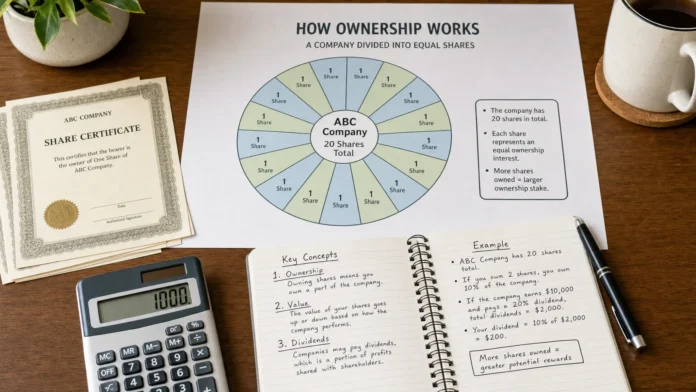
If the word “shares” makes the stock market sound more complicated than it really is, you are not alone. Many beginners hear phrases like “owning shares,” “share price,” “dividends,” and “market value” before anyone explains what they actually mean.
Here is the plain English version: a share is a small unit of ownership in a company. If a company is divided into millions or billions of tiny ownership pieces, each piece is a share. When you buy shares, you become a shareholder.
That does not mean you can walk into the company’s office and take a chair home. It means you own a financial claim on a small part of the business, with potential benefits and risks attached.
Shares explained: the simplest definition
A share represents a slice of ownership in a company. Public companies sell shares so investors can buy and sell ownership through the stock market.
Think of a company like a large pizza cut into many tiny slices. If the company has 100 million shares and you buy 100 shares, you own 100 of those 100 million slices. Your ownership percentage is small, but it is real.
The terms “stock” and “share” are often used together, but they are not exactly the same:
| Term | Plain English meaning | Simple example |
|---|---|---|
| Stock | Ownership in a company in general | “I own Apple stock.” |
| Share | One unit of that ownership | “I own 10 shares.” |
| Shareholder | A person or institution that owns shares | You, a pension fund, or an investment fund |
| Share price | The current price of one share | One share trades at $50 |
| Market cap | The total stock market value of the company | Share price multiplied by total shares |
If you want a broader foundation before going deeper, Greek Shares also has a beginner-friendly stock market basics guide for new investors that explains exchanges, brokers, indexes, and diversification.
What do you actually own when you buy shares?
When you buy shares, you own part of the company’s equity. Equity is the ownership value left after a company’s debts and obligations are considered.
As a shareholder, you may benefit if the company grows, earns more money, or becomes more valuable in the eyes of other investors. But you also accept the risk that the company may perform poorly and your shares may fall in value.
Share ownership can include several possible rights and benefits:
- Price appreciation: If the share price rises after you buy, your investment becomes worth more.
- Dividends: Some companies distribute part of their profits to shareholders.
- Voting rights: Some shares allow you to vote on company matters, such as board elections.
- Limited liability: If you buy ordinary shares in a cash brokerage account, you can lose the money you invested, but you are not personally responsible for the company’s debts.
Not all shares are identical. The two most common categories are common shares and preferred shares.
| Type of share | Main feature | Beginner takeaway |
|---|---|---|
| Common shares | Usually include voting rights and potential long-term growth | Most shares beginners hear about are common shares |
| Preferred shares | Often prioritize dividend payments over voting rights | More income-focused, but less common for beginners |
For most new investors, when someone says “I bought shares,” they usually mean common shares listed on a stock exchange.
Why do companies sell shares?
Companies sell shares to raise money. That money can be used to grow the business, hire employees, build products, expand into new markets, reduce debt, or fund research.
Selling shares is different from taking a loan. A loan must be repaid with interest. Shares do not have to be repaid in the same way, but they give investors ownership. That means existing owners give up part of the company in exchange for capital.
When a private company first sells shares to the public, the process is called an initial public offering, or IPO. After that, shares usually trade between investors on the secondary market. In plain English, most everyday investors are not buying directly from the company. They are buying from another investor who wants to sell.
This is why the stock market exists. It gives buyers and sellers a place to trade shares.
How share prices move
A share price moves because buyers and sellers disagree about what the company is worth.
If more investors want to buy a share than sell it, the price often rises. If more investors want to sell than buy, the price often falls. The price you see in a brokerage app or market website is usually the latest price at which buyers and sellers agreed to trade.
Share prices can move for many reasons, including:
- Company earnings and revenue growth
- Expectations about future profits
- Interest rates and inflation
- News about products, regulation, lawsuits, or management
- Overall market optimism or fear
- Industry trends and competition
A key idea for beginners is that price is not the same as value. A $10 share is not automatically cheaper than a $200 share. You need to know how many shares exist and how much the whole company is worth.
For example, imagine two companies:
| Company | Share price | Shares outstanding | Market value |
|---|---|---|---|
| Company A | $10 | 1 billion | $10 billion |
| Company B | $200 | 10 million | $2 billion |
Company A has the lower share price, but it is worth more in total. This is why investors look at market capitalization, earnings, debt, growth, and other financial measures rather than judging a stock only by its share price.
If you feel lost when you hear words like valuation, bid, ask, volume, or earnings per share, the Greek Shares guide to essential terms in the stock market can help you build your vocabulary step by step.
How investors make money from shares
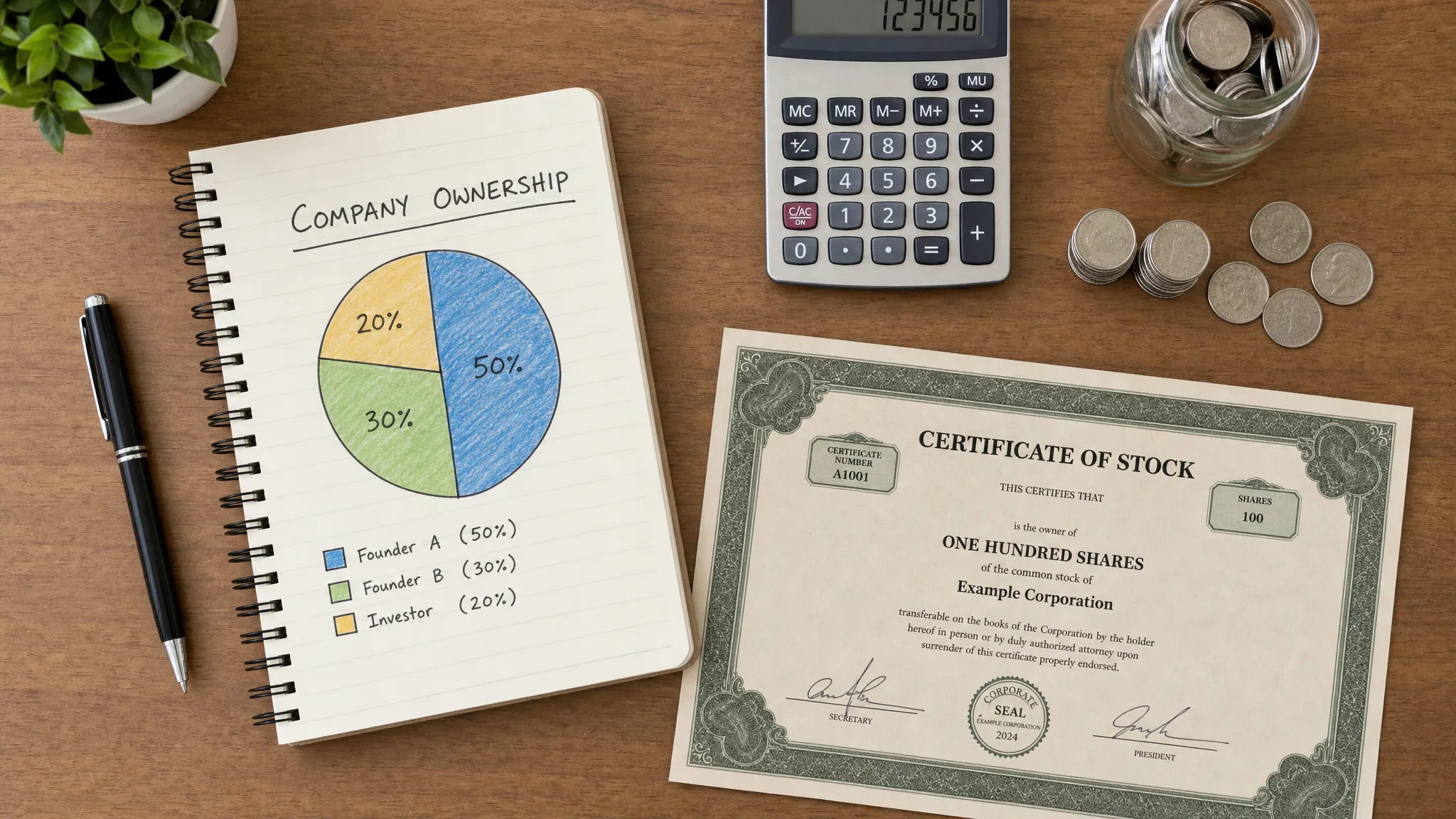
There are two main ways investors may make money from shares: capital gains and dividends.
A capital gain happens when you sell shares for more than you paid. If you buy one share for $40 and later sell it for $55, your gain is $15 before fees and taxes.
A capital loss happens when you sell shares for less than you paid. If you buy at $40 and sell at $30, your loss is $10.
A dividend is a payment some companies make to shareholders, usually from profits or available cash. Not all companies pay dividends. Younger or fast-growing companies may prefer to reinvest money into the business instead.
| Scenario | What happens | Result |
|---|---|---|
| Buy at $40, sell at $55 | Share price rises | Capital gain |
| Buy at $40, sell at $30 | Share price falls | Capital loss |
| Company pays $1 per share | You receive cash for each share owned | Dividend income |
| Company pays no dividend | Profits may be reinvested or retained | No dividend income |
Dividends can be useful, but they are not guaranteed. Companies can reduce, pause, or cancel dividends if business conditions change. For a deeper explanation, see Greek Shares’ guide to stock dividends explained clearly.
Taxes also matter. Capital gains and dividends may be taxed differently depending on your country, account type, holding period, and personal situation. Beginners should understand the basic tax rules in their own jurisdiction before investing meaningful amounts.
A simple beginner example
Imagine you buy 5 shares of a company at $20 per share. Your total investment is $100, excluding any fees.
If the share price rises to $25, your 5 shares are now worth $125. You have an unrealized gain of $25. It is called “unrealized” because you have not sold yet.
If the share price falls to $15, your 5 shares are worth $75. You have an unrealized loss of $25. If you sell at that price, the loss becomes realized.
Now imagine the company also pays a dividend of $0.50 per share. Since you own 5 shares, you receive $2.50 before any tax withholding or account rules.
This example shows why share investing is not only about buying something and hoping the price goes up tomorrow. It is about understanding what you own, why it may become more or less valuable, and how it fits your financial goals.
The main risks beginners should understand
Shares can build wealth over time, but they are not risk-free. The stock market can reward patience, but it can also punish overconfidence.
The first risk is market risk. Even strong companies can fall when the overall market drops. During recessions, financial crises, or periods of uncertainty, investors may sell shares broadly.
The second risk is company-specific risk. A business can lose customers, face lawsuits, take on too much debt, miss earnings expectations, or be disrupted by competitors. If you own only one or two companies, your portfolio depends heavily on their success.
The third risk is valuation risk. A good company can still be a bad investment if you pay too high a price. Beginners often confuse a popular company with a fairly priced stock.
The fourth risk is emotional risk. Many investors buy because prices are rising and sell because prices are falling. This can lead to buying high and selling low, the opposite of a good investment process.
Online communities can be useful for seeing what other investors are discussing, but they should not replace independent research. The fact that businesses use tools such as Redditor AI to follow Reddit conversations shows how valuable public discussions can be, but forum activity is not the same as a company’s financial statements, risk profile, or long-term prospects.
Individual shares vs funds: what should beginners consider?
Beginners often ask whether they should buy individual company shares or invest through funds such as ETFs and index funds.
Individual shares can be interesting because you know the specific companies you own. They can also teach you how businesses work. The trade-off is concentration risk. If one company performs badly, your portfolio can be affected significantly.
Funds can hold dozens, hundreds, or even thousands of shares. This spreads risk across many companies. You still face market risk, but you are less dependent on one company’s outcome.
| Approach | What you own | Potential advantage | Main trade-off |
|---|---|---|---|
| Individual shares | Specific companies | More control and learning | Higher company-specific risk |
| ETF or index fund | A basket of shares | Broad diversification | Less control over each holding |
| Mutual fund | Professionally managed basket | Built-in management | Fees and strategy vary |
There is no single best answer for everyone. A beginner who enjoys researching companies may choose a small number of individual shares as part of a broader plan. Another beginner may prefer diversified funds and avoid picking individual companies altogether.
The important point is to match your investments to your knowledge, time horizon, risk tolerance, and financial goals.
A simple checklist before buying your first share
Before buying a share, pause and answer a few basic questions. If you cannot answer them in plain English, you may not understand the investment well enough yet.
- What does the company actually do?
- How does the company make money?
- Is it profitable, or is there a clear path to profitability?
- Why might the share price rise over time?
- What could cause the investment to fail?
- Does the company pay dividends, and are they sustainable?
- How much of my portfolio would depend on this one company?
- Am I investing for years, or am I reacting to short-term excitement?
- Can I afford to see the price fall without panic selling?
Beginners should also be careful with margin, options, short selling, and highly speculative shares. Buying ordinary shares with cash is already risky enough when you are learning. Adding leverage or complex products can increase losses quickly.
Common beginner mistakes to avoid
One common mistake is buying a share only because the price looks low. A stock trading at $3 is not automatically a bargain. It may be cheap for a reason, or the company may have issued so many shares that the total value is still high.
Another mistake is investing money needed soon. Shares can fall sharply in the short term. Money needed for rent, emergency savings, medical costs, or near-term goals should generally not be exposed to stock market volatility.
A third mistake is confusing a great product with a great investment. You might love a company’s product, but that does not automatically mean its shares are attractively priced.
A fourth mistake is checking prices too often. Watching every small move can create stress and encourage impulsive decisions. Long-term investing usually works better when decisions are based on a plan rather than daily noise.
Frequently Asked Questions
Are shares the same as stocks? Not exactly. “Stock” usually means ownership in a company in general, while “share” means one unit of that ownership. In everyday conversation, people often use the words interchangeably.
Can I lose more than I invest in shares? If you buy ordinary shares using cash in a standard brokerage account, your loss is generally limited to the amount you invested. You can lose more if you use margin, short selling, options, or other leveraged strategies.
Do all shares pay dividends? No. Some companies pay regular dividends, some pay occasional dividends, and some pay none at all. Companies may also change dividend policies over time.
Is a low share price better for beginners? Not necessarily. A low share price does not mean a stock is cheap or safe. Beginners should look at the whole company, including market value, profits, debt, growth, and risks.
How many shares should a beginner buy? The number of shares matters less than the total amount invested, the quality of the investment, and how it fits your portfolio. Buying 1 share at $500 and 50 shares at $10 both represent a $500 investment.
Should beginners start with individual shares or funds? Many beginners start with diversified funds because they reduce company-specific risk. Individual shares can be useful for learning, but they require more research and discipline.
Keep learning before you invest
Shares are not mysterious once you understand the basics. A share is simply a unit of ownership in a company. Its price moves because investors constantly reassess what that ownership is worth.
Before you buy, focus on understanding the business, the risks, your time horizon, and your reason for investing. The goal is not to know every advanced stock market term immediately. The goal is to make decisions you can explain clearly and stick with calmly.
Greek Shares is built to help beginners and everyday investors improve their financial literacy one concept at a time. Keep learning, compare ideas carefully, and treat every investment decision as part of a long-term plan rather than a quick guess.