


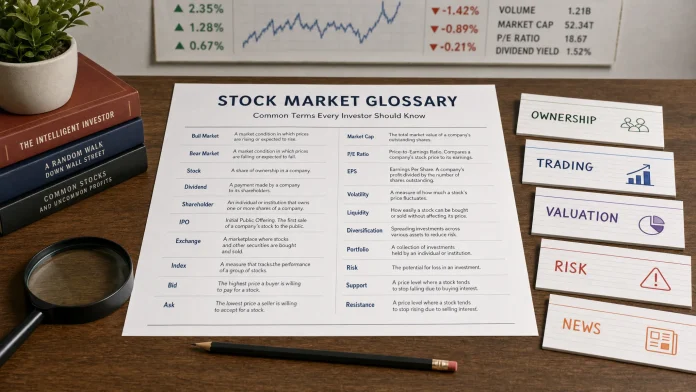
Stock market language can make investing feel more complicated than it really is. You open a brokerage app, read a market headline, or listen to an earnings call, and suddenly you are surrounded by words like bid, spread, market cap, EPS, beta, float, and guidance.
The good news is that you do not need to memorize a financial dictionary before you start learning. You need to understand the essential terms in the stock market well enough to read, compare, and question investment information with confidence.
This guide explains the core vocabulary beginners should know, grouped by how you will actually use it: ownership, trading, valuation, risk, and market news. It is educational, not personalized financial advice, but it will help you build a clearer foundation for smarter investing decisions.
Why terms in the stock market matter
Investing vocabulary is not just jargon. Each term points to a specific part of how markets function. If you do not understand the language, it becomes easy to misread headlines, misunderstand risk, or make decisions based on incomplete information.
For example, a stock that is down 20% may be described as cheaper, but that does not automatically mean it is undervalued. A company with a high dividend yield may look attractive, but the payout may not be sustainable. A market order may seem simple, but in an illiquid stock it can execute at a worse price than expected.
Learning the language helps you slow down and ask better questions. If you are still building your basic foundation, Greek Shares also has a broader guide on how the stock market works that pairs well with this glossary-style overview.
Basic ownership and market structure terms
These are the first terms to understand because they describe what you are buying and where trading happens.
| Term | Meaning | Why it matters |
|---|---|---|
| Stock | Ownership interest in a company | Buying stock means you own a claim on part of a business, not just a price chart |
| Share | One unit of stock ownership | Investors often use stock and share interchangeably, but a share is the unit you buy or sell |
| Common stock | The standard type of stock most investors buy | Common shareholders may vote and may benefit from price appreciation and dividends |
| Preferred stock | A hybrid security with features of stocks and bonds | Preferred shareholders usually have priority over common shareholders for dividends |
| Ticker symbol | The short code used to identify a traded security | It helps investors locate the correct company or fund quickly |
| Stock exchange | A marketplace where securities are listed and traded | Examples include the NYSE and Nasdaq in the United States |
| Stock index | A basket of securities used to track a market or segment | Indexes help investors follow broad market performance |
| Broker | A firm or platform that executes buy and sell orders | Most individual investors need a brokerage account to trade |
| Brokerage account | An account used to buy, sell, and hold investments | It is the practical home for your stocks, funds, and cash balances |
| Portfolio | The collection of investments you own | Portfolio structure affects risk, diversification, and long-term results |
A helpful mental shift is to think of stocks as partial business ownership. Prices move daily, but the underlying investment is tied to a company, its profits, its competitive position, and what other investors are willing to pay for those future prospects.
If you want a deeper beginner explanation of ownership, start with What Is Stock? Shares of Stock. If you are thinking about how different holdings fit together, read What Is a Stock Portfolio?.
Price and trading terms you will see on a brokerage screen
Trading terms describe how buying and selling actually happens. Even long-term investors should understand them because order type, liquidity, and volatility can affect the price you receive.
| Term | Meaning | Beginner takeaway |
|---|---|---|
| Market price | The most recent price at which a security traded | It is a snapshot, not a guarantee of your execution price |
| Bid | The highest price buyers are currently willing to pay | If you sell immediately, the bid is usually the relevant price |
| Ask | The lowest price sellers are currently willing to accept | If you buy immediately, the ask is usually the relevant price |
| Bid-ask spread | The difference between the bid and ask | A wider spread can make trading more expensive |
| Market order | An order to buy or sell as soon as possible | It prioritizes execution, not price control |
| Limit order | An order to buy or sell only at a specified price or better | It gives price control, but execution is not guaranteed |
| Volume | The number of shares traded in a period | Higher volume often means easier buying and selling |
| Liquidity | How easily an asset can be bought or sold without moving the price much | Low liquidity can increase trading costs and slippage |
| Volatility | The degree of price movement over time | High volatility means larger price swings, both up and down |
| Market capitalization | Share price multiplied by shares outstanding | It measures the company’s total equity market value |
| Float | Shares available for public trading | A low float can contribute to sharper price swings |
Market orders and limit orders deserve special attention. A market order may work fine for a very liquid stock during normal market hours, but it can be risky for thinly traded shares or fast-moving markets. A limit order may help you avoid paying more than planned, but you might miss the trade if the stock never reaches your limit price.
For a practical comparison, see Greek Shares’ guide to limit order vs market order. Understanding this difference can prevent one of the most common beginner mistakes: assuming an order screen is only a formality.
Valuation and company performance terms
Valuation terms help you judge whether a stock’s price makes sense relative to the company’s business results. They do not give perfect answers, but they help you compare opportunities more intelligently.
| Term | Meaning | How to use it |
|---|---|---|
| Revenue | Money a company earns from selling goods or services | Revenue growth shows demand, but not necessarily profitability |
| Net income | Profit after expenses, interest, taxes, and other costs | Also called earnings or the bottom line |
| Earnings per share, EPS | Net income divided by shares outstanding | A common way to measure profit per share |
| Profit margin | Profit as a percentage of revenue | Higher margins may show pricing power or cost control |
| P/E ratio | Share price divided by earnings per share | A quick valuation measure, but not useful in every situation |
| Free cash flow | Cash generated after necessary capital spending | Important for dividends, buybacks, debt reduction, and reinvestment |
| Dividend | Cash payment a company may distribute to shareholders | Dividends can provide income, but they are not guaranteed |
| Dividend yield | Annual dividend divided by current stock price | A high yield can signal opportunity or danger |
| Payout ratio | Percentage of earnings paid as dividends | Helps assess whether a dividend may be sustainable |
| Capital gain | Profit from selling an investment above your purchase price | It is realized only when you sell |
| Total return | Price change plus dividends and other distributions | This is often more complete than price return alone |
One of the most important lessons is that a good company and a good stock are not always the same thing. A strong business can be a poor investment if the price already assumes too much future growth. A weaker company can appear statistically cheap but remain cheap for good reasons.
The P/E ratio is often the first valuation metric beginners learn. It is useful, but it can mislead when earnings are temporarily high, temporarily low, negative, or distorted by one-time items. For more detail, read P/E Ratio Explained for Stock Investors and the Beginner Guide to Stock Valuation.
Dividend terms also require caution. Dividend yield is simple to calculate, but it should not be used alone. A falling stock price can make the yield look higher even when the market is worried that the dividend may be cut. Greek Shares explains this in more detail in What Is a Dividend Yield?.
Risk and portfolio terms
Risk vocabulary helps you understand what can go wrong and how to structure your investments so that one mistake does not damage your entire financial plan.
| Term | Meaning | Why it matters |
|---|---|---|
| Diversification | Spreading investments across companies, sectors, or asset classes | It reduces dependence on any single holding |
| Asset allocation | Dividing money among asset classes such as stocks, bonds, cash, or funds | It is one of the biggest drivers of portfolio risk |
| Risk tolerance | Your emotional ability to handle losses and volatility | If you cannot stick with a plan, the plan may be too aggressive |
| Risk capacity | Your financial ability to take risk | A long time horizon usually allows more risk than money needed soon |
| Time horizon | How long you expect to invest before needing the money | Short horizons usually require more caution |
| Beta | A measure of a stock’s sensitivity to market movements | A beta above 1 suggests greater movement than the market, while below 1 suggests less |
| Drawdown | A decline from a previous high to a lower point | Drawdowns test discipline and risk management |
| Margin | Borrowed money used to buy securities | It can amplify gains and losses |
| Leverage | Using borrowed money or derivatives to increase exposure | It increases both opportunity and danger |
| Short selling | Selling borrowed shares in expectation of buying them back lower | Losses can be very large if the stock rises |
| Rebalancing | Returning a portfolio to its target allocation | It helps prevent risk from drifting over time |
Beginners often focus on return first and risk second. Experienced investors usually reverse that order. They ask: What can I lose? How much of my portfolio is exposed? What would make my investment thesis wrong? Can I remain disciplined if the market moves against me?
This is why risk terms are not optional. They help you think before acting. Greek Shares covers this mindset in How to Manage Portfolio Risk Wisely and in guides on short selling, such as How Does Short Selling Work in Stocks?.
Market cycle and news terms
Market news is full of dramatic language. Some terms describe broad conditions, while others describe company-specific events. Knowing the difference helps you avoid reacting emotionally to every headline.
| Term | Meaning | What to remember |
|---|---|---|
| Bull market | A sustained period of rising market prices | Optimism is high, but valuation still matters |
| Bear market | A sustained period of falling market prices | Fear is high, but long-term opportunities may appear |
| Correction | A market decline often described as around 10% from a recent high | Corrections are common and not always crises |
| Crash | A sudden, sharp market decline | Crashes are emotionally difficult and often driven by panic or forced selling |
| Rally | A period of rising prices after weakness or during an uptrend | A rally can be temporary or part of a larger trend |
| Sector | A group of companies in a similar industry | Sector exposure affects diversification and performance |
| Catalyst | An event expected to move a stock price | Examples include earnings, product launches, regulatory decisions, or acquisitions |
| Guidance | Management’s outlook for future revenue, earnings, or business conditions | Markets often react strongly when guidance changes |
| Earnings report | A company’s periodic financial update | Investors compare results with expectations, not just with past numbers |
| IPO | Initial public offering, when a private company first sells shares to the public | IPOs can be exciting, but they often carry limited public history |
Sector language can be especially useful because it tells you what kind of business risks you are analyzing. For instance, if you are researching an electronics or industrial technology company, learning what power electronics and embedded systems specialists actually do can make phrases in annual reports and earnings calls less abstract.
Market cycle terms also help you separate your portfolio from the daily news cycle. A broad market correction may affect many good companies at once, while a company-specific decline may signal a broken thesis. For more context, read What Causes Market Volatility? and Why Do Stocks Fall? What Drives Prices Down.
Common beginner misunderstandings
Learning terms is only useful if you also avoid using them mechanically. Many costly mistakes come from knowing a word but not understanding its limits.
- Low share price does not mean a stock is cheap. A $5 stock can be expensive if the business is weak, while a $500 stock can be reasonably valued if earnings and cash flows support it.
- High dividend yield does not guarantee high income. A yield can rise because the stock price is falling, and the dividend may later be reduced.
- High volume does not prove a stock is good. It only shows that many shares are trading.
- A market order does not guarantee the price you saw. It guarantees speed of execution more than price precision.
- Volatility is not the same as permanent loss. A temporary price decline and a permanent impairment of business value are different problems.
The goal is not to sound sophisticated. The goal is to make fewer avoidable mistakes. Every term should lead to a question: What does this tell me, what does it not tell me, and what else should I verify?
How to use these stock market terms in real decisions
A simple way to practice is to take one company and translate the investing language into plain English. Look at its ticker, market cap, revenue growth, earnings, P/E ratio, dividend policy, debt level, sector, and recent guidance. Then write a short paragraph explaining what the business does, why the stock might rise, why it might fall, and what would change your mind.
You can also use the terms as a checklist before buying:
- What exactly am I buying, an individual stock, an index fund, or another security?
- How liquid is it, and what order type should I use?
- Is the valuation reasonable compared with earnings, cash flow, growth, and peers?
- How much of my portfolio will this position represent?
- What risks could make my investment thesis wrong?
- Does this investment fit my time horizon and financial goals?
This approach turns vocabulary into process. Instead of reacting to a headline or tip, you force yourself to define the opportunity and the risk in understandable terms.
Frequently Asked Questions
What are the most important terms in the stock market for beginners? Start with stock, share, ticker symbol, broker, portfolio, market order, limit order, volume, liquidity, market cap, earnings, EPS, P/E ratio, dividend, diversification, volatility, and risk tolerance. These terms appear constantly in basic investing decisions.
Is stock market terminology hard to learn? It can feel difficult at first because many terms are used together. The easiest way to learn is by grouping terms by purpose: ownership, trading, valuation, risk, and market news. You do not need to learn everything at once.
What is the difference between price and value? Price is what the market currently charges for a stock. Value is what you believe the business is worth based on earnings, cash flow, assets, growth, and risk. Successful investing often depends on not confusing the two.
Why do bid, ask, and spread matter? They affect the real cost of trading. The bid is what buyers are willing to pay, the ask is what sellers want, and the spread is the gap between them. Wide spreads can make buying and selling more expensive.
Do I need to understand advanced terms like margin and short selling? You should understand what they mean, even if you never use them. Margin and short selling can increase risk significantly, so beginners should approach them cautiously and focus first on sound long-term investing basics.
Keep learning one term at a time
You do not become a better investor by memorizing every market phrase overnight. You become better by understanding enough vocabulary to read carefully, ask sharper questions, and avoid decisions based on confusion or emotion.
Greek Shares is built around that kind of investing education, from beginner tutorials to risk management guidance and market analysis updates. Keep expanding your knowledge one concept at a time, and let each new term improve the quality of your decisions rather than the complexity of your portfolio.