


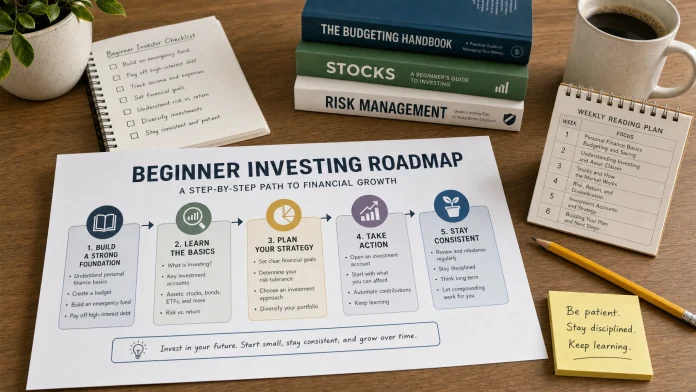
Beginners usually do not fail because they read too little. They fail because they read in the wrong order.
One day they are studying dividend yields, the next they are watching options videos, then they are reacting to inflation headlines, then they are considering a stock tip from social media. The result is information without structure. Good investing education should build like a staircase, with each step supporting the next.
The best investment articles for beginners are not the most exciting ones. They are the ones that explain how money, risk, markets, behavior, and time work together. Before trying to pick a winning stock, a new investor should understand what they are trying to accomplish, what they can afford to risk, and how to avoid the mistakes that cause permanent damage.
This reading roadmap is designed to help you start in the right place.
Start with your financial foundation
Before reading about stocks, charts, or market predictions, begin with your own finances. Investing is not separate from your financial life. It is part of it.
A beginner should first understand the difference between money needed soon and money available for long-term growth. Cash for rent, bills, debt payments, medical needs, taxes, or emergencies should not be exposed to stock market volatility. The market can be generous over long periods, but it is not reliable over short ones.
A good first step is learning how budgeting works. A practical article like Budgeting helps explain why a spending plan matters before you invest. If you do not know where your money goes, it is difficult to decide how much you can invest consistently.
Then read about the difference between saving and investing. Saving Versus Investing is the kind of beginner article that prevents a very common mistake: treating the stock market like a savings account. Savings are for stability and short-term access. Investing is for growth, but it comes with uncertainty.
A simple rule helps: if you may need the money soon, protect it. If the money is for a goal many years away, you can consider investing it according to your risk tolerance and plan.
Learn what the stock market actually is
After your personal foundation, move to market basics. Many beginners buy stocks before they understand what a stock represents.
A stock is not just a moving price on a screen. It is ownership in a business. When you buy shares, you are participating in the future results, expectations, risks, and valuation of that company. Prices move because buyers and sellers constantly reassess what those shares are worth.
A beginner-friendly article such as How to Start Investing in Stocks gives you the broad starting framework: goals, account setup, diversification, and realistic expectations. It is much more useful than jumping directly into stock recommendations.
You should also understand what a portfolio is. What Is a Stock Portfolio? explains how holdings fit together. This matters because investment success is rarely about one position. It is about how all your positions interact.
A portfolio can include individual stocks, funds, bonds, cash, or other assets. The exact mix should depend on your goals, time horizon, and risk tolerance. Beginners often focus on finding the next great stock. Experienced investors focus on building a structure they can live with.
Read in the right order
Here is a simple sequence for beginner investment articles. You do not need to master everything immediately, but the order matters.
| Reading stage | Main question | Article type to read first | Why it matters |
|---|---|---|---|
| Personal finance | Can I afford to invest? | Budgeting, saving, debt, emergency cash | Prevents investing with money you may need soon |
| Market basics | What am I buying? | Stocks, bonds, funds, portfolios | Builds understanding before decisions |
| Strategy | What is my plan? | Goals, allocation, time horizon | Turns investing into a process |
| Risk | What could go wrong? | Volatility, diversification, position sizing | Helps you survive bad markets |
| Execution | How do I buy correctly? | Brokers, order types, account basics | Reduces avoidable trading mistakes |
| Analysis | Is this investment reasonable? | Valuation, earnings, company analysis | Helps separate price from value |
| Behavior | Can I stick with the plan? | Psychology, mistakes, discipline | Protects you from emotional decisions |
| Taxes and costs | What do I keep after expenses? | Fees, taxes, capital gains | Improves real after-tax results |
This sequence keeps you from putting advanced tactics before basic judgment. That is important because complexity can make a beginner feel informed while still being unprepared.
Understand risk before chasing returns
Every beginner wants to know how much they can make. A better first question is: how much can I lose, and how would I react?
Risk is not just volatility on a chart. It includes the chance of permanent loss, the risk of selling at the wrong time, the risk of being overconcentrated, the risk of misunderstanding what you own, and the risk of needing money during a downturn.
Start with broad comparisons. Stocks vs Bonds: Which Fits Your Goals? helps explain why different assets behave differently. Stocks usually offer higher long-term growth potential, but with larger price swings. Bonds may provide income and stability, but they also carry interest-rate and inflation risks.
Then compare individual stocks with funds. Index Funds vs Stocks: Which Fits You? is especially useful for beginners because it frames a practical choice. You can try to select individual companies, or you can use diversified funds to own many companies at once. Many investors use both, but beginners often benefit from starting simple.
Risk management is not about avoiding all risk. That is impossible. It is about choosing risks that match your goals and avoiding risks you do not understand. How to Manage Portfolio Risk Wisely is worth reading early because portfolio construction matters more than most beginners realize.
Build a plan before buying anything
One of the most useful investment articles a beginner can read is not about a stock, sector, or market forecast. It is about having a plan.
A basic investment plan should answer several questions:
- What am I investing for?
- When will I need the money?
- How much can I invest regularly?
- What mix of assets fits my risk tolerance?
- What would make me sell?
- How often will I review my portfolio?
- What mistakes am I most likely to make?
You do not need a complicated document. A one-page plan is better than a vague intention. The purpose is to make decisions before emotions take over.
For example, if your plan says you are investing monthly for retirement over 25 years, a normal market decline should not automatically trigger panic selling. If your plan says no single stock should exceed a certain percentage of your portfolio, you are less likely to bet too much on one exciting idea.
A plan also protects you from financial noise. There will always be predictions, warnings, hot sectors, and confident opinions. Your plan helps you decide which information is relevant and which is merely distracting.
Learn how to buy without rushing
Once you understand the basics, then you can read articles about buying your first investment.
A practical guide such as How to Buy Your First Stock the Right Way is useful because it slows the process down. It reminds beginners to choose a broker carefully, research the company, size the position properly, and avoid buying simply because a stock is popular.
Execution also matters. Many beginners do not understand the difference between order types. Limit Order vs Market Order Explained teaches an important lesson: getting into an investment is not just about what you buy, but also how you buy it.
A market order prioritizes immediate execution. A limit order prioritizes price control. In highly liquid investments, the difference may be small. In less liquid stocks, volatile markets, or after-hours trading, the difference can matter. Beginners should understand this before placing trades.
The goal is not to become a day trader. The goal is to avoid preventable errors when you decide to invest.
Study valuation before believing a stock is cheap
A falling stock is not automatically cheap. A rising stock is not automatically expensive. Price alone tells you very little.
Valuation helps you compare what you pay with what you may be getting. That requires looking at earnings, revenue, cash flow, debt, growth, profitability, and industry context. A stock with a low price-to-earnings ratio may be a bargain, or it may be a troubled business. A stock with a high valuation may be overpriced, or it may reflect unusually strong growth expectations.
Start with Beginner Guide to Stock Valuation. It introduces the difference between price and value, which is one of the most important concepts in investing.
Then read about earnings. How to Read Earnings Reports Clearly helps beginners understand company updates without reacting only to headlines. Earnings reports show whether revenue is growing, margins are improving or weakening, cash flow is healthy, and management expectations are changing.
A beginner does not need to build complex financial models immediately. But you should learn to ask basic questions:
- Is the company profitable?
- Is growth improving or slowing?
- Is debt manageable?
- Is the stock price reasonable compared with results?
- What assumptions must come true for this investment to work?
If you cannot explain why a stock is worth owning, you are probably not investing. You may simply be hoping.
Read about psychology as early as possible
Investor psychology is not an advanced topic. It is a beginner topic.
Fear, greed, regret, overconfidence, and herd behavior affect new investors immediately. A beginner may buy after a stock has already risen sharply because everyone is talking about it. Then the same beginner may sell after a normal decline because the pain feels unbearable.
Investor Psychology for Beginners Explained should be part of your early reading list because behavior can ruin even a reasonable strategy. The best portfolio on paper is useless if you cannot stick with it.
Money decisions are also connected to life experience, discipline, family background, and personal values. Reading outside traditional finance can sometimes help you understand how people think under pressure. Reflective writing based on lived experience, such as factual personal insight on life, growth, and discipline, can be a useful reminder that investing is not only mathematical. It is also personal.
The market will test your temperament. You need to know whether you are patient or impulsive, cautious or overconfident, independent or easily influenced. Self-knowledge is a financial advantage.
Learn the mistakes before making them
Some investing mistakes are unavoidable. You will misunderstand something, buy too early, sell too late, or misjudge a company. That is part of learning.
But many beginner mistakes are predictable and avoidable. These include:
- Investing without understanding the asset
- Confusing a good company with a good stock price
- Putting too much money into one idea
- Chasing past performance
- Reacting emotionally to headlines
- Ignoring fees and taxes
- Trading too often
- Expecting quick wealth
A strong beginner reading list should include mistake-focused articles because they teach defense. Avoiding large errors can be more important than finding brilliant opportunities.
Read 10 Top Stock Market Mistakes to Avoid once before you start and again after you have invested for a few months. The second reading will feel different because you will recognize some of the temptations from experience.
Also read about learning from errors. Investing improves when you review decisions honestly. Keep a simple journal that records what you bought, why you bought it, what risks you saw, and what would make you change your mind. This habit creates accountability.
Do not ignore taxes and costs
Beginners often focus on gross returns. Experienced investors care about what remains after taxes, fees, spreads, and mistakes.
Taxes vary depending on account type, holding period, country, and personal situation. Still, every investor should understand the basic difference between unrealized gains and realized gains. A stock that has risen in your account has not created a taxable sale until you sell it in a taxable account. Dividends, capital gains distributions, and short-term trades can all have tax consequences.
Capital Gains Tax on Stocks Explained is a useful article to read before you start selling positions casually. It can help you think about after-tax returns and understand why frequent trading may create hidden costs.
This does not mean taxes should control every investment decision. A bad investment should not be held forever simply to delay tax. But tax awareness should be part of mature investing behavior.
Leave advanced strategies for later
Once beginners gain confidence, they often become curious about options, margin, short selling, futures, forex, penny stocks, and leveraged products. Curiosity is good. Rushing is not.
Advanced strategies can have legitimate uses, but they often introduce risks that are not obvious at first. Short selling can create large losses. Options can expire worthless. Margin can magnify mistakes. Illiquid securities can be difficult to exit. Complex products can hide costs and risks in their structure.
Before studying advanced tactics, make sure you can answer basic questions about your current portfolio, risk exposure, time horizon, and investment thesis. If you cannot manage a simple portfolio calmly, complexity will not solve the problem. It will likely make the problem harder to see.
A useful beginner rule is this: learn advanced topics for education before using them with real money.
A practical first-month reading plan
If you are new, do not try to read everything at once. Use a four-week structure.
In week one, read about budgeting, saving versus investing, and how the stock market works. Your goal is to understand where investing fits in your life.
In week two, read about portfolios, stocks versus bonds, index funds versus stocks, and risk management. Your goal is to understand structure and diversification.
In week three, read about buying your first stock, order types, valuation, and earnings reports. Your goal is to understand decision-making and execution.
In week four, read about investor psychology, common mistakes, taxes, and long-term expectations. Your goal is to build discipline before market pressure arrives.
By the end of a month, you will not know everything. That is not the objective. The objective is to stop being random. You will have a basic map, and that map will help you decide what to learn next.
Frequently Asked Questions
What investment articles should beginners read first? Beginners should start with articles about budgeting, saving versus investing, stock market basics, portfolio construction, risk management, and investor psychology. These topics build the foundation needed before choosing individual stocks or advanced strategies.
Should I read stock-picking articles first? Usually no. Stock-picking articles are more useful after you understand risk, diversification, valuation, and your own goals. Otherwise, it is easy to confuse an interesting company with a suitable investment.
How many investing articles should I read before buying my first stock? There is no exact number, but you should understand what a stock is, how portfolios work, what risks you face, how orders work, and why you are buying. If you cannot explain your reason in plain language, keep learning first.
Are index fund articles useful for beginners? Yes. Index funds can teach diversification, market exposure, fees, and long-term discipline. Even if you later buy individual stocks, understanding index funds gives you a helpful benchmark for your decisions.
What is the biggest beginner investing mistake? One of the biggest mistakes is investing without a plan. Without a plan, beginners often react to news, follow tips, overtrade, or take risks that do not match their goals.
Continue building your investing education
The right reading order can save you time, money, and frustration. Start with the basics, learn risk before return, study behavior before panic arrives, and treat investing as a long-term skill.
Greek Shares offers beginner-friendly investing education, stock market guides, glossary resources, and practical articles to help you build that skill step by step. Choose one topic from this roadmap, read it carefully, and turn it into action before moving to the next.