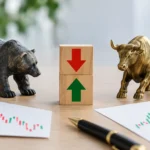



A market can look calm at noon and chaotic by the closing bell. One inflation report comes in hotter than expected, a central bank official makes a brief comment, or a major company misses earnings, and stock prices can swing sharply within hours. If you have ever wondered what causes market volatility, the short answer is that prices move when expectations change – and expectations can change quickly.
That answer is simple, but the mechanics matter. Volatility is not random noise. It is the visible result of investors constantly repricing risk, future profits, interest rates, and economic conditions. For long-term investors, understanding these forces does not remove uncertainty, but it does make market behavior easier to interpret.
What market volatility actually means
Market volatility refers to the degree and speed of price movement in a market, index, or individual security. When prices move up or down by small amounts, volatility is low. When they swing more dramatically over short periods, volatility is high.
Volatility does not always mean the market is falling. A sharp rally can also be volatile. What matters is the size and frequency of price changes, not the direction alone. This distinction is useful because many newer investors equate volatility with danger, when in reality it is a measure of movement. Risk and volatility are related, but they are not identical.
What causes market volatility in practice
At the most basic level, volatility happens because buyers and sellers disagree about value, and new information forces them to update their views. The market is forward-looking. Prices do not only reflect what is happening now. They reflect what investors think is likely to happen next.
When expectations are stable, price moves tend to be more orderly. When expectations shift suddenly, the market has to adjust fast. That adjustment process is what creates volatility.
Economic data can reset expectations fast
Economic reports are one of the most common answers to the question of what causes market volatility. Data on inflation, jobs, consumer spending, GDP growth, and manufacturing can all move markets because they influence the outlook for corporate earnings and monetary policy.
For example, if inflation comes in higher than expected, investors may assume the Federal Reserve will keep interest rates higher for longer. That can reduce the present value of future earnings, especially for growth stocks, and pressure the broader market. On the other hand, weak economic data may raise concerns about a slowdown or recession, which can hurt cyclical sectors such as industrials, consumer discretionary, and financials.
The key point is that markets often react less to the number itself and more to whether it differs from expectations. A bad report that was already expected may cause little movement. A modest surprise can trigger a large one.
Interest rates and central bank policy matter a lot
Interest rates are one of the strongest drivers of valuation. When rates rise, borrowing becomes more expensive for companies and consumers. Higher rates can slow economic activity, reduce profit margins, and make lower-risk assets like bonds more attractive relative to stocks.
This is why central bank meetings, policy statements, and speeches from Fed officials often create volatility. Even small changes in language can affect how investors price future rate decisions. Markets are sensitive not only to current rates but also to the expected path of rates over the coming months.
There is also a trade-off here. Rising rates can pressure stock prices, but they may also reflect a strong economy. Falling rates can support valuations, but they may come during economic weakness. The market has to weigh both sides at once, which is one reason price action can look inconsistent from day to day.
Corporate earnings change the story stock by stock
For individual companies, earnings reports are a major source of volatility. Investors are not just evaluating whether a company made money last quarter. They are also judging revenue growth, margins, guidance, competitive pressures, and management confidence.
A stock can report rising profits and still fall if results were weaker than expected or if future guidance disappoints. The reverse is also true. A company with mediocre current results may rise sharply if investors believe the worst is over.
This is especially common in sectors where valuations rely heavily on future growth, such as technology. When investors are paying for expected expansion years into the future, any change in that outlook can produce an outsized move.
Investor psychology amplifies price swings
Markets are not moved by data alone. They are moved by how people interpret data. Fear, greed, relief, uncertainty, and overconfidence all influence decision-making, which is why investor psychology is a major part of what causes market volatility.
When investors become anxious, they may sell not because business fundamentals changed dramatically, but because they want to reduce exposure quickly. When optimism takes over, they may buy aggressively and push prices above levels justified by current earnings. In both cases, emotion can magnify moves that began with a legitimate catalyst.
Short-term trading, algorithmic strategies, and options activity can intensify this effect. Once prices start moving, stop-loss orders, margin calls, and momentum trading can add fuel to the move. That does not mean the market is irrational all the time. It means the path from one price level to another is often more volatile than the underlying fundamentals alone would suggest.
Uncertainty is often more destabilizing than bad news
One useful lesson for investors is that uncertainty can create more volatility than clearly negative news. Markets can usually price bad outcomes if they are visible enough. They struggle more when the range of possible outcomes is wide.
This is why events such as elections, geopolitical tensions, policy disputes, banking stress, and unexpected global shocks can lead to sharp swings. Investors are not only asking what happened. They are asking what might happen next, how severe it could be, and how long it may last.
When there is no clear answer, price ranges widen.
Liquidity and market structure also play a role
Another part of what causes market volatility is liquidity, or how easily assets can be bought and sold without causing large price changes. In a highly liquid market, there are enough buyers and sellers to absorb orders smoothly. In a less liquid environment, even moderate selling pressure can push prices down quickly.
Liquidity often dries up during stress. Investors become more cautious, bid-ask spreads widen, and fewer participants are willing to step in aggressively. That can make market declines appear sudden.
Market structure matters too. Exchange-traded funds, index investing, derivatives, and high-speed trading have changed how capital moves. These tools are not inherently harmful, and they offer real benefits, but they can contribute to faster repricing during periods of uncertainty. A broad selloff in index products, for example, can pull down stocks regardless of whether each company experienced new business-specific problems that day.
Different assets react differently
Not all volatility has the same cause, and not all parts of the market respond the same way. Growth stocks tend to be more sensitive to interest rates. Commodity-related stocks may react more to oil, metals, or supply disruptions. Defensive sectors such as utilities or consumer staples may hold up better when investors become risk-averse.
This matters because broad statements about the market can miss what is happening under the surface. Sometimes the major indexes look volatile because a handful of large companies are swinging sharply. Other times the turbulence is widespread across sectors and asset classes. Understanding the source helps investors decide whether they are seeing a short-term repricing event or a broader change in market conditions.
What investors should do when volatility rises
The most useful response to volatility is not prediction. It is preparation. If your portfolio is built around clear goals, realistic risk tolerance, and proper diversification, volatile periods become easier to manage.
That does not mean every drop should be ignored. Sometimes volatility reflects real deterioration in economic or company fundamentals. But reacting to every swing usually leads to poor decisions, especially when fear is highest.
A disciplined investor asks a few practical questions. Has the long-term thesis changed? Is this a market-wide move or a company-specific issue? Was the portfolio risk level appropriate before the volatility started? These questions are more productive than trying to guess tomorrow’s headline.
For readers building their investing knowledge through structured education, this is where market volatility becomes less intimidating. It stops looking like random chaos and starts looking like a series of reactions to changing information, expectations, and emotions.
Volatility is the price markets pay for constantly updating the future. The better you understand what moves expectations, the less likely you are to let short-term swings control long-term decisions.