



Every investor eventually faces the same challenge: the stock market is simple enough to understand, but difficult to master. Prices move every second, headlines change daily, and confident predictions often age badly. Yet the key ideas behind successful investing are surprisingly stable.
A useful stock market overview should not teach you to predict tomorrow morning’s price. It should help you understand what you are buying, why prices move, how risk works, and how to build a process you can follow when markets become noisy.
This guide is for beginners and improving investors who want a clear mental map before making decisions with real money.
What the stock market actually is
The stock market is a system where investors buy and sell shares of publicly listed companies. A share represents partial ownership in a business. If you own shares in a company, you own a small claim on its future profits, assets, and cash flows, although common shareholders are last in line if the company fails.
Companies use public markets to raise capital, increase visibility, and give early investors or founders a way to sell ownership stakes. Investors use markets to participate in business growth, earn dividends, diversify wealth, or trade price movements.
There are two broad parts of the market:
| Market area | What happens | Why it matters |
|---|---|---|
| Primary market | Companies issue new shares, often through an IPO or secondary offering | The company receives capital from investors |
| Secondary market | Investors buy and sell existing shares with each other | Most daily stock trading happens here |
When you buy a stock through your broker, you are usually buying from another investor, not directly from the company. That distinction matters because a rising or falling share price does not automatically mean the company is receiving or losing cash. It reflects what investors are willing to pay for ownership at that moment.
Why stock prices rise and fall
In the short term, prices move because of supply and demand. If more buyers want a stock than sellers are willing to sell at the current price, the price rises. If sellers are more aggressive than buyers, the price falls.
But supply and demand are influenced by many deeper factors. Investors are constantly adjusting expectations about future profits, interest rates, inflation, competition, management decisions, and economic conditions.
| Price driver | What it means | Investor question |
|---|---|---|
| Earnings and cash flow | A company’s ability to generate profit and cash | Is the business becoming more valuable over time? |
| Interest rates | The cost of money and the return available from safer assets | Are investors being paid enough to accept stock risk? |
| Inflation | Rising prices can affect margins, consumers, and discount rates | Can the company protect profits in changing conditions? |
| Market sentiment | Fear, greed, optimism, or pessimism across investors | Is the price reacting to facts or emotion? |
| Liquidity | How easily shares can be bought or sold | Can investors enter or exit without large price impact? |
| Company news | Earnings reports, lawsuits, products, debt, or leadership changes | Has the original investment thesis changed? |
This is why a stock can fall after a company reports good profits, if investors expected even better results. It is also why weak companies can rise temporarily when market enthusiasm is strong. Price is not a perfect measure of value. It is a real-time negotiation between buyers and sellers with different information, time horizons, and emotions.
For a deeper look at downside movements, Greek Shares has a practical guide on why stocks fall.
Stock market indices: the market’s scoreboards
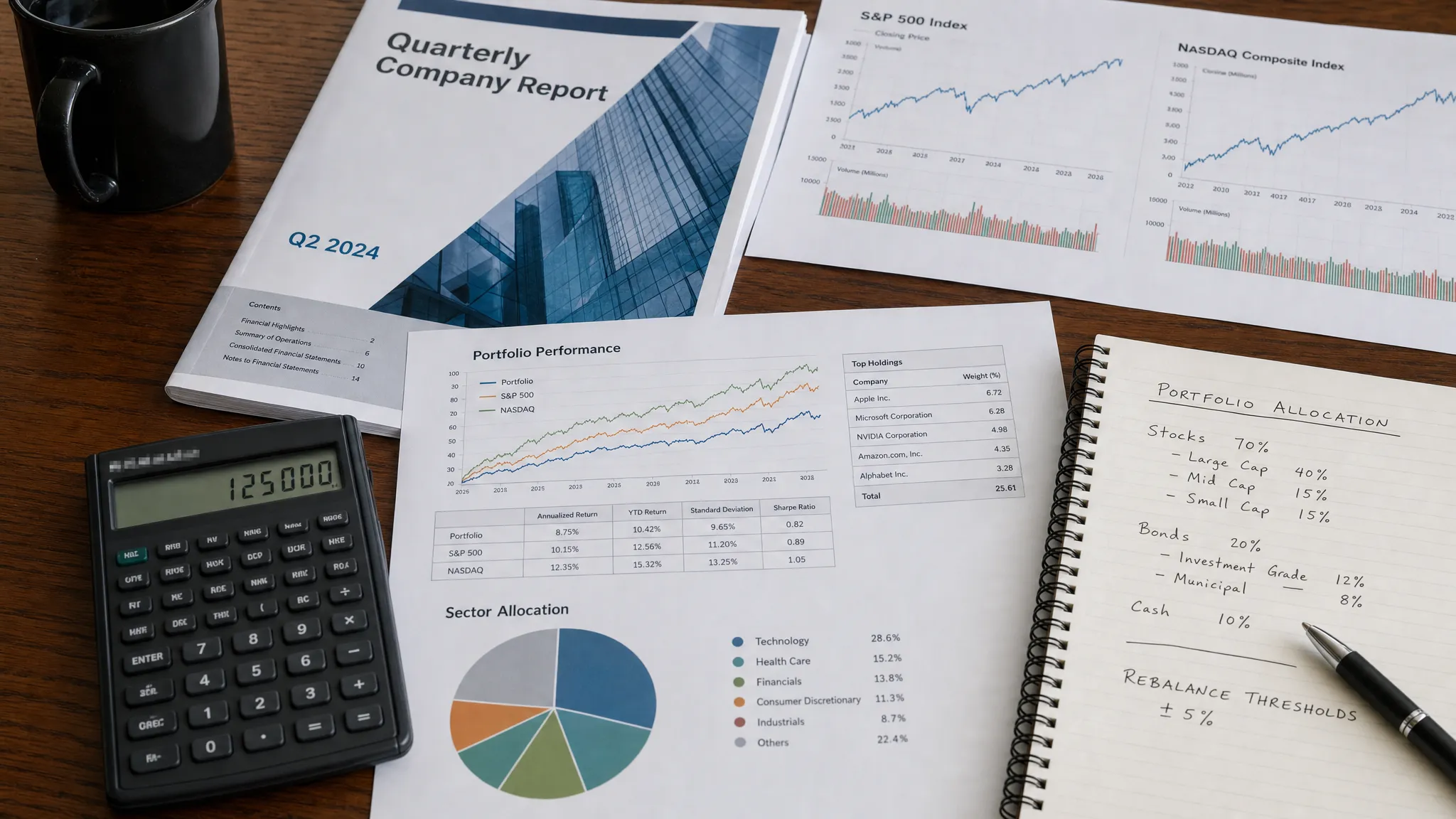
A stock market index tracks a selected group of stocks. Indices help investors summarize market performance without studying every company individually.
Common examples include the S&P 500, which tracks large U.S. companies, the Nasdaq Composite, which is heavily influenced by technology and growth companies, and national indices such as the Athens Stock Exchange General Index for Greek equities.
An index is not the whole market. It is a sample. Some indices are weighted by market capitalization, meaning larger companies have more influence. Others may use different rules. This is why one index can rise while another falls.
Indices are useful for three main reasons. They provide a benchmark, they show broad trends, and they allow investors to compare their own results against a passive alternative. If your portfolio is taking more risk than an index but producing worse long-term returns, your strategy deserves review.
Many investors gain index exposure through mutual funds or exchange traded funds. If you are deciding between broad diversification and individual company selection, read Index Funds vs Stocks for a more detailed comparison.
Risk and return are inseparable
Stocks have historically offered attractive long-term return potential because they are risky. Investors demand the possibility of higher returns because shareholders face uncertainty. A company can disappoint, an industry can decline, a recession can reduce earnings, or an overvalued stock can spend years correcting.
Risk is not only volatility. A stock moving up and down is uncomfortable, but the deeper danger is permanent capital loss. Permanent loss can happen when a company’s economics deteriorate, when debt becomes unmanageable, when investors overpay for optimistic assumptions, or when a portfolio is too concentrated in one idea.
Good investors do not try to eliminate risk. They try to understand, price, and manage it.
Here are several major forms of stock market risk:
| Risk type | Example | Basic response |
|---|---|---|
| Business risk | A company loses customers or margins shrink | Study the business model and competitive position |
| Valuation risk | A good company is bought at too high a price | Compare price with earnings, cash flow, growth, and peers |
| Market risk | Broad market declines affect most stocks | Use diversification and match stocks to long time horizons |
| Liquidity risk | A thinly traded stock is hard to sell | Be careful with small or illiquid positions |
| Behavioral risk | Panic selling or chasing hype | Create rules before emotions take over |
Risk management starts before you buy. Ask how much you can afford to lose, how long you can wait, and whether one position would damage your finances if it went badly. Greek Shares covers this in more detail in How to Manage Portfolio Risk Wisely.
Investing is not the same as trading
Investing and trading both involve buying and selling securities, but they are not the same activity.
Investors usually focus on business value, future earnings power, dividends, asset allocation, and long-term compounding. Traders focus more on price patterns, momentum, short-term catalysts, and timing. Both approaches require discipline, but they use different skills.
A common mistake is to buy a stock as an investor, then react like a trader when the price falls. Another mistake is to enter a short-term trade and then call it an investment after it moves against you. The label matters because it determines how you make decisions.
Before buying anything, decide whether the position belongs in a long-term portfolio or a trading plan. If you want a full comparison, see Trading vs Long Term Investing Explained.
Brokers, orders, and execution basics
To buy listed stocks, you normally need a brokerage account. A broker provides access to exchanges and trading venues, processes your orders, holds securities, and provides statements and tax documents.
Learning how orders work is essential. A market order seeks immediate execution at the best available price. A limit order sets the maximum price you are willing to pay when buying, or the minimum price you are willing to accept when selling.
Market orders can be fine for very liquid securities during normal market hours, but they can create surprises in fast or thin markets. Limit orders provide price control, but they may not execute.
This is one of those practical areas where education prevents avoidable mistakes. Learning to invest is similar to learning to drive: you should understand the rules before entering busy traffic. A learner driver in the UK might use a platform to find certified driving instructors before taking the wheel; an investor should also seek structured guidance before placing orders with real capital.
Greek Shares explains order choices in detail in Limit Order vs Market Order Explained, and beginners can continue with How to Buy Stocks the Right Way.
Fundamental analysis: studying the business
Fundamental analysis asks a basic question: what is this business worth?
To answer it, investors look at revenue, profits, margins, cash flow, debt, competitive advantages, management quality, and valuation. The goal is not to know everything. The goal is to understand enough to make a reasoned decision.
A company can be excellent but still be a poor investment if the price already assumes perfection. A struggling company can be attractive if the market has become too pessimistic and the balance sheet is strong enough to survive. This is why valuation matters.
One common valuation tool is the price-to-earnings ratio, or P/E ratio. It compares a company’s share price with its earnings per share. A high P/E can indicate strong growth expectations, overvaluation, or temporarily depressed earnings. A low P/E can indicate a bargain, poor prospects, or a cyclical peak in profits. Context is everything.
If you want to study this metric more carefully, Greek Shares has a dedicated guide: P/E Ratio Explained for Stock Investors.
Technical analysis: studying price and volume
Technical analysis looks at price behavior, volume, trends, support and resistance, and chart patterns. It does not replace business analysis, but it can help investors understand market behavior and manage entries or exits.
For long-term investors, charts can be useful without becoming the center of the strategy. A chart may reveal whether a stock is in a strong uptrend, whether a decline is accelerating, or whether volume is confirming a move. It can also help investors avoid buying impulsively after a vertical rise.
The danger is treating charts as prophecy. A pattern is not a guarantee. It is a way to frame probabilities and risk. Investors who use charts well usually combine them with fundamental judgment and position sizing.
For a clear beginner guide, see How to Read Stock Charts Clearly.
A portfolio is more than a list of stocks
Owning several stocks does not automatically mean you are diversified. If all your holdings are in the same industry, country, currency, or economic theme, your portfolio may be more concentrated than it looks.
A strong portfolio begins with goals. Are you investing for retirement, income, wealth building, education funding, or future flexibility? Your goal determines your time horizon. Your time horizon influences how much volatility you can accept. Your risk tolerance determines whether you can stay disciplined when markets fall.
The key portfolio ideas are allocation, diversification, position sizing, and rebalancing. Allocation is how your money is divided across asset types. Diversification spreads risk across different holdings. Position sizing limits the damage from a single mistake. Rebalancing brings the portfolio back toward its intended structure after markets move.
A beginner does not need a complicated portfolio. In many cases, a broad fund or a small number of diversified funds can create a better foundation than a collection of exciting stock tips. Individual stocks can be added later if you have the time and skill to analyze them.
Greek Shares explains the portfolio foundation in What Is a Stock Portfolio?.
Dividends, growth, and total return
Some investors focus on dividends. Others focus on growth. Both approaches can work, but both can also be misunderstood.
A dividend is a cash payment from a company to shareholders. Dividend-paying companies are often mature businesses with stable cash flows, although this is not always true. Growth companies may reinvest profits instead of paying them out, hoping to create more value over time.
Total return includes both price appreciation and dividends. A stock with a low dividend yield can still be a strong investment if earnings grow rapidly and the valuation remains reasonable. A stock with a high dividend yield can be risky if the dividend is unsustainable.
The key is to match the investment to the purpose. If you need income, dividend quality matters. If you seek long-term growth, reinvestment opportunities and competitive advantages matter. In either case, do not evaluate a stock using only one number.
Investor psychology: the hidden force
Many investors understand the theory but fail in practice because of behavior. Markets test patience, humility, and emotional control.
Fear can make investors sell quality assets at poor prices. Greed can make them chase overvalued trends. Overconfidence can make them concentrate too heavily in one idea. Recency bias can make the latest market environment feel permanent.
A written process helps. It does not remove emotion, but it gives you something to follow when emotion appears.
Before buying a stock, consider using a simple checklist:
- What does the company do, and how does it make money?
- Why might earnings or cash flow grow over time?
- What could go wrong with the business or industry?
- Is the balance sheet strong enough for difficult periods?
- Is the valuation reasonable compared with growth and risk?
- How large should the position be in the portfolio?
- What would make you sell or reduce the position?
The best investors are not those who never make mistakes. They are those who identify mistakes early, learn from them, and avoid repeating the same pattern. For a practical warning list, read 10 Top Stock Market Mistakes to Avoid.
What every investor should remember
A good stock market overview comes down to a few durable principles. Stocks are ownership claims on businesses. Prices move because expectations change. Risk and return cannot be separated. Diversification protects against being wrong. Valuation matters. Behavior matters even more.
You do not need to predict every market turn to become a better investor. You need a clear plan, a sensible portfolio, and the discipline to keep learning.
In any market environment, whether headlines are optimistic or frightening, the same questions remain useful: What do I own? Why do I own it? What is it worth? What risks am I accepting? What will I do if I am wrong?
If you can answer those questions honestly, you are already ahead of many market participants.
Frequently Asked Questions
What is the stock market in simple terms? The stock market is a place where investors buy and sell ownership shares in public companies. Prices change based on supply, demand, expectations, and new information.
Is the stock market good for beginners? It can be, if beginners start with education, diversification, realistic expectations, and money they do not need in the short term. Beginners should avoid treating the market like a casino.
What makes a stock price go up? A stock price rises when buyers are willing to pay more than sellers previously accepted. This can happen because of stronger earnings, improved expectations, lower interest rates, positive news, or market optimism.
Should I buy individual stocks or index funds? Many beginners start with diversified index funds because they reduce single-company risk and require less research. Individual stocks may suit investors who have time, skill, and discipline to analyze businesses.
How often should I check my portfolio? Long-term investors do not need to react to every daily move. A periodic review, such as quarterly or semiannually, is often enough unless there is major company-specific news or a change in personal circumstances.
Can you lose all your money in stocks? Yes, if you own shares in a company that fails, that stock can become worthless. Diversification reduces the chance that one failure destroys your portfolio, but it does not eliminate market risk.
Build your stock market knowledge step by step
The stock market rewards patience, preparation, and continuous learning. You do not need to master every strategy at once. Start with the foundations, understand risk, learn the language, and build a process before chasing returns.
Greek Shares offers investing education articles, stock market guides, glossary resources, and practical tutorials to help you improve your financial literacy over time. Continue exploring the site, compare concepts, and turn this overview into a disciplined investing plan.