


Choosing the best share market as a beginner is not about finding the market that went up the most last year. It is about finding a place to invest where the rules are clear, the costs are reasonable, the information is reliable, and your risk can be controlled while you learn.
For a new investor, that distinction matters. A fast-rising market can still be a poor starting point if it is illiquid, expensive to access, dominated by a few risky companies, or difficult to research. A calmer, better-regulated market may be less exciting, but it can give beginners a stronger foundation.
This article is educational, not personal financial advice. The right choice depends on your country, tax situation, goals, time horizon, and risk tolerance. Still, there are clear qualities that make one share market more beginner-friendly than another.
The short answer: the best share market is the one that helps you invest clearly
The best share market for beginners is usually a well-regulated, liquid, transparent market with broad access to diversified investments. It should let you buy and sell efficiently, understand what you own, compare companies or funds, and avoid unnecessary complexity.
That does not mean beginners must invest only in one country. In many cases, new investors can access several markets through a regulated broker, including their home market, large international markets, and global funds. The key is not to chase every opportunity. The key is to choose a market structure that supports disciplined, long-term decisions.
If you are still learning the basic mechanics, it helps to first understand how the share market works for new investors before comparing specific exchanges or countries.
Strong regulation and investor protection
A beginner-friendly share market should operate under clear rules. Regulation cannot protect you from normal investment losses, but it can reduce the risk of unfair practices, poor disclosure, and unreliable intermediaries.
Look for markets where listed companies must publish financial statements, report important events, follow accounting standards, and meet listing requirements. You also want brokers that are licensed by recognized regulators and that clearly explain account protection, fees, order handling, and client asset rules.
In the United States, for example, the SEC explains key considerations for opening a brokerage account, including costs, risks, and the importance of understanding account terms. If you invest in another country, check the equivalent securities regulator and confirm that your broker is properly authorized to serve investors in your location.
A market with strong regulation is not automatically safe, but it gives beginners a more reliable environment for learning.
High liquidity and efficient trading
Liquidity means there are enough buyers and sellers for securities to trade without large price gaps. For beginners, liquidity is important because it can make investing less frustrating and less costly.
In a liquid market, major shares and funds tend to have tighter bid-ask spreads. The bid is the price buyers are willing to pay, while the ask is the price sellers want to receive. A wide spread means you may lose money simply by entering and exiting a position, even if the quoted price barely changes.
Liquidity also matters during stressful market periods. In thinly traded markets, prices can move sharply because there are fewer participants. A beginner who uses a market order in an illiquid share may end up paying far more, or receiving far less, than expected.
This is one reason beginners often benefit from starting with widely traded shares, broad index funds, or exchange-traded funds rather than obscure small companies.
Broad diversification options
A good beginner market should make diversification easy. Diversification means spreading your money across different companies, sectors, regions, or asset types so that one poor investment does not dominate your results.
Investor.gov describes diversification as a way to reduce risk by holding a variety of investments. It does not guarantee gains or prevent losses, but it can help reduce the impact of a single company or sector performing badly.
This is where broad markets have an advantage. If a market offers many sectors, established companies, and low-cost funds, a beginner has more ways to build a balanced portfolio. If a market is dominated by only banks, energy companies, technology stocks, or a handful of large businesses, your portfolio may be more concentrated than it appears.
For new investors, diversification is often more useful than trying to identify the next winning stock.
Clear information and transparent company reporting
Beginners need markets where information is easy to find and reasonably trustworthy. Public companies should provide annual reports, quarterly or semiannual updates, earnings releases, risk disclosures, and shareholder information.
The quality of information matters because investing is not just about price charts. A share represents ownership in a business. To understand that business, you need access to revenue, profits, debt, cash flow, management commentary, competitive risks, and future plans.
Transparent markets also tend to have more independent analysis, financial news coverage, educational content, and comparison tools. That makes it easier to learn, cross-check claims, and avoid relying only on social media opinions.
A beginner should be cautious if company information is hard to access, financial reports are delayed, investor relations pages are poor, or most available commentary is promotional rather than analytical.
Reasonable costs and simple access
The best share market for beginners should not drain returns through hidden costs. Trading commissions have fallen in many markets, but zero-commission trading does not always mean investing is free.
Common costs include broker commissions, currency conversion fees, spreads, fund expense ratios, custody fees, inactivity fees, stamp duties, transaction taxes, and tax reporting costs. Some of these may be small individually, but they can add up for investors who trade frequently or invest small amounts.
Currency also matters. If you earn and spend in euros but invest in a U.S. dollar market, your returns will be affected by both the investment performance and the exchange rate. Currency exposure is not necessarily bad, but beginners should know it exists.
Before choosing a market, compare the full cost of investing, not just the headline trading fee.
| Beginner-friendly quality | Why it matters | What to look for |
|---|---|---|
| Strong regulation | Reduces avoidable market and broker risks | Licensed brokers, reporting rules, investor disclosures |
| High liquidity | Helps you buy and sell more efficiently | Tight spreads, high trading volume, widely followed securities |
| Diversification choices | Lowers dependence on one company or sector | Broad funds, multiple sectors, international options |
| Transparent information | Supports better research decisions | Financial reports, company filings, analyst coverage, market data |
| Reasonable costs | Keeps more of your return working for you | Low commissions, fair spreads, clear fund fees, known taxes |
| Accessible education | Helps beginners improve judgment | Guides, glossaries, broker education, independent sources |
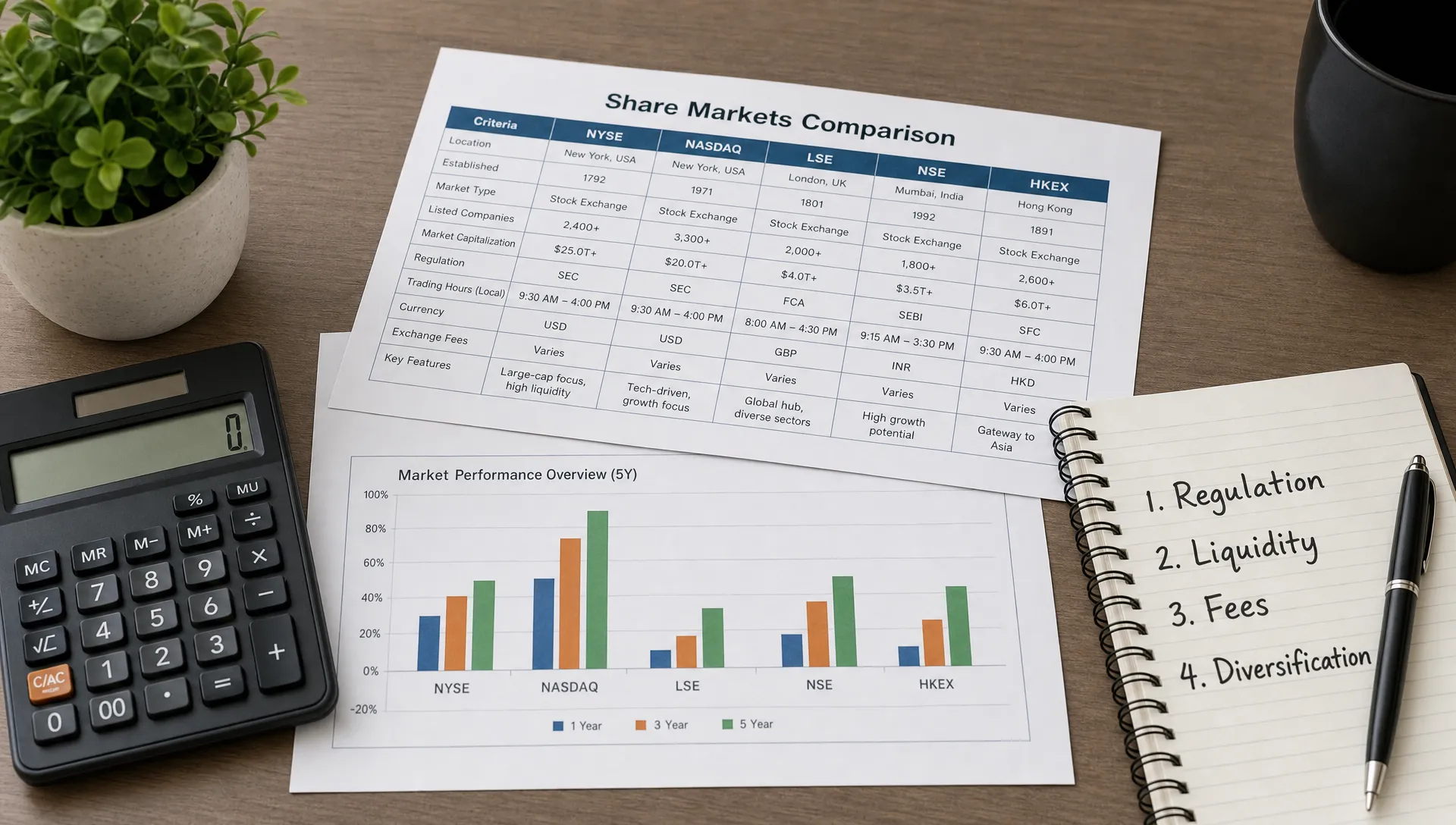
How different share market choices compare
There is no universal answer to which country has the best share market for every beginner. Instead, it is better to compare market types.
Large developed markets, such as the United States and major European markets, often offer deep liquidity, many listed companies, broad funds, and extensive research coverage. These qualities can make them easier to navigate. However, they still carry valuation risk, currency risk, and normal market volatility.
A home market can also be a sensible starting point. You may understand local companies better, follow local news more easily, and face simpler tax reporting. The downside is that smaller home markets can be concentrated in a few sectors, which may reduce diversification.
Global funds can give beginners access to many countries through a single investment product. This can be useful for diversification, but it still requires understanding fund costs, index methodology, currency exposure, and the difference between accumulating and distributing funds where relevant.
Emerging and frontier markets can offer growth potential, but they are usually more volatile and may involve greater political, currency, liquidity, and governance risks. They are not automatically unsuitable, but they are rarely the simplest first step for someone still learning the basics.
| Market route | Potential beginner advantage | Main caution |
|---|---|---|
| Large developed market | Strong liquidity, broad company choice, many funds | Still exposed to market cycles and currency risk |
| Home market | Familiar companies and often simpler local context | May be concentrated in a few sectors or companies |
| Global diversified funds | Broad exposure through one product | Requires understanding fund structure and fees |
| Emerging market exposure | Higher growth potential in some periods | Higher volatility, governance risk, and currency swings |
| Single-sector or thematic market | Easy to understand the investment theme | Concentrated risk and possible hype-driven pricing |
The best market depends on your investing style
A beginner who wants to invest for 20 years has different needs from someone who wants to trade short-term price moves. For most beginners, long-term investing is easier to learn and less demanding than frequent trading. It allows more focus on asset allocation, diversification, savings habits, and patience.
If your goal is long-term wealth building, the best market is one where you can invest regularly, keep costs low, diversify broadly, and avoid emotional decisions. If your goal is active trading, you need to understand volatility, order types, risk controls, taxes, and the possibility of rapid losses.
Many new investors say they want to “learn the market,” but they begin by trading too often. A better approach is to decide your purpose first. Are you trying to build retirement savings, grow long-term capital, create dividend income, or practice small-scale investing? The market that fits your purpose is usually better than the market that simply looks exciting.
A practical checklist before choosing a share market
Before you put money into any market, answer a few simple questions. Can you explain what you are buying? Do you know the costs? Can you access reliable information? Is the market liquid enough? Are you comfortable with the currency? Do you understand the tax basics in your country?
You do not need to become an expert before making your first investment, but you should know enough to avoid obvious mistakes. If you are ready to move from research to action, Greek Shares has a practical guide on how to buy in shares without making beginner mistakes.
For most beginners, the process should be slow and deliberate. Start by learning the terminology. Compare brokers. Study how orders work. Understand the difference between shares, funds, and indexes. Build an emergency fund before investing money you may need soon. Then consider starting small so that early mistakes are educational rather than financially painful.
A beginner-friendly market gives you room to learn without forcing you into high-risk decisions.
Red flags that a market may not be beginner-friendly
Some markets or investment products look attractive because they promise speed, exclusivity, or extraordinary returns. Beginners should be especially cautious when they see warning signs.
Be careful with markets or opportunities that have limited public information, very low trading volume, unusually wide spreads, unclear regulation, aggressive promotional claims, or pressure to act quickly. Also be cautious when an investment is difficult to explain in plain language.
Another red flag is when the entire investment case depends on recent price performance. A market that has already risen sharply may continue rising, but past returns alone do not tell you whether it is suitable for your goals.
The best share market for beginners should encourage research, patience, and risk management. It should not require guessing, rushing, or trusting unverified claims.
What about choosing individual shares?
Once you choose a market, the next question is whether to buy individual company shares, funds, or both. Individual shares can be educational because you learn how businesses operate, but they also require more research and carry company-specific risk.
Funds can offer instant diversification, which is why many beginners use them as a foundation before selecting individual companies. There is no single correct approach, but beginners should avoid building an entire portfolio around one or two popular stocks.
If you are interested in individual companies, study what makes a stock more suitable for new investors. Greek Shares covers this in more detail in its guide to the best stocks to buy for beginners.
The important point is that a strong market does not remove the need for good investment selection. Even in the most developed markets, there are excellent companies, weak companies, overpriced companies, and speculative traps.
Frequently Asked Questions
What is the best share market for beginners? The best share market for beginners is usually one that is regulated, liquid, transparent, affordable to access, and rich in diversification options. It should help you invest clearly rather than tempt you into unnecessary risk.
Is the U.S. stock market the best option for beginners? The U.S. market is popular because it is large, liquid, and well covered by research, but it is not automatically the best choice for everyone. Your country, currency, tax rules, broker access, and goals all matter.
Should beginners start with their home market? A home market can be a good starting point if you understand local companies and tax rules. However, if the home market is small or concentrated, beginners may also want to learn about broader international diversification.
Are emerging markets good for new investors? Emerging markets can offer growth potential, but they often involve higher volatility, currency risk, political risk, and liquidity challenges. Beginners should usually understand these risks before making them a major part of a portfolio.
Do beginners need to pick individual stocks? No. Many beginners start with diversified funds before buying individual shares. Individual stocks can be useful for learning, but they require more research and can create more concentrated risk.
Keep learning before you invest
The best share market for beginners is not the loudest, newest, or fastest-moving market. It is the one that lets you build knowledge, manage risk, diversify sensibly, and stay consistent over time.
Greek Shares is built to help new and improving investors understand the stock market step by step, from basic terms to practical investing decisions. Use education as your first investment, then choose markets and products that match your goals with patience and discipline.