


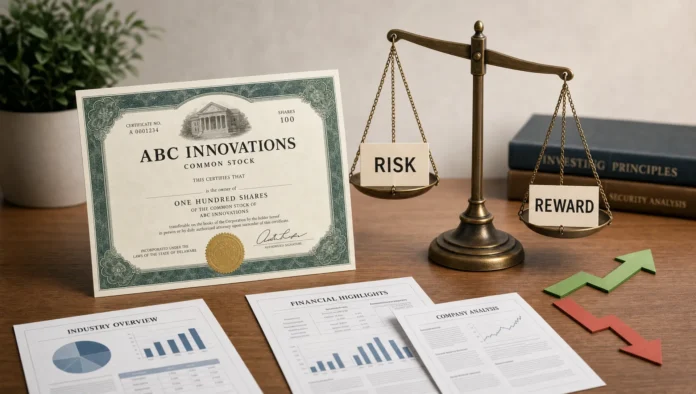
A “best stock” idea can feel obvious when a chart is rising, a famous investor owns it, or everyone online is talking about it. But the market does not reward excitement by itself. It rewards investors who can separate a good story from a good investment at a reasonable price.
A stock market best stock idea is not simply the company you like most. It is an idea that passes several tests at the same time: the business is understandable, the financials are solid enough, the valuation leaves room for error, the risks are known, and the position fits your portfolio.
This article is educational, not personal financial advice. Its goal is to give you a practical framework you can use before you buy, add, hold, or pass.
Start by defining what “best” means for you
Before judging any stock idea, define the job you want that stock to do. A stock can be “best” for one investor and unsuitable for another because investors have different time horizons, risk tolerance, income needs, tax situations, and levels of experience.
For example, a stable dividend payer may appeal to someone looking for lower volatility and income. A fast-growing technology company may appeal to someone who can tolerate large price swings. A cyclical industrial stock may be attractive only if the investor understands economic cycles and can wait through difficult periods.
Ask yourself:
- Am I looking for long-term growth, dividend income, capital preservation, or a combination?
- Can I hold through a 30% or 50% decline if the business remains healthy?
- Do I understand the industry well enough to recognize when the thesis changes?
- Would this stock make my portfolio more balanced or more concentrated?
The “best stock” is not the one with the most exciting upside. It is the one whose risk and reward match your plan.
Separate a stock tip from an investable thesis
A tip is usually short: “This stock will go up.” A thesis is specific: “This company can grow earnings because of X, Y, and Z, and the current price does not fully reflect that, while the main risks are A and B.”
If you cannot explain why the stock should perform well in plain language, you do not have an investment idea yet. You have a headline.
A simple stock thesis should answer five questions:
| Thesis question | Why it matters |
|---|---|
| What does the company do? | You need to understand the source of revenue and profit. |
| Why might it create value? | Growth, margins, returns on capital, or better capital allocation must drive results. |
| What is the market missing? | A good idea often depends on a difference between your view and the market’s view. |
| What could prove you wrong? | Every thesis needs clear risk markers. |
| What would make you sell or review? | Predefined rules reduce emotional decisions later. |
This is where many investors lose discipline. They start with a conclusion, then search for supporting evidence. A better approach is to write the thesis first, then actively look for facts that could weaken it.
Test the business before you debate the price
A cheap stock can stay cheap for years if the business is weak. An expensive stock can still disappoint if expectations are unrealistic. That is why business quality comes before valuation.
Begin with the company’s filings, not only news articles or social media. In the United States, investors can use the SEC’s EDGAR database to find annual reports, quarterly reports, and other company disclosures. Annual reports are especially useful because they explain business segments, risk factors, competition, debt, and management’s discussion of results.
When reviewing the business, focus on four areas.
1. Revenue quality
Look at how the company makes money. Recurring revenue, diversified customers, and essential products are often more resilient than one-time sales, customer concentration, or products that depend heavily on short-term trends.
Do not stop at revenue growth. Ask whether growth is profitable, sustainable, and funded responsibly. A company can grow sales while destroying shareholder value if it spends too much to acquire customers or relies on constant share issuance.
2. Profitability and cash flow
Accounting profits matter, but cash flow tells you whether profits are turning into usable money. Compare net income with operating cash flow over multiple years. If earnings rise but cash flow does not, investigate why.
Strong companies often show improving margins, healthy free cash flow, and the ability to reinvest at attractive rates. Weak companies may require constant borrowing, dilution, or asset sales just to continue operating.
3. Balance sheet strength
Debt is not automatically bad. Many excellent businesses use debt responsibly. The question is whether the company can handle obligations during a downturn.
Review total debt, interest expense, debt maturities, cash on hand, and the stability of earnings. A highly leveraged company may perform well in good times but become fragile when sales slow, interest rates rise, or credit markets tighten.
4. Competitive position
A stock idea becomes stronger when the company has a durable advantage. That advantage might come from brand strength, scale, switching costs, patents, network effects, cost leadership, or regulatory barriers.
If competitors can easily copy the product, undercut pricing, or take market share, the company may need to spend heavily just to defend its position. That can limit future returns even if the business looks attractive today.
For a broader foundation, Greek Shares also has a practical guide on how to judge any stock to invest in that complements this idea-focused checklist.
Check valuation against expectations, not just ratios
Many investors ask, “Is the P/E ratio low?” That is a useful starting point, but it is not enough. A stock is not automatically cheap because it has a low multiple, and it is not automatically expensive because it has a high multiple.
Valuation is about expectations. The current price reflects what investors collectively believe about future growth, margins, risk, and cash flows. Your job is to decide whether those expectations are too optimistic, too pessimistic, or roughly fair.
Use ratios as tools, not answers. Compare valuation to the company’s own history, similar companies, industry economics, and realistic growth assumptions.
| Valuation tool | Best used for | Main caution |
|---|---|---|
| Price-to-earnings | Profitable companies with relatively normal earnings | Misleading when earnings are temporarily high or low |
| Price-to-sales | Early-stage or low-margin businesses | Sales do not equal profits |
| Free cash flow yield | Cash-generating companies | Cash flow can be temporarily boosted or depressed |
| Enterprise value to EBITDA | Comparing companies with different debt levels | Ignores capital spending and working capital needs |
| Dividend yield | Income-focused stocks | A high yield may signal risk, not value |
The key question is: what must happen for today’s price to be justified?
If the stock already assumes years of strong growth, high margins, and smooth execution, the margin for error may be small. If the market assumes permanent weakness but the company has a credible recovery path, the opportunity may be more interesting. Either way, valuation should connect directly to the thesis.
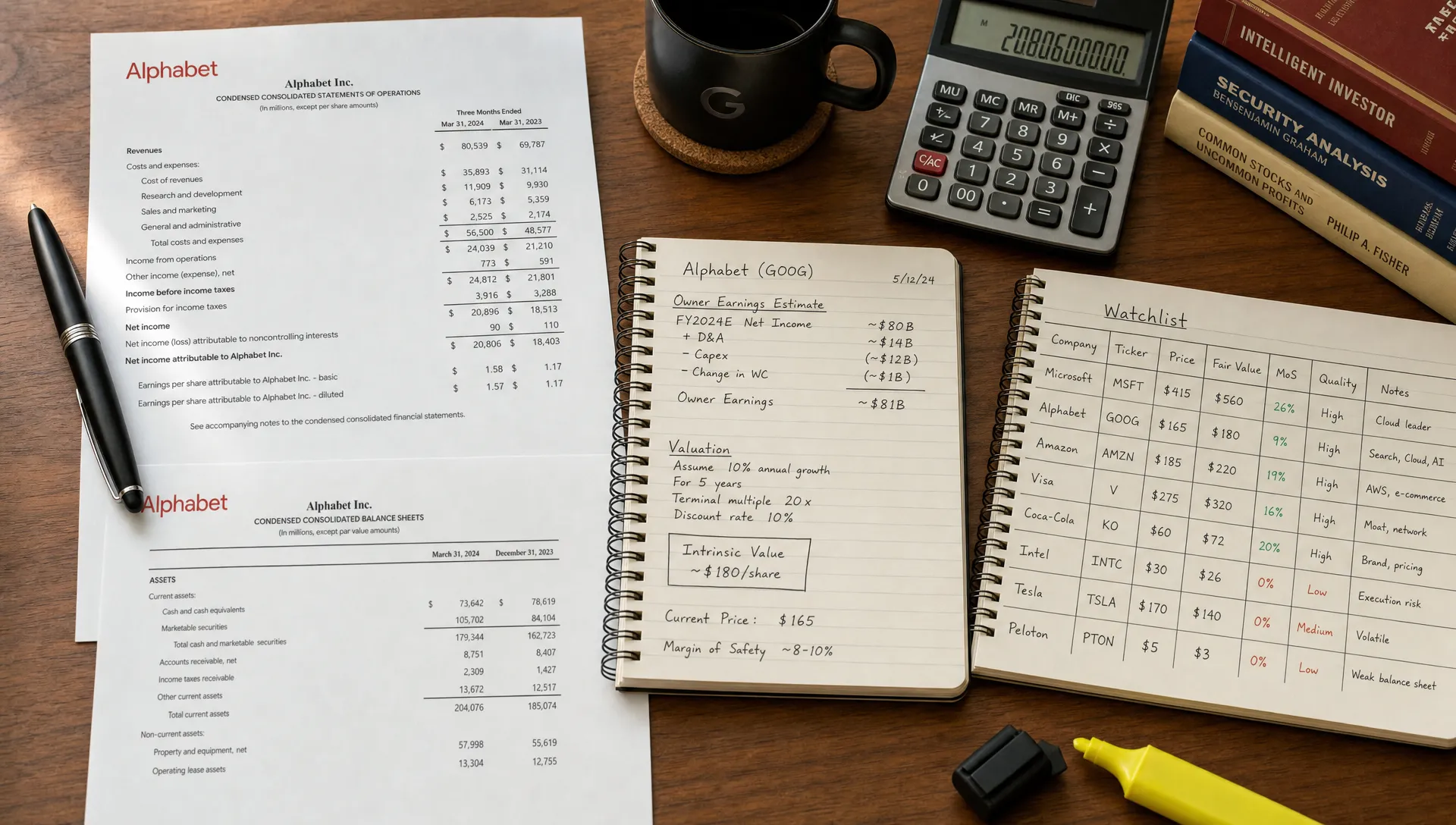
Study downside before upside
A good stock idea should survive a tough question: “What could go wrong, and how much could I lose if it does?”
Investors often spend most of their time estimating upside and very little time studying downside. That is backwards. Avoiding major permanent losses can matter more than finding one impressive winner.
Look for risks in several categories:
- Business risk, such as slowing demand, weak margins, customer concentration, or product disruption.
- Financial risk, such as high debt, refinancing pressure, negative cash flow, or repeated dilution.
- Valuation risk, such as a price that requires perfect execution.
- Management risk, such as poor capital allocation, aggressive accounting, or shareholder-unfriendly decisions.
- Portfolio risk, such as owning too many stocks exposed to the same sector, country, currency, or economic cycle.
This is also where position sizing matters. Even a well-researched idea can fail. A stock that looks attractive as a 3% position may be reckless as a 40% position. The goal is not to eliminate risk, which is impossible, but to make sure no single mistake can damage your long-term plan beyond repair.
The SEC’s Investor.gov explains the importance of asset allocation and diversification as part of managing investment risk. Individual stock investors should take that seriously, especially when a new idea feels unusually convincing.
Compare the idea with alternatives
A stock does not need to be perfect. It needs to be better than the alternatives available to you, after considering risk.
Before calling something your best stock idea, compare it with at least three alternatives:
| Alternative | Question to ask |
|---|---|
| A broad market index fund | Is this stock likely to justify the extra research and single-company risk? |
| Another stock in the same industry | Is this truly the strongest business or just the most popular name? |
| Your existing holdings | Does this improve the portfolio or duplicate risks you already own? |
Opportunity cost is real. Every dollar placed into one stock cannot be placed somewhere else. Sometimes the best decision is not buying the exciting new idea because an existing holding offers a clearer risk-reward setup.
If you are still building your process, the Greek Shares guide to finding the stock market’s best investments can help you think beyond isolated picks and focus on a repeatable approach.
Use a simple scorecard before making the decision
A scorecard prevents you from being carried away by one attractive feature. A company may have excellent growth but poor cash flow. Another may look cheap but face serious structural decline. A scorecard forces balance.
You do not need a complex model to start. Use a one-page checklist and rate each area as strong, acceptable, weak, or unclear.
| Area to judge | Strong sign | Warning sign |
|---|---|---|
| Business understanding | You can explain how the company makes money in a few sentences | The business model depends on jargon or unclear assumptions |
| Financial health | Consistent profits, cash flow, and manageable debt | Losses, weak cash flow, heavy leverage, or dilution |
| Competitive position | Durable advantages and rational competition | Low barriers, price wars, or rapid disruption |
| Valuation | Reasonable expectations with room for error | Price assumes near-perfect execution |
| Management | Clear communication and disciplined capital allocation | Promotional language, poor incentives, or repeated surprises |
| Portfolio fit | Adds useful exposure without excessive concentration | Increases risks you already have too much of |
| Review plan | You know what would confirm or break the thesis | You plan to “see what happens” |
A stock does not need to score perfectly. But if several categories are weak or unclear, it may belong on a watchlist instead of in your portfolio.
Decide: buy, watch, or pass
Judging a stock idea should lead to one of three decisions.
A “buy” decision means the thesis is clear, the valuation is acceptable, the risks are understood, and the position size fits your plan.
A “watch” decision means the business may be interesting, but something is missing. The valuation may be too high, the balance sheet may need improvement, or you may need another quarter of evidence. Watchlists are valuable because they turn impatience into preparation.
A “pass” decision means the idea does not meet your standards. Passing is not failure. In investing, avoiding weak opportunities is part of building better long-term results. As Greek Shares has discussed in its article on the best questions before buying stocks, asking the right questions before you act can be more valuable than reacting after the price moves.
Keep a decision journal
Once you decide, write down your reasoning. This habit is simple, but powerful.
Record the date, price, thesis, valuation assumptions, main risks, expected holding period, and conditions that would make you review the position. Later, compare what happened with what you expected.
A decision journal helps you identify patterns. Maybe you overpay for growth. Maybe you sell too soon. Maybe you ignore debt. Maybe your best results come from boring companies with steady cash flow. Without records, those lessons are easy to miss.
Do not judge your process only by one outcome. A good decision can lose money if unexpected events occur. A bad decision can make money because of luck. Over time, the aim is to improve the quality of your decisions, not to pretend every investment will be right.
Common mistakes when judging a “best stock” idea
The most dangerous ideas are often the ones that feel effortless. If a stock seems obvious, slow down and look for what you might be missing.
Common mistakes include confusing a great company with a great stock, ignoring valuation because the story is exciting, buying because a famous investor owns it, relying only on recent price momentum, and underestimating how much expectations are already built into the share price.
Another mistake is judging a stock in isolation. A company can be attractive but still make your portfolio riskier if you already own similar businesses. For example, adding another bank, energy producer, or technology platform may increase concentration more than you realize.
Finally, beware of certainty. The best investors are not certain. They are prepared. They know what they own, why they own it, what could go wrong, and what they will do if the facts change.
Frequently Asked Questions
What makes a stock idea worth researching? A stock idea is worth researching when you can identify a clear business, a possible reason the market may be mispricing it, and a realistic path for value creation. If the idea is based only on hype, a chart pattern, or a vague prediction, it needs more work before it becomes investable.
How do I know if a stock is the best stock for me? A stock may be suitable if it matches your goals, time horizon, risk tolerance, and portfolio needs. The “best” stock is not universal. It depends on whether the business quality, valuation, downside risk, and position size make sense for your situation.
Should I buy a stock just because it has fallen a lot? Not automatically. A lower price can create opportunity, but it can also reflect real business deterioration. Before buying a fallen stock, examine why it declined, whether the company’s fundamentals remain intact, and whether the valuation now offers enough margin for error.
Is valuation more important than business quality? Both matter. Business quality helps determine how much value a company can create over time, while valuation determines how much of that future value you are paying for today. A strong business bought at an unrealistic price can still produce poor returns.
How many stock ideas should I research before buying one? There is no fixed number, but comparing several alternatives usually improves discipline. Looking at competitors, index funds, and your current holdings helps you avoid buying the first idea that sounds attractive.
Build a better stock-picking habit
Judging a stock market best stock idea is not about predicting tomorrow’s price. It is about building a disciplined process that helps you understand the business, test the valuation, respect the risks, and decide whether the idea belongs in your portfolio.
The strongest investors do not chase every opportunity. They filter ideas carefully, wait for favorable setups, and keep learning from both mistakes and successes.
For more investing education, stock market guides, and practical decision-making frameworks, explore Greek Shares and keep strengthening the process behind every investment choice you make.