


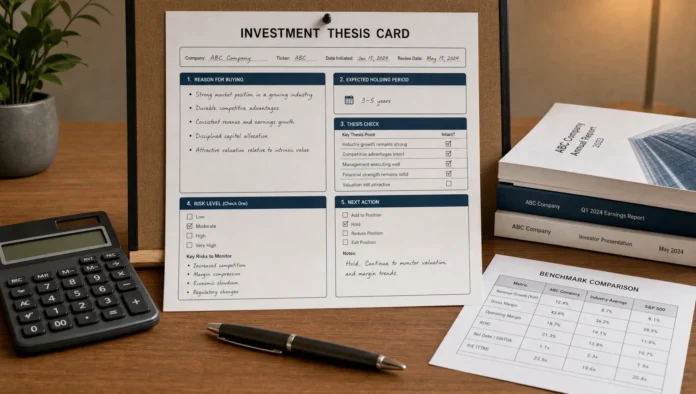
Recent investments are often the hardest to judge clearly. They are close enough to feel personal, new enough that the original excitement is still fresh, and usually too young to prove whether the decision was genuinely strong or simply lucky.
A wiser review process does not ask only, Did it go up? It asks whether the investment still fits your plan, whether the reason you bought it remains valid, and whether the risk you are taking is still acceptable. That shift matters because a profitable mistake can teach the wrong lesson, while a temporarily losing investment can still be a sound decision.
The goal is not to react faster. The goal is to review recent investments with more structure, less emotion, and better evidence.
Start by defining what you are reviewing
Before you look at the price chart, clarify what the investment was supposed to do in your portfolio. A stock bought for long-term compound growth should not be reviewed the same way as a short-term tactical position. A dividend holding should not be judged by the same criteria as an early-stage growth company. A broad index fund has a different role than a single stock.
Write down, or reconstruct, the original purpose of the investment:
- The reason you bought it
- The expected holding period
- The key assumptions behind the decision
- The risk you accepted at the time
- The conditions that would make you buy more, hold, reduce, or sell
If you cannot explain why you bought an investment, that is already useful information. It may mean the purchase was driven by a headline, a tip, fear of missing out, or the feeling that you had to do something. Greek Shares has covered this emotional side of investing before, and it is worth revisiting the reminder to think carefully before investing when a recent purchase feels more impulsive than planned.
A review is most valuable when it compares the investment against its intended role, not against a vague wish that it should have made money immediately.
Separate the result from the decision process
One of the biggest review mistakes is confusing outcome quality with decision quality. In markets, good decisions can lose money for a while, and poor decisions can make money quickly. That does not mean results do not matter. It means results need context.
Use this simple distinction:
| Review question | What it tells you | What it does not prove |
|---|---|---|
| Did the price rise or fall? | Short-term market reaction | Whether your reasoning was sound |
| Did the business results improve? | Whether fundamentals are supporting the thesis | Whether the stock is now cheap or expensive |
| Did the investment beat a relevant benchmark? | Relative performance | Whether it still fits your goals |
| Did your risk increase? | Whether the position may need adjustment | Whether you should automatically sell |
| Did your thesis change? | Whether the original case still stands | Whether the next price move is predictable |
This is especially important with recent investments because early performance can be misleading. A stock may rise because the whole market rallied, not because your specific thesis was correct. Another may fall because interest rates, sector sentiment, or currency movements changed, even though the company’s long-term prospects remain intact.
A wise review asks, What happened, why did it happen, and does it change the original case?
Rebuild the investment thesis from scratch
After a few weeks or months, it is tempting to defend your original view. Instead, pretend you do not own the investment and ask whether you would still consider buying it today. This helps reduce the endowment effect, the tendency to value something more simply because you already own it.
Focus on the core drivers of value. For a company stock, that might include revenue growth, margins, debt, cash flow, competitive position, valuation, management execution, and industry conditions. For a fund, it might include fees, exposure, diversification, tracking quality, and whether the fund still matches your desired asset allocation.
For individual stocks, the most useful review usually starts with primary information: company reports, earnings releases, investor presentations, balance sheet changes, and management commentary. If your investment came from a recent market story, pair your review with a more disciplined research process like the one explained in Greek Shares’ guide on researching recent stocks without chasing hype.
A practical thesis check can be built around three questions:
- What has improved since I bought?
- What has worsened since I bought?
- What did I misunderstand or fail to consider?
The third question is the most uncomfortable, and often the most profitable over time. Honest reviews improve your future decisions, even when they reveal that a recent investment was poorly researched.
Use the right benchmark, not the loudest comparison
Many investors judge recent investments against whatever is moving fastest. If technology stocks are surging, every slower holding feels disappointing. If crypto is rising, a balanced portfolio feels boring. If one friend made a quick profit, your careful investment may suddenly feel inadequate.
That is not analysis. That is social comparison.
A better benchmark depends on the investment’s purpose. A large U.S. stock might be compared with a broad U.S. equity index or sector peer group. A Greek or European equity position may need a more regionally relevant comparison. A dividend portfolio should be assessed by total return, income stability, and valuation, not only by price movement. A defensive holding may be doing its job if it falls less during market stress.
Also remember to include costs, dividends, taxes where relevant, and currency effects. For international investors, a stock can perform well in its local market but deliver a weaker result after currency translation. The reverse can also happen.
The question is not, Did something else perform better? Something else always did. The question is, Did this investment perform reasonably compared with the risk and role it was meant to carry?
Review risk before you review return
Return gets attention, but risk determines whether you can stay disciplined. A recent investment that has risen sharply may now be too large a portion of your portfolio. A losing position may be small enough to hold calmly, or it may expose you to more downside than you originally intended.
Check these areas before deciding what to do next:
- Position size: Has the holding become too large or too small relative to your plan?
- Concentration: Are several holdings exposed to the same sector, country, currency, or economic factor?
- Liquidity: Could you exit without unreasonable cost if circumstances changed?
- Volatility: Is the price movement within the range you expected?
- Downside scenario: What would happen to your portfolio if the investment fell another 20% or 30%?
This is where a written risk budget helps. If you want a deeper framework for sizing positions and controlling downside, Greek Shares’ guide to investing in shares with better risk control is a useful companion to this review process.
That approach is not unique to markets. A careful traveler would not choose an ocean adventure from one beautiful photo alone. They might review destination details, preparation tips, and conditions through resources such as Diving Escapades before deciding whether a trip fits their comfort level. Reviewing investments deserves the same discipline: do not jump in, or stay in, without checking the conditions.

Create a simple recent investment scorecard
You do not need a complicated spreadsheet to review recent investments more wisely. A short scorecard can keep your thinking consistent and prevent every review from becoming a mood-based decision.
| Review area | Green signal | Yellow signal | Red signal |
|---|---|---|---|
| Thesis | Original reason still valid | Some assumptions need monitoring | Original reason is broken |
| Valuation | Still reasonable for expected growth | Fair but less attractive | Price no longer justifies risk |
| Fundamentals | Results support the case | Mixed results | Clear deterioration |
| Risk | Position size and volatility are acceptable | Risk has increased but is manageable | Risk exceeds your plan |
| Portfolio fit | Still supports your goals | Role is less clear | Duplicates risk or conflicts with goals |
| Behavior | You can hold calmly | You are checking too often | You are acting from fear or pride |
A scorecard does not make the decision for you. It slows you down enough to make the decision more deliberately. Over time, it also creates a record of how you think, which is one of the best tools for improving as an investor.
Decide before the market pressures you
A review should end with a decision, even if that decision is to do nothing. The problem is that many investors wait until the market forces action. They sell after a frightening drop, buy more after a dramatic rally, or hold only because they cannot admit the original decision was weak.
A more disciplined review usually leads to one of four choices:
| Decision | When it may make sense |
|---|---|
| Hold | The thesis is intact, risk is acceptable, and the investment still fits your plan |
| Add | The thesis is stronger, valuation remains attractive, and position size allows it |
| Trim | The investment has grown too large, valuation is stretched, or risk has increased |
| Exit | The thesis is broken, better opportunities exist, or the holding no longer fits your goals |
The key is to define your reasoning. Selling because the thesis is broken is different from selling because the price is down. Adding because risk-reward improved is different from averaging down just to feel right. Holding because nothing material changed is different from ignoring warning signs.
Good reviews turn vague feelings into specific decisions.
Watch for the traps that distort reviews
Recent investments trigger several common biases. Recognizing them does not eliminate them, but it gives you a chance to pause before they control your behavior.
Recency bias makes the latest price movement feel more important than it is. Confirmation bias pushes you to seek only opinions that support your current holding. Anchoring causes you to fixate on your purchase price, even though the market does not care what you paid. Loss aversion makes a small loss feel emotionally larger than a similar gain feels rewarding.
Another subtle trap is the need to be right quickly. Many investments, especially long-term equity investments, need time for the thesis to play out. Reviewing wisely does not mean demanding instant proof. It means checking whether the evidence is developing in the right direction.
If you find yourself repeatedly changing your mind based on daily headlines, your review schedule may be too frequent. For long-term holdings, quarterly or semiannual reviews often provide more signal and less noise than daily checking. Shorter-term trades may require tighter monitoring, but even then, rules should be set before emotions rise.
Keep a review journal
A review journal is one of the simplest ways to become a better investor. It does not need to be elegant. It only needs to be honest.
For each recent investment, record the date, price, reason for buying, expected time horizon, key risks, and review notes. At each review, update what changed and what action you took. After six months or a year, look back and ask which decisions were based on evidence and which were based on emotion.
Patterns will appear. You may discover that you buy too soon after good news, sell too quickly after volatility, underestimate debt, overtrust popular narratives, or hold losing investments long after the thesis has failed. These lessons are more valuable than any single trade.
A journal also helps you separate market noise from personal process. You cannot control whether every investment rises immediately. You can control whether your reasoning becomes more consistent.
A practical review rhythm
Not every investment needs the same review frequency. Too little attention can let risk build unnoticed, while too much attention can lead to overtrading.
A reasonable rhythm might look like this:
| Investment type | Possible review frequency | Main focus |
|---|---|---|
| Broad index funds | Semiannually or annually | Allocation, fees, goal fit |
| Long-term individual stocks | Quarterly and after major reports | Fundamentals, thesis, valuation |
| Dividend holdings | Quarterly or semiannually | Income safety, payout quality, balance sheet |
| Tactical positions | According to pre-set rules | Entry thesis, stop conditions, risk limits |
| Speculative positions | More frequent, with strict sizing | Downside risk, liquidity, thesis survival |
The exact schedule depends on your strategy, but the principle is consistent: review often enough to stay informed, not so often that every price movement feels like a command.
Frequently Asked Questions
How soon should I review a recent investment? Review it soon enough to confirm that your original thesis is documented, often within the first few weeks. For long-term holdings, the more meaningful review usually comes after new information appears, such as earnings, economic data, or a material company update.
Should I sell a recent investment if it drops quickly? Not automatically. First ask why it dropped, whether the original thesis changed, whether your risk limit was breached, and whether the position still fits your plan. A price drop alone is not a complete reason, but ignoring a broken thesis is also dangerous.
What if a recent investment rises much faster than expected? Recheck valuation and position size. A fast gain can be positive, but it can also make the holding riskier if it becomes too large or if the price now assumes unrealistic future results.
How do I avoid being too emotional during reviews? Use a written checklist, compare the investment with its original purpose, and schedule reviews in advance. Avoid making major decisions immediately after shocking news unless your pre-set rules require action.
Is reviewing recent investments the same as rebalancing? Not exactly. Reviewing asks whether each investment still makes sense. Rebalancing adjusts portfolio weights back toward your target allocation. A good review may lead to rebalancing, but the two are separate decisions.
Review to learn, not just to react
The smartest investors do not review recent investments to prove they were right. They review to understand what is working, what is changing, and what their next decision should be.
A wise review process looks beyond the latest price. It checks the thesis, the benchmark, the risk, the portfolio role, and your own behavior. Sometimes the answer will be to hold patiently. Sometimes it will be to add, trim, or exit. In every case, the discipline of reviewing well can make you a more thoughtful investor.
For more practical investing education, explore the guides and articles on Greek Shares and keep building a process that helps you make decisions with evidence instead of impulse.