



Buying shares is easy. Understanding what you are buying is the part that protects you.
If you want to learn about shares before putting real money into the market, you are already approaching investing more wisely than many beginners. The goal is not to memorize every financial term or predict tomorrow’s price. The goal is to build enough knowledge, discipline, and risk awareness that your first investment decision is deliberate instead of emotional.
Shares can help investors participate in business growth, receive dividends in some cases, and build wealth over time. They can also fall sharply, stay disappointing for years, or tempt you into bad decisions when news and social media become noisy. Before you risk capital, treat your learning phase like training for a skill.
What learning about shares really means
A share is a unit of ownership in a company. When you buy a share, you become a shareholder. That does not mean you control the business, but it may give you economic exposure to its profits, losses, expectations, and sometimes shareholder rights such as voting or dividends.
For a first-time investor, the most important shift is this: a share is not just a moving price on a screen. It represents a business. The price moves because investors constantly update what they believe that business is worth.
To understand shares properly, you need to connect three ideas:
- The business: What does the company sell, who are its customers, and how does it make money?
- The valuation: Is the current share price reasonable compared with earnings, growth, assets, risks, and alternatives?
- The investor behavior: Are you buying based on research, or reacting to fear, greed, headlines, or online hype?
If the basic terminology still feels unclear, start with a plain-language foundation such as stock shares explained for first-time investors before moving into research and portfolio decisions.
| Concept | What it means | Why it matters before investing |
|---|---|---|
| Share price | The current market price of one share | A low price does not always mean a cheap company |
| Market capitalization | Share price multiplied by shares outstanding | Helps compare company size more realistically |
| Earnings | Company profit after costs | Often influences long-term valuation |
| Dividend | Cash paid to shareholders, if declared | Can provide income, but is never guaranteed |
| Volatility | How much the price moves up and down | Tests your patience and risk tolerance |
| Liquidity | How easily shares can be bought or sold | Thinly traded shares can be harder to exit at a fair price |
Why you should practice before using real money
Most beginners underestimate the emotional side of investing. Reading about a 20% price drop is very different from watching your own money fall by 20%. A practice period helps you discover how you respond before the stakes are real.
Paper trading, or tracking imaginary investments, is useful because it forces you to make decisions and record outcomes without financial damage. You can create a simple spreadsheet with the date, share name, price, reason for buying, expected holding period, and risk level. After several weeks or months, review whether your reasoning was sound.
The point is not to prove you are a market genius. Short-term gains in a practice account can be luck. Instead, use practice to answer better questions. Did you research the company? Did you understand why the price moved? Did you panic when the market fell? Did you chase a share only because it was rising?
This stage also helps you separate investing from speculation. Investing usually involves a reasoned view of the business, its price, and your time horizon. Speculation often depends mostly on someone else paying more later.
A simple learning plan before your first share purchase
You do not need a finance degree to begin learning. You do need a structured path. A random mix of videos, tips, and headlines can make you feel informed while leaving major gaps in your understanding.
Here is a practical sequence to follow before risking money.
- Learn the basic language: Make sure you understand shares, stocks, dividends, earnings per share, market cap, portfolio, broker, order types, and diversification. If you cannot explain a term simply, do not use it to make a decision.
- Study how companies make money: Pick three well-known companies and write one paragraph on each business model. Identify their products, customers, competitors, costs, and main risks.
- Read financial summaries carefully: You do not need to analyze every accounting detail at first, but you should know whether revenue, profit, debt, and cash flow are improving or weakening.
- Compare price with value: A great company can still be a poor investment if the price already assumes unrealistic growth. Learn common valuation measures, but remember that no single ratio tells the whole story.
- Create a risk plan: Decide how much of your total savings could reasonably be exposed to shares, how diversified you want to be, and what would make you sell.
A good beginner habit is to write an investment thesis before every purchase, even in a practice portfolio. Keep it short. For example: “I would buy this company because revenue is growing, debt is manageable, the product has durable demand, and the valuation looks reasonable compared with similar companies.”
Then write the opposite case. What could go wrong? Maybe competition is increasing. Maybe margins are falling. Maybe the company depends too much on one product, one country, one regulation, or one major customer.
Build a risk-control mindset, not just a watchlist
Many new investors focus only on what to buy. Experienced investors also ask what could damage them. That difference matters.
Risk control is not pessimism. It is the habit of preparing for outcomes you cannot perfectly predict. In other industries, prevention is often built into the process. For example, food producers use contamination-control solutions for production lines because waiting until a problem appears can be expensive and dangerous. Investors need the same mindset: build safeguards before the market tests you.
Your safeguards can be simple. Avoid putting all your money into one company. Do not invest money needed for rent, tuition, emergencies, or near-term obligations. Be cautious with borrowed money. Understand that even well-researched shares can lose value.
Before you buy anything, decide what “too much risk” means for you. If a 30% decline would force you to sell in panic, your position may be too large or your time horizon may be too short.
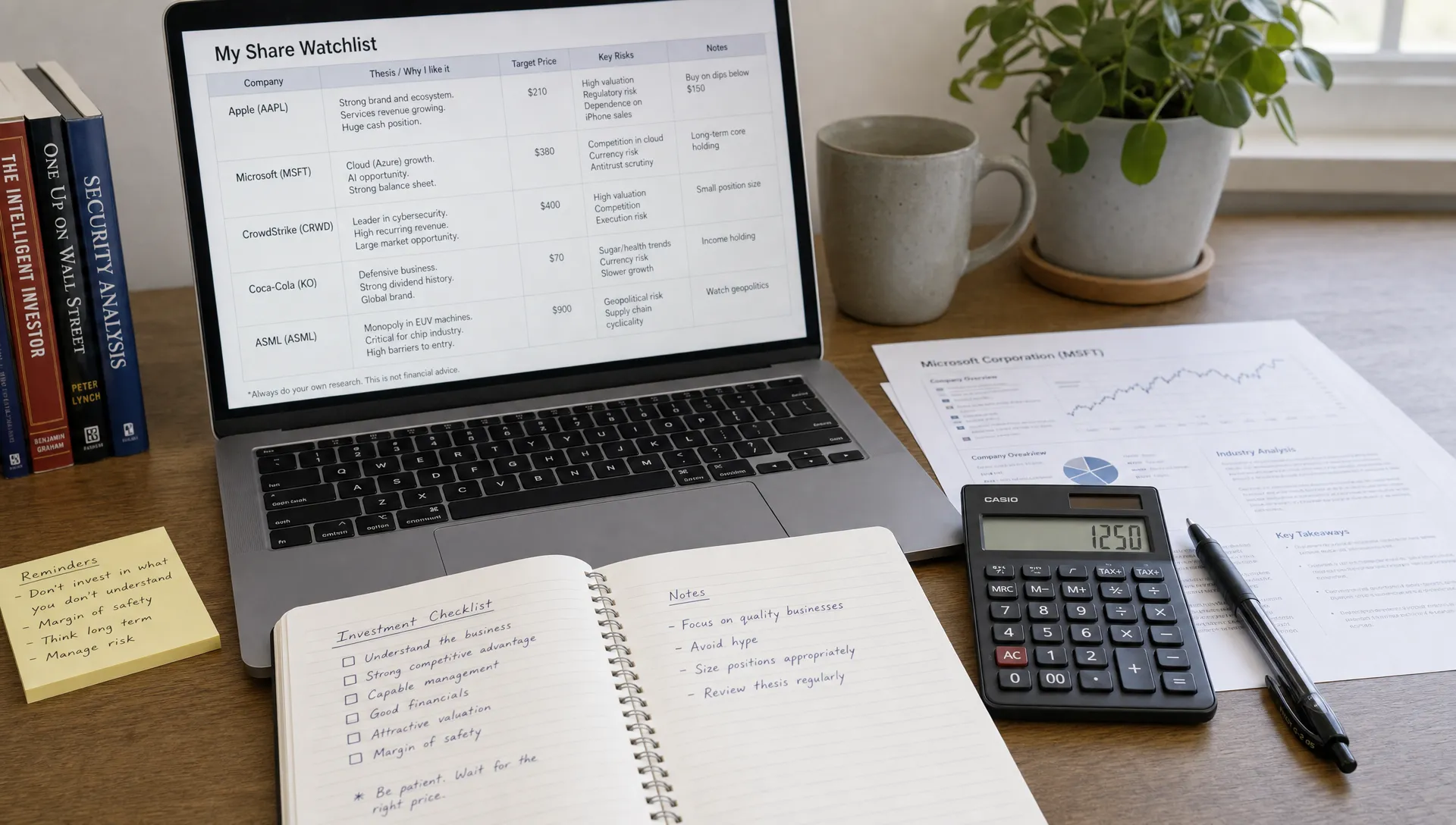
What to research before buying a share
When you are ready to move from general learning to specific shares, research should become more disciplined. A share idea should not come only from a friend, a headline, or a trending post.
Start with the business. Ask what the company sells and whether demand is likely to continue. A business with a clear product, loyal customers, and strong financial discipline is easier to understand than a company whose future depends entirely on promises.
Then look at the numbers. Revenue growth matters, but growth without profit can be risky. Profit matters, but profit supported by too much debt can become fragile. Cash flow matters because companies need cash to fund operations, dividends, investment, and debt repayment.
Next, study valuation. Beginners often think a $5 share is cheaper than a $100 share. That is not necessarily true. A company’s total value depends on how many shares exist, how much profit the company earns, and what investors expect in the future. A $5 share can be expensive, and a $100 share can be reasonable.
Finally, consider the wider environment. Interest rates, inflation, regulation, currencies, consumer spending, and sector trends can all influence share prices. You do not need to predict the economy perfectly. You do need to know which external forces could affect the company.
If you want a structured way to turn research into a practical shortlist, Greek Shares has a guide on how to research main shares to watch that can help you move beyond random stock picking.
Questions to answer before risking real money
Before your first real trade, slow down and answer a few uncomfortable questions. These are not meant to discourage you. They are meant to reveal whether you are investing or improvising.
Can you explain the company in two minutes without using buzzwords? Do you know how it earns revenue and what could reduce its profits? Have you checked whether the share price already reflects very optimistic expectations? Are you comfortable holding through normal market declines? Do you know how much you could lose if the investment performs badly?
You should also understand the mechanics of buying. A brokerage account, bid-ask spread, market order, limit order, settlement, fees, and taxes can all affect your actual result. The trade button may look simple, but the process behind it is worth learning first. For practical buying mechanics, review how to buy in shares without making beginner mistakes before placing an order.
A useful rule is to never buy a share you would be embarrassed to explain. If your reason is “everyone online says it will go up,” you do not have a thesis. If your reason is “the price has fallen a lot,” you still need to know whether the business is genuinely undervalued or simply deteriorating.
Common beginner mistakes to avoid
The first mistake is investing money you cannot afford to leave alone. Shares are better suited to money with a longer time horizon because prices can be unpredictable in the short term. If you may need the cash soon, market volatility can force you to sell at the wrong time.
The second mistake is confusing a familiar company with a good investment. You may love a product, store, app, or brand, but that does not automatically mean the shares are attractively priced. Customers and shareholders can have very different experiences.
The third mistake is concentrating too heavily in one idea. Confidence feels good, but concentration magnifies errors. Diversification cannot eliminate losses, but it can reduce the damage from being wrong about one company.
The fourth mistake is checking prices too often. Constant monitoring encourages emotional decisions. If your time horizon is years, reacting to every daily move can harm your judgment.
The fifth mistake is buying without an exit framework. You do not need to predict every sell date, but you should know what would change your mind. A broken thesis, excessive valuation, worsening debt, or better opportunity elsewhere may all be valid reasons to reassess.
For a deeper look at protecting your portfolio from avoidable damage, study how to invest in shares with better risk control before increasing your position sizes.
A beginner checklist before your first investment
Use this checklist as a final pause before you risk real money. If several answers are weak, continue practicing.
- I understand what a share represents.
- I can explain the business behind the share.
- I have reviewed basic financial information.
- I know why the current valuation might be reasonable.
- I understand the main risks to the company and industry.
- I have decided how much I can afford to invest.
- I am not using money needed for short-term expenses.
- I have written down my reason for buying and what would make me reconsider.
This checklist will not guarantee profits. Nothing can. Its value is that it slows you down and turns investing into a repeatable decision-making process.
Frequently Asked Questions
How long should I learn about shares before investing real money? There is no fixed timeline, but many beginners benefit from at least several weeks of structured learning and paper tracking. You should understand the basics, practice researching companies, and know your risk limits before placing a real trade.
Is paper trading enough preparation? Paper trading is useful, but it does not fully replicate emotions because no real money is at risk. Treat it as a training tool, then start small if you decide to invest.
Should beginners buy individual shares or funds first? It depends on your goals, time, and interest in research. Individual shares require more company-specific analysis. Diversified funds can reduce single-company risk, but they still carry market risk.
Can I lose all my money in shares? With individual companies, severe losses are possible, especially if a business fails or becomes highly distressed. Diversification, position sizing, and avoiding borrowed money can help reduce the chance of catastrophic damage.
What is the most important habit for a new investor? Write down your reasoning before you buy. A clear investment thesis helps you avoid impulse decisions and gives you something to review later.
Keep learning before you commit more capital
Learning about shares is not a one-time step before your first purchase. It is an ongoing process. Markets change, companies change, and your own financial situation changes.
Start small, stay curious, and keep improving your process. The best beginner goal is not to find the next famous winning share immediately. It is to become the kind of investor who understands what they own, why they own it, and how much risk they are taking.
Greek Shares is built to help investors strengthen that foundation through educational articles, guides, glossary resources, and practical investing lessons. Before you risk real money, give yourself the advantage of preparation.