


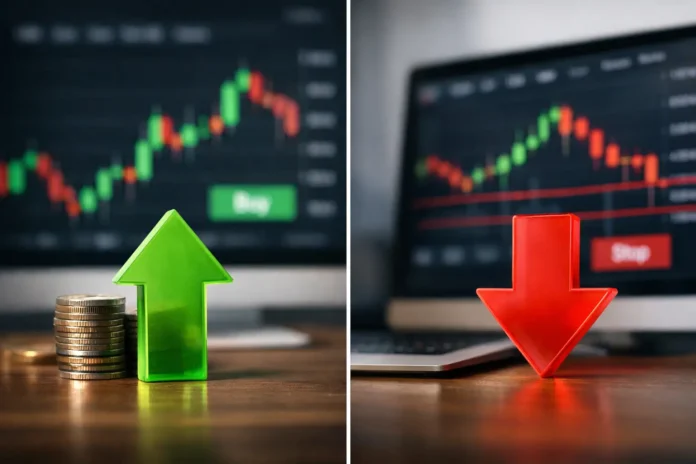
A stock is trading at $52, but you are only comfortable buying it at $48. Or perhaps you own it and want to limit the damage if it falls below $46. Those are two different decisions, and the limit order vs stop order distinction determines how your brokerage handles them.
Order types are not predictions. They are instructions. Used well, they can help you enter or exit positions according to a plan rather than reacting to every price move. Used carelessly, they can leave you unfilled, sell shares at an unexpected price, or create a false sense of protection.
What Is a Limit Order?
A limit order tells your broker to buy or sell a stock only at a specified price or better. You control the price, but you do not control whether the trade happens.
With a buy limit order, the limit price is the highest price you are willing to pay. If a stock trades at $52 and you place a buy limit order at $48, the order can execute only if shares become available at $48 or less.
With a sell limit order, the limit price is the lowest price you will accept. If you own a stock at $52 and submit a sell limit order at $58, it can execute only at $58 or higher.
The main appeal is price discipline. A limit order prevents you from paying more than your chosen entry price or accepting less than your chosen exit price. This can be useful when a stock is volatile, when the market is moving quickly, or when you have already decided what price makes sense for your investment thesis.
The trade-off is simple: your order may never fill. A stock can come close to your limit price, then reverse before enough shares trade at that level. In a thinly traded stock, even reaching the quoted price does not guarantee that your entire order will execute. Other orders may be ahead of yours in line.
What Is a Stop Order?
A stop order, often called a stop-loss order when used to reduce downside risk, becomes active when the stock reaches a specified stop price. Once triggered, a standard stop order usually becomes a market order.
A sell stop order is commonly used by an investor who already owns shares. Suppose you bought a stock at $52 and decide that a decline to $46 would mean your original reason for owning it is no longer valid. A sell stop at $46 instructs the broker to sell once the stock trades at or below that trigger price.
A buy stop order works in the opposite direction. It is placed above the current market price and may be used to buy a stock if it rises through a level that signals momentum or a breakout. Investors who sell stocks short may also use buy stops to limit losses if the share price rises.
The key point is that the stop price is a trigger, not a guaranteed execution price. If a sell stop is triggered at $46 during a fast decline, the resulting market order could execute at $45, $44, or lower. This is especially possible after major news, during low-liquidity periods, or when a stock opens far below the prior day’s closing price.
Limit Order vs Stop Order: The Core Difference
The practical difference comes down to what each order prioritizes. A limit order prioritizes price. A stop order prioritizes action after a price threshold is reached.
A limit order says, “Trade only if I can get this price or better.” A stop order says, “If the market reaches this level, get me in or out.” For investors, that difference matters most during sharp market moves.
Consider a sell limit order at $58 for a stock currently trading at $52. It is designed to capture an upside target. If the stock never reaches $58, no sale occurs.
Now consider a sell stop order at $46 on that same stock. It is designed to respond to a downside move. If the stock falls to $46, the order activates and seeks the best available market price. The sale is likely to occur, but the final price may be below $46.
Neither order type is automatically better. They address different risks. A limit order protects you from an unfavorable price. A stop order can help prevent a small loss from becoming much larger, although it cannot guarantee the exact exit price.
Where Stop-Limit Orders Fit
A stop-limit order combines features of both. It has a stop price that triggers the order and a limit price that controls the minimum or maximum acceptable execution price.
For example, you could place a sell stop-limit order with a stop price of $46 and a limit price of $45.50. If the stock trades at $46, the order activates. It will then sell only at $45.50 or higher.
This gives you more control over the price than a standard stop order, but it introduces a meaningful risk: if the stock falls quickly from $46 to $44, your order may not execute at all. You could still be holding the shares while the price continues to decline.
Stop-limit orders are most useful when price control matters more than certainty of execution. That may fit an investor trading a liquid stock in normal conditions. It may be less suitable as a strict loss-control tool for a position that could gap lower after earnings or unexpected news.
Choosing an Order Type for Common Situations
Your purpose should guide your choice. If you have researched a company and want to buy only below a valuation level, a buy limit order is generally the logical tool. It lets you state the maximum price you will pay without needing to watch the market continuously.
If you own a position and have identified a point where you would reassess the investment, a sell stop order may be appropriate. But choose the stop price based on your risk tolerance and the stock’s normal volatility, not on a random round number. A stock that regularly moves 4% in a week may trigger a very tight stop even when the long-term investment case has not changed.
If you want to sell part of a profitable position at a predetermined target, a sell limit order is usually more suitable. It allows you to take gains at a price you find acceptable, while leaving the order unfilled if the market does not reach it.
Investors should also distinguish between an order placed for convenience and an investment plan. An order type cannot compensate for weak research, an oversized position, or a portfolio that lacks diversification. It is one tool within a broader process of managing risk.
Details That Can Change the Outcome
Before submitting any order, review whether it is set for the day only or marked good till canceled. A day order expires when the trading session ends if it has not filled. A good-till-canceled order may remain active longer, subject to your broker’s policies. An old order can be forgotten and execute months later after a market move, so review open orders regularly.
Also consider liquidity. Large, widely traded stocks generally have narrower gaps between the bid and ask prices than smaller companies. In a thinly traded stock, a stop order may execute well below its trigger price, while a limit order may sit unfilled for a long time.
Extended-hours trading deserves extra caution. Lower trading volume can create wider price swings and unusual executions. Many brokers apply different rules to orders entered before the opening bell or after the market closes, so confirm the settings rather than assuming they work the same way as regular-session orders.
Use Orders to Support a Written Plan
The strongest use of order types starts before you open your brokerage app. Decide why you are buying, what would change your view, how much of your portfolio belongs in the position, and what price movement you can realistically tolerate.
For long-term investors, a temporary price decline is not always a reason to sell. For shorter-term traders, ignoring a predefined exit point can turn a manageable loss into a decision driven by hope. The appropriate response depends on your time horizon, goals, and the evidence behind the original purchase.
Limit and stop orders can bring discipline to those decisions, but they work best when their prices reflect a clear reason. Set the order only after you can explain what that price means for your plan, then review it as the company, market conditions, and your own financial goals change.