



Before you buy your first stock, the most important question is not “Which company will go up next?” It is “Am I ready to own risk?”
Stocks can be one of the most effective long-term wealth-building tools, but they are not magic tickets. A share of stock represents partial ownership in a real business. That ownership can grow in value, pay dividends, lose value, or disappoint for years. The difference between a confident beginner and a stressed beginner often comes down to preparation.
This guide explains what to know about investing in stocks first, before you open a trading app and start placing orders.
Start With the Right Definition of Stock Investing
Investing in stocks means buying ownership in businesses with the expectation that, over time, those businesses may become more valuable or distribute cash to shareholders. That is different from guessing short-term price moves.
A stock price can rise or fall every second, but a business changes more slowly. Revenue, profits, debt, management quality, competition, and the wider economy all influence what investors are willing to pay for a company. If you are new, it helps to separate two ideas:
- The business is what the company actually does, such as selling products, providing services, or developing technology.
- The stock is the market price investors are willing to pay for a small piece of that business.
- Your return depends on the price you pay, the company’s future results, dividends if any, and how long you hold.
If you want a simpler foundation before risking real money, Greek Shares has a helpful primer on how to learn about stocks before you risk your money.
Know Why You Are Investing Before You Choose What to Buy
Many beginners start with a stock tip, a trending company, or a headline. A better starting point is your goal.
Are you investing for retirement, a home deposit, future education costs, financial independence, or general wealth building? The answer matters because each goal has a different time horizon and risk tolerance.
Money you may need within the next year or two usually does not belong in individual stocks. Even strong companies can fall sharply in a bad market. Long-term goals, especially those five years or more away, give you more time to ride out volatility, although losses are still possible.
A simple way to think about it:
| Question to ask first | Why it matters |
|---|---|
| When will I need this money? | Short timelines leave less room for market downturns. |
| Can I handle a temporary 20% to 30% drop? | Stocks can be volatile even when the long-term case is sound. |
| Am I investing a lump sum or monthly amount? | Regular contributions can reduce the pressure of timing the market. |
| Do I want simplicity or active research? | This affects whether funds or individual stocks are a better starting point. |
If your goal is vague, your decisions will feel random. If your goal is clear, it becomes easier to decide how much to invest, what to buy, and when to leave your plan alone.
Build Your Financial Base First
Investing should not be your first financial move. Before buying stocks, make sure your basic financial foundation is stable.
That usually means having a budget, paying high-interest debt down, keeping an emergency fund, and understanding your monthly cash flow. If one unexpected bill would force you to sell investments, you may be taking stock market risk too early.
The stock market rewards patience, but patience is easier when your daily finances are not under pressure. An emergency fund gives your investments breathing room. It also protects you from selling during a downturn simply because you need cash.
For many beginners, a strong starting order looks like this:
- Track income and expenses: Know how much money is available after essentials.
- Reduce high-interest debt: Credit card interest can easily exceed realistic stock market returns.
- Create an emergency fund: Keep cash available for unexpected expenses.
- Set an investing amount: Choose an amount you can contribute consistently without stress.
- Start simple: Begin with a plan you understand, not one that looks impressive.
This is not exciting advice, but it is often what prevents beginners from making expensive mistakes.
Understand Risk, Not Just Return
New investors often ask, “How much can I make?” Experienced investors also ask, “How much can I lose, and can I stay invested if that happens?”
Risk is not only the chance that a stock price falls. It can also mean buying an overvalued company, concentrating too much money in one idea, reacting emotionally to news, or misunderstanding what you own.
The U.S. Securities and Exchange Commission explains that all investments involve some degree of risk, and that risk and expected return are usually connected. Higher potential return generally comes with higher uncertainty. The SEC’s Investor.gov guide to risk and return is a useful reference for beginners who want a plain-language overview.
Common stock investing risks include:
- Market risk: The whole market declines because of economic, political, or interest rate concerns.
- Business risk: A company loses customers, faces stronger competition, or makes poor decisions.
- Valuation risk: You buy a good company at a price that already assumes too much future growth.
- Liquidity risk: A stock is difficult to buy or sell at a fair price, often more relevant with smaller companies.
- Behavior risk: You panic sell, chase hype, or change strategies too often.
The last one matters more than beginners expect. You can own a reasonable investment and still get poor results if you cannot stick with the plan.
Diversification Is Your First Defense
Putting all your money into one stock can feel exciting, but it also creates unnecessary risk. Diversification means spreading your money across multiple companies, sectors, and sometimes countries, so one mistake does not ruin the whole plan.
This is why many beginners start with broad market index funds or exchange-traded funds, known as ETFs, before choosing individual stocks. A single fund can provide exposure to hundreds or thousands of companies. That does not remove risk, but it reduces dependence on one business.
Individual stocks can still have a place in a portfolio, especially if you enjoy research and understand the business. But beginners often do better when they treat individual stock picking as a smaller part of a broader plan.
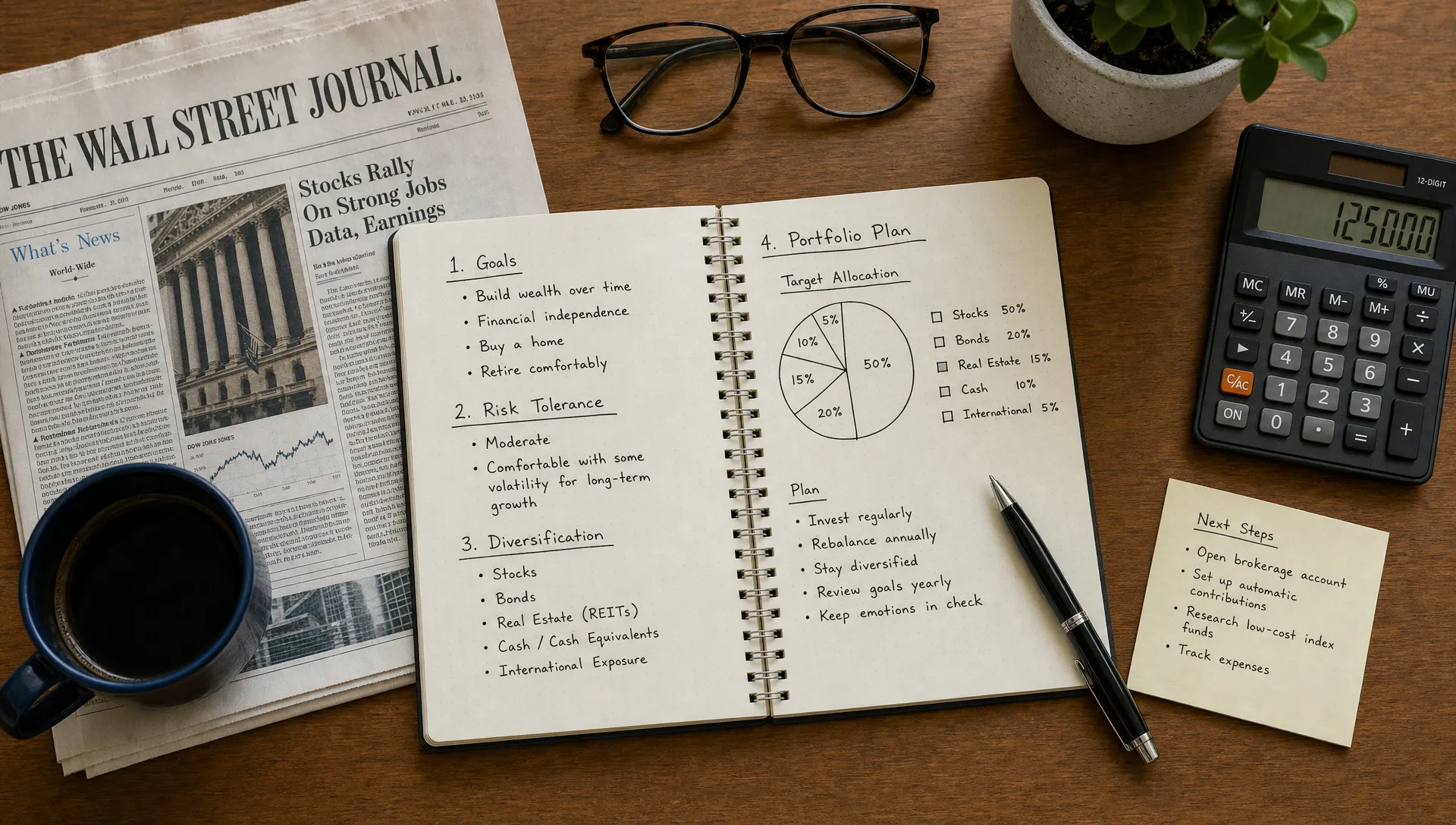
A practical beginner approach could be to build a diversified core first, then add selected individual stocks later. If you want a step-by-step plan for that style, you can review this guide on how to invest in stocks the smart way as a beginner.
Learn the Basic Numbers Before You Buy Individual Stocks
You do not need to become a professional analyst before buying stocks, but you should understand a few basic terms. Without them, it is hard to know whether you are investing or simply reacting to a story.
Here are some useful starting metrics:
| Term | What it means | Why beginners should care |
|---|---|---|
| Revenue | Money a company earns from sales | Shows whether the business is growing or shrinking. |
| Net income | Profit after expenses and taxes | Helps indicate whether growth is actually profitable. |
| Earnings per share (EPS) | Profit divided by shares outstanding | Used in many valuation comparisons. |
| Price-to-earnings ratio (P/E) | Stock price compared with earnings | Helps you see how much investors pay for current profits. |
| Dividend yield | Annual dividend compared with stock price | Useful for income investors, but high yields can signal risk. |
| Debt-to-equity | Debt compared with shareholder equity | Shows how much leverage the company uses. |
No single number tells the whole story. A low P/E ratio does not automatically mean a stock is cheap, and a high P/E ratio does not automatically mean it is bad. Numbers need context, including growth prospects, industry conditions, and business quality.
Beginners should also learn to read company reports, investor presentations, and earnings releases with a skeptical mindset. Marketing language can be optimistic. Financial statements are where the reality becomes clearer.
Choose the Right Account and Broker Carefully
Before buying your first stock, you need a brokerage account. The right broker depends on your location, available markets, fees, account protections, platform usability, tax reporting tools, and the types of investments offered.
Do not choose a broker only because the app looks simple. Simplicity is useful, but you also need reliability, transparent costs, and access to the investments that fit your plan.
Check the following before opening an account:
- Fees and commissions: Look at trading costs, currency conversion costs, inactivity fees, and fund fees.
- Available investments: Confirm whether you can buy the stocks, ETFs, or funds you actually want.
- Regulation and protection: Understand who regulates the broker and what investor protections apply.
- Order types: Learn the difference between market orders and limit orders before trading.
- Tax documents: Make sure you can access the reports needed for your local tax obligations.
If you are ready for the practical next step, Greek Shares explains the process in more detail in how to buy your first stock the right way.
Avoid Confusing Investing With Entertainment
Modern investing platforms can make buying and selling feel like a game. Price alerts, trending lists, social media posts, and constant market commentary can push you toward action even when doing nothing is the better choice.
A useful rule is to create a calm research process. Set aside time, read slowly, take notes, and compare investments against your goals. Some investors even create a quiet home office or study area to reduce distractions. If noise is a real issue where you live or work, professional soundproofing and acoustic solutions can be a practical way to create a better environment for focused financial learning.
The point is simple: your investing environment affects your decisions. If you make choices while stressed, distracted, or influenced by hype, your portfolio may reflect that.
Think in Years, Not Days
Stock prices move daily, but wealth building usually happens over long periods. The challenge is that long-term thinking feels easy when markets rise and difficult when they fall.
Before investing, decide how often you will review your portfolio. Checking every hour can increase anxiety and tempt you to trade too often. For many beginners, a monthly or quarterly review is enough, unless something significant changes about a company you own or your personal finances.
Long-term investing does not mean ignoring your portfolio. It means giving your investments enough time to play out while reviewing them with discipline. If your original reason for buying is still valid and your allocation still matches your plan, a falling market price alone may not be a reason to sell.
Know the Difference Between Price and Value
A stock with a low dollar price is not automatically cheap. A stock with a high dollar price is not automatically expensive. What matters is the relationship between the company’s value and the price investors are paying.
For example, a $10 stock can be expensive if the company has weak profits, heavy debt, and poor prospects. A $500 stock can be reasonable if the company has strong earnings, durable advantages, and long-term growth potential.
This is why beginners should avoid judging stocks by price alone. Instead, ask:
- What does this company do?
- How does it make money?
- Is it profitable or moving toward profitability?
- What could go wrong?
- What price am I paying compared with earnings, assets, growth, and competitors?
- Would I still want to own this if the market closed for a year?
That final question encourages ownership thinking. If you would only buy because you hope to sell to someone else next week, you may be trading rather than investing.
Accept That You Will Not Know Everything
One of the healthiest beginner mindsets is humility. No investor knows the future with certainty. Professionals with large research teams still make mistakes. The goal is not to be right every time. The goal is to build a process that keeps mistakes manageable.
This means position sizing matters. If you are researching individual stocks, avoid putting too much money into one company too soon. Give yourself room to learn. A small mistake can be educational. A large mistake can be financially and emotionally damaging.
It also means you should be careful with predictions. Headlines about recessions, interest rates, inflation, elections, and technology trends can all sound urgent. Some will matter. Many will not matter as much as they seem in the moment.
Focus on what you can control: savings rate, diversification, costs, taxes, research quality, and behavior.
Watch Costs and Taxes Early
Investment costs reduce returns. Even small fees can add up over time, especially for long-term investors. Trading too frequently can also create costs through spreads, commissions, currency conversion, and potential tax consequences.
Taxes depend on your country, account type, holding period, dividends, and realized gains. Because rules vary, it is wise to learn the basics in your jurisdiction or speak with a qualified tax professional. Do this before you create a messy history of trades that becomes hard to report later.
Beginners should keep records of:
- Purchase dates and prices
- Sale dates and prices
- Dividends received
- Currency conversions if applicable
- Broker statements and tax forms
- Fees connected to transactions
Good recordkeeping is boring until you need it. Then it becomes very valuable.
Create a Simple First Stock Investing Plan
You do not need a complicated strategy to begin. In fact, complexity often creates confusion. A simple written plan can protect you from emotional decisions.
Your first investing plan can include:
- Goal: What the money is for and when you may need it.
- Monthly contribution: How much you plan to invest regularly.
- Asset mix: How much goes to diversified funds, individual stocks, bonds, or cash.
- Buying rules: What must be true before you buy an investment.
- Selling rules: What would make you sell, rebalance, or stop adding.
- Review schedule: How often you will evaluate your portfolio.
The plan does not need to be perfect. It needs to be clear enough that you can follow it when markets become emotional.
The Most Important Thing to Know First
The biggest beginner mistake is believing you must act quickly. You do not. There will always be another company, another market decline, another opportunity, and another headline.
Before investing in stocks, learn the basics, stabilize your finances, define your goals, understand risk, and start with diversification. If you choose individual stocks, research the business before you focus on the price chart.
Good investing is not about finding excitement. It is about making informed decisions repeatedly over time.
Frequently Asked Questions
How much money do I need to start investing in stocks? You can often start with a small amount, depending on your broker and whether fractional shares or low-cost funds are available. The more important question is whether your emergency fund, debt situation, and cash flow are stable enough to invest.
Should beginners buy individual stocks or ETFs first? Many beginners start with diversified ETFs or index funds because they spread risk across many companies. Individual stocks require more research and can be more volatile, so they are often better as a smaller part of a beginner portfolio.
Can I lose all my money in stocks? With an individual stock, it is possible to lose most or all of your investment if the company fails. A diversified fund reduces company-specific risk, but it can still decline in value during market downturns.
How often should I check my portfolio? Checking too often can lead to emotional decisions. Many long-term investors review monthly or quarterly, while also staying aware of major changes that affect their holdings or financial goals.
What is the first thing to learn about investing in stocks? Start by learning what a stock actually represents: ownership in a business. Then learn risk, diversification, valuation basics, and how your personal goals shape the right strategy.
Keep Learning Before You Risk More
The best first investment is often education. Greek Shares is built to help beginners and developing investors understand the stock market with clear guides, practical tutorials, and risk-aware investing principles.
Explore more stock market education on Greek Shares and build your knowledge before you put more money at risk.