


Buying shares is deceptively easy. Open an app, search a ticker, tap buy, and you own a piece of a company. The hard part is not the transaction. The hard part is avoiding the beginner mistakes that turn a sensible investment plan into an emotional guessing game.
If you arrived here wondering how to buy in shares, the safest answer is not simply pick a broker and place an order. A better answer is: prepare your finances, understand what you are buying, research with a checklist, use the right order type, and decide in advance how you will manage the investment after purchase.
This guide focuses on the mistakes beginners make before, during, and after buying shares, so you can build a calmer process from your first investment onward.
First, understand what buying a share actually means
A share is a small ownership stake in a company. When you buy shares of a public company, you are not just buying a price on a screen. You are becoming a partial owner of a real business with revenue, costs, assets, debt, management decisions, competitors, and risks.
That distinction matters because many beginners think only in terms of price movement. They ask whether the stock will go up next week instead of asking whether the business is healthy, whether the price is reasonable, and whether the investment fits their goals.
Before buying, make sure you understand the difference between a stock, a share, market capitalization, dividends, earnings, and valuation. If those terms still feel unclear, Greek Shares has a beginner-friendly explanation of stock shares for first-time investors that can help you build the foundation first.
The key mindset shift is simple: do not buy a ticker. Buy an ownership claim in a business or a diversified fund. That one change can prevent many impulsive decisions.
Mistake 1: Buying before your personal finances are ready
The stock market is not the place for money you may need soon. Share prices can fall sharply, even for strong companies, and they can stay down longer than beginners expect. If you are forced to sell during a downturn because you need cash for rent, tuition, a car repair, or medical expenses, your investment plan has already failed.
Before buying shares, check your financial base:
- You have an emergency fund or a realistic cash buffer.
- You are not relying on invested money for short-term expenses.
- High-interest debt is under control.
- You know your time horizon, ideally several years or longer.
- You can invest an amount that will not make you panic if the market drops.
This does not mean you need to be wealthy before you start. It means your first investment should be sized so that you can learn without putting your financial stability at risk.
A common beginner mistake is investing a large lump sum immediately because of excitement. A more patient approach is to start small, learn the mechanics, and build consistency over time. Your first goal is not to make a dramatic profit. Your first goal is to become the kind of investor who can follow a plan.
Mistake 2: Choosing a broker only because it looks easy
A brokerage account is the gateway between you and the stock market. A clean app interface is helpful, but it should not be your only selection criterion. Beginners should pay attention to regulation, account fees, trading costs, available markets, customer support, security features, tax documents, and whether the platform makes risky products too easy to access.
In the United States, investors can use FINRA BrokerCheck to research brokers and financial professionals. Outside the United States, look for the relevant financial regulator in your jurisdiction and confirm that the broker is properly authorized.
Also decide whether you need a cash account, retirement account, taxable brokerage account, or another account type available in your country. Each account can have different tax rules, withdrawal rules, and risk considerations. If you need a practical walk-through of the account setup process, Greek Shares explains how to open an account for shares investing in more detail.
One beginner warning is worth repeating: be careful with margin. Borrowing money to buy shares can magnify gains, but it can also magnify losses and force you to sell at the worst possible time. Most beginners are better served by learning with cash before considering leverage.
Mistake 3: Buying based on a tip instead of a thesis
A stock tip is not an investment plan. It is usually a shortcut around research, and shortcuts are dangerous when real money is involved.
Before buying any individual share, write down your investment thesis in plain English. You should be able to answer why the company might grow, what could go wrong, how expensive the stock appears relative to its earnings or future prospects, and what would make you change your mind.
Good research does not need to be complicated at the beginning. Start with the company website, annual reports, earnings releases, investor presentations, and reputable financial data sources. Compare revenue growth, profit margins, debt levels, cash flow, competitive position, and management commentary. For funds, read the fund objective, holdings, expense ratio, and index methodology.
The same principle used in serious data programs applies here. Teams that work on governance, analytics, and digital independence, such as Anwit SAS, start by questioning data sources and systems. Investors should do the same before trusting a chart, headline, or influencer thread.
A beginner does not need to become a professional analyst overnight. But you should know enough to explain why you bought and what risks you accepted.
Mistake 4: Confusing a low share price with a cheap investment
A 5 dollar stock is not automatically cheaper than a 200 dollar stock. Share price alone tells you very little. What matters is the value of the whole company compared with its earnings, assets, growth prospects, debt, and risks.
For example, a company with many shares outstanding can have a low price per share but still be expensive relative to its business performance. Another company can have a high price per share but trade at a reasonable valuation because it earns strong profits and has a durable competitive position.
Beginners often chase low-priced shares because they seem easier to multiply. This can lead them into highly speculative companies with weak finances, limited disclosure, or extreme volatility. Instead of asking whether a stock looks cheap per share, ask whether the business or fund is worth owning at today’s price.
Mistake 5: Buying individual shares when diversification would fit better
Individual stocks can be rewarding, but they require research, patience, and emotional discipline. A single company can disappoint investors because of bad management, regulation, competition, debt, product failure, accounting issues, or a broader industry decline.
Diversification spreads risk across multiple companies, sectors, and sometimes countries. Many beginners use broad funds as the core of a portfolio and individual shares as a smaller learning or conviction area. That structure can reduce the chance that one bad decision damages the entire plan.
Here is a simple comparison:
| Choice | Best suited for | Main risk | Beginner-friendly habit |
|---|---|---|---|
| Individual shares | Investors willing to research companies | Company-specific losses | Limit position size and write a thesis |
| Broad index funds or ETFs | Investors seeking diversified exposure | Market-wide declines | Use as a long-term core if appropriate |
| Sector funds | Investors with a focused view on an industry | Concentrated industry risk | Keep allocation modest |
| Dividend shares | Investors interested in income and stability | Dividend cuts and slow growth | Check cash flow, debt, and payout sustainability |
There is no single correct choice for everyone. The right choice depends on your goals, risk tolerance, time horizon, knowledge, and willingness to monitor your investments.
Beginner mistake filter before you press buy
Use this table as a final check before placing an order. If you recognize one of these behaviors, pause and fix the process first.
| Beginner mistake | Why it hurts | Better habit |
|---|---|---|
| Buying because a stock is trending | Hype can disappear faster than your capital recovers | Research the business and valuation first |
| Investing money needed soon | You may be forced to sell during a decline | Keep short-term money in safer, liquid places |
| Putting too much into one stock | One bad outcome can dominate your portfolio | Set position limits before buying |
| Ignoring fees and taxes | Small costs can reduce long-term returns | Understand trading costs and local tax rules |
| Checking prices constantly | Daily noise encourages emotional decisions | Review on a planned schedule |
| Averaging down automatically | You may add to a weakening investment | Recheck the thesis before adding money |

Mistake 6: Using the wrong order type
When you buy shares, you usually choose an order type. The two most common are market orders and limit orders.
A market order tells your broker to buy as soon as possible at the best available price. This can be fine for highly liquid investments, but it can surprise beginners during volatile periods or with thinly traded shares. The price you see before clicking may not be the exact price you receive.
A limit order lets you set the maximum price you are willing to pay. If the market reaches that price, the order may execute. If it does not, the order may remain unfilled or expire, depending on your settings. Limit orders can help beginners avoid overpaying in fast-moving markets.
Do not place trades when you are rushed, angry, excited, or distracted. Review the ticker, number of shares, order type, estimated cost, and account before submitting. Many beginner mistakes are not analytical mistakes. They are simple execution errors made too quickly.
Mistake 7: Having no plan after you buy
Buying is only the beginning. After you own shares, you need a plan for monitoring, adding, holding, or selling.
A good post-purchase plan includes a review schedule. For example, you might review individual stocks after quarterly earnings or when major company news appears. You might review a diversified long-term portfolio less often, focusing on contributions, rebalancing, and whether your goals have changed.
Keep an investment journal. Write down the date, price, reason for buying, key risks, expected holding period, and what would make you sell. This simple habit can protect you from rewriting history after the price moves.
Selling rules matter too. Beginners often sell winners too early because they fear losing gains, then hold losers too long because they do not want to admit a mistake. A written thesis helps separate normal volatility from a real reason to exit.
For a broader list of traps to watch for, Greek Shares also covers common stock market investing mistakes to avoid early on. Use that kind of checklist regularly, not only before your first purchase.
A simple first-purchase workflow
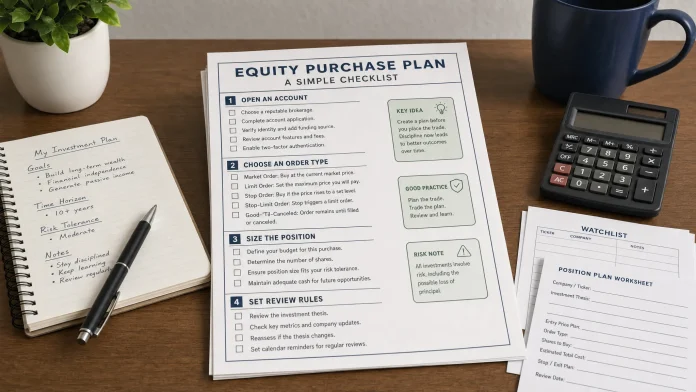
If you want a practical sequence, use this as a calm beginner process:
- Decide your goal and time horizon before choosing any investment.
- Confirm that the money is not needed for near-term expenses.
- Choose a regulated broker and the right account type for your situation.
- Decide whether a diversified fund, individual share, or combination fits your knowledge and risk tolerance.
- Research the investment and write a short thesis.
- Choose an order type, review every detail, and start with a sensible position size.
- Record the purchase in an investment journal and set a review date.
This workflow is not exciting, and that is the point. Good investing often feels boring because it is based on preparation, risk control, and patience. Beginners get into trouble when they try to make investing feel like entertainment.
Frequently Asked Questions
How much money do I need to buy shares? The required amount depends on your broker, the share price, and whether fractional shares are available. More important than the starting amount is whether the money is truly available for investing and not needed for short-term expenses.
Should beginners buy individual shares or funds first? Many beginners prefer diversified funds because they spread risk across many companies. Individual shares can make sense if you are willing to research businesses and keep position sizes reasonable.
Is it risky to buy shares? Yes. Share prices can fall, and individual companies can perform poorly. Risk can be managed through diversification, position sizing, a long-term mindset, and avoiding money you may need soon.
What is the biggest mistake beginners make when buying shares? The biggest mistake is buying without a plan. That includes unclear goals, poor research, emotional timing, excessive concentration, and no rule for what to do after the purchase.
How often should I check my shares after buying? Checking prices every day can encourage emotional decisions. A planned review schedule is usually healthier, especially if your goal is long-term investing rather than short-term trading.
Keep learning before you invest more
Learning how to buy shares without beginner mistakes is less about finding the perfect stock and more about building the right habits. Start small, protect your finances, research carefully, diversify where appropriate, and write down your decisions.
Greek Shares is designed to help beginners and developing investors improve their financial literacy step by step. Use each investment as a learning opportunity, but make sure the lessons are affordable, intentional, and guided by a process you can repeat.