



If you are looking for stock help for beginners, the biggest favor you can do yourself is to learn in the right order. Most new investors jump from ticker symbols to opinions before they understand goals, risk, valuation, or how a brokerage order works. That makes the stock market feel confusing, emotional, and sometimes more like guessing than investing.
A better starting point is to build a simple foundation. You do not need a finance degree. You need enough knowledge to understand what you are buying, why you are buying it, how it can go wrong, and how it fits your life. This guide is educational, not personalized financial advice, but it will give you a practical sequence for what to learn first.
Start with the purpose: why are you investing?
Before learning which stock to buy, learn what problem investing is supposed to solve for you. A stock portfolio built for retirement should look different from money you may need next year. A beginner who skips this step often ends up making random decisions, buying one stock for excitement, another because of social media, and another because the price recently fell.
Your first lesson is goal setting. Ask what the money is for, when you might need it, and how much uncertainty you can realistically tolerate. Stocks can be powerful long-term assets, but they can also fall sharply over short periods. Money needed soon usually does not belong entirely in volatile assets.
| Goal type | Typical priority | What to learn first |
|---|---|---|
| Emergency savings | Stability and access | Cash reserves before market risk |
| Short-term purchase | Capital preservation | Time horizon and volatility |
| Retirement | Long-term growth | Compounding, diversification, and fees |
| Wealth building | Balanced growth | Asset allocation and risk control |
This is also where personal finance matters. If you have no emergency fund, high-interest debt, or unclear monthly cash flow, stock research may not be your first financial task. Investing works best when it is built on a stable base.
Learn the basic language before studying ticker symbols
The stock market has its own vocabulary. Beginners do not need to memorize every financial term at once, but they do need to understand the words that appear repeatedly in brokerage apps, financial news, and company reports.
If you are still learning the mechanics, Greek Shares has a deeper guide to stock market basics for complete beginners that explains core ideas like stocks, prices, and order types in more detail.
Here are the first terms to understand:
| Term | Simple meaning | Why it matters |
|---|---|---|
| Stock | Ownership in a public company | You are buying a piece of a business, not just a moving price |
| Share | One unit of stock ownership | It tells you how much of the company you own |
| Index | A basket that tracks part of the market | It helps you compare performance and understand broad trends |
| ETF | A fund that trades like a stock | It can offer diversification in one purchase |
| Dividend | Cash paid by some companies to shareholders | It is one way investors may receive returns |
| Market cap | Company value based on share price and shares outstanding | It helps compare company size |
| Volatility | How much a price moves up and down | It affects your emotional and financial comfort |
| Brokerage account | Account used to buy and sell investments | It is the tool that connects you to the market |
Knowing the language reduces anxiety. It also helps you spot when someone is using complicated words to make a weak idea sound sophisticated.
Understand the difference between investing and trading
One of the most important pieces of stock help for beginners is this distinction: investing and trading are not the same activity.
Investing usually means buying assets because you believe they can create value over time. The focus is on business quality, valuation, diversification, and patience. Trading usually means trying to profit from short-term price movements. The focus is often on charts, momentum, news, or market psychology.
Neither word is automatically good or bad, but beginners should learn investing first. Trading introduces extra challenges, such as faster decisions, more frequent losses, higher emotional pressure, and the temptation to overreact to every price move. If you do not yet understand what a business earns, how risk works, or what a limit order is, short-term trading is usually too advanced.
A helpful beginner mindset is simple: a stock is not a lottery ticket. It is a claim on a company whose value depends on profits, growth, competition, interest rates, investor expectations, and market sentiment.
Learn risk before chasing returns
Beginners often ask how much they can make. Experienced investors first ask what can go wrong. That does not mean being afraid of the market. It means respecting risk before money is on the line.
Risk includes more than the chance that a stock goes to zero. A good company can still be a poor investment if bought at an inflated price. A diversified fund can still fall during a market downturn. A beginner can also create risk through behavior, such as panic selling, buying from fear of missing out, or putting too much money into one idea.
The Greek Shares article on how to learn about stocks before you risk your money is a useful next step if you want to build this foundation carefully.
Focus first on these beginner risk concepts:
- Volatility: Prices can move sharply even when the long-term story has not changed.
- Concentration: Owning only one or two stocks can make your results depend on very few outcomes.
- Liquidity: Some investments are easier to buy and sell than others.
- Valuation risk: A popular company can become expensive relative to its fundamentals.
- Behavior risk: Your own decisions during fear or excitement can hurt results.
A simple rule for beginners is to decide risk limits before you buy. If you wait until a stock is falling, your emotions will make the decision for you.
Learn diversification and asset allocation
Many beginners search for the best stock. A more useful first question is: how should my money be spread across different investments?
Diversification means not relying on a single company, sector, country, or trend. Asset allocation means deciding how much of your overall portfolio belongs in stocks, bonds, cash, or other assets. These concepts matter because even strong companies can have bad years, and even broad markets can decline.
For many beginners, broad funds such as index funds or ETFs are easier to understand than building a portfolio of individual stocks immediately. They do not remove risk, but they can reduce the risk that one company-specific problem damages your whole portfolio.
If you want to move from learning to a basic action plan, Greek Shares also explains how to invest with a simple starter plan for stocks.
Learn to read a business at a beginner level
Once you understand goals, vocabulary, risk, and diversification, you can begin learning how to evaluate an individual company. This does not mean predicting the future perfectly. It means asking better questions.
Start with the business model. What does the company sell? Who are its customers? Why do they choose this company instead of a competitor? Is the company growing because it is genuinely improving, or because the industry is temporarily popular?
That same habit applies outside the stock market: if you were assessing a creative services business, you would review its portfolio, client fit, and service mix, such as the work showcased by Vancouver Island filmmaker Ami Bornstein, instead of relying only on a catchy brand name. Public companies are larger and more complex, but the principle is similar. Look at what the business actually does.
Then move to basic financials. You do not need complex spreadsheets at first, but you should learn to find revenue, profit, debt, cash flow, and margins. A company with rising sales but no path to profit may be very different from a mature company with steady earnings and dividends.
Learn valuation without pretending to predict perfectly
A great company is not always a great stock to buy at any price. Valuation is the discipline of asking whether the current price makes sense compared with the company’s earnings, assets, growth, and risks.
Beginners do not need to master every valuation model. Start with a few common ratios and learn their limits. Ratios are not magic answers. They are tools for asking better questions.
| Valuation measure | What it compares | Beginner caution |
|---|---|---|
| P/E ratio | Price to earnings | Less useful for companies with low or negative earnings |
| P/S ratio | Price to sales | Does not show whether sales are profitable |
| Dividend yield | Annual dividend to price | A high yield can signal risk if the dividend is unsustainable |
| Free cash flow | Cash left after key business spending | Can vary by industry and business cycle |
| Debt to equity | Debt compared with shareholder equity | High debt may be normal in some sectors but dangerous in others |
The goal is not to find one perfect number. The goal is to understand whether expectations are realistic. If a stock price assumes years of fast growth, ask what could interrupt that growth. If a stock looks cheap, ask whether the market is seeing a real problem.
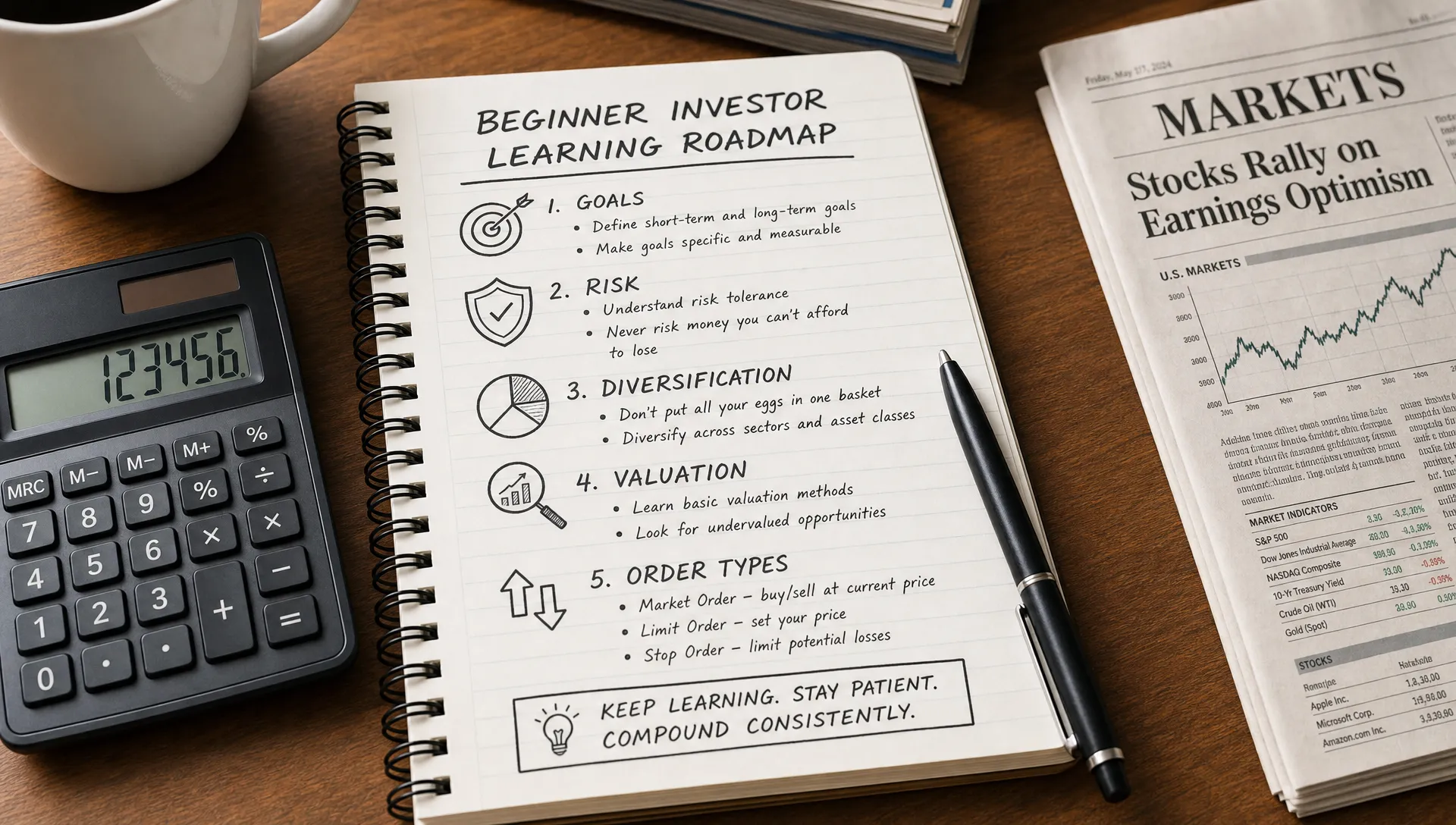
Learn how brokerage orders work
Before buying anything, learn the mechanics of placing an order. Many beginners focus on which stock to buy but ignore how the purchase actually happens. That can lead to mistakes, especially in fast-moving markets.
A brokerage account lets you submit orders to buy and sell investments. The most common beginner order types are market orders and limit orders. A market order prioritizes getting the trade done, while a limit order sets the maximum price you are willing to pay or the minimum price you are willing to accept when selling.
| Order type | What it does | Beginner consideration |
|---|---|---|
| Market order | Buys or sells at the best available current price | Execution is likely, but final price can vary |
| Limit order | Sets a specific price limit | Gives price control, but the order may not fill |
| Stop order | Triggers an order after a set price is reached | Can help manage risk, but execution price is not guaranteed |
| Stop-limit order | Combines a trigger price and a limit price | Offers more control, but may not execute |
Also learn about fees, account minimums, tax treatment, settlement periods, and whether your broker offers educational tools. These details may seem boring, but they affect real outcomes.
Follow a 30-day learning plan
If the stock market feels overwhelming, give yourself a structured month. The goal is not to become an expert in 30 days. The goal is to stop being a random buyer and become a prepared beginner.
| Time period | What to learn | Practice task | Outcome |
|---|---|---|---|
| Days 1 to 7 | Goals, budgeting, emergency savings, time horizon | Write your investing purpose in one paragraph | You know why you are investing |
| Days 8 to 14 | Stocks, funds, indexes, dividends, market cap | Create a glossary of 15 key terms | You understand basic market language |
| Days 15 to 21 | Risk, diversification, asset allocation | Sketch a sample portfolio on paper | You see how investments can fit together |
| Days 22 to 30 | Business analysis, valuation, order types | Research one company without buying it | You can explain a stock before risking money |
This simple structure helps you avoid the most common beginner problem: consuming endless market opinions without building a decision process.
Know what not to learn first
Some topics are interesting, but they are not the best starting point. Beginners can waste months studying advanced tactics while missing the basics that matter most.
Avoid making these your first lessons:
- Options strategies before understanding ordinary shares.
- Margin borrowing before understanding downside risk.
- Penny stocks promoted through hype or social media.
- Day trading indicators without a risk management plan.
- One-stock all-in bets based on excitement.
- Predictions about next week’s market direction.
Advanced tools can wait. Your first job is not to sound sophisticated. It is to make decisions you can understand and explain.
How to know you are ready to buy your first stock
You do not need perfect knowledge before making your first investment, but you should meet a basic readiness standard. A beginner is more prepared when they can explain the purpose, risk, and process in plain language.
Before buying, you should be able to answer these questions:
- What goal does this investment serve?
- How long can I leave this money invested?
- What does the company or fund actually own?
- Why might this investment go down?
- How much of my portfolio will this represent?
- What order type will I use?
- What would make me sell, hold, or buy more?
If you cannot answer these yet, that is not failure. It simply means the next best step is learning, not rushing.
Frequently Asked Questions
How much money do I need to start learning about stocks? You do not need any money to start learning. You can study market basics, read company reports, follow prices, and build a sample portfolio on paper before opening or funding a brokerage account.
Should beginners buy individual stocks or index funds first? Many beginners find broad index funds or ETFs easier because they provide diversification in one investment. Individual stocks require more research, more monitoring, and more tolerance for company-specific risk.
What is the first stock market term I should learn? Start with stock. A stock represents ownership in a company. Once that idea is clear, terms like share, dividend, market cap, index, and valuation become easier to understand.
How long should I study before buying my first stock? There is no universal timeline. A better standard is readiness. If you can explain your goal, the investment, the main risks, and the order process, you are much closer to being prepared.
Is stock help for beginners the same as stock picks? No. Real stock help teaches you how to think, evaluate risk, and make informed decisions. Stock picks may give you a ticker, but they do not replace understanding.
Keep your next step simple
The best stock help for beginners is not a secret list of companies. It is a learning path. Start with your goals, learn the language, understand risk, study diversification, and only then move into business analysis and valuation.
Greek Shares is built to help new and developing investors improve financial literacy step by step. Use the guides, glossary-style explanations, and beginner tutorials to build confidence before you risk real money. The market will always offer another opportunity, but preparation is what helps you recognize one responsibly.