


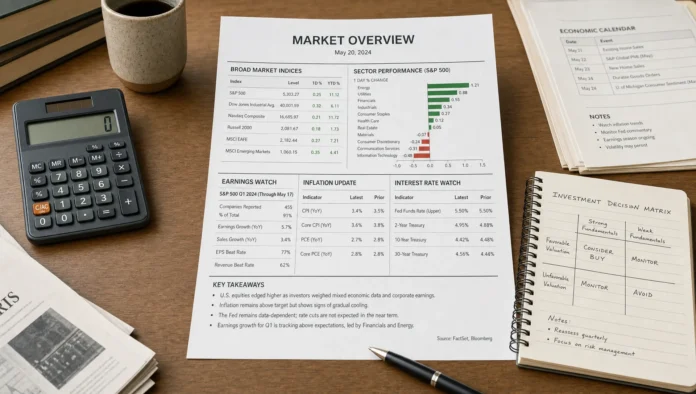
The current stock market can feel like a live scoreboard for fear, greed, inflation, interest rates, earnings, geopolitics, and investor psychology all at once. One strong day can make risk look easy. One sharp selloff can make a long-term plan feel suddenly fragile.
But reading the market well is not the same as reacting to every move. Good investors learn to ask better questions before they act. They look for context, compare signals, and separate information that affects their plan from noise that only affects their mood.
This guide gives you a practical framework for reading the current stock market without overreacting, whether you are checking broad indices, individual stocks, or daily financial headlines.
Start by defining your time frame
Before asking, “What is the market doing today?” ask, “What time frame matters for my decision?”
A day trader, a retiree drawing income, and a 30-year-old investing monthly should not read the same market move in the same way. A 2 percent index drop may be meaningful for a short-term trader, uncomfortable for a nervous beginner, and mostly irrelevant for a long-term investor with a diversified portfolio.
The first mistake many investors make is using short-term information to make long-term decisions. Daily moves are often driven by positioning, headlines, option flows, or short-lived emotion. Long-term returns are usually shaped by earnings growth, valuation, business quality, inflation, interest rates, and investor discipline.
| If you are looking at… | Ask this question first | Common overreaction |
|---|---|---|
| One trading day | Did anything fundamental change? | Selling because red numbers feel urgent |
| One week | Is the move broad or limited to a few sectors? | Assuming a trend has fully changed |
| One quarter | Are earnings, margins, and guidance changing? | Extrapolating one report too far |
| One year or more | Are valuations and fundamentals improving or deteriorating? | Ignoring risk because recent returns were strong |
Once your time frame is clear, the market becomes easier to interpret. You are no longer asking whether every move matters. You are asking whether the move matters to your specific strategy.
Separate price movement from new information
A stock or index moving up does not automatically mean conditions are improving. A falling market does not automatically mean something is broken. Price is the result. Information is the reason you need to investigate.
When the market moves, try to identify what actually changed. Did a central bank signal a shift in interest rates? Did inflation data surprise investors? Did a major company report weaker margins? Did a sector sell off because of regulation, commodity prices, or currency moves?
If you cannot identify a clear piece of new information, be cautious about drawing a big conclusion. Markets can move because investors were overpositioned, because expectations were too high, or because short-term traders are adjusting risk.
This is where charts can help, but only if you use them as context rather than prophecy. Price trends, volume, support levels, and relative strength can show how investors are behaving, but they do not replace business analysis. If you are new to this, Greek Shares has a practical guide on how to read stock charts clearly without turning every pattern into a prediction.
Use a simple three-lens framework: macro, earnings, valuation
To read the current stock market calmly, look through three lenses before making a decision: macro conditions, corporate earnings, and valuation.
Macro: what is happening around companies?
The macro lens includes inflation, interest rates, employment, economic growth, currencies, credit conditions, and government policy. These forces influence investor expectations and the cost of capital.
For example, higher interest rates can pressure richly valued growth stocks because future profits become less valuable when discounted at higher rates. Lower inflation can improve sentiment if investors believe central banks may ease policy. Strong employment may support consumer spending, but it can also complicate inflation expectations.
You do not need to become an economist. You do need to understand which macro variable the market currently cares about most. In some periods, inflation dominates. In others, earnings, credit stress, or geopolitical risk becomes more important.
Useful primary sources include the Federal Reserve for monetary policy, the U.S. Bureau of Labor Statistics for inflation and employment data, and company filings through the SEC EDGAR database. Primary sources reduce the risk of reacting to exaggerated interpretations.
Earnings: are companies actually performing?
The earnings lens asks whether companies are growing revenue, protecting margins, generating cash, and guiding realistically. A market can rise on optimism, but earnings eventually matter.
When earnings season arrives, do not focus only on whether a company “beat” analyst expectations. Look at the quality of the beat. Was revenue strong or did the company rely on cost cuts? Are margins expanding for sustainable reasons? Is free cash flow improving? Did management raise guidance, lower it, or use vague language?
For broad indices, pay attention to whether earnings strength is widespread or concentrated in a few large companies. A market led by many sectors can be healthier than a market carried by a narrow group of mega-cap names.
Valuation: what price are investors paying?
Valuation does not tell you exactly when a market will rise or fall. Expensive markets can become more expensive, and cheap markets can stay cheap. But valuation helps set expectations.
If investors are paying high multiples for uncertain growth, the market becomes more sensitive to disappointment. If valuations are reasonable and earnings are improving, negative headlines may matter less than they appear.
The key is to compare price with expectations. A great company can be a poor investment if the stock already assumes perfection. A disliked company can sometimes offer opportunity if expectations are too low and fundamentals stabilize.
Check whether the move is broad or narrow
One of the best ways to avoid overreacting is to look beneath the headline index. A major index can rise even if many stocks are falling, especially when a few large companies have heavy influence. Likewise, an index can look weak while certain sectors are quietly improving.
Market breadth asks how many stocks are participating in a move. Sector performance asks where money is flowing. Volume asks whether the move has conviction. These tools do not give perfect answers, but they make your interpretation more balanced.
Imagine the market is up 1 percent. That sounds positive. But if the gain comes mostly from a handful of large technology stocks while banks, industrials, small caps, and consumer stocks are weak, the message is more mixed. On the other hand, if the market is up and participation is broad, investor confidence may be more durable.
Sector context matters too. Energy stocks may move because of oil prices. Banks may move because of interest-rate expectations or credit quality. Real estate may react strongly to yields. Technology may respond to growth expectations and capital spending trends.
When you follow specialized industries, learn the business drivers before reacting to stock moves. For example, in digital gaming infrastructure, a white-label casino software platform would be evaluated through factors such as payments, compliance, fraud prevention, and scalability, not simply by whether a broad “tech” headline is positive or negative.
For a wider view of the forces shaping markets, Greek Shares also covers updated stock market trends investors should watch, including rates, inflation, earnings quality, market concentration, and global growth.
Build a calm daily market-reading routine
You do not need to watch every tick to stay informed. In fact, watching too closely can make you more emotional. A simple routine is usually better than constant monitoring.
Try this sequence when reading the market:
- Check the major indices first: Look at broad moves in the S&P 500, Nasdaq, Dow, Russell 2000, or the relevant local index for your market.
- Look under the surface: Review sector performance, market breadth, and whether defensive or cyclical areas are leading.
- Identify the catalyst: Find out whether the move is linked to economic data, central bank comments, earnings, commodities, currencies, or geopolitical news.
- Compare the move with your plan: Ask whether the information changes your expected holding period, risk tolerance, or investment thesis.
- Delay action if emotions are high: If you feel panic or excitement, wait before placing a trade unless your written plan already tells you what to do.
This routine turns market reading into a process. Process matters because it reduces the power of impulse.

Know the difference between a signal and a story
Financial media has to explain market moves quickly. That creates a problem: not every move has one clean explanation. Sometimes the market rises because yields fell. Sometimes it rises because earnings were strong. Sometimes it rises because investors were already too bearish.
A story is a narrative that sounds convincing. A signal is information that can be checked, compared, and connected to fundamentals.
For example, “stocks fell because investors are worried” is a story. “Stocks fell after a hotter-than-expected inflation report pushed bond yields higher and reduced expectations for rate cuts” is closer to a signal. The second explanation gives you something to verify.
When reading commentary, watch for vague language. Phrases like “investors fear,” “markets are nervous,” or “risk appetite returned” may describe mood, but they do not always explain cause. Better commentary points to data, earnings, policy, valuations, or positioning.
If you want a beginner-friendly approach to filtering headlines, Greek Shares has a guide on how to read stock market news for beginners that explains how to focus on credible sources and avoid hype.
Avoid the three most common overreactions
The current stock market often tempts investors into predictable mistakes. The details change, but the emotional pattern stays the same.
The first overreaction is panic selling after a decline. This usually happens when investors discover their risk tolerance only after prices fall. If a normal correction makes you want to abandon your plan, your portfolio may be too aggressive, or your plan may not be clear enough.
The second overreaction is chasing after a rally. Strong markets can make investors feel left behind. But buying only because prices have already gone up can lead to poor entries, especially in crowded trades.
The third overreaction is changing strategies too often. An investor may buy long-term assets, then judge them using short-term headlines. Or they may start with a diversified plan, then concentrate in whatever sector performed best last month.
A useful rule is this: do not make a major portfolio decision unless you can explain it without using the words “everyone,” “always,” “never,” or “I feel.” Those words often reveal emotion rather than analysis.
For investors who struggle with fear, greed, regret, or overconfidence, Greek Shares has a dedicated guide on how to control emotions when investing.
Use a decision matrix before acting
A decision matrix can help you slow down. It does not remove uncertainty, but it forces you to connect market conditions with a rational response.
| Market situation | Better question | Possible disciplined response |
|---|---|---|
| Broad market selloff | Did fundamentals change or only sentiment? | Rebalance gradually if your plan allows it |
| One stock drops sharply | Was the original thesis damaged? | Review earnings, guidance, debt, and valuation before acting |
| Market rallies quickly | Am I chasing performance? | Compare price with expected return and risk |
| Headlines are alarming | Is this new information or repeated fear? | Wait for primary sources before making changes |
| Your portfolio feels too volatile | Is my allocation aligned with my risk tolerance? | Adjust future contributions or rebalance according to rules |
The point is not to predict perfectly. The point is to respond consistently.
Read the market through your portfolio, not your mood
The broad market can be up while your portfolio is down. Your portfolio can rise even when the news sounds negative. This happens because every investor owns a different mix of assets, sectors, currencies, and risk exposures.
Instead of asking, “What is the market doing?” ask, “What risks do I actually own?”
If you own mostly growth stocks, interest rates and earnings expectations may matter more. If you own dividend stocks, payout safety and balance sheets may matter more. If you own international stocks, currency and regional growth trends may matter more. If you own a broad index fund, market concentration and valuation may matter more than any single company headline.
This portfolio-specific view reduces emotional decision-making. You stop reacting to every market headline and start focusing on the variables that actually affect your holdings.
When should you take action?
Not overreacting does not mean never acting. Sometimes the market provides important information. A disciplined investor is calm, not passive.
Consider taking action when new information changes your thesis, your risk level, or your financial goals. For example, a company may report deteriorating cash flow, rising debt, or weaker demand that challenges your original reason for buying. A broad market rally may push your allocation far above your target risk level. A personal life change may make your portfolio too volatile for your needs.
But if nothing material has changed, action may not be necessary. Sometimes the best response to the current stock market is to observe, document, and wait.
A simple investment journal can help. Write down what happened, what you think it means, what you plan to do, and why. Reviewing your notes later will show whether your decisions came from analysis or emotion.
Frequently Asked Questions
How often should I check the current stock market? For most long-term investors, checking once a day or a few times per week is enough. If frequent checking makes you anxious or impulsive, reduce it and focus on scheduled portfolio reviews.
Is a market drop always a buying opportunity? No. A drop can create opportunity, but only if fundamentals, valuation, and your risk tolerance support buying. Some declines reflect temporary fear, while others reflect real deterioration.
What is the best indicator for reading the stock market? There is no single best indicator. A balanced view combines price action, market breadth, earnings, interest rates, valuation, and investor sentiment.
How do I know if I am overreacting? You may be overreacting if you feel urgency, ignore your original plan, rely on one headline, or make a decision you cannot explain with evidence. Waiting 24 hours can often improve judgment.
Should beginners focus on individual stocks or the overall market first? Beginners should usually understand the overall market first. Once you know how indices, sectors, rates, earnings, and valuation interact, individual stock analysis becomes more meaningful.
Final thought: calm is an investing advantage
The current stock market will always give investors reasons to feel excited or afraid. Your edge is not knowing every headline first. Your edge is having a process that helps you interpret information without being controlled by it.
Read the market in layers. Start with your time frame, identify what changed, check breadth and sectors, connect the move to fundamentals, and compare everything with your plan. If you can do that consistently, you will be less likely to panic at lows, chase at highs, or let short-term noise disrupt long-term progress.
For more practical investing education, explore the guides and market resources at Greek Shares.