



Market investments can seem complicated from the outside. Financial news moves quickly, prices change by the second, and every expert seems to have a different opinion about what investors should do next.
Yet the basic idea is simple: market investing means putting money into assets that are bought and sold in financial markets, with the goal of building wealth, earning income, or preserving purchasing power over time. You do not need to be a professional trader to understand the foundations. You do need a clear plan, realistic expectations, and a respect for risk.
This guide explains market investments in plain English for everyday investors. It is educational, not personal financial advice, and it is designed to help you ask better questions before putting money to work.
What are market investments?
A market investment is an asset you buy through a financial market or investment platform. The asset may represent ownership in a company, a loan to a government or business, a basket of securities, a claim on real estate income, or exposure to commodities.
The word market simply means there are buyers and sellers. When demand rises, prices may rise. When confidence falls, prices may fall. The market is not a machine that always rewards patience immediately. It is a place where expectations, information, emotion, interest rates, profits, and risk all meet.
For beginners, the most important shift is to stop thinking of investing as guessing tomorrow's price. A better starting point is to think about what you own, why you own it, and how it fits your goals. If the stock market still feels mysterious, Greek Shares has a beginner-friendly explanation of why the stock market is simpler than it first appears.
Why everyday investors use markets
People invest in markets for different reasons. Some want long-term growth for retirement. Some want income from dividends or bonds. Others want to protect their savings from inflation, diversify beyond cash, or participate in the growth of businesses and economies.
Cash is useful and necessary, especially for emergencies and short-term needs. But over long periods, inflation can reduce what cash can buy. Market investments introduce risk, but they also create the possibility of returns that may outpace inflation.
That tradeoff is central. There is no return without some form of risk. The goal is not to avoid risk entirely, because that is impossible. The goal is to take risks you understand, can afford, and are being reasonably compensated for.
Common types of market investments
Everyday investors usually start with a handful of major asset types. Each behaves differently, which is why many portfolios combine several rather than relying on only one.
| Market investment | What it represents | Why investors use it | Key risk to understand |
|---|---|---|---|
| Stocks | Ownership in a public company | Long-term growth and possible dividends | Company performance and price volatility |
| Bonds | A loan to a government or company | Income and relative stability | Interest rate risk, inflation risk, and default risk |
| ETFs and mutual funds | A basket of investments | Diversification and convenience | Fees, tracking differences, and market risk |
| REITs | Exposure to income-producing real estate | Real estate income without directly buying property | Property cycles, rates, and sector concentration |
| Commodities | Exposure to resources such as gold or oil | Diversification or inflation sensitivity | Sharp price swings and no business earnings |
| Cash equivalents | Money market funds, short-term bills, or similar instruments | Liquidity and capital preservation | Lower long-term growth potential |
Stocks are often the most discussed because they offer ownership in companies. Bonds can help balance a portfolio, although they are not risk-free. Funds and ETFs are popular because they let investors own many securities through one purchase. For many everyday investors, broad diversification is easier through funds than through selecting individual securities one by one.
How market investments make money
Market investments usually generate returns in three main ways: price appreciation, income, and reinvestment.
Price appreciation happens when an asset becomes worth more than you paid for it. If you buy a share at 50 and later sell it at 70, the difference is your capital gain before costs and taxes. The opposite can also happen, which is why price movement alone should not be treated as guaranteed profit.
Income comes from payments such as dividends from stocks, interest from bonds, or distributions from certain funds and real estate investments. Income can be spent, but many long-term investors reinvest it. Reinvestment means using that income to buy more assets, which can increase the base on which future returns are earned.
The powerful part is compounding. Compounding occurs when returns begin to earn returns of their own. It is most effective when paired with time, consistency, and patience. It is weakened by high fees, panic selling, excessive trading, and unrealistic expectations.
The return that matters most is your real return, meaning your return after inflation, fees, and taxes. A portfolio that looks profitable on paper may be less impressive after these factors are considered.
Understanding risk without being afraid of it
Risk is not just the chance that prices move up and down. Volatility is one type of risk, but it is not the only one. A stock may swing sharply in price while still being a strong long-term investment. A low-volatility asset may still lose purchasing power if its return is below inflation.
Everyday investors should understand at least four types of risk.
Volatility risk is the discomfort of seeing prices move, sometimes dramatically. Permanent loss risk is the danger that an investment declines because the underlying asset is impaired, not just temporarily unpopular. Liquidity risk is the possibility that you cannot sell quickly at a fair price. Behavior risk is the risk that your own decisions, such as panic selling during a downturn or chasing hype near a peak, damage your results.
Risk tolerance and risk capacity are not the same. Risk tolerance is emotional. It asks how much fluctuation you can handle. Risk capacity is financial. It asks how much loss you can afford without harming your life goals. A 25-year-old investing for retirement may have high capacity for stock market volatility. Someone saving for a house deposit next year likely has much lower capacity, even if they feel confident.
A simple framework for everyday investors
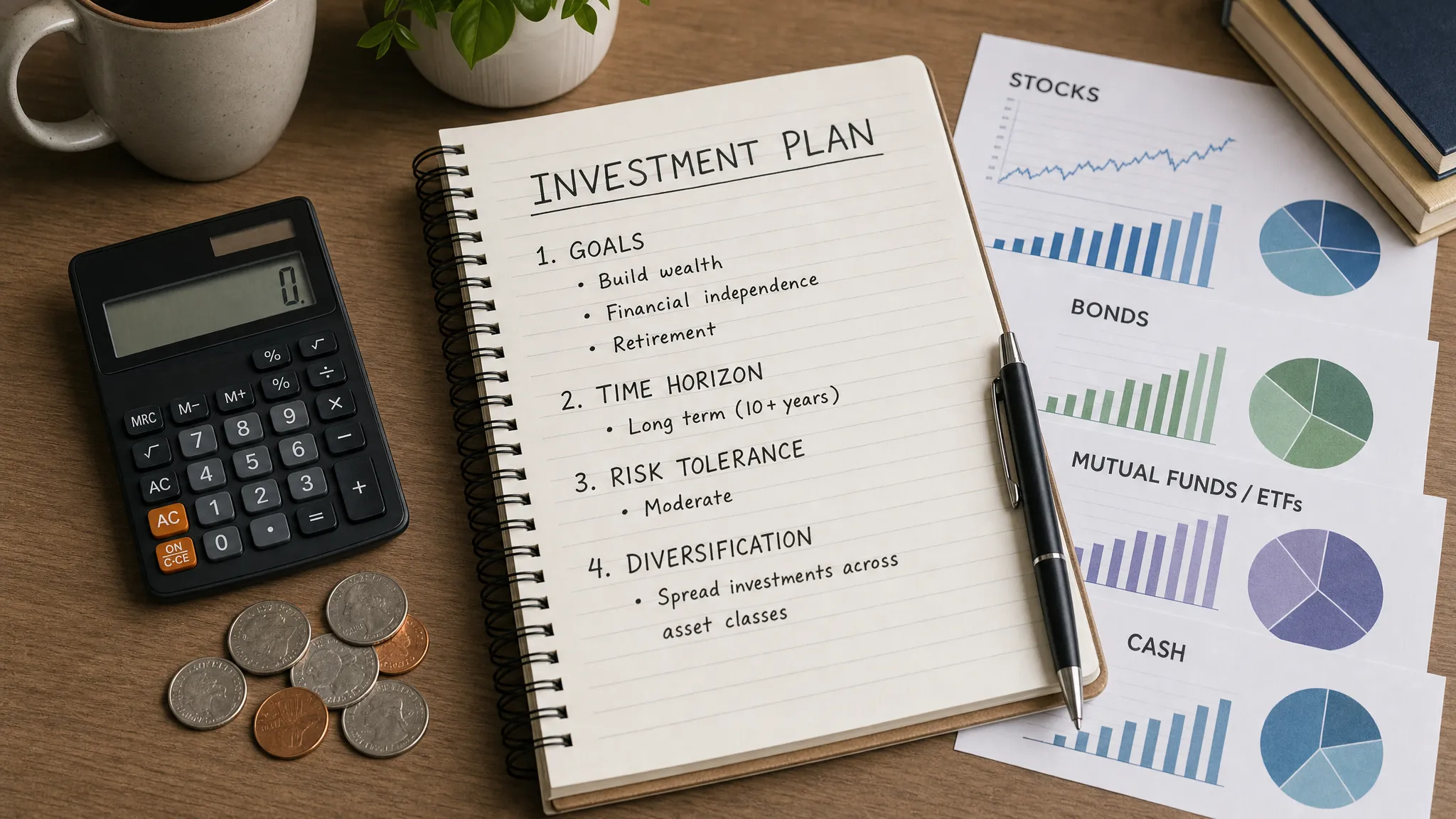
Before choosing an investment, build the decision around your goal rather than the latest market headline. The right investment for a 30-year retirement plan may be wrong for a tuition payment due in two years.
Financial language can also create unnecessary confusion. If terms like dividend yield, market cap, ETF, limit order, or P/E ratio are unfamiliar, start with Greek Shares' guide to essential stock market terms every investor should know. Better vocabulary leads to better decisions because you can understand what you are buying and compare alternatives more clearly.
A practical framework looks like this:
- Define the goal: Decide whether the money is for retirement, education, a home, income, wealth building, or another specific purpose.
- Set the time horizon: Money needed soon usually belongs in lower-risk, more liquid assets, while long-term money can usually accept more volatility.
- Choose an asset mix: Decide how much exposure you want to stocks, bonds, funds, cash, or other assets based on risk and goals.
- Select the investment vehicle: Consider whether individual securities, ETFs, mutual funds, retirement accounts, or taxable brokerage accounts fit your situation.
- Write your rules: Decide in advance when you will contribute, rebalance, review, or sell so emotions do not control every decision.
This process does not remove uncertainty. It gives uncertainty a structure.
Diversification is more than owning many things
Diversification means spreading risk across different assets, sectors, regions, and return drivers. Owning ten technology stocks may feel diversified, but those companies may still move together if interest rates rise or investor sentiment toward the sector changes.
True diversification asks whether different parts of your portfolio respond differently to the same environment. Stocks may benefit from economic growth. High-quality bonds may help during slower periods, although they can struggle when rates rise quickly. Cash can provide flexibility. International exposure may reduce dependence on one country, but it adds currency and geopolitical considerations.
| Investing principle | What it means in practice | Why it matters |
|---|---|---|
| Diversification | Avoid relying on one company, sector, or asset class | Reduces the impact of one bad outcome |
| Rebalancing | Periodically bring your portfolio back to target weights | Helps control risk after markets move |
| Cost awareness | Pay attention to expense ratios, commissions, and spreads | Lower costs leave more return for you |
| Tax awareness | Understand how dividends, interest, and gains may be taxed | After-tax returns are what you keep |
| Patience | Give long-term investments time to work | Reduces the temptation to react to noise |
Diversification does not guarantee profit or prevent loss. It simply helps reduce avoidable concentration risk.
How to evaluate a market investment before buying
A good investment decision should be explainable in simple language. If you cannot describe what the asset is, how it may generate returns, and what could go wrong, you may not be ready to buy it.
For individual stocks, investors often look at the company's business model, revenue growth, profitability, debt, valuation, competitive position, and management quality. For funds, the focus may be the index or strategy, holdings, fees, tracking record, and how the fund fits the rest of the portfolio. For bonds, investors consider credit quality, maturity, yield, and interest rate sensitivity.
If you want to go deeper into evaluating companies and securities, Greek Shares covers the foundations in stock market analysis basics for everyday investors. Analysis does not need to be complex to be useful. Often, the biggest benefit is learning what not to buy.
Before buying, ask yourself:
- What exactly am I buying?
- How does this investment make money?
- What could cause it to lose value?
- How long do I plan to hold it?
- What percentage of my portfolio will it represent?
- What would make me sell?
If your only answer is that the price has been going up, that is speculation rather than a plan.
Practical steps before your first investment
The first step is not opening a brokerage account. It is making sure your financial foundation is strong enough to handle market risk.
Start with basic cash reserves for emergencies and planned near-term expenses. High-interest debt should also be taken seriously, because paying it down may offer a more reliable benefit than taking investment risk. Once the foundation is stable, you can choose an investment account, learn how orders work, and start with an amount that allows you to gain experience without threatening your financial security.
Costs deserve attention from day one. A fee that looks small can matter over decades. Taxes also matter, especially when choosing between income-producing assets, frequent trading, and long-term holdings. Rules vary by country and personal situation, so it is wise to consult a qualified professional when needed.
Business owners should be especially careful to separate personal investing from company cash. Legal ownership, governance, banking, tax registration, and compliance can all affect how capital should be managed. If your plans involve a UAE entity, professional UAE company setup and governance support can help you think through structure before business capital is put to work.
Common mistakes everyday investors can avoid
One common mistake is confusing investing with trading. Investing usually focuses on long-term ownership and fundamentals. Trading focuses more on short-term price movement. Both involve risk, but they require different skills, time commitments, and emotional discipline.
Another mistake is chasing recent winners. When an asset has already risen sharply, future returns may be lower if expectations have become too optimistic. Good news can still lead to poor results if the price paid is too high.
A third mistake is ignoring position size. Even a reasonable idea can become dangerous if it dominates your portfolio. Position sizing is how you admit that you might be wrong before the market proves it.
Many investors also underestimate behavior. A portfolio can be mathematically sound but emotionally impossible to hold. If you sell every time the market falls, your real risk level is probably too high. A slightly more conservative portfolio that you can stick with may be better than an aggressive portfolio you abandon at the worst moment.
Finally, avoid investing based only on social media, rumors, or fear of missing out. Markets will always offer another opportunity. Protecting your capital and judgment is more important than participating in every trend.
What a realistic investing mindset looks like
A healthy approach to market investments is boring in the best way. It is based on regular learning, sensible diversification, controlled costs, and enough humility to know that no one can forecast every market turn.
You do not need to predict the next crisis, identify the next superstar stock, or trade every headline. For many everyday investors, the core challenge is simpler: save consistently, invest according to a plan, avoid avoidable mistakes, and let time do as much work as possible.
Review your portfolio periodically, but not obsessively. A quarterly or semiannual review may be enough for many long-term investors, while major life changes can justify a fresh look. The question is not whether every holding went up this month. The question is whether your portfolio still matches your goals, timeline, and risk capacity.
Frequently Asked Questions
What are market investments? Market investments are assets bought and sold through financial markets, such as stocks, bonds, ETFs, mutual funds, REITs, commodities, and cash equivalents. They are used to pursue growth, income, diversification, or capital preservation.
Are market investments only for wealthy people? No. Many platforms and funds allow everyday investors to start with modest amounts. The more important requirement is not wealth, but a clear plan, an emergency cushion, and an understanding of risk.
Can I lose money with market investments? Yes. Market prices can fall, companies can perform poorly, bonds can lose value, and speculative assets can decline sharply. Diversification and planning can reduce certain risks, but they cannot eliminate loss.
Are ETFs safer than individual stocks? ETFs can reduce company-specific risk because they often hold many securities, but they still carry market risk. A broad equity ETF can fall during a stock market downturn, even if it is more diversified than one individual share.
How often should I check my investments? Long-term investors usually benefit from reviewing periodically rather than reacting daily. Checking too often can encourage emotional decisions, especially during normal market volatility.
What is the best market investment for beginners? There is no universal best choice. Beginners often start by learning about diversified funds, basic asset allocation, and risk management before deciding whether individual stocks or other assets fit their goals.
Keep learning before you commit capital
Market investing becomes easier when you treat it as a skill, not a shortcut. Learn the terms, understand the assets, build a written plan, and give yourself time to improve.
Greek Shares is built to help everyday investors strengthen that foundation through clear guides, tutorials, and market education. The more you understand what you own and why you own it, the better prepared you will be to invest with patience and confidence.