



The stock market is often presented as a mysterious world of flashing prices, expert opinions, economic forecasts, and complicated charts. That can make beginners feel they need to understand everything before they can do anything.
In reality, the stock market is simpler than it looks when you reduce it to its basic purpose: it is a place where people buy and sell ownership in businesses.
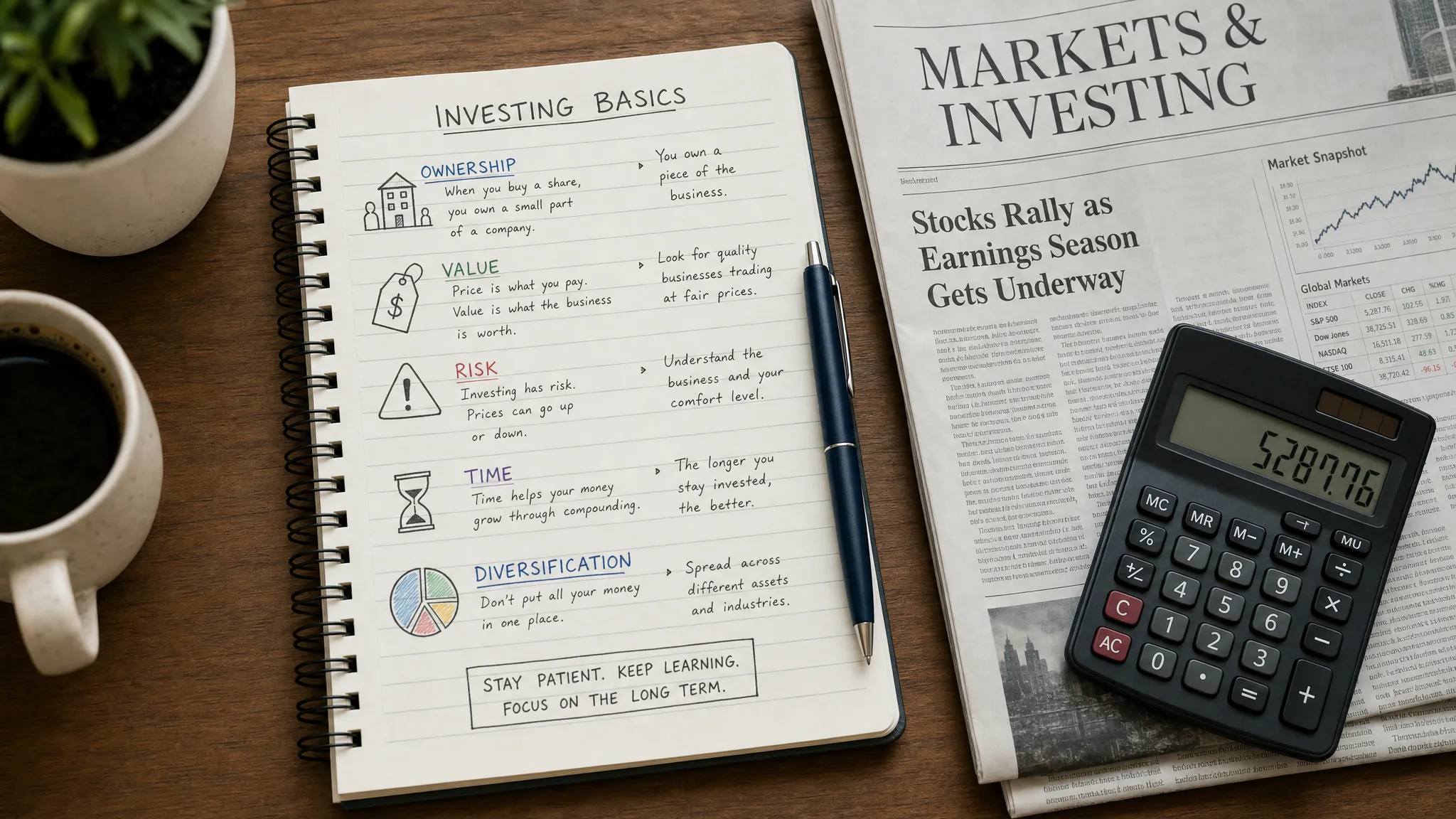
That does not mean investing is easy. Prices move, emotions interfere, and mistakes can be expensive. But the core ideas are not reserved for professionals. If you can understand ownership, value, risk, time, and discipline, you already understand more than many people who trade constantly without a plan.
The stock market is a marketplace for ownership
A stock is not just a ticker symbol moving up and down on a screen. It represents a fractional ownership interest in a company. When you buy shares of a business, you are buying a claim on a small part of that company’s future profits, assets, and opportunities.
The stock market simply gives buyers and sellers a place to exchange those ownership claims. If many investors want to buy a stock and few want to sell, the price usually rises. If many want to sell and few want to buy, the price usually falls.
That is the first simplification: stock prices are driven by supply and demand, but long-term value is driven by business results.
A company can have an exciting story and still be a poor investment if the price is too high. Another company can look boring and still be a good investment if it earns steady profits, has a strong balance sheet, and trades at a reasonable price.
The jargon is less scary when translated
Financial language can make simple concepts feel more complicated than they are. Here is a plain-English translation of common stock market terms.
| Market term | Simple meaning | Why it matters |
|---|---|---|
| Stock | A small ownership piece of a company | You are buying part of a business, not just a price chart |
| Stock exchange | A marketplace for buying and selling stocks | It helps investors trade shares efficiently |
| Broker | The firm that places trades for you | You need one to buy and sell listed investments |
| Index | A basket that tracks a group of stocks | It shows how a market segment is performing |
| Dividend | Cash a company may pay shareholders | It can be part of your total return |
| Volatility | Price movement up and down | It affects your emotions and risk management |
| Market order | An order to buy or sell immediately | It prioritizes speed over price control |
| Limit order | An order with a maximum buy price or minimum sell price | It prioritizes price control over execution certainty |
Once you understand the plain meaning, much of the fear disappears. The stock market has complexity, but the beginner’s job is not to master every product, strategy, or indicator. The beginner’s job is to build a solid foundation.
Most investing decisions come down to four questions
Whether you are considering an individual stock, an index fund, or a broader portfolio, the same questions keep returning.
| Question | What you are really asking |
|---|---|
| What am I buying? | Do I understand the asset, business, fund, or strategy? |
| What is it worth? | Am I paying a reasonable price for the expected future results? |
| What could go wrong? | What risks could damage returns or cause permanent loss? |
| How does it fit my plan? | Does it match my goals, time horizon, and risk tolerance? |
These four questions prevent many beginner mistakes. They slow you down before you chase a hot stock, copy a stranger’s trade, or invest money you may need soon.
For individual companies, the first question is especially important. A business is more than its latest headline. It may own factories, software, brands, customer relationships, patents, or other intellectual property. In industries built around content and rights, for example, licensing and enforcement can be a real part of business value, which is why platforms that help rights holders monitor usage and unlock licensing revenue can be relevant when thinking about how intangible assets become cash flows.
That is the mindset investors need: look beneath the ticker and ask how the business actually makes money.
Why prices move every day
If the stock market is basically about ownership, why do prices move so much from day to day?
Because the price of a stock reflects expectations. Investors are constantly revising what they think a company will earn in the future, what interest rates will be, how strong the economy will be, and how much risk they are willing to accept.
Short-term price movement can be caused by many things:
- Earnings results that beat or miss expectations
- Interest rate changes and inflation concerns
- News about management, regulation, lawsuits, or competition
- Broad market fear or excitement
- Large buyers or sellers moving quickly
- Traders reacting to charts, momentum, or short-term signals
This is why a stock can fall even when a company is still profitable. If investors expected very fast growth and the company delivers only decent growth, the price can decline. Markets react to the gap between expectations and reality.
Greek Shares has a deeper guide on why stocks fall if you want to explore the forces that push prices down. The key point here is simple: daily prices are noisy, while long-term returns depend more on earnings, cash flow, dividends, and valuation.
Simple does not mean predictable
One common beginner error is confusing simplicity with certainty. The basic mechanics of the market are simple. Predicting next month’s price is not.
No one knows exactly what the market will do tomorrow. Even experienced investors are wrong often. The difference is that disciplined investors build plans that can survive uncertainty.
A simple investor does not need to forecast every recession, interest rate move, or earnings surprise. Instead, a simple investor can focus on controllable habits: saving regularly, diversifying, avoiding excessive debt, limiting speculation, and refusing to panic during normal market declines.
This is why long-term investing often works better for ordinary individuals than constant trading. Trading asks you to repeatedly make correct short-term decisions under pressure. Investing asks you to own productive assets at reasonable prices and give them time to work.
The easiest starting point: broad diversification
For many beginners, the simplest stock market approach is not picking individual stocks. It is owning a diversified basket of stocks through index funds or diversified funds.
An index fund can give exposure to many companies at once. That reduces the risk that one company’s failure will damage your entire plan. It also lowers the pressure to identify the next winning stock before everyone else does.
Individual stocks can still have a place, especially for investors who enjoy business analysis and can tolerate company-specific risk. But beginners should understand the trade-off. A single stock can outperform dramatically, but it can also disappoint dramatically. A diversified fund is less exciting, but often more suitable as a core holding.
If you are comparing both paths, Greek Shares explains the decision in Index Funds vs Stocks: Which Fits You?.
The stock market becomes clearer when you separate price from value
Price is what the market quotes today. Value is what the asset is reasonably worth based on future benefits.
The two are related, but they are not the same. A great company can become a bad investment if bought at an absurd price. A struggling company can look cheap but still be dangerous if its business keeps deteriorating. A boring company can be attractive if it produces reliable cash and the price is sensible.
This is where valuation enters the picture. You do not need to become an accountant overnight, but you should understand basic tools such as earnings, cash flow, debt, margins, and the price-to-earnings ratio. The P/E ratio is not perfect, but it gives investors a starting point for asking whether a stock’s price is reasonable compared with its profits.
For a beginner-friendly explanation, see P/E Ratio Explained for Stock Investors.
The point is not to find one magic number. The point is to avoid buying blindly.
Risk is not just price movement
Many people think risk means a stock went down today. That is only one form of risk.
A more useful definition is this: risk is the possibility that your investment plan fails to meet your goals.
That can happen for several reasons. You might buy an overvalued stock. You might concentrate too much money in one company. You might sell during a panic. You might invest money needed for a house deposit next year into volatile stocks. You might use borrowed money and face a forced sale at the worst possible time.
Good investing is not about eliminating risk. That is impossible. It is about choosing risks you understand and can live with.
A simple risk framework looks like this:
| Risk area | Simple control |
|---|---|
| Too much in one stock | Diversify across companies, sectors, and assets |
| Need money too soon | Keep short-term money in safer, more liquid places |
| Emotional selling | Write a plan before volatility arrives |
| Overpaying | Compare price with earnings, cash flow, growth, and peers |
| Strategy confusion | Know whether you are investing, trading, or speculating |
Greek Shares covers this topic further in How to Manage Portfolio Risk Wisely.
A simple investing plan beats a complicated guess
You do not need a plan with dozens of indicators or constant portfolio changes. A simple plan you can follow is better than a clever plan you abandon under stress.
A practical beginner plan might include these elements:
- A clear goal, such as retirement, long-term wealth building, education funding, or future financial independence
- A time horizon, because money needed in one year should not be treated like money needed in thirty years
- A savings habit, since consistent contributions often matter more than perfect timing
- A diversified core portfolio, often using funds before adding individual stocks
- A rule for position size, so no single idea can ruin the plan
- A review schedule, such as quarterly or annually, instead of reacting to every headline
This does not guarantee profits. Nothing does. But it gives you a structure, and structure is what keeps many investors from making emotional decisions.
The hardest part is behavior
The stock market is simple in theory and difficult in practice because humans are emotional. Fear makes people sell after prices fall. Greed makes people buy after prices rise. Overconfidence makes people trade too often. Impatience makes people abandon good strategies before they have time to work.
This is why investing education matters. Learning definitions is useful, but learning your own behavior is even more important. You need to know whether you can watch a portfolio decline without panicking. You need to know whether you are tempted by hype. You need to know whether you can admit a mistake and move on.
Many losses come not from a lack of intelligence, but from a lack of process. The investor who avoids major mistakes often does better than the investor who constantly searches for brilliance.
For more practical warnings, read 10 Top Stock Market Mistakes to Avoid.
What beginners should ignore at first
Beginners often try to learn everything at once: options, futures, margin, short selling, day trading, crypto, technical indicators, macroeconomics, and complex tax strategies. These topics can be interesting, but they are not the foundation.
At the start, it is usually better to ignore anything that requires speed, leverage, or precision forecasting. You can always study advanced tools later. First, understand how stocks work, how funds work, how risk works, and how your own financial goals shape your decisions.
A beginner does not need to win every opportunity. A beginner needs to avoid damaging mistakes while building knowledge.
The simple truth: stocks reward ownership, not excitement
The stock market attracts excitement because prices change every second. But long-term investing is not mainly about excitement. It is about owning productive assets and allowing time, earnings, reinvestment, and compounding to do their work.
A disciplined investor sees the market differently. Instead of asking, what will this stock do tomorrow, the disciplined investor asks, what am I buying, what is it worth, what could go wrong, and does it fit my plan?
That is not complicated. It is just not always easy.
Frequently Asked Questions
Is the stock market good for beginners? The stock market can be suitable for beginners if they start with education, avoid money they need soon, diversify, and understand that prices can fall. Beginners should focus on simple, long-term strategies before considering advanced trading.
Do I need a lot of money to start investing? Not necessarily. Many investors begin with small amounts and build gradually. The more important starting point is having a stable financial base, clear goals, and a willingness to learn before taking unnecessary risk.
Is buying individual stocks better than buying index funds? Neither is automatically better. Index funds offer broad diversification and simplicity, which suits many long-term investors. Individual stocks require more research and carry more company-specific risk, but they may appeal to investors who enjoy analyzing businesses.
Why does the stock market go up over time if it falls so often? Broad markets can fall sharply in the short term because of fear, recessions, interest rates, or changing expectations. Over longer periods, stock returns are generally linked to business profits, innovation, productivity, and economic growth, although there is never a guarantee.
What is the biggest mistake new investors make? One of the biggest mistakes is investing without understanding what they own. Other common errors include chasing hype, overtrading, ignoring risk, concentrating too much money in one idea, and selling emotionally during market declines.
Keep learning one step at a time
The stock market is simpler than you think when you focus on the essentials: ownership, value, risk, time, and behavior. You do not need to master every strategy before you begin learning. You need a clear foundation and the discipline to build on it.
Greek Shares exists to help investors improve their financial literacy through guides, tutorials, investing education articles, and practical explanations. If you want to become more confident, start with the basics, keep your process simple, and continue learning before you risk more than you understand.