


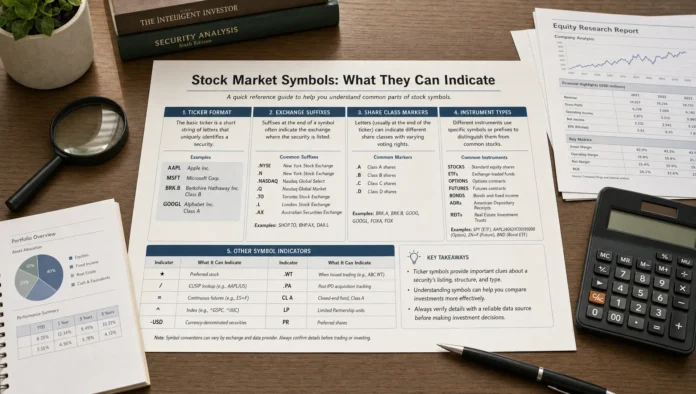
A stock market symbol looks simple. It may be only one to five letters on a quote screen, yet it is often the first clue investors use to identify a company, find its price, and place an order.
But a symbol is not just a shortcut. It can tell you which security you are looking at, where it trades, whether there may be different share classes, and sometimes whether the instrument is a common stock, preferred share, fund, warrant, or foreign listing.
At the same time, it tells you much less than many beginners assume. A symbol does not tell you whether a company is undervalued, financially strong, or likely to rise tomorrow. It is the starting point for research, not the conclusion.
A stock market symbol is a market identifier
A stock market symbol, often called a ticker symbol, is an abbreviated code used to identify a publicly traded security. When investors type a symbol into a broker, exchange website, or financial data platform, they are asking for information about a specific tradable instrument.
This matters because company names can be long, similar, or confusing. Symbols help reduce ambiguity. Instead of searching for the full legal name of Apple Inc., investors can search for AAPL. Instead of writing out Microsoft Corporation, they can use MSFT.
Still, a ticker should always be paired with context. The same or similar symbols may appear in different markets, and data vendors can use different suffixes for international exchanges. If you are still learning the basics, Greek Shares has a separate explainer on stock ticker symbols that covers the definition and common examples in more detail.
What a symbol can tell investors at a glance
The most useful thing a symbol tells you is identity. It helps answer the question, “Am I looking at the exact security I intended to research or buy?”
That sounds basic, but it is critical. A parent company may have multiple securities. A foreign company may trade locally and also as an American depositary receipt. A business may have common shares, preferred shares, warrants, or units. Each can have a different symbol and a different risk profile.
A symbol may also suggest the exchange or market where the security trades. Many quote systems show the ticker plus the listing venue, such as NASDAQ, NYSE, London, Tokyo, or Athens. International tickers often include suffixes in broker platforms, such as “.L” for London or “.T” for Tokyo, although exact formatting varies by provider.
This exchange context can affect practical details, including trading hours, currency, liquidity, settlement rules, and the information sources you should check before making a decision.
| Symbol clue | What it may indicate | What investors should verify |
|---|---|---|
| Short letter code | The company or security identity | Full company name and exchange |
| Exchange suffix | The market where it trades | Currency, trading hours, and liquidity |
| Class marker | Different voting or economic rights | Share class terms in filings |
| Preferred or warrant notation | A non-common stock instrument | Dividend priority, conversion terms, or expiration |
| Fund-style symbol | ETF, fund, or basket exposure | Holdings, fees, and structure |
Share classes can make one company look like several symbols
One of the most important lessons for beginners is that a ticker can refer to a specific class of shares, not just a company.
Alphabet is a common example. GOOG and GOOGL both relate to Alphabet, but they represent different share classes. Berkshire Hathaway is another well-known example, with BRK.A and BRK.B representing different classes of stock. The exact notation can differ between platforms, but the point is the same: similar symbols do not always mean identical rights.
Share classes may differ in voting power, price, liquidity, and investor audience. In some cases, one class may have voting rights while another has limited or no voting rights. In other cases, a lower-priced class exists to make shares more accessible while still representing ownership in the same overall business.
This is why investors should never stop at the symbol. Check the company’s investor relations page, annual report, or official filings to understand what rights come with the exact security you are considering.
Symbols can also reflect corporate history and branding
Some tickers are chosen because they are memorable. A company may want a symbol that reflects its brand, industry, or story. For example, a consumer brand might prefer a symbol that is easy to recognize and remember, while a technology company may choose one that aligns with its product identity.
This branding value can be useful, but it can also mislead investors. A strong ticker symbol does not guarantee a strong business. A clever abbreviation may help a company stand out on a quote screen, but it says little about margins, debt, competition, or management quality.
That is especially true in brand-driven sectors such as sports, fitness, apparel, and wellness. A public company in those categories may have a memorable symbol, but investors still need to evaluate distribution, customer acquisition, creative execution, and the ability to turn attention into profitable growth. Those same growth levers are why emerging brands often work with a sports marketing and brand accelerator before they are large enough to attract public market attention.
What a stock market symbol does not tell you
A symbol is useful because it points you to the right place. It is dangerous when investors treat it as if it contains an investment opinion.
A stock market symbol does not tell you whether a company is cheap or expensive. It does not reveal whether revenue is growing, whether profits are sustainable, whether the balance sheet is strong, or whether management is allocating capital wisely.
It also does not tell you why a stock price is moving. Prices move because investors update expectations about future cash flows, risk, interest rates, competition, and broader market conditions. For a deeper beginner-friendly explanation, Greek Shares covers how shares in the market gain or lose value beyond the ticker itself.
| What the symbol shows | What it does not show |
|---|---|
| The security’s market identifier | Whether the investment is attractive |
| Possible exchange or suffix information | Whether the company is financially healthy |
| Possible share class or instrument type | Whether the price is fair |
| A clue to brand identity | Whether the business has a durable advantage |
| A way to retrieve quote data | Whether you should buy, hold, or sell |

How to use a symbol in your research process
The best way to think about a symbol is as step one in a structured research process. It gets you to the right security, then your real analysis begins.
Start by confirming the full company name and exchange. This avoids a common beginner mistake: selecting the wrong security from an auto-complete list. Some companies have similar names, and some tickers look alike at a glance.
Next, check whether you are looking at common stock, a different share class, an ADR, an ETF, a preferred share, or another instrument. These distinctions can materially change the risk and reward profile.
Then move from identification to analysis. Look at revenue, earnings, cash flow, debt, valuation, dividends, dilution, and competitive position. If terms such as market capitalization, earnings per share, dividend yield, or bid-ask spread feel unfamiliar, the stock market terminology guide for beginners can help you connect the symbol on the screen to the language investors use.
Finally, compare the security with alternatives. A ticker can help you pull up one quote, but good investing requires context. How does the company compare with competitors? Is the sector growing? Is the valuation reasonable compared with the quality of the business? Are you buying for long-term ownership or short-term trading?
Common mistakes investors make with symbols
A symbol is small, but mistakes around it can be costly. The most common errors usually come from rushing.
- Buying the wrong ticker: Similar company names or auto-complete suggestions can lead investors to a different stock than the one they intended.
- Ignoring the exchange: The same company may trade in different markets, currencies, or formats.
- Overlooking share class differences: Two tickers tied to the same company may not carry the same voting rights or liquidity.
- Assuming a famous brand equals a good stock: A recognizable symbol or company name does not automatically mean the shares are attractively priced.
- Confusing the company with the security: The business may be one thing, but the exact instrument you buy determines your rights as an investor.
A careful investor slows down long enough to confirm the details before placing an order. This is not exciting, but it is part of good risk management.
A simple example of why the exact symbol matters
Imagine a fictional company called Global Fitness Group. It has a common stock listed on a major exchange, a preferred share issued years ago, and an international depositary receipt that trades in another country.
The common stock might give investors ordinary ownership and voting rights. The preferred share might offer a dividend preference but limited upside. The depositary receipt might provide exposure to the same business but trade in a different currency and follow different market hours.
All three instruments could be connected to the same company, but they would not be the same investment. The symbol is how the market separates them. If you choose the wrong one, your portfolio may end up with a different risk profile than you intended.
This is why “I bought the company” is often too vague. In public markets, you buy a specific security, at a specific price, on a specific exchange, under a specific symbol.
Frequently Asked Questions
Is a stock market symbol the same as a ticker symbol? Yes, in everyday investing language, “stock market symbol” and “ticker symbol” usually refer to the same thing: the short code used to identify a traded security.
Can two companies have the same stock symbol? On the same exchange, symbols are designed to be unique. Across different countries, exchanges, or data providers, similar or identical-looking symbols can appear, which is why the exchange and company name should always be checked.
Does a ticker symbol tell me if a stock is a good investment? No. A ticker helps you identify the security, but it does not tell you whether the company is profitable, undervalued, risky, or suitable for your goals.
Why do some companies have more than one symbol? A company may have multiple share classes, foreign listings, depositary receipts, preferred shares, or other securities. Each one can trade under a different symbol.
Should beginners memorize stock symbols? Memorizing popular symbols can be useful, but it is more important to understand what each symbol represents. Always confirm the company, exchange, and security type before researching or buying.
Make the symbol your starting point, not your shortcut
A stock market symbol can tell investors a lot in a small package. It identifies a security, points to a trading venue, and may reveal clues about share class or instrument type.
But it cannot replace research. The symbol does not analyze the business, value the shares, or protect you from buying the wrong instrument. Treat it like an address on a map. It helps you find the right place, but you still need to inspect what is there before deciding whether it belongs in your portfolio.