


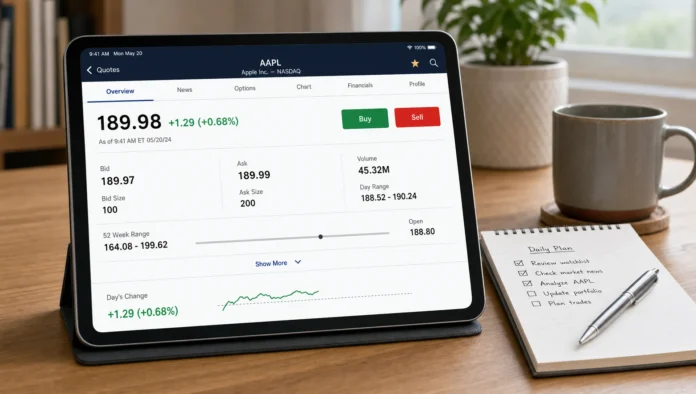
A shares ticker can feel like a foreign language the first time you open a brokerage app. You may see short codes like AAPL, MSFT, TSLA, or VOD.L next to changing prices, green and red percentages, volume figures, and tiny arrows. It looks fast and technical, but the basic idea is simple: a shares ticker helps investors identify a specific stock and follow its latest quoted market price.
For first-time investors, understanding tickers matters because small mistakes can be expensive. Buying the wrong company, confusing two similar ticker symbols, or reacting emotionally to a red price move can lead to poor decisions. This guide explains what a shares ticker is, how to read the information around it, and how to use it as a starting point for smarter research.
What Is a Shares Ticker?
A shares ticker is commonly used to describe two closely related things.
First, it can mean the ticker symbol, which is the short code used to identify a publicly traded company’s shares on an exchange. For example, Apple trades under AAPL on Nasdaq, while Microsoft trades under MSFT. These codes make it easier for investors, brokers, exchanges, and financial news platforms to refer to stocks quickly and accurately.
Second, people may use “shares ticker” to describe the moving or updating display of stock prices, often called a ticker tape or market ticker. This is the scrolling line of symbols, prices, and percentage changes you might see on financial news channels, market websites, or trading platforms.
If you are still learning what investors actually own when they buy shares, Greek Shares has a beginner-friendly guide on stock shares explained for first-time investors that pairs well with this topic.
A ticker symbol is not the same thing as the company’s full name, and it is not a recommendation to buy or sell. It is simply an identifier. Think of it as a shorthand label that points to a specific security.
Why Do Stocks Have Ticker Symbols?
Ticker symbols exist because markets process enormous amounts of information. Thousands of securities trade across exchanges around the world, and many companies have long names, similar names, or multiple share classes. Short symbols reduce confusion and make quotes easier to display.
The U.S. Securities and Exchange Commission’s Investor.gov explains that stocks represent ownership interests in companies, but markets still need a practical way to identify each traded security. A ticker symbol provides that practical shortcut.
Ticker formats vary by exchange and country. A U.S.-listed stock may have a simple symbol such as AAPL. A stock listed in London may appear with a suffix on some platforms, such as .L. Some companies also have multiple share classes, which can appear as different symbols. Alphabet, for example, has traded with different ticker symbols for different share classes.
For a deeper look at the symbol itself, see Greek Shares’ guide to the stock ticker symbol, which explains why these codes exist and how they are used across markets.
Ticker Symbol vs. Stock Quote: What Is the Difference?
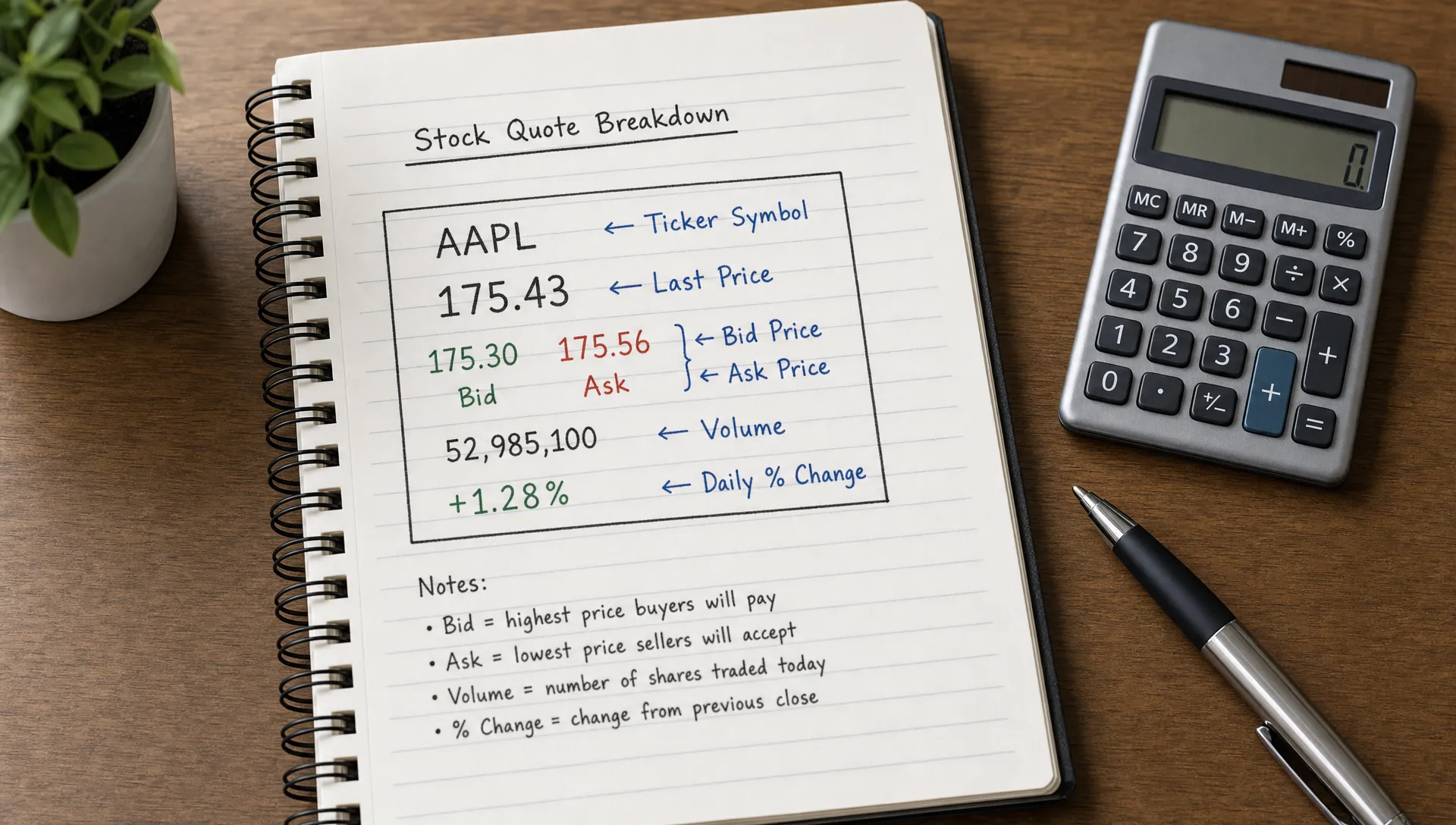
The ticker symbol identifies the stock. The stock quote shows current or recent market information about that stock.
When you type a ticker symbol into a brokerage platform, you usually see a quote page. That quote page may include the latest price, the day’s change, trading volume, bid and ask prices, market capitalization, dividend yield, and valuation ratios.
Here is the key distinction:
| Term | What it means | Simple example |
|---|---|---|
| Ticker symbol | The short code identifying the stock | AAPL identifies Apple shares on Nasdaq |
| Stock quote | The market data attached to that stock | Price, daily change, bid, ask, and volume |
| Ticker tape | A scrolling or updating display of quotes | A line of symbols and prices on a financial site |
Beginners often say “the ticker went up” when they mean the stock price increased. That is common language, but technically the ticker symbol did not change. The quoted price changed.
How to Read a Shares Ticker Quote
A brokerage app or finance website may show many data points at once. You do not need to understand every advanced metric on day one, but you should recognize the core fields before placing your first order.
| Quote field | What it tells you | Why it matters |
|---|---|---|
| Symbol | The stock’s ticker code | Helps confirm you are viewing the right security |
| Company name | The business behind the ticker | Reduces the risk of confusing similar symbols |
| Last price | The most recent traded price shown by the platform | Gives a reference point, but may not be the exact price you receive |
| Change | The price move since the previous close | Shows whether the stock is up or down for the session |
| Percent change | The move shown as a percentage | Makes price moves easier to compare across stocks |
| Bid | The highest price buyers are currently offering | Important when selling or using limit orders |
| Ask | The lowest price sellers are currently accepting | Important when buying or using limit orders |
| Volume | Number of shares traded during a period | Helps indicate how actively the stock is trading |
| Market cap | Total market value of the company’s equity | Helps compare company size |
The “last price” is especially important to understand. It is usually the price of the most recent trade displayed by your platform, not a guaranteed purchase price. In active markets, quotes can change quickly. Some platforms also show delayed data, especially for free quote services.
A Simple Example of a Shares Ticker Quote
Imagine a fictional company called Example Foods Inc. It trades under the ticker symbol EXFD. You open your brokerage app and see this quote:
| Symbol | Last price | Day change | Percent change | Bid | Ask | Volume |
|---|---|---|---|---|---|---|
| EXFD | $50.00 | +$1.25 | +2.56% | $49.95 | $50.05 | 1,200,000 |
This means the latest displayed trade happened at $50.00. The stock is up $1.25 compared with the previous closing price, which equals a 2.56% increase. Buyers are currently bidding $49.95, while sellers are asking $50.05. The volume shows that 1.2 million shares have traded during the period shown by the platform.
If you place a market order to buy, your final execution price could be close to the ask, but it is not guaranteed to be exactly $50.00. If the price moves quickly, your order may execute higher or lower than the last displayed trade. That is one reason beginners should learn how order types work before investing large amounts.
What a Shares Ticker Does Not Tell You
A shares ticker is useful, but it is only a doorway into research. It does not tell you whether a stock is a good investment. It does not reveal the company’s competitive position, balance sheet strength, management quality, valuation, or long-term risks.
Think of a ticker quote as a price reference, not a full decision. Just as a homeowner might compare cost guides for tradespeople before deciding whether a job quote is reasonable, an investor should compare a stock’s price with earnings, growth, debt, cash flow, and risk before deciding whether the price makes sense.
This is where beginners often make a mistake. They see a stock trading at $20 and assume it is “cheaper” than a stock trading at $200. In reality, the share price alone tells you very little. A company’s value depends on how many shares exist, how much profit it earns, and what investors expect in the future.
For example, a $200 stock can be reasonably valued if the company has strong earnings and growth prospects. A $2 stock can be risky or expensive if the business is losing money, heavily indebted, or issuing more shares. To interpret these details, it helps to build your vocabulary with a resource like the Greek Shares stock market terminology guide for beginners.
How First-Time Investors Should Use a Shares Ticker
A ticker is most useful when it helps you confirm, compare, and research. Before buying any stock, slow down and use the ticker as the starting point for a basic checklist.
- Confirm the exact ticker symbol and exchange before placing an order.
- Match the ticker with the full company name to avoid similar-symbol mistakes.
- Check whether the quote is real-time or delayed.
- Look at the bid and ask, especially for less actively traded stocks.
- Review the company’s business, financials, valuation, and risks.
- Consider how the stock fits your portfolio instead of focusing only on today’s price move.
This process does not need to be complicated. The goal is to avoid treating the ticker like a signal by itself. A green percentage move does not automatically mean opportunity, and a red percentage move does not automatically mean danger.
Common Shares Ticker Mistakes to Avoid
Confusing similar ticker symbols
Some companies have tickers that look alike. A single wrong letter can point you to a completely different business. Always check the full company name, exchange, and security type before placing an order.
Ignoring the exchange
The same company may have listings, depositary receipts, or related securities in different markets. Your platform may show suffixes or exchange labels to help distinguish them. This matters because currency, trading hours, fees, taxation, and liquidity can differ.
Assuming the stock price equals value
A ticker quote shows price, not value. Price is what the market is currently quoting. Value is your estimate of what the business is worth based on its fundamentals and future prospects. Serious investing requires more than reading the latest quote.
Overreacting to short-term movement
Tickers update constantly, and that can make small moves feel urgent. First-time investors may be tempted to buy because a stock is rising or sell because it is falling. Short-term movement can be driven by news, market mood, analyst comments, interest rates, or temporary order flow.
Forgetting about bid-ask spreads
The bid-ask spread is the gap between what buyers are offering and what sellers are asking. For large, liquid stocks, the spread is often small. For less traded stocks, the spread can be wider, which can increase your cost when entering or exiting a position.
A Beginner-Friendly Research Routine
Once you understand the ticker, use it as part of a repeatable process. A simple research routine can help you avoid impulsive decisions.
| Step | Question to ask | What to check |
|---|---|---|
| Identify | Am I looking at the correct stock? | Ticker, company name, exchange, share class |
| Understand | What does the company do? | Business model, products, customers, industry |
| Evaluate | Is the price reasonable? | Revenue, profit, debt, cash flow, valuation ratios |
| Compare | How does it stack up against alternatives? | Competitors, index funds, sector trends |
| Decide | Does it fit my plan? | Risk tolerance, time horizon, diversification |
This routine helps separate information from action. You can look up a ticker every day without needing to trade every day. In fact, many long-term investors benefit from watching less frequently and focusing more on business quality, diversification, and time horizon.
How Tickers Appear in Different Investing Tools
You will see ticker symbols in several places as you begin investing.
In a brokerage account, the ticker is used to search for a security and place orders. On financial news websites, tickers appear beside charts, headlines, analyst ratings, and earnings dates. In portfolio trackers, tickers help organize your holdings and performance. In watchlists, tickers let you follow companies you may want to research later.
The same ticker can appear with slightly different formatting depending on the platform. For example, one app may show a market suffix, while another may show the exchange in a separate field. Do not rely only on the symbol if anything looks uncertain. The full company name and exchange are your safety checks.
Shares Ticker and Investor Psychology
A ticker can be helpful, but it can also encourage emotional behavior. Bright colors, flashing prices, and constant updates are designed to make market information easy to scan. They can also make investing feel like a game.
First-time investors should remember that the stock market is not just a screen of moving symbols. Behind every ticker is a real business, with employees, customers, assets, liabilities, competitors, and uncertain future results. The ticker is the label. The business is what you are evaluating.
One useful habit is to write down your reason for researching a stock before looking at the day’s price movement. If your interest is based on long-term business fundamentals, a one-day red or green move should not dominate your thinking. If your interest is based only on a sudden jump in price, pause and ask whether you are reacting to momentum rather than making an investment decision.
Frequently Asked Questions
What is a shares ticker in simple terms? A shares ticker is a short code or quote display that helps investors identify and follow a publicly traded stock. The ticker symbol identifies the stock, while the quote shows market data such as price, change, bid, ask, and volume.
Is a shares ticker the same as a ticker symbol? Not always. Many people use the terms interchangeably, but a ticker symbol is the code for a stock, while a shares ticker can also refer to the updating display of stock prices and market data.
Can two companies have the same ticker symbol? On the same exchange, ticker symbols are generally unique. Across different countries or exchanges, similar or identical-looking symbols may exist, so always check the company name and exchange.
Does a low share price mean a stock is cheap? No. A low share price does not automatically mean a stock is undervalued. You need to consider market capitalization, earnings, debt, growth prospects, and the number of shares outstanding.
Why does the price I receive differ from the ticker quote? Quotes can move quickly, and some platforms display delayed data. If you use a market order, your final execution price may differ from the last displayed price, especially in fast-moving or less liquid stocks.
Keep Learning Before You Invest
A shares ticker is one of the first things new investors encounter, but it is only the beginning. Learn to use ticker symbols to identify stocks accurately, read quote data calmly, and research the business behind the symbol before making decisions.
Greek Shares is built to help beginners and developing investors understand the stock market step by step. Keep building your foundation, focus on clear concepts, and treat every ticker as an invitation to research, not as a command to trade.