

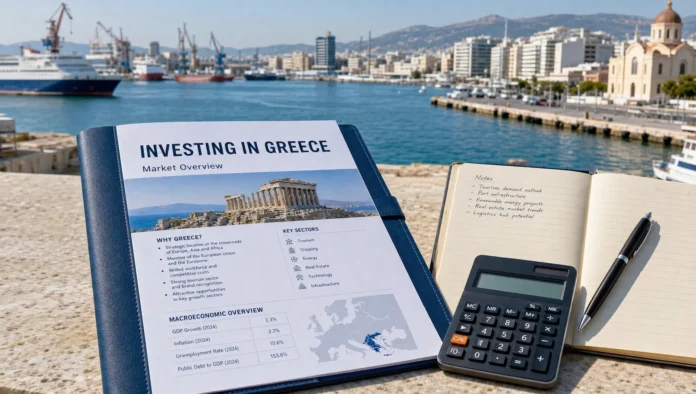
Investing in Greece can be exciting for beginners because the market sits at the crossroads of Europe, tourism, shipping, banking, energy, and infrastructure. It can also feel unfamiliar if most investing examples you read are written for the U.S. or larger European markets.
The good news is that you do not need to be an expert economist to start learning. You do need a clear framework: what you can invest in, how the Greek market works, what risks are specific to Greece, and how to avoid making emotional decisions with your first money.
This guide explains the essentials of investing in Greece in plain English. It is educational, not personal financial advice, but it will help you ask better questions before opening an account or buying your first asset.
First, define what “investing in Greece” means for you
People use the phrase “investing in Greece” in different ways. Before comparing brokers or reading stock opinions, clarify which situation applies to you.
| Investor situation | What it usually means | Main questions to ask |
|---|---|---|
| You live in Greece and want to invest | You may invest in Greek, European, or global assets from Greece | Which account can I open, what taxes apply, and how much can I invest monthly? |
| You live abroad and want exposure to Greece | You may buy Greek stocks, Greek-focused funds, bonds, or real estate-related assets | Can my broker access Greek markets, and how much country risk am I taking? |
| You are Greek but investing globally | Greece is your home base, but your portfolio may include international ETFs or stocks | How do I diversify beyond my local economy and currency needs? |
| You want to invest in the Athens Stock Exchange | You are focusing on Greek-listed shares or listed funds | Which companies are liquid, transparent, and suitable for my risk level? |
This distinction matters because a Greek resident buying a global ETF faces different practical issues than a foreign investor buying shares of a company listed in Athens. Your tax residency, broker access, currency exposure, and reporting obligations can all change the answer.
Why Greece attracts investors
Greece has gone through major economic cycles over the past two decades. That history makes some beginners cautious, and rightly so. But it also means the country has areas that investors watch closely, including banks, tourism, energy transition, logistics, ports, real estate, and consumer recovery.
Greek assets can appeal to investors for several reasons:
- The economy is part of the euro area, which removes currency conversion issues for euro-based investors.
- Several listed companies are tied to sectors with international revenue, not only local demand.
- The market is smaller than major exchanges, which can create both opportunity and higher volatility.
- Dividends are an important part of the return profile for some mature Greek companies.
However, “interesting” does not automatically mean “safe” or “cheap.” A stock can look undervalued for a reason. A country can improve economically while some companies still struggle. Beginners should learn to separate a positive national story from the financial reality of a specific investment.
The main ways beginners can invest in Greece
You do not have to start by picking individual Greek stocks. In fact, many beginners are better served by understanding the full menu of options first.
| Investment type | What it is | Potential advantage | Main risk |
|---|---|---|---|
| Greek-listed shares | Ownership in companies traded on the Athens Stock Exchange | Direct exposure to Greek businesses | Company-specific risk and market volatility |
| ETFs or funds with Greek exposure | A basket of assets that may include Greek companies or broader regional exposure | Diversification compared with one stock | Fees, tracking differences, and limited Greece-only choices |
| Greek government bonds or treasury bills | Debt issued by the Greek state | More predictable income than stocks if held appropriately | Interest-rate risk, credit risk, and reinvestment risk |
| Corporate bonds | Debt issued by companies | Potential income and lower volatility than shares | Credit risk if the company weakens |
| Real estate-related investments | Direct property or listed real estate vehicles | Exposure to property, tourism, and rental trends | Illiquidity, costs, regulation, and concentration risk |
| Cash and deposits | Money kept liquid for emergencies or short-term goals | Stability and flexibility | Inflation may reduce purchasing power |
For most beginners, the first decision is not “which Greek stock should I buy?” It is “what role should Greece play in my overall portfolio?” If all your income, property, and future expenses are already tied to Greece, putting 100% of your investments into Greek assets can increase concentration risk.
How the Athens Stock Exchange works in simple terms
The Athens Stock Exchange is the main marketplace where Greek-listed shares and other securities trade. Buyers and sellers place orders through brokers. Prices move based on supply, demand, earnings expectations, interest rates, news, and broader market sentiment.
A beginner should understand a few basic concepts before trading:
Market orders and limit orders: A market order buys or sells at the best available price, but the final price can be different from what you expect in a fast or illiquid market. A limit order sets the maximum price you will pay or the minimum price you will accept.
Liquidity: Large, frequently traded companies are usually easier to buy and sell. Smaller companies can have wider spreads, meaning the gap between buying and selling prices may cost you more.
Dividends: Some companies distribute part of their profits to shareholders. Dividends can be attractive, but they are not guaranteed and should not be the only reason to buy a stock.
Indices: Market indices track groups of stocks and can help investors understand broad market direction. They are useful reference points, but your personal portfolio may perform very differently.
For a more practical walkthrough of account setup and first steps, Greek Shares has a dedicated guide on how to start investing in the Athens Stock Exchange.
You can also review official market information through the Athens Exchange Group, especially when you want to verify listed securities, announcements, and market structure.
Choosing a broker: what to check before depositing money
Your broker is the bridge between you and the market. A good broker does not make investing risk-free, but a poor choice can create unnecessary costs, confusion, or operational problems.
Before opening an account, check whether the broker is properly authorized, what markets it offers, how custody works, what fees apply, and how customer support is handled. Investors in Greece should also understand the role of the Hellenic Capital Market Commission, which supervises parts of the Greek capital market.
Pay attention to these practical points:
- Trading commissions and minimum fees
- Currency conversion costs if you invest outside the euro area
- Custody, inactivity, or account maintenance fees
- Access to Greek, European, and global securities
- Quality of statements for tax reporting
- Investor protection rules and account segregation
- Ease of depositing and withdrawing funds
Selecting a broker deserves the same level of due diligence you would apply to any important life purchase. Just as you would compare reviews, availability, and appointment details before choosing a specialist for a major event, such as Le Michel Bruidsmode for bridalwear, you should compare licensing, fees, service quality, and transparency before trusting a platform with your investing capital.
Taxes and paperwork beginners should not ignore
Taxes are one of the least exciting parts of investing, but ignoring them can cause problems later. The rules may depend on your tax residency, the asset type, the country where the security is issued, and whether income comes from dividends, interest, or capital gains.
If you invest from Greece, you may need to keep records of purchases, sales, dividends, interest, withholding taxes, and broker statements. If you live outside Greece but buy Greek assets, you may also have reporting obligations in your country of residence.
Do not rely on social media comments for tax treatment. Rules can change, and small details matter. Before investing meaningful amounts, consider speaking with a qualified tax professional who understands cross-border investments if your situation involves more than one country.
A simple habit helps: download and store your monthly or annual broker statements. Keep a spreadsheet with dates, tickers, quantities, purchase prices, sale prices, dividends, and fees. Even if your broker provides reports, your own records make it easier to review performance and answer tax questions.
Key risks when investing in Greece
Every market has risks. Greece has some that beginners should understand early, especially if they are used to reading about larger, more liquid markets.
Country concentration risk: If your job, home, pension expectations, and investments are all tied to one economy, a local downturn can affect several parts of your financial life at the same time.
Sector concentration: The Greek market can be influenced heavily by certain sectors, especially banks and economically sensitive companies. If you buy several stocks that all depend on the same macro trend, you may be less diversified than you think.
Liquidity risk: Some shares may not trade actively. This can make it harder to enter or exit at a fair price, particularly during market stress.
Political and regulatory risk: Policy changes, taxation, energy rules, banking regulation, and European-level decisions can affect companies and investor sentiment.
Dividend traps: A high dividend yield can look attractive, but it may signal that the market expects the dividend to fall or the business to struggle. Always compare dividends with profits, cash flow, debt, and future investment needs.
Emotional risk: Beginners often buy after a strong rise because they fear missing out, then sell after a drop because they panic. Your behavior can be a bigger risk than the market itself.
How to build a beginner-friendly Greece-aware portfolio
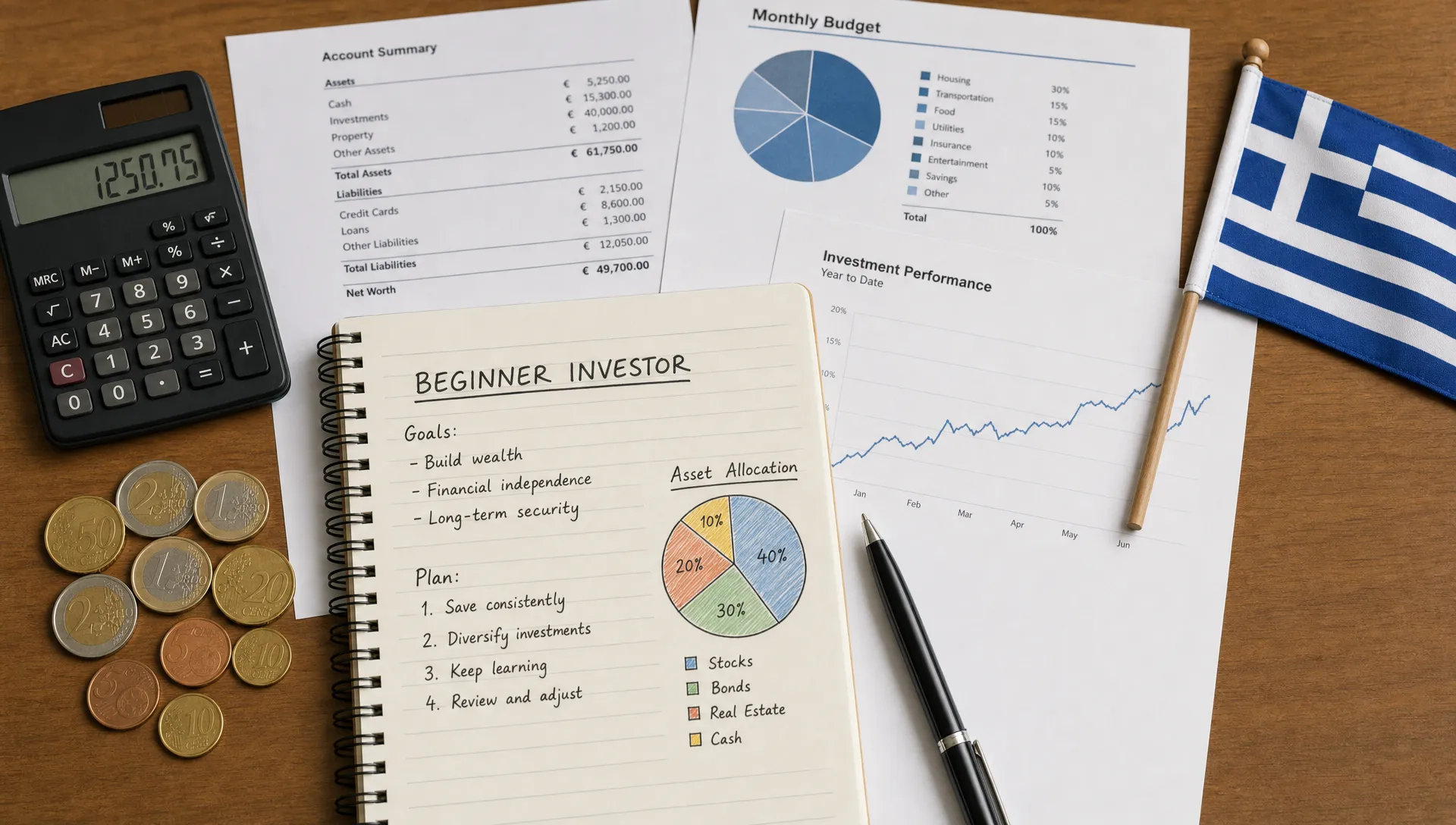
A good beginner portfolio starts with goals, not predictions. Ask what the money is for and when you may need it. Money needed in the next one to three years generally should not be exposed heavily to stock market volatility. Long-term money can usually tolerate more fluctuation, but only if you can stay disciplined.
A Greece-aware portfolio might include Greek exposure, but it does not need to be entirely Greek. For example, a beginner may combine global diversification with a smaller allocation to Greek shares or bonds. The exact mix depends on age, income stability, debt, emergency savings, and risk tolerance.
Greek Shares covers the fundamentals of asset mix in its beginner portfolio building guide, which is a helpful next step if you are still deciding how stocks, bonds, cash, and funds might work together.
Here is a simple way to think about portfolio roles:
| Portfolio component | Purpose | Beginner note |
|---|---|---|
| Emergency cash | Covers unexpected expenses | Build this before taking major investment risk |
| Broad diversified assets | Forms the long-term core | Helps reduce dependence on one country or sector |
| Greek stocks or funds | Adds local market exposure | Keep position sizes reasonable while learning |
| Bonds or lower-risk assets | Adds income and stability | Understand interest-rate risk before buying |
| Learning allocation | Small amount for practice | Use it to gain experience without risking your plan |
The “learning allocation” idea can be useful. Instead of putting a large amount into your first stock idea, you can start small, track your reasoning, and review what happened. This turns investing into a process rather than a one-time bet.
Researching Greek stocks without guessing
Beginners often start with familiar company names. Familiarity can help you understand a business, but it is not a complete investment thesis. A company you know as a customer may still be too expensive, too indebted, or facing weak growth.
When researching a Greek-listed company, focus on the basics first. What does the business sell? Where does revenue come from? Is profit growing? How much debt does it carry? Does it generate cash, or only accounting earnings? Who are its competitors? What could go wrong?
Company announcements, annual reports, and financial statements are more reliable than rumors. If you cannot explain in a few sentences why you are buying, what would make you sell, and what risks you are accepting, you may not be ready to invest in that company yet.
For a deeper beginner-friendly approach, read Greek Shares’ guide on how to research stocks before buying.
Common beginner mistakes to avoid
One common mistake is investing before building a financial foundation. If you have high-interest debt, no emergency fund, or unstable income, taking market risk may add stress rather than build wealth.
Another mistake is confusing price with value. A share trading at €2 is not automatically cheaper than a share trading at €20. What matters is the value of the whole company compared with its earnings, assets, growth prospects, and risks.
Beginners also tend to overtrade. Frequent buying and selling can increase fees, taxes, and emotional decision-making. A slower process often works better: research, decide, document your thesis, size the position carefully, and review periodically.
Finally, avoid building a portfolio from tips. A tip may occasionally work, but it does not teach you risk management. If you cannot evaluate the idea yourself, you are depending on someone else’s confidence instead of your own understanding.
A practical first-month checklist
If you are serious about investing in Greece, your first month does not need to involve buying anything. It can be a preparation period.
- Write down your investing goal and time horizon.
- Build or review your emergency fund.
- Decide how much you can invest monthly without pressure.
- Learn the difference between stocks, bonds, ETFs, and cash.
- Compare regulated brokers and their fee schedules.
- Read official company announcements before relying on opinions.
- Start with small amounts if you decide to invest.
- Keep records of every transaction and the reason behind it.
This checklist may sound basic, but basics protect beginners from expensive errors. The goal is not to become perfect before starting. The goal is to avoid starting blindly.
Frequently Asked Questions
Is Greece a good place to invest for beginners? Greece can be part of a beginner’s investment plan, but it should be approached with diversification and risk management. The market offers opportunities, yet it is smaller and can be more concentrated than larger global markets.
Can foreigners invest in Greek stocks? In many cases, foreign investors can access Greek stocks through brokers that offer the Athens Stock Exchange or through funds with Greek exposure. Requirements depend on the broker, investor residency, and account documentation.
How much money do I need to start investing in Greece? The amount depends on your broker’s minimums, fees, and the assets you choose. Many beginners start with modest monthly contributions, but it is important to have emergency savings and avoid investing money needed soon.
Are Greek stocks risky? Yes, Greek stocks carry market risk, company risk, liquidity risk, and country-specific risk. Some companies may be financially strong, while others may be highly cyclical or less liquid. Research and position sizing are essential.
Should I invest only in Greek companies if I live in Greece? Usually, beginners should be careful about investing only in their home market. If your income and expenses are already connected to Greece, global diversification can reduce concentration risk.
Do I need a tax advisor before investing? For small and simple investments, you may begin by learning the basics and keeping good records. If you have cross-border income, large amounts, complex products, or uncertainty about reporting, a qualified tax advisor is strongly recommended.
Keep learning before you scale up
Investing in Greece does not have to be complicated, but it should be intentional. Start with your goals, understand the available investment types, choose your broker carefully, keep tax records, and avoid concentrating too much money in one idea.
As your confidence grows, you can move from basic concepts to company research, portfolio construction, and risk management. Greek Shares is built to help investors do exactly that through educational guides, market-focused articles, and beginner-friendly explanations that make the stock market easier to understand.