



The phrase “best investments” sounds like it should lead to a list of tickers. In reality, the stock market’s best investments are rarely discovered by copying someone else’s list. They are found through a repeatable process that matches business quality, valuation, risk, and your own goals.
A great investment for a 30-year-old building wealth may be wrong for a retiree who needs income. A fast-growing company can still be a poor investment if the price already assumes perfection. A boring dividend stock can be excellent if it protects capital and compounds steadily for years.
So the better question is not “What should I buy today?” It is “How do I recognize a stock market opportunity that is attractive enough, durable enough, and suitable enough for my portfolio?”
This guide gives you a practical framework for finding stock market best investments without relying on hype, hot tips, or short-term predictions.
Start by Defining “Best” for Your Situation
Before analyzing any company, define what “best” means for you. The best investment is the one that helps you reach a specific goal with an acceptable level of risk.
Some investors want long-term capital growth. Others want dividend income, inflation protection, lower volatility, or a balanced mix. Without that clarity, every market narrative can sound convincing.
A strong personal investment definition includes three things:
- Your time horizon, such as 3 years, 10 years, or 25 years
- Your risk tolerance, including how much volatility you can handle without panic selling
- Your return objective, such as market-like returns, income, or higher growth with higher risk
This matters because the same stock can be attractive for one investor and unsuitable for another. A small growth company may offer high upside but also large drawdowns. A broad market ETF may be less exciting, but it can be one of the best choices for investors who want diversification and simplicity.
If you are still building your process, Greek Shares has a useful guide on how to invest in the stock market with confidence by focusing on preparation and risk control rather than predictions.
Look for Businesses, Not Just Stock Charts
Many investors start with price movement. They ask what is up, what is down, or what looks ready to break out. Price matters, but it should not be the first thing you study.
A stock is ownership in a business. Over long periods, the value of that ownership is driven by earnings, cash flow, competitive position, capital allocation, and the price you pay. Charts can show sentiment, but they cannot replace business analysis.
When looking for potential best investments, ask whether the company has a business that can become more valuable over time. Good signs include:
- A product or service customers need repeatedly
- Revenue that is not overly dependent on one customer or one short-term trend
- A balance sheet strong enough to survive recessions
- Management that invests capital wisely
- A competitive advantage that is difficult to copy
This is why experienced investors often study industries before studying individual stocks. If you understand how an industry makes money, what threatens it, and what creates long-term demand, you can separate real opportunities from temporary excitement.
For example, demographic trends can affect health care, insurance, housing, and consumer services. If you are researching the long-term need for elder support, it can help to study real service providers such as home care providers like Omegayksi, not because every operator is investable, but because real-world examples reveal what customers value, what costs matter, and where demand may be persistent.
Use a Quality Checklist Before You Think About Price
The best stock market investments usually share a common feature: the underlying business is better than average. That does not mean every great business is a great stock at any price. It means quality should be filtered first, then valuation.
Here is a simple quality checklist you can use when reviewing a company.
| Quality factor | What to look for | Why it matters |
|---|---|---|
| Revenue durability | Recurring sales, repeat customers, or essential products | Helps earnings survive difficult periods |
| Profitability | Healthy margins and returns on capital | Shows the company can turn sales into value |
| Balance sheet strength | Manageable debt and enough liquidity | Reduces the risk of permanent capital loss |
| Competitive advantage | Brand, scale, network effects, patents, cost advantage, or switching costs | Protects profits from competitors |
| Management quality | Clear strategy, disciplined acquisitions, sensible buybacks, honest communication | Determines how shareholder capital is used |
| Growth runway | Expanding market, pricing power, or new products | Creates room for long-term compounding |
You do not need perfection in every category. Few companies have it. But if a company fails most of these tests, the investment case should be very strong elsewhere, usually in valuation or a credible turnaround.
A common mistake is to buy a weak business simply because the stock has fallen. A cheap price can become cheaper if earnings keep declining, debt becomes unmanageable, or the business model breaks. The best investors distinguish between a temporarily unpopular company and a permanently damaged one.
Understand Valuation, Because Price Changes Everything
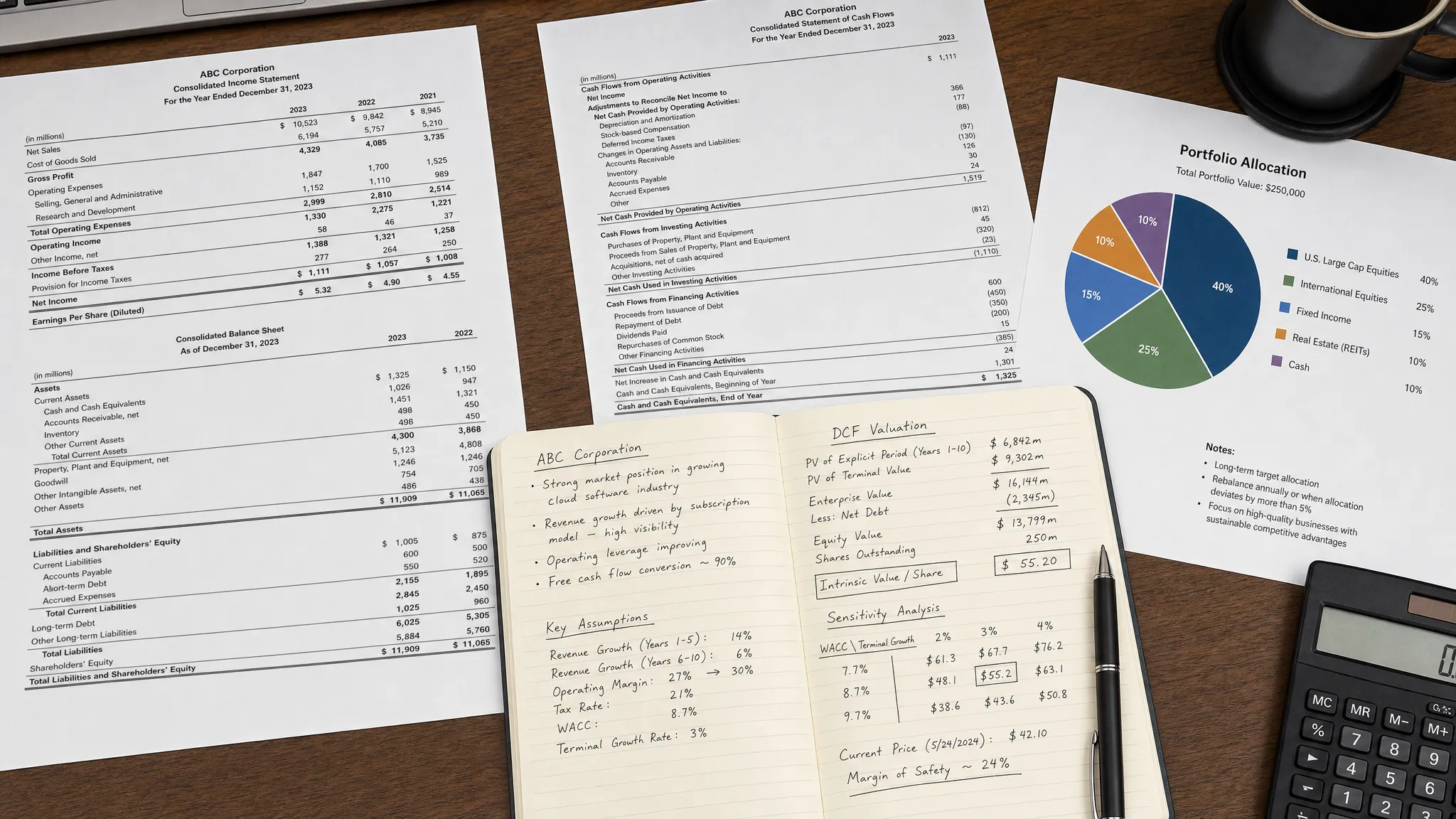
A wonderful company can be a disappointing investment if you overpay. A mediocre company can sometimes be a profitable investment if the price is low enough and the risks are already reflected. Valuation is the bridge between a good business and a good investment.
Common valuation tools include price-to-earnings, price-to-sales, price-to-book, free cash flow yield, dividend yield, and discounted cash flow analysis. None of these metrics works perfectly in isolation. Each must be interpreted based on the industry, growth rate, profitability, and balance sheet.
For example, a software company with high recurring revenue may deserve a higher valuation than a cyclical steel producer. A bank should not be valued the same way as a biotechnology company. A retailer with thin margins needs a different analysis than a company with strong pricing power.
A practical valuation question is this: “What must go right for this stock to produce a good return from today’s price?”
If the answer requires flawless execution, rapid growth, expanding margins, and a permanently high valuation multiple, the margin of safety may be too small. If the stock can perform reasonably well under conservative assumptions, it may deserve closer attention.
Before buying, it is worth comparing your thesis against a structured set of questions. Greek Shares has a dedicated guide with 10 questions to ask before buying stocks, which can help you avoid rushing into an idea before the facts support it.
Separate Great Stories From Great Investments
The market loves stories. Artificial intelligence, clean energy, defense, luxury goods, cloud computing, emerging markets, and new medical technology can all create powerful narratives. Some narratives become outstanding investments. Others become bubbles.
A story becomes investable only when it connects to measurable business results. That means revenue growth, margins, cash flow, market share, and returns on capital. If the story is exciting but the numbers never improve, you may be buying hope instead of value.
To test an investment story, look for evidence in the financial statements:
- Is revenue growing faster than the industry, or only because of acquisitions?
- Are profit margins improving, stable, or deteriorating?
- Is the company generating free cash flow, or only accounting profits?
- Is share dilution reducing the value of your ownership?
- Is debt helping growth, or creating fragility?
The U.S. Securities and Exchange Commission’s Investor.gov is a helpful resource for understanding basic investment concepts, risk, and disclosures. Even if you invest outside the United States, the principles of reading filings, understanding fees, and avoiding fraud are broadly useful.
Study Risk Before You Study Upside
Most investors naturally focus on how much they can make. Better investors first ask how much they can lose and why.
Risk is not just volatility. A stock moving up and down is not necessarily dangerous if the underlying business remains strong. The bigger danger is permanent loss of capital, when the value of the business is impaired or the price paid was far too high.
Important risks to examine include:
- Business risk, such as falling demand, disruption, or loss of customers
- Financial risk, especially excessive debt or weak cash flow
- Valuation risk, when expectations are too high
- Management risk, including poor capital allocation or weak governance
- Portfolio risk, when too much money is concentrated in one idea
Position sizing is one of the most underrated parts of finding the stock market’s best investments. Even a strong idea can hurt your portfolio if it becomes too large and something unexpected happens. A smaller position in a higher-risk stock can be sensible, while a larger position may be reserved for companies with stronger balance sheets, durable earnings, and clearer visibility.
A useful rule is to decide your maximum position size before you buy. That prevents emotion from taking over after the stock rises or falls.
Think in Market Cycles, But Do Not Try to Predict Every Turn
The best investments often depend on where markets and economies are in the cycle. Early in recoveries, cyclical sectors may perform well. Late in expansions, quality businesses with pricing power and strong balance sheets can become more attractive. During recessions, defensive sectors and financially resilient companies may hold up better.
However, cycle analysis should guide your expectations, not become a guessing game. No one can consistently predict exact tops and bottoms. The goal is to understand which types of businesses are likely to be helped or hurt by interest rates, inflation, consumer spending, credit conditions, and earnings trends.
For a deeper look at how different sectors and styles behave across environments, you can review Greek Shares’ article on what performs best in stock market cycles.
The most important point is balance. If your portfolio only owns companies that perform well in one specific environment, you may be exposed when conditions change. The best investors build portfolios that can survive multiple scenarios.
Build a Repeatable Research Process
Finding excellent investments is not about having one brilliant idea. It is about using a process that helps you compare opportunities consistently.
A simple research workflow can look like this:
- Define the investment category, such as growth, value, dividend, turnaround, or index exposure.
- Screen for basic quality, including profitability, debt, revenue growth, and cash flow.
- Read the latest annual report, investor presentation, and earnings call transcript.
- Identify the main drivers of future returns, such as earnings growth, dividends, buybacks, or valuation improvement.
- Estimate a fair value range using conservative, base, and optimistic assumptions.
- Write down the key risks that would prove your thesis wrong.
- Decide position size, buy price, and review schedule before placing an order.
Writing things down is powerful. It forces you to be specific. Instead of saying “this is a great company,” you might write, “I expect earnings to grow 8% to 10% annually for the next five years, debt to remain manageable, and the valuation to stay near its historical average.” That thesis can later be tested against reality.
If you cannot explain why you own a stock in a few clear sentences, you may not understand it well enough yet.
Know the Red Flags That Usually Disqualify an Investment
Some investments look attractive because the headline numbers are strong, but the details reveal danger. Avoiding poor investments is just as important as finding good ones.
Watch carefully for these red flags:
- Revenue growth without profit or cash flow improvement
- Heavy debt combined with rising interest costs
- Frequent share issuance that dilutes existing investors
- Management that constantly promotes the stock but avoids hard questions
- One-time gains that make earnings look better than they are
- A valuation that requires unrealistic future growth
- A business model you cannot clearly understand
The best investment may be the one you avoid. Preserving capital gives you the ability to act when better opportunities appear. This is why patience is not passive. It is an active part of intelligent investing.
Compare Individual Stocks With Funds and ETFs
When people search for the stock market’s best investments, they often think only of individual stocks. But for many investors, broad index funds or ETFs may be more appropriate.
Individual stocks can offer higher upside if you identify exceptional companies early and hold them through compounding. They also require more research, more emotional discipline, and greater tolerance for company-specific risk.
Funds and ETFs offer diversification, simplicity, and lower dependence on one company’s outcome. They can be especially useful as a portfolio core, with individual stocks added only when you have a clear edge or strong conviction.
A practical approach is core and satellite investing. The core may be diversified funds aligned with your long-term goals. The satellite portion may include selected individual stocks where your research supports a higher-conviction view.
This structure helps investors participate in the market while still leaving room for carefully chosen opportunities.
Frequently Asked Questions
What are the stock market’s best investments for beginners? For many beginners, diversified funds or ETFs are often more suitable than individual stocks because they reduce company-specific risk. Beginners who buy individual stocks should focus on simple businesses, strong balance sheets, reasonable valuations, and position sizes they can handle emotionally.
How do I know if a stock is undervalued? A stock may be undervalued if its price is low compared with realistic future earnings, cash flow, assets, or dividends. The key word is realistic. Compare the company with peers, its own history, and conservative estimates of future performance.
Should I buy stocks when the market is falling? Falling markets can create opportunities, but not every lower price is a bargain. Focus on financially strong companies, long-term business value, and your own cash needs. Never invest money you may need soon simply because prices have dropped.
Is the best investment always the one with the highest return? No. The best investment is the one that offers attractive potential return relative to risk and fits your goals. A lower-return investment with lower risk and better suitability may be better than a volatile stock that creates stress or forces poor decisions.
How often should I review my investments? Long-term investors do not need to react to every daily price move, but they should review holdings periodically. A quarterly or semiannual review can be enough for many portfolios, unless major company-specific news changes the investment thesis.
Make Better Investment Decisions One Step at a Time
Finding the stock market’s best investments is not about chasing the loudest trend. It is about developing a disciplined process: define your goal, study the business, judge valuation, understand risk, and build a portfolio that can survive uncertainty.
The more consistent your process becomes, the less dependent you are on tips, headlines, and emotions. Greek Shares exists to help investors strengthen that process through practical education, market guides, and decision-making frameworks you can apply over time.