


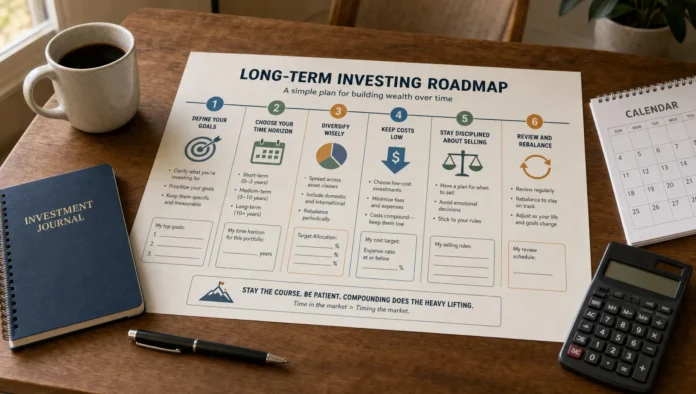
Wise investing is not about finding the perfect stock tip, predicting every market turn, or copying the loudest opinion online. It is about building a repeatable process that helps you make better decisions, manage risk, and stay invested long enough for compounding to work.
For many people, the stock market feels complicated because prices move every day, financial media creates urgency, and investors often confuse action with progress. A wiser approach starts with a simple question: What job should your investments do for you?
If your goal is long-term wealth building, your strategy will look very different from someone saving for a home deposit in two years or someone trying to generate retirement income. This guide will help you think through the key decisions before you invest, so you can approach the stock market with more discipline and less emotion.
Start With the Purpose of Your Money
Before choosing stocks, funds, or a broker, define the purpose of the money you are investing. This matters because the stock market can be rewarding over long periods, but it can also be volatile in the short term.
Money needed soon should usually not be exposed to high market risk. If you need cash for rent, taxes, tuition, medical expenses, or an emergency fund, that money has a different purpose from capital you can leave invested for many years.
A practical way to organize your money is by time horizon:
| Time horizon | Typical goal | Stock market suitability |
|---|---|---|
| 0 to 2 years | Emergency fund, near-term purchase | Usually low suitability |
| 3 to 5 years | Flexible medium-term goal | Limited or cautious exposure |
| 5 to 10 years | Wealth building, future expenses | More suitable with diversification |
| 10+ years | Retirement, long-term financial independence | Often highly suitable if risk is managed |
This does not mean stocks are only for distant retirement goals. It means your allocation should match your timeline. A short timeline gives you less room to recover from downturns. A longer timeline gives your investments more time to benefit from business growth, reinvested earnings, and compounding.
If you are still learning the mechanics of accounts, brokers, indexes, and orders, Greek Shares also has a beginner-friendly introduction in its practical stock market guide for getting started.
Understand What You Are Actually Buying
When you buy a stock, you are not buying a ticker symbol. You are buying a fractional ownership interest in a real business. That business has customers, products, costs, debt, competitors, managers, and future expectations already reflected in its price.
This distinction is important. A stock can represent a great company and still be a poor investment if the price is too high. A struggling company can look cheap but remain risky if its problems are getting worse. Wise investors study both quality and valuation.
At a basic level, ask:
- How does the company make money?
- Is revenue growing, stable, or declining?
- Does the company generate profits and cash flow?
- How much debt does it carry?
- What could hurt the business over the next several years?
- Is the current price reasonable compared with its earnings, assets, or future prospects?
You do not need to become a professional analyst before investing, especially if you use diversified funds. But you should avoid buying something simply because it is popular, mentioned on social media, or recently increased in price.
Diversification Is Your First Line of Defense
No investor can know the future with certainty. Even experienced professionals make wrong calls. Diversification helps protect you from the risk that one company, sector, country, or idea performs badly.
The U.S. Securities and Exchange Commission explains that diversification can help reduce investment risk by spreading money across different assets rather than concentrating it in one place. It does not eliminate risk, but it can reduce the damage from any single mistake or unexpected event.
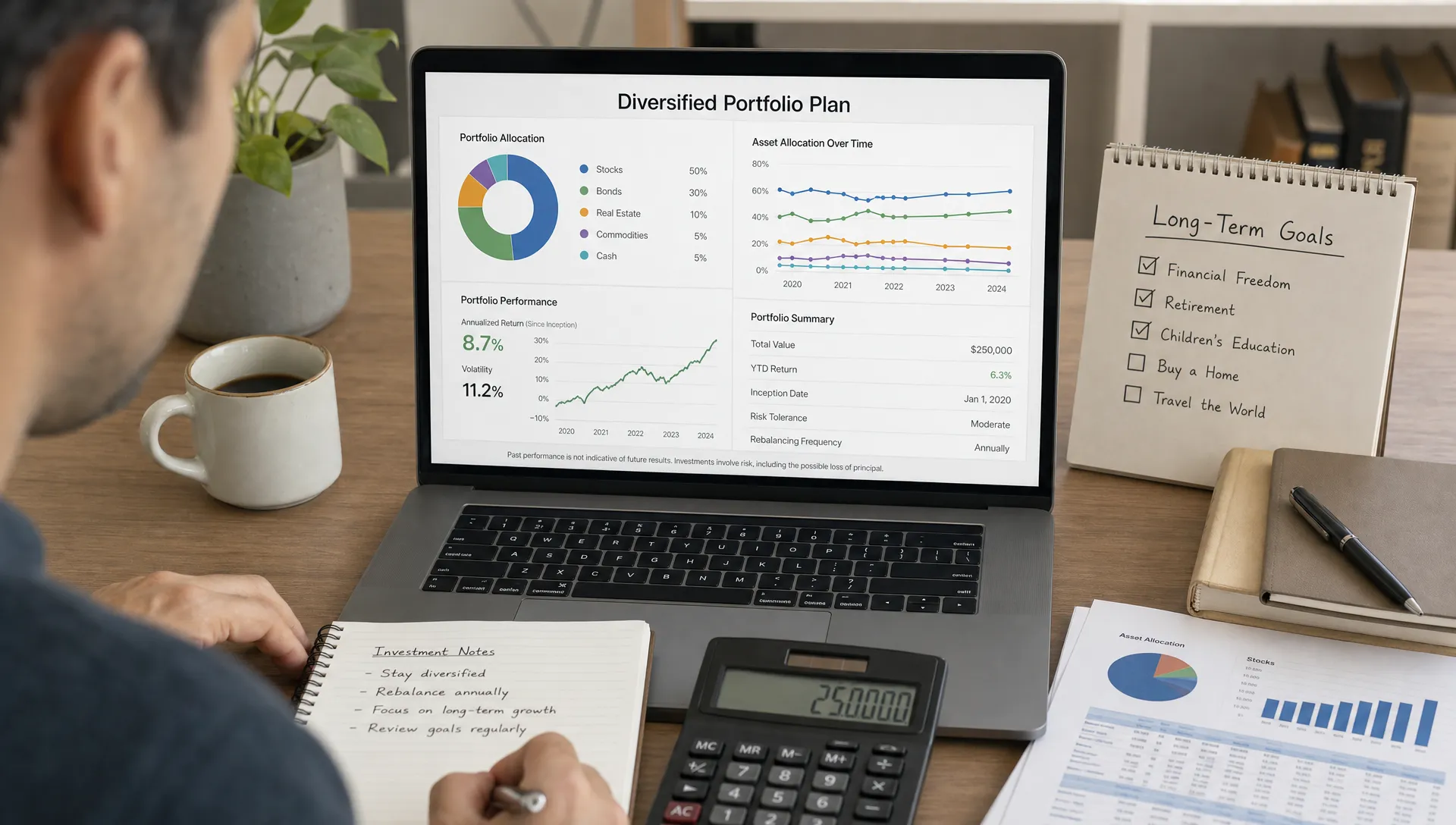
A diversified portfolio may include broad stock market funds, bonds, cash reserves, and possibly exposure to different regions or sectors. The right mix depends on your goals, age, income stability, risk tolerance, and investing knowledge.
Here is a simple comparison:
| Approach | Potential advantage | Main risk |
|---|---|---|
| Single stock portfolio | High upside if picks are right | Very high company-specific risk |
| Sector-focused portfolio | Exposure to a strong theme | Vulnerable if the sector falls out of favor |
| Broad index fund portfolio | Built-in diversification | Still exposed to overall market declines |
| Balanced stock and bond portfolio | Smoother risk profile | May grow more slowly in strong bull markets |
Diversification may feel less exciting than chasing a hot stock. That is exactly why it works for many investors. It shifts your focus away from prediction and toward resilience.
Decide Whether You Are Investing or Trading
Investing and trading are often discussed as if they are the same thing, but they require different skills, timelines, and emotional control.
Investing usually means buying assets based on long-term value, income potential, or broad market growth. Trading usually means attempting to profit from shorter-term price movements. Neither is automatically wrong, but confusing the two can be costly.
For example, an investor who buys a stock for long-term business growth should not panic because of a normal weekly price swing. A trader, on the other hand, needs clear rules for entries, exits, position sizing, and losses. Without those rules, trading can quickly become emotional gambling.
For most beginners, long-term investing is a more realistic place to start. It allows you to focus on savings rate, diversification, fees, tax awareness, and behavior, which are often more controllable than short-term market timing.
If you want a deeper foundation before making decisions, you may find it useful to review the stock market basics guide for new investors, especially if terms like indexes, exchanges, and market orders still feel unclear.
Build a Portfolio Around Risk, Not Hype
A wise stock market plan starts with risk. Many investors do the opposite. They first ask, “How much can I make?” and only later discover how much they could lose.
Risk is not just volatility on a chart. It includes the possibility of needing money during a downturn, overconcentrating in one investment, paying too much, reacting emotionally, misunderstanding a product, or ignoring taxes and fees.
Before investing, define your risk rules. For example, decide how much of your portfolio can go into individual stocks, how much cash you will keep outside the market, and how often you will review your allocation.
A simple risk framework might look like this:
| Risk question | Why it matters |
|---|---|
| What percentage can I lose temporarily without panic selling? | Helps define stock allocation |
| How many years can I leave this money invested? | Aligns investments with time horizon |
| Am I relying on one stock, sector, or country? | Reveals concentration risk |
| Do I understand what I own? | Reduces avoidable mistakes |
| What will make me sell? | Prevents emotional decisions |
This kind of thinking may sound conservative, but it is not anti-growth. It is how investors stay in the game. The stock market rewards patience, but only if you avoid decisions that force you out at the wrong time.
Learn the Difference Between Price and Value
A stock price tells you what the market currently agrees to pay. Value is your estimate of what the business is worth based on its fundamentals and future prospects.
The two are related, but they are not identical. Prices can rise because of enthusiasm, liquidity, momentum, or speculation. They can fall because of fear, temporary disappointment, or broad market weakness. Wise investors learn to ask whether price movements are supported by business reality.
This is where valuation matters. Common valuation measures include price-to-earnings ratio, price-to-sales ratio, dividend yield, free cash flow yield, and comparison with similar companies. None of these metrics is perfect. A high-growth company may deserve a higher valuation than a slow-growth company, while a low valuation may signal either opportunity or serious business risk.
The point is not to find one magic number. The point is to avoid buying blindly. If you cannot explain why an investment is attractive at its current price, you may not have an investment thesis yet.
Keep Fees, Taxes, and Turnover Under Control
Investment returns are uncertain, but costs are certain. Fees, spreads, taxes, and unnecessary trading can quietly reduce your results over time.
Low-cost diversified funds can be attractive because they reduce the hurdle your portfolio must overcome. Individual stocks do not usually have fund management fees, but frequent buying and selling can still create costs, tax consequences, and behavioral mistakes.
Turnover also matters. Every time you sell, you are making a new decision under uncertainty. Sometimes selling is correct. But if you constantly change positions because of headlines, you may never give your original thesis time to develop.
A wise investor reviews costs in three places:
- Fund expense ratios and account fees.
- Trading costs, spreads, and currency conversion charges.
- Tax treatment of dividends, capital gains, and foreign holdings.
Tax rules vary by country and personal situation, so it is wise to consult a qualified tax professional when needed. The key principle is simple: what you keep after costs and taxes matters more than the headline return.
Use Evidence, But Stay Humble
Markets are competitive. Millions of investors, analysts, institutions, algorithms, and funds are constantly evaluating information. That does not mean you cannot make good decisions. It means humility is essential.
The SPIVA research from S&P Dow Jones Indices has repeatedly shown that many active fund managers underperform their benchmarks over long periods. This is one reason index investing has become popular. It also reminds individual investors that consistently beating the market is difficult.
However, “difficult” does not mean “impossible,” and it does not mean every investor must use the same strategy. Some people prefer broad funds. Others enjoy researching individual businesses. Some combine both, using diversified funds as a core and individual stocks as a smaller satellite allocation.
The wise approach is to match your strategy with your skill, time, temperament, and willingness to learn. If you choose individual stocks, keep position sizes reasonable and track your decisions. If you choose funds, avoid constantly switching because one fund performed better last year.
Protect Your Mindset as Much as Your Portfolio
Investor behavior is often the difference between a good plan and a poor outcome. A sensible portfolio can still fail if the investor panics during downturns, chases bubbles, or abandons the plan at the worst possible moment.
Financial decisions are also affected by sleep, stress, health, and daily routines. If you are exhausted, anxious, or constantly reacting to market noise, your judgment can suffer. Many serious investors underestimate the value of stepping away, exercising, resting, and creating a stable decision-making environment. Some people even build broader wellness routines with tools such as at-home compression and red light therapy devices to support recovery and consistency outside their financial life.
Good investing is not just intellectual. It is behavioral. You need a process that works when markets are rising and when they are falling.
Consider creating personal rules such as:
- Do not buy a stock the same day you first hear about it.
- Write down the reason for every investment before buying.
- Review your portfolio on a schedule rather than every hour.
- Avoid making major decisions when angry, fearful, or euphoric.
- Compare results against your plan, not someone else’s social media post.
These rules are simple, but they create friction between emotion and action. That friction can save you from many avoidable mistakes.
Know When to Sell Before You Buy
Many investors spend a lot of time deciding what to buy and very little time deciding when to sell. This creates confusion later.
Before buying an investment, write down what would make you sell. Your reason might be that the business thesis is broken, the valuation becomes extreme, the position grows too large, you need to rebalance, or your personal goal changes.
A falling price alone is not always a reason to sell. Sometimes it creates opportunity. But a falling price combined with deteriorating fundamentals may be a warning sign. Likewise, a rising price is not always a reason to hold forever. Sometimes a stock becomes so expensive that future returns become less attractive.
A written sell discipline helps you separate signal from noise. It also allows you to evaluate your decisions later. Did you sell because the facts changed, or because you were uncomfortable? Did you hold because the thesis remained strong, or because you did not want to admit a mistake?
Review Your Portfolio Without Overreacting
A portfolio review is not the same as portfolio tinkering. The goal is to check whether your investments still match your plan, not to create activity for its own sake.
For many long-term investors, a quarterly or semiannual review is enough. During that review, look at allocation, concentration, performance, fees, and whether your goals or personal circumstances have changed.
Useful review questions include:
- Is my portfolio still aligned with my time horizon?
- Has any single holding become too large?
- Am I taking more risk than I intended?
- Do I still understand why I own each investment?
- Are my contributions and savings rate on track?
If you want to strengthen your decision-making process further, Greek Shares has a useful article on stock market investing mistakes to avoid early on. Avoiding major errors can be just as important as finding great opportunities.
A Simple Wise Investing Checklist
Before putting money into the stock market, pause and run through a basic checklist. It will not guarantee profits, but it can reduce impulsive decisions.
| Checklist item | What to confirm |
|---|---|
| Financial foundation | You have handled high-interest debt and basic cash reserves |
| Time horizon | The money can remain invested long enough to handle volatility |
| Strategy | You know whether you are using funds, stocks, or both |
| Diversification | You are not depending on one company or theme |
| Valuation | You have considered price versus fundamentals |
| Costs | Fees, taxes, and trading costs are understood |
| Behavior | You have rules for buying, selling, and reviewing |
The goal is not perfection. The goal is to create a process that is clear enough to follow and flexible enough to improve over time.
Frequently Asked Questions
How much money do I need to start investing in the stock market? You do not need to be wealthy to begin learning or investing, but you should first have a stable financial foundation. The exact amount depends on your broker, country, and chosen investments. Many investors start small while focusing on consistency and education.
Is it better to buy individual stocks or index funds? It depends on your knowledge, time, and temperament. Broad index funds offer diversification and simplicity, while individual stocks require more research and carry more company-specific risk. Some investors use both, with diversified funds as the core of the portfolio.
Can I lose all my money in the stock market? If you put all your money into one company, a total loss is possible if that company fails. A diversified portfolio greatly reduces single-company risk, although it can still decline during market downturns.
How often should I check my investments? Long-term investors usually do not need to check prices constantly. Reviewing your portfolio on a planned schedule, such as quarterly or twice a year, can help you stay disciplined and avoid emotional reactions.
What is the biggest mistake new investors make? One of the biggest mistakes is investing without a plan. This often leads to chasing hype, selling in panic, taking too much risk, or buying assets that do not match personal goals.
Continue Learning Before You Invest More
The stock market can be a powerful wealth-building tool, but wisdom matters more than excitement. Start with your goals, understand what you own, diversify carefully, control costs, and create rules that protect you from emotional decisions.
If you want a structured way to deepen your knowledge, explore Greek Shares and continue building your financial education step by step. The more clearly you understand your process, the more confidently you can invest for the long term.