


Buying your first stock can feel like stepping into a noisy room where everyone is shouting numbers, opinions, and predictions. The good news is that you do not need to master every market theory before you begin. You do need a practical foundation, because the stock market rewards patience, preparation, and clear thinking far more reliably than excitement.
The most useful thing to know about stock market basics is that investing is not about guessing tomorrow’s price. It is about understanding what you own, why you own it, how much risk you are taking, and whether your choices match your financial goals.
This guide walks through the core ideas beginners should understand before investing real money, from how stocks work to risk, diversification, fees, and decision-making habits.
The stock market is a marketplace for ownership
A stock represents a small ownership stake in a company. When you buy shares, you are not just buying a price chart. You are buying exposure to a business, its profits, its future growth, its management decisions, and its risks.
The stock market is where buyers and sellers exchange those shares. Prices move because investors constantly reassess what a company may be worth. Strong earnings, new products, interest rate changes, recessions, regulation, investor sentiment, and global events can all affect prices.
For new investors, the key point is simple: a stock’s price can change quickly, but the long-term value of a stock is tied to the business behind it. That does not mean every good company is automatically a good investment. Price still matters. A wonderful business bought at an extremely expensive valuation can produce disappointing returns.
If you want a broader first explanation of exchanges, brokers, and how prices move, Greek Shares also has a helpful guide to stock market basics for new investors.
Investing is not the same as trading
Many beginners use the words “investing” and “trading” as if they mean the same thing. They do not.
Investing usually means buying assets with the intention of holding them for years. The investor’s focus is on business quality, valuation, diversification, and long-term compounding. Trading usually means trying to profit from shorter-term price movements. Traders may use charts, momentum, news events, or technical signals.
Neither approach is automatically right or wrong, but they require different skills, time commitments, and emotional discipline. Problems often happen when someone says they are investing, but behaves like a short-term trader whenever prices fall.
| Approach | Typical focus | Common beginner risk |
|---|---|---|
| Long-term investing | Business value, asset allocation, compounding | Losing patience during normal volatility |
| Short-term trading | Price movement, timing, market patterns | Overtrading, high stress, and poor risk control |
| Speculating | A story, rumor, trend, or quick-profit idea | Confusing excitement with evidence |
Before buying anything, decide which approach you are actually following. If your plan depends on predicting what a stock will do next week, you are not investing in the same way as someone building a long-term portfolio.
Know what should be in place before your first investment
The stock market is not the right place for every dollar you have. Money needed for rent, bills, emergency expenses, tuition, or a near-term purchase should generally not be exposed to market swings. Stocks can fall sharply at exactly the wrong time, and being forced to sell during a downturn can turn a temporary decline into a permanent loss.
Before investing, think through three basic questions.
- What is this money for?
- When will I likely need it?
- How much loss could I tolerate without making a panicked decision?
A beginner with a 20-year retirement goal can usually tolerate more volatility than someone saving for a house deposit next year. Time horizon matters because stocks have historically rewarded patient investors, but short-term results are unpredictable.
This is also where financial order matters. High-interest debt, no emergency fund, and unclear goals can make investing emotionally difficult. A portfolio should support your financial life, not create pressure inside it.
The same principle applies to other major money decisions: verify the details before committing. If someone were importing a vehicle, for example, they would want reliable documentation such as official EU conformity paperwork rather than relying on assumptions. With stocks, your “paperwork” is the company’s financial reports, fee disclosures, risk information, and your own written plan.
Understand risk before chasing return
Every investment involves risk. The goal is not to eliminate risk completely, because that is impossible. The goal is to understand which risks you are taking and whether you are being compensated for them.
The U.S. SEC’s Investor.gov explains investing concepts for individuals, including the importance of understanding risk, diversification, and investment products through its investing basics resources. Beginners should treat education as part of the investing process, not as something optional.
Here are common risks new investors should recognize:
| Risk type | What it means | Beginner-friendly response |
|---|---|---|
| Market risk | The overall market falls, pulling many stocks down | Avoid investing money needed soon and diversify |
| Business risk | A company performs worse than expected | Study the business and avoid overconcentration |
| Valuation risk | You pay too much for future growth | Compare price with earnings, cash flow, and growth expectations |
| Liquidity risk | You cannot sell easily at a fair price | Be careful with thinly traded securities |
| Currency risk | Foreign investments move due to exchange rates | Understand your exposure across countries and currencies |
| Behavioral risk | You panic, chase hype, or ignore your plan | Use rules, journals, and position limits |
Behavioral risk deserves special attention. Many investors know the right answer intellectually, but do the wrong thing emotionally. They buy after a big run because they fear missing out, then sell during a decline because losses feel unbearable.
That is why your first investment plan should be simple enough to follow when markets are uncomfortable.
Diversification is your first defense
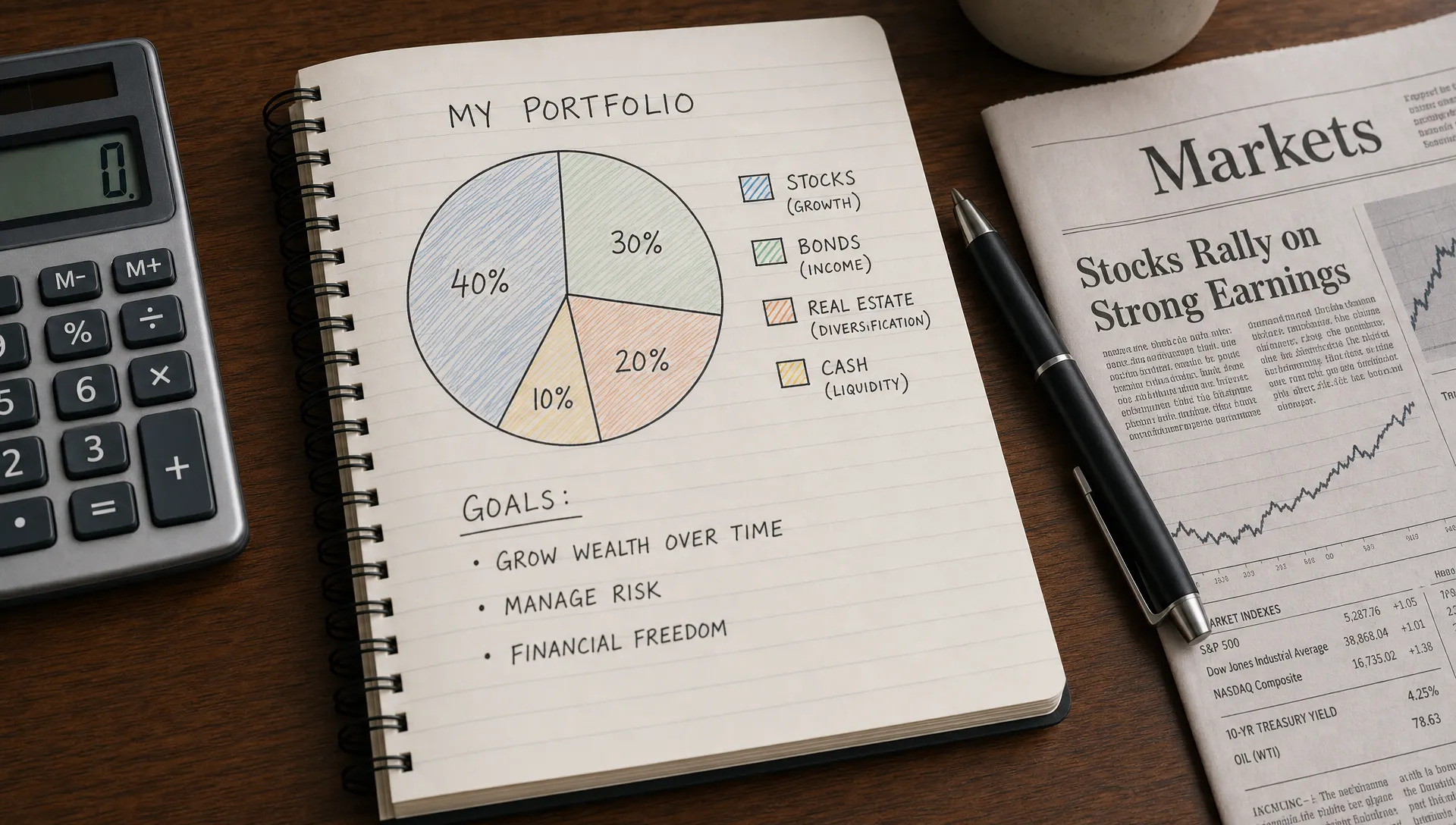
Diversification means spreading your money across different investments so one mistake does not destroy your entire portfolio. It can include owning multiple companies, sectors, countries, and asset types.
A concentrated portfolio can produce strong gains if you are right, but it can also create painful losses if one company disappoints. Beginners often underestimate this risk because they focus on upside stories. They imagine what could go right without asking what happens if they are wrong.
Diversification does not guarantee profits or prevent losses, but it can reduce the impact of any single bad outcome. For many beginners, diversified funds are easier to understand and manage than a collection of individual stocks. Others prefer to learn by owning a small number of individual companies while keeping most of their money diversified.
There is no single perfect structure for every investor. What matters is that your portfolio is intentional rather than random.
Learn basic orders, fees, and account mechanics
Before placing your first order, understand what your broker is actually doing. A brokerage account is the platform that lets you buy and sell securities. The broker may offer different order types, research tools, account options, and fee structures.
The two most common order types beginners see are market orders and limit orders.
| Order type | What it does | What beginners should know |
|---|---|---|
| Market order | Buys or sells immediately at the best available price | Execution is usually fast, but the final price can differ from what you expected |
| Limit order | Buys or sells only at a price you set or better | Price control is better, but the order may not be filled |
Fees also matter. A trade with zero commission may still involve costs such as bid-ask spreads, fund expense ratios, foreign exchange charges, or account fees. Taxes matter too, although rules vary by country, account type, holding period, and personal situation. Beginners should avoid making investment decisions based only on tax assumptions unless they have checked the rules that apply to them.
A useful habit is to slow down before every purchase and ask: What am I buying, what will it cost, what could go wrong, and when would I sell?
Read the business, not just the ticker
A ticker symbol is only a shortcut. The real investment is the business behind it.
When looking at a company, beginners should learn to connect the story with the numbers. A company may have an exciting product, but if it is losing money, taking on debt, or issuing many new shares, the investment case may be weaker than the headline suggests.
Start with a few practical questions:
- How does the company make money?
- Are sales and profits growing consistently?
- Does the company have too much debt?
- Is management allocating capital wisely?
- What are investors already expecting at the current price?
- What would prove your investment thesis wrong?
This is where basic analysis becomes valuable. You do not need to become a professional analyst, but you should know the difference between a strong business and a strong narrative. Greek Shares covers this in more detail in its guide to stock market analysis basics for everyday investors.
Valuation is especially important. A company can be popular, innovative, and growing, yet still be overpriced. The higher the expectations built into a stock, the more vulnerable it may be if growth slows.
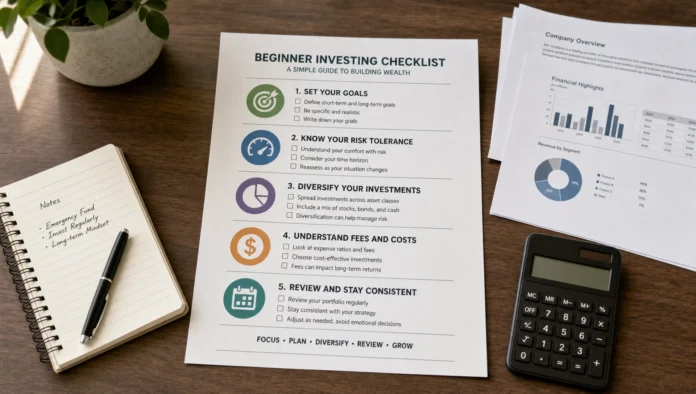
Build a simple first-investment checklist
A checklist helps beginners avoid emotional decisions. It does not need to be complicated. In fact, a simple checklist you actually use is better than a complex system you ignore.
Before investing, consider these checkpoints:
- I have a clear goal and time horizon for this money.
- I understand what the investment is and how it can lose value.
- I am not investing money I may need soon.
- I know the main fees and possible tax considerations.
- I have considered diversification and position size.
- I can explain why I am buying without using hype or rumors.
- I have a plan for what would make me review, add, hold, or sell.
This is not about removing uncertainty. Markets are always uncertain. The purpose is to make sure your decision is based on a process rather than impulse.
Many early mistakes come from moving too fast, chasing recent winners, copying influencers, or buying before understanding risk. If you want to strengthen your habits, review these common stock market investing mistakes to avoid early on.
Keep learning after you start
Investing education does not end after your first purchase. In many ways, it begins there. Real market experience teaches you how you react to gains, losses, boredom, volatility, and uncertainty.
One of the best beginner habits is keeping an investment journal. Write down why you bought, what you expected, what risks you saw, and what would change your mind. Later, compare what actually happened with what you believed at the time. This helps you separate good decisions with bad outcomes from bad decisions that happened to work once.
Also be careful with financial media. News can be useful, but it is designed to move quickly. Your long-term plan should not change every time a headline appears. A calm investor filters information. A reactive investor gets pulled in every direction.
If you are just starting, focus on understanding durable principles: cash flow, valuation, diversification, risk management, fees, taxes, and behavior. These concepts remain useful across market cycles.
Frequently Asked Questions
How much money do I need to start investing in stocks? You do not need a large amount to begin learning, but you should only invest money that fits your budget, goals, and time horizon. Many beginners start small while they learn how markets and their own emotions behave.
Is the stock market safe for beginners? The stock market involves risk, so “safe” depends on what you buy, how diversified you are, how long you can stay invested, and whether you understand potential losses. Education and risk management are essential.
Should I buy individual stocks or funds first? Many beginners find diversified funds easier to manage, while individual stocks require more research and monitoring. The right choice depends on your knowledge, interest, risk tolerance, and goals.
What is the biggest mistake new investors make? A common mistake is investing without a plan, then reacting emotionally to price changes. Buying based on hype and selling during fear can damage long-term results.
How often should I check my investments? Checking too often can encourage emotional decisions. Long-term investors usually benefit from scheduled reviews rather than constant monitoring, unless something material changes about the investment.
Start with clarity, not prediction
You do not need to predict the next market move to become a better investor. You need to understand what you own, why you own it, what risks you are accepting, and how each decision fits your financial goals.
Stock market basics are not just definitions. They are the foundation for better judgment. Learn the mechanics, respect risk, diversify intelligently, and build habits that help you stay calm when markets are not.
Greek Shares is built to help investors keep learning through practical guides, tutorials, and market education. Start with the basics, move at a pace you can sustain, and let knowledge reduce the role of guesswork in your investing decisions.