



If you are asking “stocks what to invest in when I am starting out?”, the smartest answer is usually not a single ticker symbol. It is a simple structure that helps you grow, learn, and avoid one bad decision wiping out your confidence.
Beginners often feel pressure to find the next big winner. Social media makes investing look like a race, but long-term wealth building is usually much quieter. It is built through diversification, consistent contributions, patience, and understanding what you own.
This guide focuses on beginner-friendly stock investments, how to think about risk, when individual stocks make sense, and what to avoid in your first year. It is educational, not personal financial advice, but it can help you build a practical starting point.
Start with the goal, not the stock
Before choosing what to invest in, ask one question: what job is this money supposed to do?
Money you may need in the next 12 to 24 months usually should not be exposed heavily to stocks. Stock prices can fall sharply even when the underlying companies are good. If the money is for rent, a house deposit, tuition, or an emergency fund, safety and liquidity matter more than potential return.
Money you can leave invested for many years has more room to handle market ups and downs. That is where stocks can become powerful, because you give quality businesses and broad markets time to compound.
A beginner’s stock plan should usually pass three tests:
- It is diversified: You are not depending on one company, one sector, or one prediction.
- It is understandable: You can explain what you own and why you own it.
- It is repeatable: You can keep investing through normal market volatility without changing strategy every week.
If you still need a broader roadmap, Greek Shares has a helpful guide on building a simple starter plan for investing in stocks before you focus on specific investments.
The best beginner answer: broad stock index funds or ETFs
For many new investors, the most practical first investment is not an individual stock. It is a broad stock index fund or exchange-traded fund, often called an ETF.
An index fund is designed to track a basket of companies rather than trying to pick one winner. For example, a broad U.S. stock market fund may hold hundreds or thousands of companies. A global stock fund may include companies across multiple countries and sectors.
This matters because beginners are especially vulnerable to concentration risk. If you buy one company and it disappoints, your portfolio can suffer heavily. If you own a broad market fund, one company’s bad quarter usually has a much smaller impact.
Index funds and ETFs are popular with beginners because they are simple, diversified, and often low-cost. They do not require you to analyze every company balance sheet before you begin. You still need to understand risk, but you are starting with a wider safety net.
What stocks to invest in when starting out: the main choices
There is no perfect beginner investment for everyone. The right choice depends on your timeline, risk tolerance, country, account type, and how much time you want to spend researching.
Here is a practical comparison of common starter options.
| Investment type | What it gives you | Why beginners consider it | Main risk |
|---|---|---|---|
| Broad market stock index ETF | Exposure to many companies in one fund | Simple diversification and lower need for stock picking | Can still fall when the whole market falls |
| Global or international stock ETF | Exposure outside your home market | Reduces dependence on one country’s economy | Currency, regional, and geopolitical risks |
| Large-cap blue-chip stocks | Ownership in established companies | Easier to research than tiny speculative companies | Individual company risk still exists |
| Dividend stocks | Potential income plus share price growth | Can appeal to long-term investors seeking cash flow | Dividends can be reduced or stopped |
| Sector ETFs | Exposure to one industry, such as technology or healthcare | Lets you target an area you believe in | Less diversified than total market funds |
| Small allocation to individual stocks | Learning experience and potential upside | Helps you practice research with limited risk | Higher chance of mistakes and volatility |
The key is not to treat all of these equally. A broad market fund is often a better core holding. Individual stocks, sector funds, or dividend stocks can be smaller additions once you understand the risks.
Build a core before adding satellites
A useful way to think about your first portfolio is the “core and satellite” approach.
The core is the stable foundation. It may be a broad stock market ETF, a global index fund, or a mix of diversified funds. This part should be simple enough that you can hold it through market declines without constantly second-guessing yourself.
The satellites are smaller positions around the core. These could include individual companies, sector ETFs, dividend stocks, or other investments you want to study. Satellites let you learn and express views without letting one idea dominate your financial future.
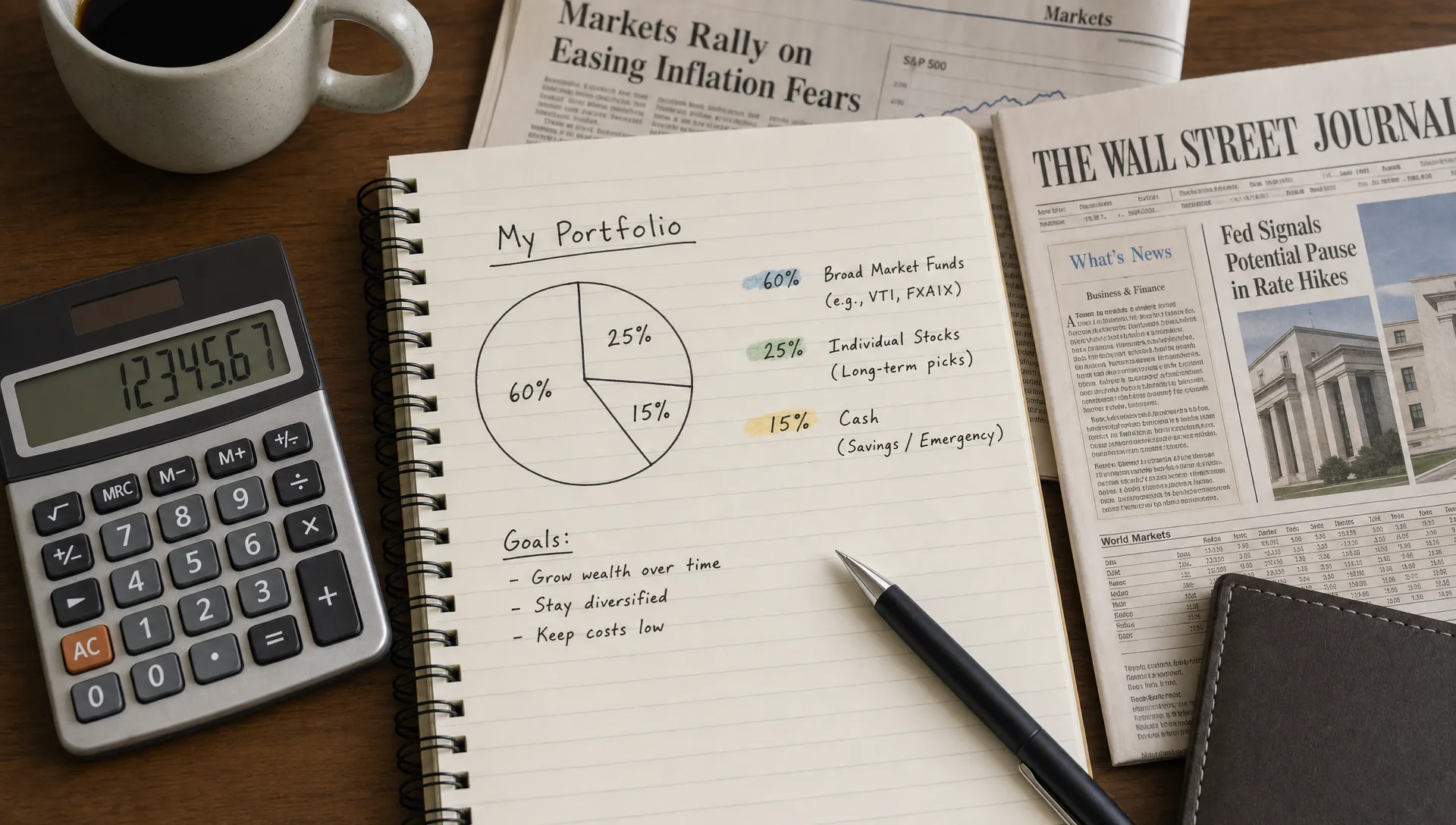
For example, a beginner who wants to invest mostly in stocks might decide that most of the portfolio belongs in diversified funds, while a smaller part is reserved for individual stocks. The exact percentage depends on your risk tolerance, but the principle is important: learn without risking everything on your learning curve.
Beginner portfolio examples for learning purposes
The examples below are not recommendations. They are simple illustrations of how a beginner might organize stock exposure based on comfort with risk.
| Beginner style | Broad stock funds | Individual stocks | Cash or lower-risk assets | Best suited for |
|---|---|---|---|---|
| Cautious learner | 60% | 0% to 5% | 35% to 40% | Someone still building confidence or with a shorter timeline |
| Balanced beginner | 75% | 5% to 10% | 15% to 20% | Someone investing for the long term but still learning |
| Growth-focused learner | 80% to 90% | 10% to 15% | 0% to 10% | Someone with a long timeline and higher tolerance for volatility |
The most important lesson from this table is not the exact percentages. It is that a beginner does not need to choose between “all index funds” and “all individual stocks.” You can combine a diversified foundation with a small learning portfolio.
If you buy individual stocks, choose businesses before stories
Individual stocks can be exciting, but beginners should be careful. A stock is not just a price chart. It is ownership in a business.
Before buying a company, ask what it sells, who its customers are, how it makes money, and why it might still be relevant in five or ten years. If you cannot explain the business in plain language, you probably need more research.
A beginner-friendly individual stock is usually easier to analyze. That often means established companies with recognizable products, steady revenue, manageable debt, and a history of profitability. It does not mean the stock is automatically cheap or safe, but it gives you more information to work with.
Speculative companies can still succeed, but they are harder to evaluate. If a company has no profits, depends on future breakthroughs, or constantly issues new shares to raise cash, you need to understand the risk before investing.
For a more structured learning path, start with what to learn first about stocks before trying to compare companies in detail.
A simple checklist for your first individual stock
When you are ready to research a single stock, avoid jumping straight to opinions online. Start with the business fundamentals.
Use this checklist as a first filter:
- Business model: Can you clearly describe how the company earns revenue?
- Profitability: Does the company make money, or is it relying on future growth to justify today’s price?
- Debt: Is debt manageable, or could rising costs pressure the business?
- Competitive advantage: Does the company have a brand, network, technology, cost advantage, or customer loyalty that competitors cannot easily copy?
- Valuation: Are investors paying a reasonable price compared with earnings, cash flow, growth, and risks?
- Management quality: Does leadership communicate clearly and allocate capital responsibly?
- Risk factors: What could go wrong, and how badly would it affect the stock?
This does not guarantee success. Even good companies can be bad investments if the price is too high. But the checklist forces you to think like an owner rather than a gambler.
Understand the difference between a good company and a good stock
One of the first lessons new investors learn is that a great company is not always a great stock to buy today.
A company can have excellent products, loyal customers, and strong growth, but if the stock price already assumes perfection, future returns may disappoint. On the other hand, a boring company with steady cash flow may produce solid returns if purchased at a reasonable valuation.
This is why valuation matters. You do not need to become a professional analyst before buying your first investment, but you should understand basic measures such as price-to-earnings ratio, revenue growth, profit margin, free cash flow, and debt levels.
You should also understand how companies spend money to grow. For example, consumer brands, software companies, and service businesses may rely heavily on marketing and customer acquisition. Looking at a real-world managed marketing service model can help you connect stock research with actual business costs, especially when analyzing companies that spend aggressively to attract customers.
What beginners should usually avoid at first
When starting out, your biggest advantage is not superior information. It is discipline. Avoiding obvious traps can matter more than finding perfect winners.
Be especially cautious with:
- Penny stocks: Low share prices can look cheap, but these companies often have weak finances, poor liquidity, and high manipulation risk.
- Meme stocks: Online excitement can push prices far away from business fundamentals.
- Highly leveraged companies: Debt can magnify losses when business conditions worsen.
- Single-theme bets: Investing only in one trend, such as artificial intelligence, clean energy, crypto-related stocks, or biotech, can create concentrated risk.
- Stocks you do not understand: If your only reason for buying is that someone else sounded confident, pause.
The goal is not to avoid risk completely. That is impossible in stocks. The goal is to take risks you understand, at a size you can survive.
Dollar-cost averaging can reduce timing pressure
Many beginners hesitate because they are afraid of investing right before a market drop. That fear is understandable. No one knows exactly what the market will do next month.
Dollar-cost averaging is one way to reduce timing pressure. Instead of investing all your money at once, you invest a fixed amount on a regular schedule, such as monthly. When prices are high, your fixed amount buys fewer shares. When prices are lower, it buys more.
This strategy does not guarantee better returns than investing a lump sum, especially over very long periods. But it can help beginners build consistency and avoid emotional all-or-nothing decisions.
The habit may matter more than the first purchase. A small, repeatable investment plan can teach you how markets move, how you react to volatility, and whether your portfolio is too risky for your personality.
How much should you invest in your first stock?
If you are buying your first individual stock, keep the position small enough that a mistake becomes a lesson, not a disaster.
A practical rule for many beginners is to separate your portfolio into two mental buckets. The first bucket is the long-term foundation, such as diversified funds. The second bucket is the learning allocation, where individual stocks can live.
If one individual stock falling 30% would make you panic or abandon investing, the position is too large. Beginners often underestimate how emotional losses feel once real money is involved.
Before placing an order, learn the mechanics of limit orders, market orders, fees, taxes, and settlement. Greek Shares covers this process in its guide on how to buy your first stock the right way.
A practical first-year plan
Your first year as an investor should be about building skill and consistency. You do not need a complicated strategy.
A simple first-year approach could look like this:
- Months 1 to 2: Build financial basics, understand your budget, create or strengthen an emergency fund, and learn stock market terminology.
- Months 3 to 4: Choose a reputable brokerage account, study diversified funds, and decide how much you can invest regularly.
- Months 5 to 8: Start with a broad market fund or ETF, track your emotions during market movements, and keep learning.
- Months 9 to 12: Research a short list of individual companies, buy only if you understand the business, and keep each position modest.
The point is to move from simple to complex. Many investors do the opposite. They buy risky stocks first, lose money, and only then learn about diversification and risk management.
How to know if you are ready for more advanced stock picking
You may be ready to increase your individual stock research when you can read a company’s basic financial statements, explain its competitive position, compare valuation with peers, and write down why you are buying before you buy.
Writing matters. If your investment thesis exists only in your head, it can change whenever the stock price moves. A short written thesis helps you separate analysis from emotion.
Include the following in your notes: what the company does, why you believe it can grow or remain profitable, what price you paid, what could prove you wrong, and how large the position is relative to your total portfolio.
If that sounds like too much work, that is useful information. It may mean that diversified funds are a better fit for most of your money, while you keep individual stock picking small or skip it entirely.
Frequently Asked Questions
What stocks should a beginner invest in first? Many beginners start with broad market index funds or ETFs rather than individual stocks. These provide diversification across many companies and reduce the risk of depending on one stock too early.
Are individual stocks bad for beginners? Not necessarily. Individual stocks can be useful for learning, but they should usually be a smaller part of a beginner portfolio until you understand business analysis, valuation, and risk management.
How many stocks should I own when starting out? If you use broad market funds, you may already own exposure to hundreds or thousands of companies through one investment. If you buy individual stocks, avoid owning so many that you cannot follow them or so few that one mistake dominates your portfolio.
Should I invest in dividend stocks as a beginner? Dividend stocks can be useful, but they are not automatically safe. Look at the company’s earnings, cash flow, debt, and dividend history. A high dividend yield can sometimes signal higher risk.
Is it better to invest all at once or monthly? Mathematically, lump-sum investing can work well over long periods when markets rise, but monthly investing can be easier emotionally. For beginners, consistency and staying invested often matter more than perfect timing.
Can I start investing with a small amount of money? Yes. Many brokers now allow small investments or fractional shares, depending on your country and platform. Starting small can be a good way to learn, as long as fees do not eat up too much of your contribution.
Final thoughts: choose a system before choosing stocks
When you are starting out, the best investment is often the one that helps you stay disciplined. For many beginners, that means a diversified stock fund as the core, a small allocation for learning with individual stocks, and a clear rule for adding money over time.
Do not rush to find the perfect stock. Build a process first. Learn the basics, understand what you own, manage risk, and give your investments time to work.
Greek Shares is built to help investors improve step by step through clear guides, tutorials, and market education. Start simple, keep learning, and let your first portfolio become a foundation rather than a gamble.