


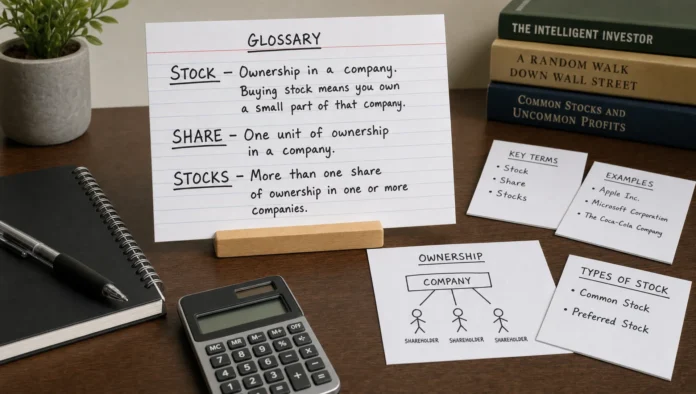
If you searched for “stock stocks,” you are probably trying to make sense of investing language that often sounds more complicated than it needs to be. The good news is that the core idea is simple: a stock represents ownership in a business.
When people say they “buy stocks,” they usually mean they buy small pieces of publicly traded companies through a brokerage account. Those pieces can rise or fall in value depending on how the business performs, what investors expect, and what is happening in the wider economy.
This guide avoids Wall Street vocabulary where possible. When jargon is useful, we will translate it into plain English.
Stock vs. stocks vs. shares
These three words are often used together, but they do not always mean exactly the same thing.
| Term | Plain-English meaning | Example |
|---|---|---|
| Stock | Ownership in a company, or the general category of company ownership | “Apple stock went up today.” |
| Stocks | Multiple company ownership investments, or the stock market as an asset class | “I invest in stocks for long-term growth.” |
| Share | One unit of ownership in a specific company | “I bought 5 shares of a company.” |
Here is the simplest way to remember it: stock is the type of investment, shares are the units you buy, and stocks usually means more than one stock.
If you want a deeper first step into what a share actually represents, Greek Shares also has a beginner guide on stock shares for first-time investors.
What you actually own when you buy a stock
When you buy stock in a publicly traded company, you own a tiny piece of that company. You do not own a specific desk, factory, delivery van, or product. You own a financial claim on part of the business.
That ownership may come with certain benefits, depending on the company and the type of stock. Common stock may allow shareholders to vote on some company matters, such as board members. Some companies also pay dividends, which are cash payments to shareholders.
But stock ownership has limits. Buying one share of a large company does not mean you can walk into headquarters and make decisions. Your ownership is real, but your influence is usually small unless you own a large number of shares.
Think of it like owning a small slice of a very large pie. If the pie grows, your slice may become more valuable. If the pie shrinks, your slice may be worth less.
Why companies sell stock in the first place
Companies sell stock because they want to raise money. That money can be used to grow the business, hire employees, build new products, pay down debt, expand into new markets, or fund research.
When a private company first sells shares to the public, that process is called an initial public offering, often shortened to IPO. After that, investors usually buy and sell shares from each other on the stock market.
This part is important: when you buy a stock through your brokerage account, you are usually not buying directly from the company. You are buying from another investor who wants to sell. The stock market is the organized place where buyers and sellers meet.
Why stock prices move
A stock price moves because buyers and sellers disagree about what the company is worth today and what it might be worth in the future.
If many investors want to buy a stock and fewer want to sell it, the price tends to rise. If many investors want to sell and fewer want to buy, the price tends to fall.
The reasons behind those decisions can vary. A company may report strong profits, launch a promising product, lose customers, face legal trouble, or benefit from a growing industry. Broader factors matter too, including interest rates, inflation, recessions, investor mood, and global events.
A useful beginner rule is this: stock prices reflect expectations, not just current facts. A company can be profitable and still see its stock fall if investors expected even better results. Another company can lose money and still rise if investors believe the future is improving.
For a broader overview of how the market fits together, you may find this plain-English guide to key stock market ideas every investor needs helpful.
How investors make money from stocks
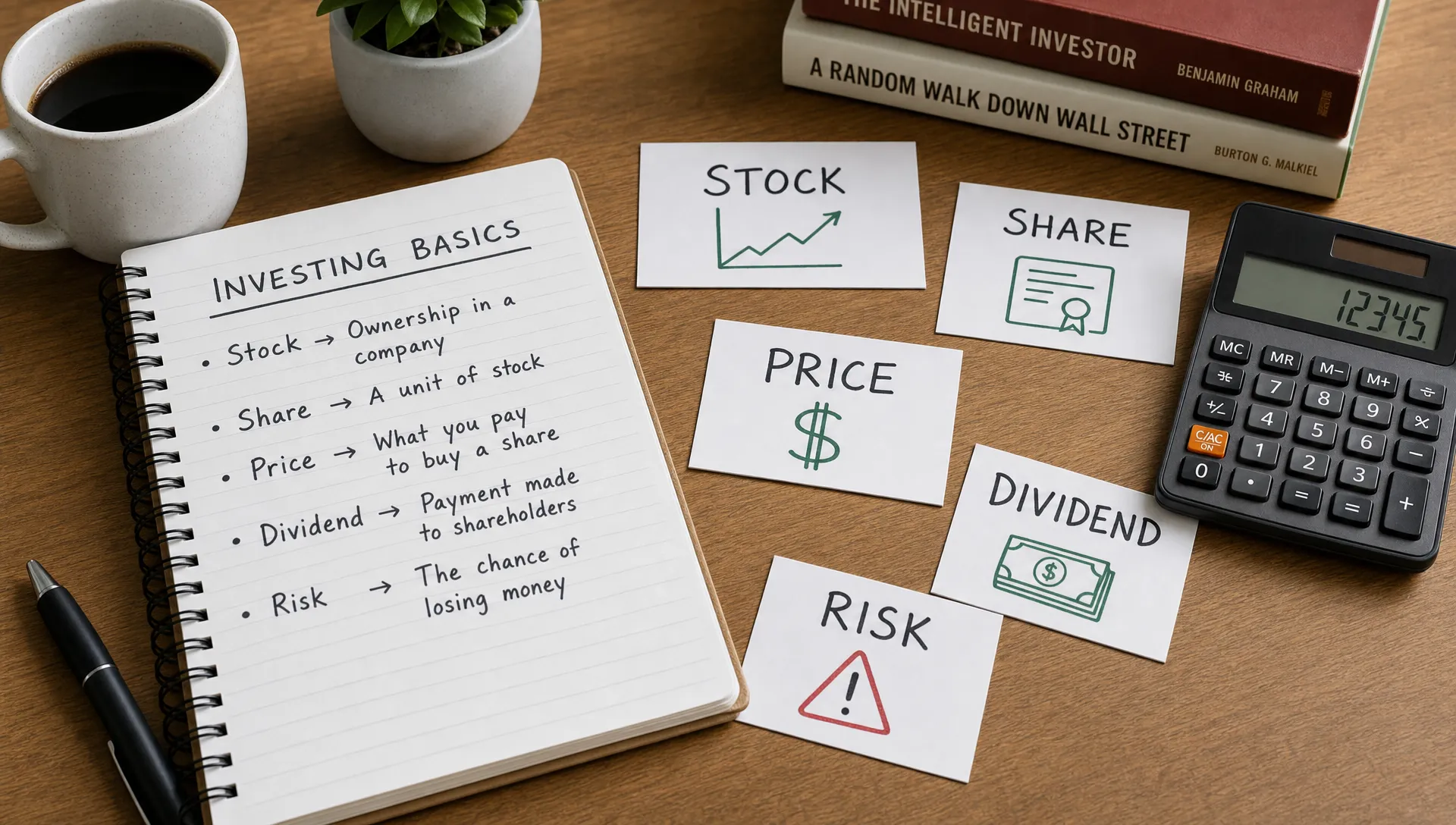
There are two main ways investors can make money from stocks: price growth and dividends.
| Method | What it means | Simple example |
|---|---|---|
| Price growth | You sell the stock for more than you paid | You buy at $50 and later sell at $70 |
| Dividends | The company pays part of its profits to shareholders | You receive cash for each eligible share you own |
Price growth is often called a capital gain. If the stock falls and you sell for less than you paid, that is a capital loss.
Dividends are not guaranteed. A company can raise, reduce, pause, or cancel them. Younger companies often keep profits inside the business to fund growth, while more mature companies may choose to return some cash to shareholders.
The best investors usually do not focus only on the stock price today. They ask whether the business can become more valuable over time, whether the price makes sense, and whether the risk fits their goals.
What risk really means
Risk does not simply mean “the stock price might go down tomorrow.” That is part of it, but risk is bigger.
In plain English, risk means the chance that your investment does not do what you need it to do. That could mean losing money, earning less than inflation, selling in panic, holding too much of one company, or investing money you need soon.
A stock can be risky because the company is weak. It can also be risky because the price is too high compared with the company’s likely future results. Even a great company can be a poor investment if you pay far too much for it.
Risk is personal. A 25-year-old investing for retirement may handle short-term drops better than someone who needs the money next year for a house deposit. The same stock can be reasonable for one person and unsuitable for another.
A simple stock example
Imagine a company called Blue Harbor Coffee. It sells coffee, owns 100 million shares, and its shares trade at $10 each.
If you buy 10 shares, you spend $100 before fees or taxes. You now own 10 tiny units of Blue Harbor Coffee. If the business grows and investors become more optimistic, the stock might rise to $15. Your 10 shares would then be worth $150.
If the company struggles, loses customers, or investors decide the stock was too expensive, the price might fall to $7. Your 10 shares would then be worth $70.
Now imagine Blue Harbor Coffee decides to pay a dividend of $0.20 per share. If you own 10 shares, you would receive $2 before any taxes. That dividend is separate from the changing stock price.
This example is simplified, but it captures the basic logic: you buy ownership, the value changes, and sometimes the company may share cash with owners.
Individual stocks vs. funds
You do not have to pick every stock yourself. Many investors use funds, such as index funds or exchange-traded funds, to own a basket of stocks in one purchase.
An individual stock gives you ownership in one company. A fund can give you exposure to dozens, hundreds, or even thousands of companies. That spread is called diversification. It does not eliminate risk, but it can reduce the damage if one company performs badly.
Think of it like business travel. When timing and reliability matter, many organizations do not leave every detail to chance, they use professional chauffeur services so the journey is handled by people focused on that job. In investing, a fund can play a similar practical role by handling the basket-building process, either through a professional manager or a rules-based index.
That does not mean funds are automatically better for everyone. Individual stocks can offer more control and potential upside, but they require more research and emotional discipline. Funds are often simpler for beginners because they reduce the pressure to be right about one company.
Common stock market words translated
Stock investing becomes less intimidating when you translate the usual terms into everyday language.
| Jargon | Plain-English translation |
|---|---|
| Brokerage account | The account you use to buy and sell investments |
| Ticker symbol | A short code used to identify a stock |
| Market cap | What the stock market says the whole company is worth |
| Dividend yield | Dividend income compared with the stock price |
| Earnings | Company profit over a period of time |
| Valuation | A judgment about whether the price is cheap, fair, or expensive |
| Volatility | How much the price jumps around |
| Portfolio | Your collection of investments |
| Diversification | Not putting all your money into one company or idea |
You do not need to memorize every term before investing, but you should understand the words connected to any investment you buy. If a term affects risk, return, taxes, or fees, it is worth learning.
Greek Shares has a helpful glossary-style article covering stock investing terms every beginner should know if you want to build your vocabulary step by step.
What beginners often get wrong
Many beginners assume stock investing is mainly about finding “the next big winner.” That can happen, but it is not a reliable plan by itself.
Another common mistake is confusing a familiar company with a good investment. You may love a company’s products and still overpay for its stock. The business and the stock price are connected, but they are not the same thing.
Beginners also often react too strongly to daily price moves. A stock falling 3 percent in a day can feel dramatic, but daily movement is normal. The bigger question is whether the long-term investment case has changed.
Here are a few practical habits that can help:
- Invest only after understanding what the company or fund owns.
- Avoid putting all your money into one stock.
- Keep short-term emergency money out of volatile investments.
- Pay attention to fees and taxes.
- Write down why you are buying before you buy.
- Decide in advance what would make you sell.
A written plan is useful because emotions are loud when markets move. If you wait until prices are falling to decide what kind of investor you are, you may make choices you later regret.
How to think before buying your first stock
Before buying a stock, ask simple questions. You do not need to sound like an analyst. You need to understand the basic story.
What does the company do? How does it make money? Is it profitable? Is it growing? Who are its competitors? What could go wrong? Is the stock price reasonable compared with the company’s results and future potential?
Then ask personal questions. Why am I buying this? How long can I hold it? What percentage of my total money will it represent? Would I still be comfortable if it dropped 30 percent? Do I need this money soon?
If you cannot answer these questions in plain English, you may not be ready to buy that investment yet. That is not a failure. It is a sign to slow down, learn more, or choose a simpler option.
The simplest way to understand stocks
A stock is not a lottery ticket, even though some people treat it like one. It is not just a moving line on a chart either. A stock is ownership in a business, and over time, business results matter.
In the short term, stock prices can move because of news, excitement, fear, interest rates, and investor behavior. In the long term, strong companies that grow profits and use money wisely often have a better chance of rewarding shareholders, although nothing is guaranteed.
So if the phrase “stock stocks” felt confusing at first, reduce it to this: stocks are pieces of businesses that people buy and sell. Your job as an investor is not to know everything. Your job is to understand what you own, why you own it, what risks you are taking, and how it fits your goals.
Frequently Asked Questions
Are stock and share the same thing? They are closely related, but not identical. Stock usually refers to ownership in a company or the category of investment, while a share is one unit of that ownership.
Can beginners invest in stocks? Yes, beginners can invest in stocks, but they should start by learning the basics, understanding risk, and avoiding money they may need in the short term. Many beginners begin with diversified funds before choosing individual stocks.
Do stocks always make money over time? No. Some stocks perform very well, while others lose value or even become worthless. Broad stock markets have historically rewarded patient investors over long periods, but individual results depend on what you buy, the price you pay, and how long you hold.
What is the safest stock to buy? There is no completely safe stock. Even large, successful companies can fall in price. Safety depends on the company’s quality, valuation, diversification, your time horizon, and your personal financial situation.
How many stocks should a beginner own? There is no perfect number. Owning only one or two stocks can be very risky because your results depend heavily on a few companies. Diversified funds can help beginners spread risk more easily.
Keep learning before you invest
Stock market success starts with understanding, not guessing. Before you buy, take time to learn the language, compare options, and think honestly about your goals and risk tolerance.
Greek Shares is built to help investors learn step by step, from basic stock market ideas to more advanced investing concepts. Use these guides as education, not as personal financial advice, and consider speaking with a qualified financial professional before making major investment decisions.