


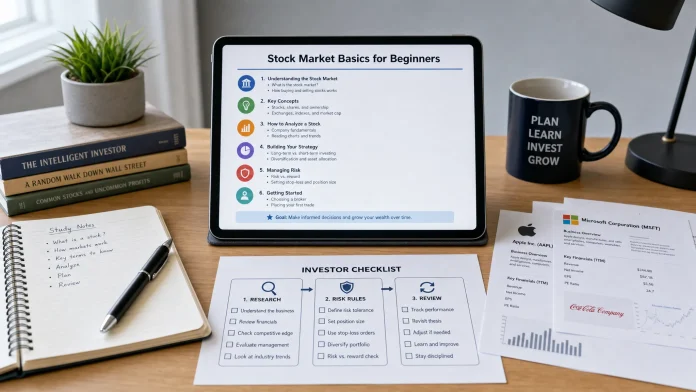
Learning the stock market can feel like learning a new language while everyone else is already having a fast conversation. Prices move, headlines compete for attention, and social media makes every decision look urgent. The good news is that you do not need to master everything before you start learning. You need a clear sequence.
This guide gives you a practical roadmap to learn stock market investing step by step, from understanding what shares are to building a simple process for research, risk control, and long-term improvement. It is written for beginners, but the same structure can help any investor replace guesswork with discipline.
This article is educational and not personal financial advice. Before making investment decisions, consider your financial situation, risk tolerance, and whether you should speak with a qualified professional.
Step 1: Understand what stock market investing really is
Stock market investing means buying ownership in businesses, usually through shares of public companies or funds that hold many shares. When you buy a stock, you are not buying a symbol on a chart. You are buying a claim on part of a company’s future results.
That simple idea changes how you think. Instead of asking, “Will this stock go up next week?” a more useful investor asks, “What business am I buying, what is it worth, what can go wrong, and does it fit my plan?”
Investing is different from trading. Trading focuses on shorter-term price movements and often requires more time, speed, and emotional control. Investing usually focuses on years, not days. A beginner who wants to build wealth gradually should learn the investing mindset first, then decide later whether any shorter-term strategies are appropriate.
A helpful starting principle is this: the stock market is not a place to get rich quickly. It is a place where disciplined investors can participate in business growth over time, while accepting that prices will rise and fall along the way.
Step 2: Build your financial foundation before you buy
The first step in learning investing is not opening a brokerage account. It is making sure you are financially ready to take risk.
Money invested in the stock market can lose value, especially in the short term. If you may need the money for rent, medical costs, tuition, or an emergency, it may not belong in stocks yet. A strong foundation gives you patience, and patience is one of the biggest advantages an individual investor can have.
Before investing, review these basics:
- Your monthly income and expenses are understood.
- You have an emergency fund or a plan to build one.
- High-interest debt is under control.
- You know why you are investing and when you may need the money.
- You can emotionally handle seeing your portfolio decline without making rushed decisions.
This preparation may feel slow, but it prevents a common beginner mistake: selling good investments at a bad time because the money was needed too soon.
Step 3: Learn the basic language of stocks
You do not need to become a finance professor, but you do need to understand the core vocabulary. Without it, market commentary can sound more complicated than it really is.
Start with these terms:
| Term | Plain-English meaning | Why it matters |
|---|---|---|
| Stock | A share of ownership in a company | Helps you think like a business owner |
| Dividend | Cash paid by a company to shareholders | Can be part of total return |
| Market capitalization | Company value based on share price times shares outstanding | Helps compare company size |
| Earnings | Company profit after expenses | Often drives long-term value |
| Valuation | The price investors pay compared with business fundamentals | Helps avoid overpaying |
| Volatility | How much prices move up and down | Helps set expectations |
| Diversification | Spreading money across investments | Reduces dependence on one company |
| ETF | A fund traded like a stock, often holding many assets | Makes diversification easier |
If these ideas are new, spend time with a beginner-friendly overview such as Greek Shares’ guide to learn about stocks before you risk your money. The goal is not to memorize definitions. The goal is to understand what you are doing before real money is involved.
Step 4: Set goals and choose your investing time horizon
A stock market plan without a goal is just activity. Your goal determines your strategy, risk level, and what “success” actually means.
For example, investing for retirement in 25 years is very different from saving for a home down payment in three years. The longer your time horizon, the more time you may have to recover from market declines. The shorter your time horizon, the more careful you need to be with risk.
Think in categories:
| Goal type | Typical time horizon | Stock market suitability |
|---|---|---|
| Emergency savings | Immediate to 1 year | Usually low suitability |
| Short-term purchase | 1 to 3 years | Often limited suitability |
| Medium-term goal | 3 to 7 years | Depends on risk tolerance |
| Long-term wealth building | 7 years or more | Often more suitable |
| Retirement | 10 years or more for many investors | Often suitable with a diversified plan |
This does not mean stocks are guaranteed to work over longer periods. It means time can reduce the pressure of short-term price swings. Your goal also helps you decide whether you should focus on broad funds, individual stocks, dividend income, growth, or a combination.
Step 5: Learn the two main ways investors analyze stocks
Once you understand the basics, you can begin learning stock analysis. Most investors use some combination of fundamental analysis and technical analysis.
Fundamental analysis studies the business. It asks whether the company is financially healthy, profitable, competitive, and reasonably priced. This includes revenue, earnings, debt, cash flow, margins, management quality, industry trends, and valuation ratios.
Technical analysis studies price behavior. It looks at charts, trends, trading volume, support and resistance, and momentum. Long-term investors do not have to rely heavily on charts, but basic chart awareness can help with patience and order placement.
For beginners, fundamental analysis usually matters more. A stock chart can tell you what the price has done. It cannot tell you whether the business is durable, whether debt is manageable, or whether the company has a competitive advantage.
When learning business analysis, start with industries you can understand. Clothing, food, banking, technology, energy, and transportation all have different economics. For example, studying a full-service apparel development and manufacturing partner like Arcus Apparel Group can help you see how sourcing, sampling, production, and supply chains affect the economics behind consumer brands. Investors who understand how an industry works are less likely to be fooled by surface-level stories.
If you want a deeper framework for evaluating companies, financial statements, valuation, and risk, Greek Shares’ article on stock market analysis basics is a useful next step.

Step 6: Practice with a watchlist before investing real money
A watchlist is a list of companies or funds you are studying. It is one of the safest tools for beginners because it lets you practice decision-making without risking capital.
Do not fill your watchlist with random popular tickers. Choose investments for a reason. You might track a broad market ETF, a dividend-paying company, a large technology company, a bank, a consumer goods business, and a company in an industry you personally understand.
For each investment, write a short note answering four questions:
- What does this company or fund own or do?
- Why might it grow or produce returns over time?
- What could go wrong?
- At what price or valuation would it become interesting?
Then follow your watchlist for several weeks or months. Watch how prices react to earnings reports, interest-rate news, market declines, and company announcements. This habit teaches you that price movement is normal. It also helps you avoid buying only because something is trending.
Paper trading can also help, but use it carefully. Because no real money is involved, paper trading often feels easier than investing. The emotional side changes when your own savings are at risk.
Step 7: Understand accounts, brokers, and order types
When you are ready to move from learning to action, you need a brokerage account. A broker is the platform that allows you to buy and sell stocks, ETFs, and other investments.
When comparing brokers, focus on practical factors: regulation, fees, available markets, account types, research tools, ease of use, customer support, and whether the platform encourages responsible investing or excessive trading.
You should also understand basic order types before buying anything:
| Order type | What it does | Beginner note |
|---|---|---|
| Market order | Buys or sells immediately at the best available price | Simple, but price can vary in fast markets |
| Limit order | Sets the maximum price you will pay or minimum price you will accept | Gives more control over price |
| Stop order | Triggers an order after a certain price is reached | Can help manage risk, but not perfect |
| Recurring investment | Automatically invests on a schedule, if supported | Can support consistency |
Many beginners start with small amounts to learn how the process works. The first purchase is less about making a perfect investment and more about understanding execution, settlement, position tracking, and your own emotional reaction.
If you are approaching your first purchase, read a dedicated walkthrough on how to buy your first stock the right way before placing an order.
Step 8: Build a simple starter portfolio
A beginner portfolio does not need to be complicated. In fact, complexity often creates more problems than it solves.
Many new investors begin with broad diversification through index funds or ETFs. These can provide exposure to many companies in one purchase, reducing the risk that one poor stock choice damages the entire portfolio. Others prefer to combine a diversified core with a small number of individual stocks they study carefully.
The key is to avoid building a portfolio out of excitement. A simple starter plan might define how much you will invest, how often you will contribute, what percentage goes into diversified funds, what percentage can go into individual stocks, and when you will review the plan.
A beginner should be especially careful with concentration. Owning only one or two stocks may feel focused, but it can expose you to company-specific problems such as weak earnings, lawsuits, regulation, management mistakes, or industry disruption.
Diversification does not eliminate risk. It helps control the damage from being wrong about any single investment.
Step 9: Create rules for risk management
Risk management is not something you add after losses happen. It is part of the plan from the beginning.
The U.S. Securities and Exchange Commission’s investor education materials frequently emphasize diversification, realistic expectations, and understanding risk before investing. FINRA also highlights the importance of risk tolerance, which includes both your financial ability and emotional willingness to take losses.
Your personal risk rules should be written down. They can be simple, but they must be clear.
Consider rules like these:
- No single individual stock will exceed a certain percentage of your portfolio.
- Money needed within the next few years will not be heavily invested in stocks.
- You will research before buying, not after the price falls.
- You will not buy because of social media hype alone.
- You will review your portfolio on a schedule, not every hour.
- You will keep learning from mistakes without making impulsive changes.
The best risk rule is the one you can actually follow under pressure. If your plan only works when markets are calm, it is not strong enough.
Step 10: Learn how to review your investments
Buying is only the beginning. Good investors review their decisions, but they do not constantly react to noise.
A useful review schedule might be monthly for contributions and tracking, quarterly for company updates, and annually for your full portfolio plan. The more long-term your strategy, the less you need to respond to daily price movement.
When reviewing an individual stock, ask whether the original reason you bought it still makes sense. Has the company improved or weakened? Are earnings growing? Has debt changed? Is the industry becoming more competitive? Is the valuation still reasonable?
When reviewing a fund, look at whether it still matches your goal. Does it track the market or sector you intended? Are costs still acceptable? Has your allocation drifted too far from your plan?
The goal of review is not to predict every market turn. It is to make sure your portfolio still fits your goals, risk tolerance, and evidence.
Common beginner mistakes to avoid
Most investing mistakes are not caused by a lack of intelligence. They are caused by impatience, overconfidence, poor preparation, or emotional decision-making.
One common mistake is chasing performance. Beginners often buy after a stock has already risen sharply, assuming recent gains will continue. Sometimes they do, but often the easy money has already been made.
Another mistake is confusing a good company with a good investment. A company can have excellent products and still be overpriced. Price matters because your return depends not only on business quality, but also on what you pay for that quality.
A third mistake is selling during normal volatility. Stock prices do not move in straight lines. Even strong companies and broad markets can experience painful declines. If every downturn feels like a reason to quit, your portfolio may be too risky for your personality or time horizon.
Finally, many beginners skip recordkeeping. Write down why you bought, what you expected, and what would change your mind. This creates a feedback loop. Without notes, it is easy to rewrite history and repeat the same mistakes.
A practical 30-day plan to start learning
If you want to learn stock market investing step by step, give yourself a structured first month. The goal is not to become an expert in 30 days. The goal is to build momentum.
| Time period | Focus | Outcome |
|---|---|---|
| Days 1 to 7 | Learn basic terms and how stocks work | You understand ownership, dividends, risk, and diversification |
| Days 8 to 14 | Set goals and assess financial readiness | You know how much risk is appropriate for your situation |
| Days 15 to 21 | Study funds, sectors, and a few companies | You build a watchlist with written reasons |
| Days 22 to 30 | Learn brokers, orders, and portfolio structure | You can decide whether you are ready for a small first investment |
Repeat this cycle as needed. Investing education is not a box you check once. Markets change, companies change, and your personal goals change. The investors who last are the ones who keep improving their process.
Frequently Asked Questions
How long does it take to learn stock market investing? You can learn the basic concepts in a few weeks, but becoming a confident investor takes months or years of practice. The goal is steady improvement, not instant mastery.
How much money do I need to start investing in stocks? This depends on your broker, market, and personal finances. Many platforms allow small starting amounts, but you should only invest money you can afford to leave invested and risk.
Should beginners buy individual stocks or ETFs first? Many beginners start with diversified ETFs because they reduce reliance on one company. Individual stocks can be useful for learning, but they require more research and risk control.
Can I learn investing without a finance background? Yes. A finance background can help, but it is not required. Beginners can learn by studying basic terms, reading company reports, following markets, and practicing with a watchlist.
What is the biggest skill for a beginner investor? Patience is one of the most important skills. Research matters, but even a good plan can fail if emotions cause you to buy impulsively or sell during normal market declines.
Keep learning with a clear process
The best way to learn stock market investing is to move in order: understand the basics, prepare your finances, set goals, study investments, practice, start small, manage risk, and review your results.
You do not need perfect predictions to become a better investor. You need a repeatable process that keeps you informed, disciplined, and honest about risk.
Greek Shares is built to help investors strengthen that process through beginner-friendly guides, market education, and practical investing articles. Use each lesson to build confidence before you risk more capital, and let your knowledge compound along with your investments.