


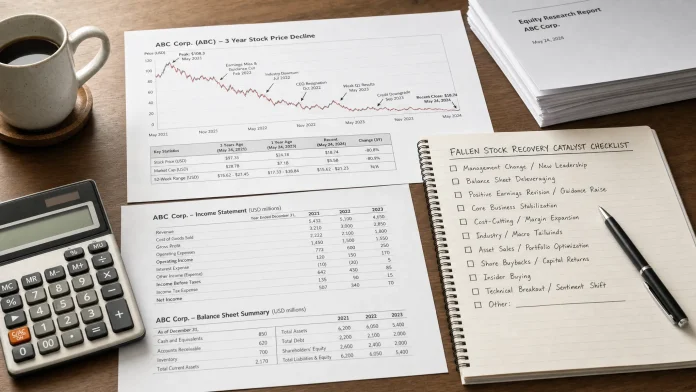
A sharp drop in a stock price always raises the same uncomfortable question: is this a bargain, or is the market warning you to stay away?
The answer rarely comes from the price chart alone. A stock can recover after a drop if the business value, financial strength, and future expectations remain strong enough to support a higher price later. But if the decline reflects permanent damage to earnings power, a broken balance sheet, or a management team losing credibility, the lower price may simply be the beginning of a longer problem.
The goal is not to predict the exact bottom. The goal is to build a disciplined process for judging whether the stock has a realistic path to recovery, and whether that path fits your risk tolerance, time horizon, and overall portfolio.
First, Find Out Why the Stock Dropped
Before asking whether a stock can recover, identify the reason it fell. A 25% decline caused by a broad market sell-off is very different from a 25% decline caused by accounting issues, collapsing demand, or excessive debt.
Stock prices fall when investors lower their expectations about future cash flows, growth, risk, or valuation multiples. Sometimes those expectations change too aggressively. Other times, the market is reacting rationally to new information. If you skip this step, you may end up buying what looks cheap without understanding what changed.
A useful starting point is to separate the decline into three broad categories.
| Type of drop | Common cause | Recovery potential |
|---|---|---|
| Market-wide decline | Interest rates, recession fears, geopolitical risk, liquidity pressure | Often higher for financially strong companies if fundamentals remain intact |
| Sector decline | Industry downturn, regulation, commodity cycle, technology shift | Depends on whether the sector headwind is temporary or structural |
| Company-specific decline | Earnings miss, debt concerns, management problems, legal issues, weak guidance | Requires deeper analysis, because the business itself may be impaired |
If you need a broader explanation of the forces behind falling prices, Greek Shares has a related guide on why stocks fall that is worth reading before analyzing individual recovery candidates.
Separate a Price Drop From Business Damage
A stock price can drop much faster than the underlying business changes. That is why opportunities sometimes appear during fear-driven markets. However, the opposite is also true. A business can deteriorate slowly while the stock price only begins to reflect the damage later.
To judge whether a stock can recover after a drop, ask one central question: has the company’s long-term earning power been reduced?
Temporary problems may include a short-term inventory adjustment, a one-time cost increase, a delayed product cycle, or a cyclical downturn in the industry. These can hurt near-term results without destroying the company’s competitive position.
Permanent problems are more serious. Examples include a product becoming obsolete, customers leaving for better alternatives, a company losing pricing power, debt becoming unmanageable, or management repeatedly failing to execute. In these cases, a recovery may require more than patience. It may require a complete turnaround, which is usually riskier than a normal rebound.
A simple way to think about it is this: a lower stock price is attractive only if the gap between price and value has widened in your favor. If the value of the business has fallen as much as the stock price, or more, the apparent bargain may not be a bargain at all.
Study Revenue, Margins, and Cash Flow
Stock recoveries usually need fundamental support. The market can become excited for a while based on hope, headlines, or technical momentum, but lasting recoveries are normally tied to improving business performance or a clear belief that future results will improve.
Start with revenue. Is the company still growing, or is revenue shrinking? A single weak quarter may not matter much, but a multi-year decline can signal deeper trouble. Look for the explanation behind the numbers. Is demand weak across the industry, or is the company losing share to competitors?
Next, examine margins. Falling margins can reveal rising costs, discounting pressure, poor execution, or weakening pricing power. A company with temporary margin pressure may recover if costs normalize or management improves efficiency. A company with permanently weaker margins may deserve a lower valuation than it had in the past.
Cash flow is especially important. Earnings can be affected by accounting assumptions, but cash flow shows whether the business is generating money after expenses and investment needs. Free cash flow gives the company more options, including paying down debt, investing in growth, buying back shares, or paying dividends. Negative free cash flow is not always bad for a growing company, but it becomes dangerous when combined with debt, slowing growth, and limited access to capital.
Key questions to ask include:
- Is revenue weakness temporary, cyclical, or structural?
- Are margins falling because of short-term costs or lost pricing power?
- Does the company generate positive free cash flow over a full cycle?
- Are earnings supported by cash flow, or only by accounting adjustments?
- Is management explaining problems clearly, or blaming external factors every quarter?
No single quarter should decide your entire view. But a pattern of weakening fundamentals should make you cautious, even if the stock looks statistically cheap.
Check the Balance Sheet Before Hoping for a Recovery
A company with a strong balance sheet has time. A company with a weak balance sheet may not.
This matters because stock recoveries often take longer than investors expect. If the company has too much debt, near-term maturities, rising interest costs, or poor liquidity, it may be forced to issue shares, sell assets, cut investment, or restructure before shareholders benefit from any recovery.
Debt is not automatically bad. Many strong businesses use debt responsibly. The danger appears when debt becomes large relative to earnings and cash flow, especially during a downturn. Higher interest rates can make refinancing more expensive, and weaker profits can reduce the company’s ability to service obligations.
Look at cash on hand, total debt, interest expense, maturity schedules, and credit ratings if available. Also review whether the company has been diluting shareholders by issuing new stock. Sometimes a business survives, but shareholders do poorly because the recovery is spread across many more shares than before.
A practical balance sheet review should focus on survival first and upside second. If the company cannot comfortably survive the downturn, the recovery thesis becomes speculative.
Decide Whether the Stock Is Cheap or Just Lower
A fallen stock is not automatically undervalued. A stock that drops from $100 to $50 may still be expensive if earnings are collapsing. A stock that drops from $40 to $30 may be attractive if cash flow is stable and the market overreacted.
Valuation must be judged against the company’s current and future fundamentals, not just its old price. Many investors anchor to the previous high and assume the stock should return there. But the old high may have been based on unrealistic growth expectations, unusually low interest rates, or market enthusiasm that will not return soon.
A discount matters only if the underlying asset is still worth owning. The same idea applies outside investing. If you are comparing hotel booking deals before a trip, the cheapest room is not necessarily the best choice unless the location, dates, reviews, and overall quality fit your needs. A stock price works the same way. Low price is only one part of the decision.
Common valuation tools include P/E ratio, price-to-sales, price-to-book, free cash flow yield, and enterprise value to EBITDA. Each has weaknesses. P/E can mislead when earnings are temporarily high or low. Price-to-sales ignores profitability. Book value matters more for banks and asset-heavy companies than for software or service businesses. Free cash flow yield can be very useful, but only if free cash flow is sustainable.
For a deeper foundation, review the Greek Shares beginner guide to stock valuation and the guide on how to analyze a company stock. Both can help you avoid judging recovery potential on price movement alone.
Look for Real Catalysts, Not Just Hope
A stock can remain cheap for a long time if there is no reason for investors to change their opinion. That is why catalysts matter. A catalyst is a development that can cause the market to reassess the company’s future.
Possible recovery catalysts include improving earnings, renewed revenue growth, cost reductions, debt refinancing, new product success, better industry conditions, falling interest rates, management changes, regulatory clarity, or a credible strategic plan.
The key word is credible. A vague statement like “management expects improvement” is weaker than measurable evidence, such as improving gross margins, positive free cash flow, lower inventory levels, reduced debt, or stabilization in customer demand.
Try to define what must happen for your recovery thesis to be proven right. For example, you might decide that the company needs to return to positive free cash flow within four quarters, keep debt ratios stable, and show that revenue declines are slowing. If those milestones do not appear, your thesis may be wrong.
This approach helps you avoid becoming emotionally attached to a losing position. You are not simply hoping the stock goes back up. You are watching for evidence that the business is repairing itself.
Use the Chart as Evidence, Not as a Substitute for Analysis
Price action can provide useful clues, but it should not replace fundamental research. A stock that keeps making lower lows after bad news may be signaling that investors still expect more trouble. A stock that stops falling despite negative headlines may suggest that pessimism is already priced in.
Volume can also matter. Heavy selling on bad news may reflect forced liquidation or institutional exits. Later stabilization with improving volume can indicate that new buyers are entering. Relative strength is another useful clue. If a stock holds up better than its sector during weak markets, investors may already be recognizing quality.
Still, charts cannot tell you whether debt is manageable, whether margins will recover, or whether the company’s product remains competitive. Technical signals can help with timing and risk control, but the reason to own the stock should be grounded in business analysis.

Watch for Value Trap Warning Signs
A value trap is a stock that looks cheap but keeps falling because the business continues to deteriorate. Many value traps share similar characteristics. They trade at low valuation multiples, attract investors who focus on the past, and appear to offer a large discount to previous highs. But the market may be discounting a future that is worse than the past.
The following table can help you separate stronger recovery candidates from higher-risk situations.
| Factor | Better recovery sign | Warning sign |
|---|---|---|
| Revenue | Stable or temporarily weak with clear explanation | Persistent decline without a credible plan |
| Margins | Short-term pressure with signs of stabilization | Continuous compression from lost pricing power |
| Cash flow | Positive or improving free cash flow | Ongoing cash burn with limited funding options |
| Debt | Manageable maturities and interest costs | Refinancing risk, covenant pressure, or high leverage |
| Management | Transparent communication and realistic targets | Repeated missed guidance or vague explanations |
| Valuation | Cheap relative to normalized earnings and peers | Cheap only because earnings are falling fast |
| Industry position | Competitive advantages remain intact | Business model threatened by better alternatives |
One of the biggest warning signs is when the original reason to own the stock no longer applies. If you bought because the company had strong growth, but growth has disappeared, the thesis has changed. If you bought because the balance sheet was safe, but debt has risen sharply, the thesis has changed. If you bought because management was disciplined, but capital allocation has become reckless, the thesis has changed.
A falling stock can recover. A broken thesis needs to be replaced, not defended.
Consider the Broader Market and Sector Environment
Even strong companies can struggle when the market environment is hostile. Interest rates, inflation, economic growth, investor risk appetite, and sector rotation can all affect recovery potential.
For example, growth stocks often face pressure when interest rates rise because future earnings are discounted more heavily. Cyclical companies may fall when investors expect recession. Banks can be affected by credit concerns and interest rate spreads. Commodity producers may depend heavily on oil, metals, or agricultural prices.
This does not mean you need to forecast the economy perfectly. In fact, most investors should be humble about macro predictions. But you should understand whether the stock’s decline is connected to a temporary macro headwind or a company-specific weakness.
A high-quality company in a temporarily unpopular sector may recover when sentiment improves. A weak company in a challenged sector may not survive long enough to benefit.
Match the Recovery Thesis to Your Risk Tolerance
Two investors can analyze the same stock and make different decisions because their goals are different. A retired investor seeking stability may avoid a turnaround situation that a younger, more risk-tolerant investor might consider. A diversified portfolio can absorb a small speculative position more easily than a concentrated portfolio can.
Before buying, holding, or adding to a fallen stock, decide how much uncertainty you can accept. Recovery investing often involves discomfort. The news may remain negative for a while. The stock may fall further before improving. Analysts may reduce estimates. Other investors may lose patience.
Position sizing is therefore crucial. Even if your analysis suggests recovery is possible, avoid letting one stock dominate your portfolio. A good idea can still produce a bad outcome if the position is too large. Diversification and risk management protect you from the fact that no analysis is perfect.
Greek Shares discusses related sell discipline in when to sell stocks and when to hold, which is especially relevant when you are deciding whether to keep a stock after a major decline.
A Practical Framework for Judging Recovery Potential
When emotions are high, a checklist can help you think clearly. Use the following framework before making a decision.
| Question | Why it matters |
|---|---|
| Why did the stock fall? | Identifies whether the issue is market-wide, sector-related, or company-specific |
| Has long-term earning power changed? | Separates temporary volatility from permanent impairment |
| Is the balance sheet strong enough? | Determines whether the company has time to recover |
| Is valuation attractive based on realistic numbers? | Prevents anchoring to old highs or outdated earnings |
| What catalysts could change sentiment? | Clarifies what must happen for the stock to recover |
| What evidence would prove you wrong? | Protects you from holding only because you dislike taking a loss |
| How large is the position? | Keeps one mistake from damaging the whole portfolio |
If you cannot answer these questions, waiting is a valid decision. Investors often feel pressured to act quickly after a big drop, but uncertainty is not an obligation. Sometimes the best move is to monitor the company until the facts become clearer.
When a Dropped Stock May Be Worth Holding or Buying
A fallen stock may deserve further consideration when the business remains financially sound, the competitive position is intact, and the market reaction appears more emotional than fundamental. This is especially true when the decline happened during a broad sell-off and the company continues to generate cash.
Other positive signs include management buying back shares responsibly, insiders owning meaningful stakes, conservative debt levels, a history of navigating downturns, and a valuation that already reflects modest expectations. None of these guarantees recovery, but together they can improve the odds.
The strongest recovery setups often combine three things: temporary pessimism, durable business quality, and a reasonable price. If only one of those is present, the case is weaker.
When It May Be Better to Move On
Sometimes the correct decision is to accept that a stock may not recover within a reasonable time, or that the risk is no longer worth the potential reward. This is not failure. It is part of disciplined investing.
Consider moving on if the company’s financial position is deteriorating, management has lost credibility, the business model is being disrupted, or your original thesis has been invalidated. Also consider selling if the position is too large for your comfort, even if you still believe recovery is possible.
Investors often hold losers because selling makes the loss feel real. But the market does not care about your purchase price. The relevant question is whether the stock is attractive today compared with your other opportunities.
Frequently Asked Questions
How long does it take for a stock to recover after a drop? There is no fixed timeline. Some stocks recover in weeks after temporary market panic, while others take years. Some never recover. The timeline depends on the cause of the drop, business fundamentals, valuation, investor sentiment, and broader market conditions.
Is a 50% drop a buying opportunity? Not automatically. A stock that falls 50% must rise 100% just to return to its previous price. Before buying, analyze whether the business value has remained intact and whether future earnings can support a recovery.
What is the biggest sign that a stock can recover? One strong sign is that the company continues to generate healthy cash flow and maintain a solid balance sheet despite temporary problems. Recovery is more likely when the business has time, resources, and a credible path to improved results.
Should I average down on a falling stock? Averaging down can be dangerous if you are adding money to a broken thesis. It may be reasonable only if your updated analysis confirms that the business remains strong, valuation is attractive, and the position size still fits your risk limits.
Can technical analysis show if a stock will recover? Technical analysis can show changes in price behavior, momentum, volume, and investor sentiment, but it cannot confirm business value by itself. Use charts as supporting evidence, not as a replacement for fundamental analysis.
Build a More Disciplined Recovery Process
Judging whether a stock can recover after a drop is not about optimism. It is about evidence. You need to understand why the stock fell, whether the business is still healthy, whether the balance sheet can support a turnaround, and whether valuation gives you a margin of safety.
The best investors do not need to catch every rebound. They need a repeatable process that helps them avoid value traps, control risk, and act when the odds are favorable.
To keep improving your investment process, explore more Greek Shares guides on stock analysis, valuation, risk management, and investor psychology. The more disciplined your framework becomes, the less likely you are to confuse a temporary decline with a permanent loss of value.