



If you are new to the market, the hardest part is not finding information. It is deciding what to do first, what to ignore, and how to stay consistent when prices move against you.
That is why a beginner stock plan should be simple enough to follow on an ordinary month, not only when you feel motivated. If you searched for investing stocks for beginners, the goal is probably not to become a professional trader overnight. The goal is to start carefully, understand what you own, and build a process you can repeat for years.
This guide is educational, not personal financial advice. Use it as a framework, then adapt it to your income, country, taxes, risk tolerance, and goals.
Why beginners need a plan before a stock pick
Many new investors start with the wrong question: Which stock should I buy? A better first question is: What job should my investments do for me?
A stock is a share of ownership in a business. When you buy stocks, you participate in the future success or failure of companies. That can create long-term growth, but it also means prices can fall sharply in the short term. Without a plan, beginners often react emotionally, buy after prices rise, sell after prices fall, and confuse market noise with real information.
A simple plan solves three problems at once. It gives your money a purpose, it limits decisions made under stress, and it helps you measure progress by behavior instead of daily price movement.
The plan does not need to be complex. In fact, complexity is usually the enemy for a beginner. The core idea is to create a repeatable routine: save, invest, diversify, review, and keep learning.
The simple beginner stock plan at a glance
Before diving into details, here is the full plan in one view.
| Step | Beginner decision | Why it matters |
|---|---|---|
| Set the goal | Decide what the money is for and when you may need it | Your time horizon affects how much stock risk makes sense |
| Protect your cash | Keep emergency savings separate from investments | You avoid selling stocks during a bad market to cover bills |
| Choose the account and broker | Pick a regulated platform with clear costs | Fees, taxes, and access can affect long-term results |
| Build a diversified core | Use broad funds or a basket of quality holdings | Diversification reduces dependence on one company |
| Invest on a schedule | Add money monthly or quarterly | A routine reduces the temptation to time the market |
| Review, do not obsess | Check allocation and progress periodically | You stay disciplined without reacting to every headline |
If you want a broader mindset guide before choosing investments, Greek Shares also explains how to start investing without guesswork by focusing on goals and process first.
Step 1: separate your money by time horizon
Stocks are better suited for long-term money than short-term money. The reason is simple: even strong companies and broad markets can decline for months or years. If you need the money soon, you may be forced to sell at a bad time.
A practical way to begin is to divide your money into three buckets.
| Money bucket | Typical purpose | Beginner approach |
|---|---|---|
| Emergency cash | Job loss, medical bills, urgent repairs | Keep outside the stock market in accessible cash |
| Short-term goals | Money needed in the next few years | Use lower-risk savings or fixed-income options, depending on your country and needs |
| Long-term investing | Retirement, wealth building, future freedom | Consider diversified stock exposure if you can handle volatility |
The exact emergency fund size depends on your life. Someone with a stable salary, low expenses, and family support may need a different cushion than someone self-employed with dependents. The key principle is the same: do not invest money you may need quickly.
This one decision protects your investing behavior. If the market falls, your emergency cash gives you breathing room. You are less likely to panic-sell your long-term investments just because life becomes expensive.
Step 2: define your goal in one sentence
A good investing goal is specific enough to guide decisions. I want to make money is not enough. Try something like this instead:
I am investing monthly for long-term wealth over at least 10 years, and I can accept temporary declines if my portfolio remains diversified.
That sentence does three useful things. It gives you a time horizon, it defines the role of stocks, and it reminds you that declines are part of the plan.
If your goal is only two years away, a stock-heavy approach may be too aggressive. If your goal is 20 years away, avoiding stocks entirely may create another risk: your money may not grow enough to beat inflation over time. According to Investor.gov’s overview of asset allocation, spreading money across asset categories is a key part of managing risk and return.
Step 3: choose a broker using boring criteria
A broker is the platform that lets you buy and sell investments. Beginners often focus on a slick app or a promotional offer, but the important criteria are more basic.
Look for regulation, transparent fees, access to the investments you actually need, reliable account security, and understandable tax documents. If you are investing internationally, also check currency conversion costs, withholding taxes, and whether the broker supports your country of residence.
Low commissions are helpful, but zero commission does not mean zero cost. Some platforms may earn money through spreads, currency fees, product fees, or order routing arrangements. Read the fee schedule before depositing money.
Also keep your first account simple. You do not need margin, options, leverage, or complex derivatives to begin learning stocks. In many cases, those features increase the chance of making a costly beginner mistake.
Step 4: build a diversified core first
A common beginner trap is trying to build a portfolio from individual stocks immediately. Picking companies can be educational, but it also concentrates risk. If your first stock performs badly, your entire portfolio may suffer, even if the broader market does fine.
A diversified core means most of your portfolio is spread across many companies, sectors, and possibly countries. Many beginners do this through broad index funds or exchange-traded funds, also called ETFs. These funds can offer exposure to hundreds or thousands of stocks in a single purchase.
Diversification does not eliminate losses, but it reduces the risk that one company failure ruins your plan. FINRA explains diversification as a way to spread investment risk across different assets instead of depending too much on one holding.
A simple structure might use a broad stock market fund as the core, then add a smaller amount to individual stocks later for learning. If you are unsure where to begin, Greek Shares has a separate guide on stocks and funds to consider when you are starting out that focuses on beginner-friendly building blocks.
The most important point is not that every beginner must own the same fund. The point is that your first portfolio should be diversified, understandable, and easy to maintain.
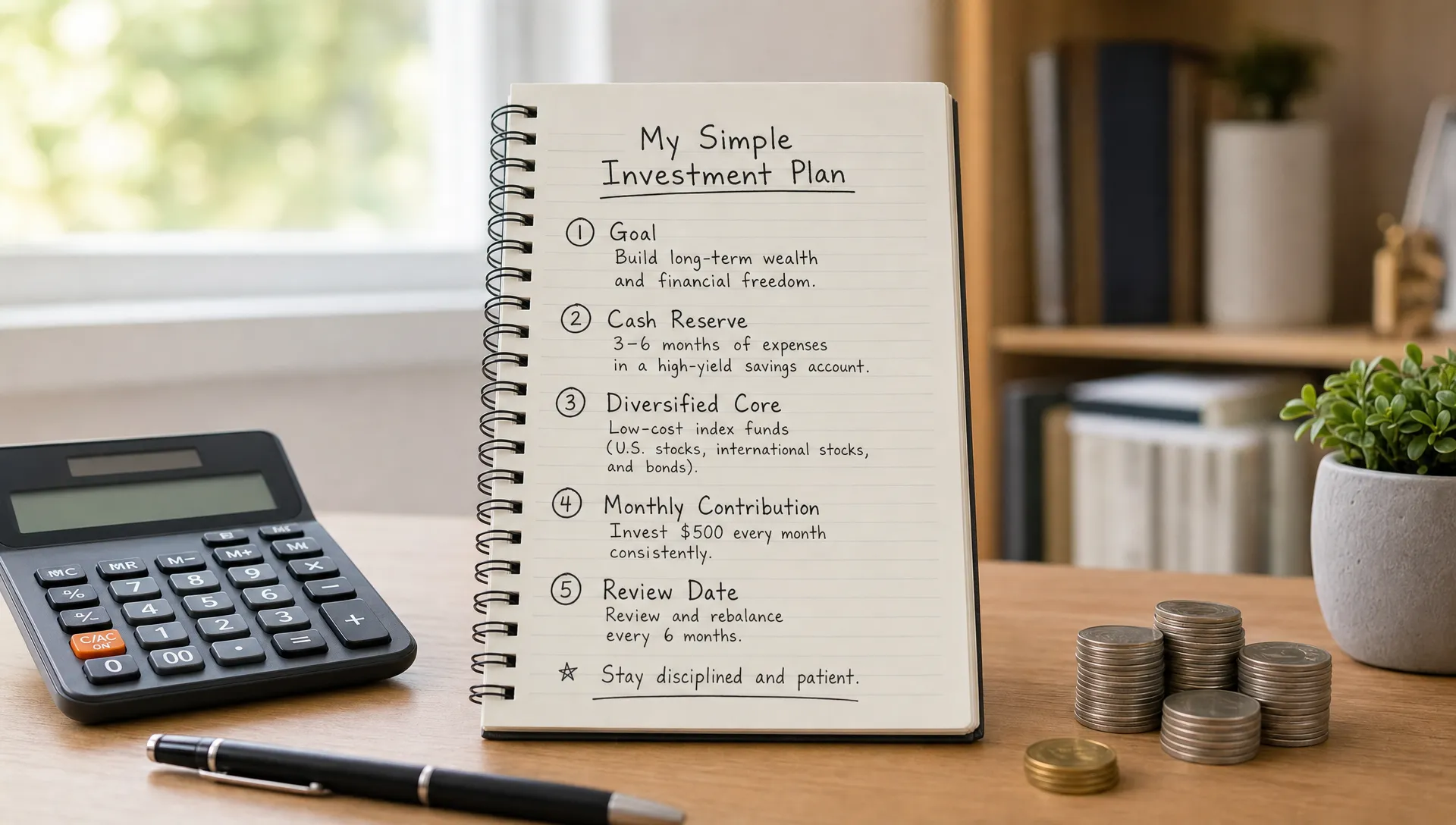
Step 5: decide how much to invest and automate it
Beginners often wait for the perfect moment. The market feels too high, then too uncertain, then too scary. Months pass and no plan is started.
One way to reduce this pressure is to invest a fixed amount on a fixed schedule. This is often called dollar-cost averaging. It means you buy more shares when prices are lower and fewer shares when prices are higher. It does not guarantee profit, and investing a lump sum can sometimes perform better if markets rise. But for beginners, a schedule can be powerful because it builds the habit.
The right amount is not the maximum you can possibly afford. It is the amount you can continue investing without damaging your budget. A smaller contribution made consistently is often better than an aggressive contribution that you stop after two months.
For example, a beginner might decide to invest once per month after payday. The amount can increase later as income grows, debts fall, or confidence improves. What matters early is creating a stable routine.
Step 6: write your rules before the market tests you
Your plan should include rules for normal months and stressful months. If you only decide what to do after the market drops, fear will influence the decision.
Here is a simple rule table beginners can adapt.
| Situation | Rule to consider | Reason |
|---|---|---|
| Market falls 10% | Continue scheduled investing if your financial situation is stable | Volatility is expected in stock investing |
| You need cash soon | Pause new investments before selling long-term holdings | Protects the plan from short-term pressure |
| One holding grows too large | Rebalance back toward your target allocation | Avoids hidden concentration risk |
| You want to buy a trending stock | Wait 48 hours and write down the reason first | Slows impulsive decisions |
| Your income changes | Review contribution amount | Keeps investing aligned with real life |
Rules do not remove uncertainty, but they reduce improvisation. A good plan should tell you what to do when you are excited and what to do when you are nervous.
What if you want to buy individual stocks?
Buying individual stocks is not automatically wrong. It can teach you how businesses work, how markets value growth, and how investor expectations affect prices. The risk is that beginners often mistake a familiar company for a safe investment.
Before buying an individual stock, understand the basics: revenue, profit, debt, cash flow, valuation, competition, and management quality. Also learn the difference between a good company and a good stock price. A great business can still be a poor investment if you pay too much.
Keep individual stocks limited until you have experience. One practical approach is to treat them as a learning portion of the portfolio while the diversified core remains the foundation. The exact percentage depends on your risk tolerance, but the principle is that no single stock should be able to destroy your long-term plan.
If the terminology feels overwhelming, start with the Greek Shares guide on stock concepts beginners should learn first before analyzing companies in detail.
A 90-day starter plan for beginners
You do not need to solve everything today. A 90-day plan gives you enough structure to begin without rushing into random trades.
- Days 1 to 15: Build the foundation. Review your budget, create or strengthen your emergency fund, list debts, and decide how much money is truly available for long-term investing.
- Days 16 to 30: Set the goal and open the account. Write your investing goal, compare regulated brokers, read fee schedules, and avoid features you do not need yet, such as margin or options.
- Days 31 to 60: Choose the core. Research broad index funds, ETFs, or other diversified vehicles available in your region. Make sure you understand the costs, holdings, currency exposure, and risk.
- Days 61 to 90: Start small and document. Make your first planned contribution, record why you chose the investment, set your next contribution date, and schedule a portfolio review for three months later.
This slow approach may feel less exciting than buying a stock immediately. That is exactly why it works. It turns investing from a reaction into a habit.
Common mistakes this plan helps you avoid
Most beginner mistakes are not caused by a lack of intelligence. They are caused by a lack of structure. A simple plan helps you avoid several predictable errors.
- Investing money needed for rent, tuition, taxes, or near-term goals.
- Buying a stock only because it is popular on social media.
- Confusing short-term price movement with business performance.
- Owning too many random stocks without real diversification.
- Checking prices daily and changing strategy too often.
- Ignoring fees, taxes, currency costs, and account rules.
The best beginner investors are not the ones who predict every market move. They are the ones who build a process they can actually follow.
How to review your portfolio without overreacting
A beginner does not need to check a long-term portfolio every day. In fact, frequent checking can make normal volatility feel like an emergency.
A quarterly or semiannual review is usually enough for many long-term investors. During the review, focus on questions that matter. Are you still investing for the same goal? Is your emergency fund intact? Are your holdings still diversified? Did one investment grow too large compared with the rest? Have fees or taxes changed?
Avoid judging your plan by one month of performance. Stocks can be unpredictable in the short term. Your early scorecard should focus more on behavior: Did you save? Did you invest on schedule? Did you avoid panic decisions? Did you learn something useful?
Over time, good behavior gives your portfolio the best chance to benefit from compounding. Compounding needs two ingredients: money invested and time. A simple plan protects both.
Frequently Asked Questions
How much money do I need to start investing in stocks? You can often start with a small amount, depending on your broker and the investment products available to you. The more important question is whether you have emergency savings and whether the money is truly long-term.
Should beginners buy individual stocks or ETFs first? Many beginners start with diversified funds or ETFs because they spread risk across many companies. Individual stocks can be added later as a smaller learning portion if you understand the business and the risks.
Is stock investing safe for beginners? Stocks involve risk, including the possibility of losing money. A beginner can reduce, not eliminate, risk by diversifying, avoiding leverage, investing long-term money, and following a written plan.
How often should I invest as a beginner? A monthly or quarterly schedule can work well if it matches your budget. Consistency matters more than trying to perfectly time the market.
What is the biggest mistake beginners make? One of the biggest mistakes is investing without a clear goal or risk limit. Without a plan, it is easy to chase trends, panic during declines, or buy investments you do not understand.
Keep the plan simple enough to repeat
Investing in stocks for the first time does not require a perfect prediction. It requires a clear goal, protected cash, a diversified core, regular contributions, and rules that keep emotions from taking over.
If you are still learning, continue building your foundation before making big decisions. Greek Shares offers beginner-friendly investing guides, market education, and practical explanations to help you become more confident one step at a time. Start with a simple plan, follow it consistently, and let your knowledge grow with your portfolio.