


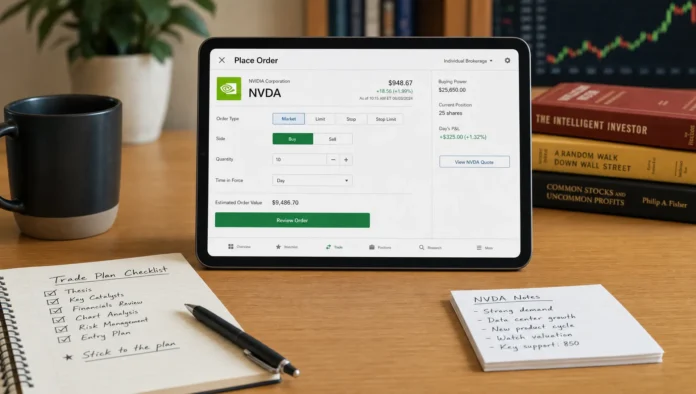
Buying your first shares is exciting, but it should not feel like a leap into the unknown. A share is a small ownership stake in a company, and buying one means you are choosing to participate in that company’s future results, good or bad.
This beginners stock guide focuses on the practical decisions that come before your first order: how to know whether you are ready, how to choose a brokerage account, how to think about your first stock, and how to avoid common mistakes that turn a learning experience into an expensive lesson.
Before we go further, remember that this article is for education only. It is not personalized financial advice. Your income, debts, tax situation, country of residence, and risk tolerance all matter, so consider speaking with a qualified financial professional if you are unsure.
Start With Readiness, Not Stock Picks
Many beginners begin by asking, “Which stock should I buy?” A better first question is, “Am I financially ready to buy shares?” The stock market can reward patient investors over long periods, but it can also fall sharply at inconvenient times. If you invest money you need soon, you may be forced to sell at a loss.
A healthy starting point is to separate your short-term money from your long-term investing money. Rent, bills, debt payments, tuition, taxes, and emergency savings should not depend on whether your first stock goes up next month.
Here is a simple readiness checklist:
| Question | Why it matters | Beginner-friendly target |
|---|---|---|
| Do I have high-interest debt under control? | Credit card interest can outweigh typical investment returns | Pay down or manage expensive debt first |
| Do I have emergency savings? | Prevents forced selling during market drops | Aim for several months of essential expenses if possible |
| Do I know my time horizon? | Stocks are more suitable for long-term goals | Preferably 5 years or longer for stock investing |
| Can I handle volatility? | Share prices move daily and sometimes dramatically | Expect losses on paper without panicking |
| Have I learned the basic terms? | Reduces mistakes when placing orders | Know shares, dividends, market cap, orders, and fees |
If terms like “dividend,” “market capitalization,” or “earnings per share” still feel unclear, it may help to review this beginner explanation of what stock shares mean for first-time investors before placing an order.
Understand What You Are Actually Buying
When you buy shares, you are not buying a lottery ticket or a line on a chart. You are buying partial ownership in a business. The share price reflects what buyers and sellers currently think that ownership stake is worth, based on expectations about profits, growth, interest rates, competition, and market sentiment.
A company’s stock can rise even when the business is average if expectations improve. It can also fall even when the company is profitable if investors expected better results. This is why beginners should avoid assuming that a famous company is automatically a good buy at any price.
There are two main ways you may benefit from owning shares:
- Capital appreciation, which happens when you sell shares for more than you paid.
- Dividends, which are cash payments some companies distribute to shareholders.
Not all companies pay dividends. Younger or faster-growing companies may reinvest cash into expansion instead. More mature companies may return part of their profits to shareholders. Neither approach is automatically better. What matters is whether the company’s strategy, financial strength, and valuation fit your goals.
Choose the Right Type of Brokerage Account
To buy shares, you need a brokerage account. A broker is the platform or financial institution that connects your order to the market. In many countries, opening an account is now digital, but you still need to verify your identity, provide tax information, and accept risk disclosures.
Your account type matters because it can affect taxes, withdrawals, and investment choices. In the U.S., for example, investors often compare taxable brokerage accounts with retirement accounts such as IRAs. In other countries, there may be local tax-advantaged accounts or different rules for foreign stocks. Always check the rules where you live.
When comparing brokers, focus less on flashy app design and more on reliability, costs, investment access, and investor protection. The U.S. Securities and Exchange Commission’s Investor.gov is a useful educational resource for understanding account basics, while FINRA BrokerCheck can help U.S. investors research registered brokers and investment professionals.
Important broker features to compare include:
- Trading commissions and account fees
- Fractional share availability
- Minimum deposit requirements
- Access to the stock exchanges or markets you want
- Quality of educational resources
- Customer support availability
- Cash withdrawal and currency conversion rules
- Regulatory status and investor protection coverage
If a platform is unregulated, unclear about fees, or aggressively promotes “guaranteed” returns, treat that as a major warning sign.
Know the Basic Order Types Before You Trade
A common beginner mistake is placing an order without understanding how it will execute. The two most important order types are market orders and limit orders.
A market order tells your broker to buy or sell immediately at the best available price. It is simple, but the final price can differ from what you saw a moment earlier, especially for volatile or thinly traded stocks.
A limit order tells your broker the maximum price you are willing to pay when buying, or the minimum price you are willing to accept when selling. It gives you more control over price, but the order may not execute if the market does not reach your limit.
| Order type | What it does | Main advantage | Main risk |
|---|---|---|---|
| Market order | Buys or sells as soon as possible | Fast execution | Price may move before completion |
| Limit order | Buys only at or below your chosen price | Better price control | Order may not fill |
| Stop order | Triggers an order after a set price is reached | Can help manage downside or enter on momentum | May execute at an unfavorable price in fast markets |
For a first purchase, many beginners prefer a limit order because it forces them to choose the maximum price they are comfortable paying. If you want a broader foundation before placing trades, Greek Shares also has a clear introduction to stock market basics for complete beginners.
Decide How Much to Invest First
Your first purchase does not need to be large. In fact, starting small can be an advantage. It lets you experience the full process, account funding, order entry, price movement, emotional reactions, and recordkeeping, without putting too much capital at risk.
A useful rule is to invest only an amount that would not damage your finances if the stock fell sharply. Even strong companies can decline 20%, 30%, or more during market stress. Individual companies can fall further if their business deteriorates.
Fractional shares, where available, make this easier. Instead of buying one full share of an expensive stock, you may be able to invest a fixed dollar amount. This can help beginners diversify earlier, although availability depends on the broker and market.

Pick Your First Share With a Simple Framework
A first stock should be understandable. This does not mean the company must be boring, but you should be able to explain how it makes money, who its customers are, and what could go wrong.
Beginners are often attracted to trending stocks because they see rapid price movement online. The problem is that excitement can hide risk. If you cannot explain the business in plain English, you are probably speculating rather than investing.
A simple research framework can help:
| Research area | Question to ask | Why it matters |
|---|---|---|
| Business model | How does the company make money? | You need to understand the source of revenue |
| Competitive position | Why do customers choose this company? | Strong businesses usually have some advantage |
| Financial health | Is revenue, profit, or cash flow stable or improving? | Weak finances increase risk |
| Valuation | Is the price reasonable compared with earnings or growth? | Great companies can still be poor investments at extreme prices |
| Risks | What could hurt the company? | Every investment has a downside case |
| Time horizon | Am I willing to hold through volatility? | Stocks often need time to work out |
You do not need to become a professional analyst before buying your first share. But you should avoid buying only because of a social media post, a friend’s tip, or fear of missing out.
If you want to compare beginner-friendly stock characteristics, you can explore Greek Shares’ practical guide to the best stocks to buy for beginners, which discusses stability, volatility, company size, and dividends.
Place Your First Order Carefully
Once you have chosen a broker, funded your account, researched the stock, and decided how much to invest, you are ready to place an order. Slow down here. Many first-time mistakes happen on the order screen.
Check the company ticker symbol carefully. Some companies have similar names, and some tickers trade on different exchanges. Confirm that you are buying the correct security in the correct currency and account.
Next, choose the number of shares or dollar amount. If your broker supports fractional shares, you may enter a cash amount. If not, you will need enough cash for at least one full share plus any costs.
Then choose your order type. If you use a limit order, enter the highest price you are willing to pay. Review the estimated cost, fees, and order duration before submitting.
After you place the order, do not assume it filled immediately unless your broker confirms execution. A filled order means the shares are now in your account. An open order means it is still waiting. A canceled or expired order means it did not execute.
Build Good Habits After You Buy
Buying your first shares is only the beginning. The habits you build afterward matter more than the first stock itself.
Start by writing down why you bought the stock. Include the date, purchase price, investment thesis, key risks, and what would make you reconsider. This record can protect you from rewriting history later.
For example, if you bought because the company has strong cash flow and a durable brand, a short-term price drop alone may not change your thesis. But if the business starts losing customers, taking on excessive debt, or missing important financial targets, your view may need updating.
Avoid checking the price every few minutes. Frequent monitoring can make normal volatility feel like a crisis. For long-term investors, reviewing holdings monthly or quarterly is often more useful than reacting daily.
Also keep records for tax purposes. Depending on where you live, dividends, capital gains, foreign withholding taxes, and currency conversion may matter. Your broker may provide statements, but you are still responsible for understanding your obligations.
Do Not Confuse Investing With Trading
Investing and trading are not the same. Investing usually means buying assets based on long-term business value, income, or growth potential. Trading usually means attempting to profit from shorter-term price movements.
Neither approach is automatically wrong, but they require different skills, time commitments, and risk controls. Most beginners are better served by learning investing fundamentals before attempting active trading.
Day trading, options, margin, leveraged exchange-traded products, and highly speculative stocks can create losses quickly. Margin is especially risky because it involves borrowing money to invest. If the trade moves against you, your broker may require additional funds or sell positions.
The Financial Industry Regulatory Authority warns investors to understand risks before using margin or complex products. If you cannot explain how an investment can lose money, you should not buy it yet.
Think About Diversification Early
Your first share may be an individual company, but your long-term portfolio should not depend on one stock. Diversification means spreading money across multiple investments so one mistake or one company’s bad result does not ruin your plan.
Many beginners eventually combine individual stocks with diversified funds, such as index funds or exchange-traded funds. A broad fund can provide exposure to many companies in a single purchase. Individual shares can then be added carefully as you gain knowledge.
Diversification does not eliminate risk. A broad market decline can still reduce the value of many holdings at once. But it can reduce company-specific risk, such as a failed product launch, accounting problem, lawsuit, or management mistake.
A beginner portfolio does not need to be complicated. What matters is that it matches your goals, time horizon, and emotional ability to withstand losses.
Common First-Share Mistakes to Avoid
New investors often repeat the same avoidable errors. Knowing them in advance can save you money and stress.
One common mistake is buying a stock only because its price is low. A $5 stock is not automatically cheaper than a $500 stock. What matters is the value of the company relative to its profits, assets, growth, and risks. A low share price can still be expensive if the business is weak.
Another mistake is chasing recent winners. A stock that doubled last month may continue rising, but it may also be priced for perfection. Momentum alone is not a complete investment thesis.
Beginners also sometimes sell too quickly after a small gain and hold losers indefinitely because they do not want to admit a mistake. This behavior can create a portfolio of weak positions while removing stronger ones too early.
Watch for these warning signs in your own behavior:
- You feel rushed to buy before doing research.
- You cannot explain why the stock should be worth more in the future.
- You are investing money needed for bills or emergencies.
- You are checking prices constantly and feeling anxious.
- You are buying more only because the stock fell, not because the thesis improved.
The goal is not to avoid every loss. Losses are part of investing. The goal is to make decisions that are thoughtful, sized appropriately, and consistent with a long-term plan.
A Simple First-Share Plan
If you want a practical path, keep it simple. Learn the basic terms, confirm your finances are ready, choose a regulated broker, start with a small amount, research a company you understand, use an order type you are comfortable with, and write down your reasoning.
Your first purchase should teach you the process, not define your financial future. If the stock rises, do not assume investing is easy. If it falls, do not assume you are bad at investing. One outcome says very little. What matters is the quality of your process repeated over time.
As your confidence grows, you can learn more about valuation, portfolio construction, dividends, index funds, risk management, and taxes. The stock market rewards patience, but it also punishes overconfidence. A steady learning mindset is one of the best assets a beginner can have.
Frequently Asked Questions
How much money do I need to buy my first shares? It depends on your broker and the stock price. Some brokers allow fractional shares, which means you may be able to start with a small dollar amount. Only invest money you can leave invested and afford to see fluctuate.
Should my first investment be one stock or an index fund? Many beginners choose a diversified index fund as a core holding because it spreads risk across many companies. Others buy one individual share as a learning experience. The right choice depends on your goals, knowledge, and risk tolerance.
Is a market order or limit order better for beginners? A limit order is often easier for beginners to control because it sets the maximum price you are willing to pay. A market order may execute quickly, but the final price can change in fast-moving markets.
Can I lose all my money buying shares? With an individual stock, a severe business failure can cause major losses, potentially even close to total loss. Diversification helps reduce company-specific risk, but it does not remove market risk.
How often should I check my first stock? Checking daily is usually not necessary for long-term investors and can lead to emotional decisions. A monthly or quarterly review is often more useful, unless important company news changes your investment thesis.
Keep Learning Before You Scale Up
Buying your first shares is a milestone, but it is only one step in becoming a thoughtful investor. Start small, document your decisions, learn from each result, and build a process before increasing the amount you invest.
For more beginner-friendly investing education, stock market guides, and practical tutorials, explore Greek Shares and continue building your financial literacy one decision at a time.