


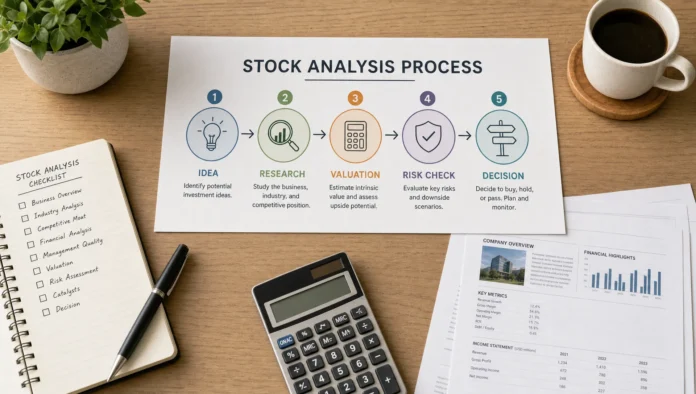
Most investors do not need more noise. They need better filters.
That is the difference between stock tips that feel exciting and stock market tips that actually improve results. A ticker recommendation might give you something to buy today, but a repeatable process helps you decide what to buy, when to wait, when to sell, and how much risk to take.
If you searched for stock marketing tips, you probably want practical stock market guidance that cuts through headlines, social media hype, and overconfident predictions. The goal of this guide is not to hand you the next popular stock. It is to help you build habits that can survive changing markets.
This article is educational and should not be treated as personal financial advice. Your financial situation, time horizon, and risk tolerance matter.
What makes a stock tip useful?
A useful stock tip does not start with a ticker. It starts with a decision rule.
Bad tips usually sound urgent: buy now, do not miss out, this stock will double, insiders know something. Helpful tips slow you down. They help you understand the business, estimate risk, compare alternatives, and avoid emotional mistakes.
| Common tip style | Why it can fail | Better investor version |
|---|---|---|
| Buy this stock before earnings | Earnings are unpredictable and expectations may already be priced in | Understand the business, valuation, and what the market already expects |
| This company is changing the world | Great products do not automatically make great investments | Compare growth potential with price, margins, competition, and cash flow |
| Everyone is talking about it | Popularity can create expensive valuations | Ask whether the future upside still compensates you for the risk |
| It is down 50 percent, so it is cheap | A falling price can reflect a deteriorating business | Identify whether the problem is temporary, structural, or unknown |
| Analysts upgraded it | Analyst views can change after prices have already moved | Use outside opinions as inputs, not as decisions |
The best stock market tips help you make fewer unforced errors. That matters because investors often lose money not from one bad stock, but from repeated poor habits: chasing performance, overconcentrating, selling in panic, or buying without a plan.
1. Start with the job of your money
Before asking which stock to buy, ask what the money is supposed to do.
Money needed for rent, tuition, taxes, emergency savings, or a near-term purchase usually should not be exposed to stock market volatility. Stocks can create wealth over long periods, but they can also fall sharply at inconvenient times. The longer your time horizon, the more flexibility you usually have to ride through market cycles.
A practical framework is to separate your money into time buckets:
- Short-term money: Funds you may need within the next one to three years.
- Medium-term money: Funds for goals that are several years away but still date-sensitive.
- Long-term money: Funds intended for retirement, long-term wealth building, or goals with flexible timing.
This simple step prevents one of the most common investor mistakes: using stock market risk for money that cannot afford stock market volatility. If you are new to investing, Greek Shares has a beginner-friendly guide on what to know before buying stocks that expands on this foundation.
2. Turn every stock idea into a written thesis
A stock idea becomes investable only when you can explain why you own it.
Your investment thesis does not need to be complicated. In fact, a simple thesis is often better because it exposes weak logic quickly. Write down what the company does, why it might grow or remain profitable, what you think the market is missing, and what would prove you wrong.
A useful thesis answers five questions:
- What does the company sell, and who buys it?
- Why does the business have an advantage over competitors?
- What could drive revenue, profit, or cash flow higher over time?
- What price are you paying relative to today’s fundamentals and future expectations?
- What event or data point would make you change your mind?
The last question is especially important. Many investors know why they want to buy, but they never define why they would sell. That creates a psychological trap. When the stock drops, they call it a discount. When it rises, they call it confirmation. A written thesis keeps you honest.
3. Judge the business before the chart
Charts can be useful, but they do not replace business analysis.
A stock is not just a line moving up and down. It represents ownership in a business. If the business is weak, heavily indebted, losing relevance, or unable to convert sales into cash, a nice-looking chart may not protect you for long.
Start with business quality. Look for understandable revenue sources, durable demand, sensible debt levels, and evidence that management allocates capital responsibly. You do not need to forecast every detail. You need to understand the key drivers well enough to know what matters.
For everyday investors, the most useful analysis often combines business understanding, financial statements, valuation, and risk control. If you want a deeper breakdown, this guide to stock market analysis basics is a natural next step.
4. Use valuation as a reality check, not a magic answer
A good company can still be a bad investment if the price is too high.
Valuation helps you compare the price of a stock with the profits, assets, growth, or cash flows behind it. It does not tell you the future with certainty. It gives you a margin for thinking.
| Valuation tool | What it can tell you | What to watch out for |
|---|---|---|
| Price-to-earnings ratio | How much investors pay for each dollar of earnings | Earnings can be temporarily high, low, or distorted by accounting items |
| Price-to-sales ratio | How the market values revenue | Revenue without profits may not create shareholder value |
| Free cash flow yield | Cash generation relative to market value | Cash flow can swing in cyclical or capital-intensive businesses |
| Enterprise value to EBITDA | Business value compared with operating earnings | It can understate capital spending needs and debt risk |
| Dividend yield | Income received relative to share price | A high yield can signal risk if the dividend is not sustainable |
Valuation is most useful when compared with growth, quality, and risk. A slow-growth company at a high valuation may be vulnerable. A high-growth company at a premium valuation may be reasonable if its economics are strong and durable. The question is not whether a stock is cheap or expensive in isolation. The question is whether the expected return justifies the uncertainty.
5. Diversify by what can go wrong
Owning many stocks does not always mean you are diversified.
If you own twenty companies but they all depend on the same interest rate environment, commodity price, country, customer type, or technology trend, your portfolio may be more concentrated than it looks. Real diversification asks: what could hurt multiple holdings at the same time?
The U.S. Securities and Exchange Commission explains that diversification can help manage investment risk, although it cannot eliminate risk entirely. That distinction matters. Diversification is not a guarantee. It is a way to avoid having one mistake or one macro shock dominate your financial outcome.
Think across different dimensions: sectors, geographies, company sizes, business models, currencies, and asset classes. If you invest only in individual stocks, consider whether your holdings behave differently under different conditions. If every stock needs low rates, strong consumer spending, and high optimism to work, you may not have as much balance as you think.
6. Separate market context from market prediction
Investors should pay attention to the market environment, but that does not mean they should pretend to know the next move.
Interest rates, inflation, earnings growth, credit conditions, currency moves, and geopolitical risks can all influence stock prices. The mistake is turning every data point into a short-term prediction. Markets often move before the news is obvious, and prices can rise on bad news if expectations were even worse.
A better habit is to ask how the environment affects your holdings. Higher rates may pressure highly valued growth stocks. Slowing demand may hurt cyclical companies. Falling input costs may help businesses with strong pricing power. These are practical connections, not crystal-ball forecasts.
For a broader look at the big-picture forces investors are monitoring, review Greek Shares’ guide to updated stock market trends.
7. Use curated opinions as filters, not instructions
Outside opinions can be valuable, but only when you know how to use them.
Think about travel planning. If someone wants to explore a new destination, they might use destination specialists such as SAT Mexico Tours to narrow choices, compare experiences, and avoid wasting time. But the traveler still chooses based on budget, schedule, interests, and comfort level.
Investing should work the same way. Analysts, newsletters, podcasts, screeners, and market commentators can help you discover ideas and understand risks. They should not replace your own judgment. A recommendation is only useful if you can translate it into your own process.
Before acting on any opinion, ask three questions. Does the source explain the reasoning? Does the idea fit my goals and risk tolerance? Do I understand what would make the idea fail? If the answer is no, the idea belongs on a watchlist, not in your portfolio.
8. Build a buy, hold, and sell checklist
A checklist is one of the simplest ways to reduce emotional investing.
It will not make you perfect. It will make your mistakes more visible. When markets are calm, you can design rules. When markets are volatile, you can follow them.
Your checklist might include:
- Buy rule: I understand the business, the balance sheet is acceptable, valuation is reasonable, and the position size fits my portfolio.
- Hold rule: The original thesis remains intact, short-term volatility is not caused by permanent business damage, and opportunity cost remains acceptable.
- Sell rule: The thesis is broken, valuation has become unrealistic, better opportunities exist, or the position has grown too large.
This approach turns investing from a series of emotional reactions into a review process. It also helps you learn. If a stock performs poorly, you can look back and ask whether the checklist failed, whether you ignored it, or whether the outcome was simply an unavoidable risk.
9. Manage position size before emotions take over
Position sizing is risk management in practical form.
Even a strong stock idea can hurt you if the position is too large. A small position gives you room to be wrong. A large position demands a much higher level of conviction, research, and emotional stability.
Many investors focus only on potential return. Better investors also ask how much damage a bad outcome could cause. If a stock fell 30 percent, would it derail your plan? If it fell 50 percent, would you panic-sell? If the answer is yes, the position is probably too large.
Position size should reflect confidence, volatility, business risk, valuation risk, and your overall portfolio. Riskier companies usually deserve smaller allocations, even when the upside looks attractive.
10. Keep a decision journal
A decision journal is one of the most underrated stock market tools.
Before buying or selling, write a short entry: the date, stock price, reason for the decision, expected outcome, main risks, and emotional state. Were you calm? Excited? Afraid of missing out? Trying to recover a loss?
After a few months or quarters, review your notes. Patterns will appear. You may discover that you buy too quickly after sharp rallies, sell too quickly after negative headlines, or overestimate companies you personally like. This feedback loop is valuable because it is based on your actual behavior, not general advice.
Great investing is not only about analyzing companies. It is also about analyzing yourself.
A simple 30-minute stock review routine
You do not need to spend all day watching markets. A focused routine can help you make better decisions without becoming overwhelmed.
- Review the business in five minutes: Reconfirm what the company does, how it makes money, and what key metric matters most.
- Check recent financials in five minutes: Look at revenue, margins, cash flow, debt, and management commentary.
- Review valuation in five minutes: Compare current valuation with growth expectations, peers, and the company’s own history.
- Check risk in five minutes: Identify what could go wrong and whether the position size still makes sense.
- Read one opposing view in five minutes: Look for a serious argument against your thesis to reduce confirmation bias.
- Update your decision in five minutes: Buy, hold, trim, sell, or wait, then write down why.
This routine works because it forces balance. You are not only looking for reasons to buy. You are looking for enough information to make a disciplined decision.
The stock market tips that matter most
If you remember only a few ideas from this guide, remember these.
A stock is a business, not a lottery ticket. Price matters because expectations matter. Diversification should protect you from specific mistakes, not just make your portfolio look busy. Outside opinions are inputs, not orders. Risk management begins before you buy. Your behavior can be as important as your analysis.
The investors who improve are usually not the ones chasing the loudest tips. They are the ones building a repeatable process, reviewing their decisions, and staying humble when markets surprise them.
Frequently Asked Questions
Are stock tips ever useful? Yes, but only as starting points for research. A stock tip becomes useful when it leads you to investigate a business, valuation, risk, and portfolio fit. It becomes dangerous when you treat it as a shortcut.
What is the biggest mistake investors make with stock market tips? The biggest mistake is acting before understanding. Investors often buy because a stock sounds exciting, then only research it after the price falls. Research should come before commitment.
How many stocks should a beginner own? There is no perfect number for everyone. The goal is not to own as many stocks as possible, but to avoid having one company, sector, or theme dominate your results. Beginners may also consider diversified funds depending on their goals and knowledge.
Should I use technical analysis or fundamental analysis? Both can be useful, but they answer different questions. Fundamental analysis helps you understand business value and quality. Technical analysis may help with timing, sentiment, or price behavior. Neither removes risk.
How do I know when to sell a stock? Selling is easier when you define rules before buying. Common reasons include a broken thesis, excessive valuation, deteriorating fundamentals, better opportunities, or a position becoming too large for your risk tolerance.
Keep building your investing process
Helpful stock market tips do not promise certainty. They help you make better decisions under uncertainty.
If you want to keep improving your financial literacy, explore the educational guides, market explainers, and investing resources on Greek Shares. The more disciplined your process becomes, the less dependent you are on rumors, headlines, and hot tips.