


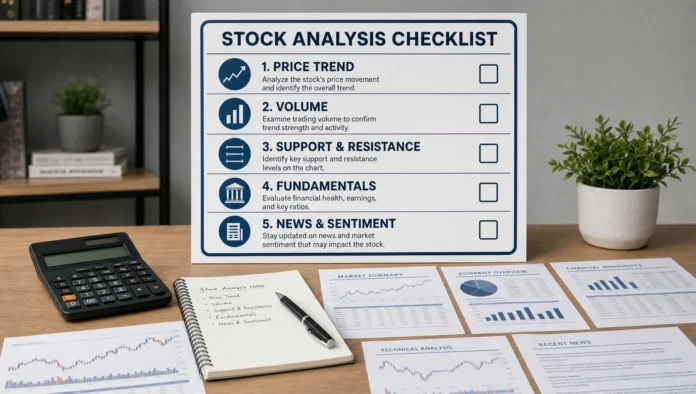
A stock rarely gives one clean signal that says buy or sell. More often, it offers clues: price action, volume, earnings, sector strength, news, and investor behavior. Your job is not to find certainty. Your job is to decide whether the evidence leans bullish, bearish, or unclear enough to wait.
That distinction matters because many beginners treat every green day as bullish and every red day as bearish. In reality, a stock can rise inside a long-term downtrend, fall inside a healthy uptrend, or move sharply on news that does not change its underlying value. Reading a stock’s signals means combining evidence instead of reacting to one candle, one headline, or one opinion.
Bullish or bearish starts with the time frame
A bullish signal suggests buyers are gaining control and the probability of higher prices has improved. A bearish signal suggests sellers are gaining control and the probability of lower prices has increased. But both labels depend on time frame.
A stock can look bullish on a daily chart because it has broken above a short-term resistance level, while still looking bearish on a weekly chart because it remains below a declining long-term moving average. A long-term investor, a swing trader, and a day trader may all look at the same stock and reach different conclusions because they are asking different questions.
This is why it helps to understand the broader language of bull and bear markets before judging an individual stock. The market environment can strengthen or weaken a single stock signal. A breakout during a strong bull market often deserves more attention than a breakout during a broad market sell-off.
The core stock signals to read first
No single indicator is enough. A stock’s signal becomes more reliable when multiple pieces of evidence point in the same direction. Think in categories rather than isolated events.
| Signal category | Bullish signs | Bearish signs | What to verify |
|---|---|---|---|
| Trend | Higher highs, higher lows, price above key moving averages | Lower highs, lower lows, price below key moving averages | Does the trend match your time frame? |
| Volume | Rising volume on advances, calmer volume on pullbacks | Heavy volume on declines, weak volume on rebounds | Is conviction increasing or fading? |
| Support and resistance | Breakout above resistance, successful retest of support | Breakdown below support, failed rally at resistance | Was the move confirmed or quickly reversed? |
| Fundamentals | Improving revenue, margins, earnings, cash flow, guidance | Deteriorating results, high debt stress, weak outlook | Is the business improving or only the chart? |
| Sentiment and news | Positive catalysts that change future expectations | Negative news that damages expectations | Is the reaction temporary or structural? |
The strongest bullish cases usually show price strength, volume confirmation, and a fundamental or sector reason for optimism. The strongest bearish cases usually show technical weakness, distribution volume, and deteriorating expectations.
Price action: trend, levels, and failed moves
Price action is the first signal because it shows what buyers and sellers are actually doing. A stock in an uptrend generally makes higher highs and higher lows. A stock in a downtrend generally makes lower highs and lower lows. Sideways price action means the market has not yet chosen a direction.
Support and resistance are especially useful. Support is an area where buyers have previously stepped in. Resistance is an area where sellers have previously appeared. If a stock breaks above resistance and holds that level, the signal leans bullish. If it breaks below support and cannot recover quickly, the signal leans bearish.
The key word is holds. Many false signals happen when price briefly crosses a level and then reverses. A breakout that fails can become bearish because it traps late buyers. A breakdown that quickly recovers can become bullish because it traps late sellers.
If you are still building this skill, spend time learning how to read stock charts clearly. The goal is not to memorize patterns. The goal is to understand where buyers and sellers are likely to make decisions.
Volume: the signal behind the signal
Volume shows participation. A price move on light volume may simply reflect a lack of sellers or buyers. A price move on unusually high volume suggests stronger conviction.
A bullish volume profile often includes rising volume during advances and lower volume during normal pullbacks. This can suggest accumulation, meaning larger or more committed buyers may be building positions over time. A bearish volume profile often includes heavy volume on down days and weak volume on rebound attempts. This can suggest distribution, meaning shares are being sold into strength.
Useful volume clues include:
- A breakout with above-average volume is more convincing than a breakout on quiet trading.
- A rally that keeps losing volume may be losing buyer enthusiasm.
- A sell-off on unusually high volume can signal fear, forced selling, or institutional distribution.
- A low-volume pullback after a strong advance can be healthy if key support remains intact.
Volume does not guarantee direction, but it helps answer a vital question: how much commitment is behind the move?
Fundamental signals: when business quality supports the chart
Technical signals show market behavior. Fundamental signals show business reality. A stock can move bullishly for a while on momentum alone, but longer-term price strength usually needs support from earnings power, cash flow, growth, or improving expectations.
Bullish fundamental signals may include accelerating revenue, expanding margins, positive free cash flow, improving guidance, reduced debt risk, or evidence that management is executing well. Bearish fundamental signals may include slowing sales, margin pressure, repeated guidance cuts, dilution, rising financing costs, or competitive threats.
The most important question is whether the business is getting better, worse, or merely being repriced. A stock that falls after good results may not be bearish if expectations were simply too high before the report. A stock that rises after weak results may not be bullish if investors are only reacting to relief that the news was not worse.
News and sentiment: useful, but easy to overread
News can create a signal, but it can also create noise. Earnings releases, regulatory decisions, product launches, interest rate changes, analyst upgrades, lawsuits, mergers, and geopolitical events can all move a stock. The mistake is assuming that every news-driven move has the same meaning.
A disciplined reader asks three questions. What exactly changed? Does the change affect future cash flows or only short-term emotion? Is the market reaction proportional to the news?
This is especially important during volatile sessions, when headlines move faster than analysis. If a stock jumps or drops because of a major headline, slow down and separate fact from interpretation. Greek Shares has a separate guide on how to read recent news about stock market moves without letting emotion take over.
A useful mindset is to treat stock signals like a risk audit, not a verdict. In other high-stakes fields, specialists use structured reviews to identify weaknesses before decisions become costly. For example, Diana Ordoñez Abogada presents legal audit and risk-control services for complex administrative and contracting issues, a reminder that disciplined review processes are valuable whenever uncertainty is high. Investors can borrow the same principle by checking evidence before acting.

A practical bullish or bearish scorecard
Instead of asking whether a stock is bullish or bearish in one step, score the evidence. This does not need to be complicated. You can use a simple checklist before making any decision.
| Area | Question to ask | Bullish answer | Bearish answer |
|---|---|---|---|
| Time frame | Which chart matters for my plan? | Short-term and long-term signals align upward | Short-term bounce conflicts with long-term weakness |
| Trend | Is price making progress? | Higher highs and higher lows | Lower highs and lower lows |
| Key levels | Is price holding important areas? | Holds above support or breaks resistance | Fails at resistance or loses support |
| Volume | Is participation confirming the move? | Strong volume on advances | Strong volume on declines |
| Fundamentals | Is the business outlook improving? | Results and guidance support optimism | Results or outlook weaken the case |
| Sentiment | Is the market reaction rational? | News improves future expectations | News damages future expectations |
| Risk | Is the downside manageable? | Clear invalidation level and position size | Unclear risk or emotionally driven entry |
If most categories lean bullish, the stock may deserve further research on the long side. If most lean bearish, caution may be appropriate. If the signals are mixed, waiting is a valid decision. Cash is also a position when the evidence is unclear.
How to interpret mixed signals
Mixed signals are normal. In fact, the market spends a lot of time in uncertain conditions. A stock may show a bullish breakout but weak volume. It may report strong earnings but sell off because the valuation was already stretched. It may hold support while the broader sector is breaking down.
When signals conflict, rank them by importance for your strategy. Long-term investors may give more weight to fundamentals, valuation, balance sheet strength, and multi-year industry trends. Short-term traders may give more weight to price action, volume, volatility, and clearly defined levels.
The worst response to mixed signals is forcing a conclusion. If you need five arguments to justify a trade and three of them are weak, the signal may not be strong enough. Good investing often means rejecting average setups and waiting for clearer alignment.
Common mistakes when reading a stock’s signals
Many losing decisions come from misreading ordinary market behavior as a major signal. A one-day move can feel important, but context decides whether it matters.
Common mistakes include:
- Treating a green candle as automatically bullish without checking the larger trend.
- Calling a stock bearish simply because it pulled back after a strong advance.
- Ignoring volume when judging breakouts and breakdowns.
- Buying after good news without asking whether the news was already priced in.
- Confusing personal opinion with market evidence.
- Forgetting risk management because the signal feels obvious.
The final mistake is the most dangerous. Even strong signals fail. A bullish setup can break down after unexpected news. A bearish setup can reverse sharply if sellers are exhausted. Your plan should define what would prove your thesis wrong before you enter, not after the trade moves against you.
Risk management turns signals into decisions
Reading signals is only analysis. A decision also requires risk control. Before acting, know your time frame, your reason for entry, your invalidation level, and how much of your portfolio you are willing to risk.
For investors, this may mean diversifying, avoiding overconcentration, and checking whether a stock still fits long-term goals. For traders, it may mean using stop levels, position sizing, and avoiding entries where the potential reward is too small compared with the downside.
A bullish signal is not permission to risk too much. A bearish signal is not a reason to panic. Signals are tools for improving judgment, not replacements for a plan.
Frequently Asked Questions
What is a bullish stock signal? A bullish stock signal is evidence that buyers may be gaining control. Examples include a confirmed breakout, higher highs and higher lows, strong volume on advances, improving earnings, or positive news that changes future expectations.
What is a bearish stock signal? A bearish stock signal is evidence that sellers may be gaining control. Examples include a breakdown below support, lower highs and lower lows, heavy volume on declines, weakening fundamentals, or negative news that reduces confidence in future results.
Is one signal enough to buy or sell a stock? Usually no. A single signal can be misleading. It is better to combine trend, volume, support and resistance, fundamentals, sentiment, and risk management before making a decision.
Can a stock be bullish and bearish at the same time? Yes. A stock can be bullish on a short-term chart and bearish on a long-term chart, or technically strong while fundamentally weak. Always define your time frame before interpreting signals.
Which signal is most important for beginners? Trend is often the easiest starting point because it shows the direction of price behavior. Beginners should then add volume, key levels, and basic fundamental checks to avoid relying on price alone.
Build a calmer signal-reading routine
Bullish or bearish is not a label you attach after one headline or one chart pattern. It is a conclusion you reach after weighing evidence. The more consistent your process, the less likely you are to react emotionally to every market move.
Use signals to ask better questions, manage risk, and decide when the evidence is strong enough to act. For more investing education, market guides, and practical stock market learning, continue exploring Greek Shares and keep refining your process one decision at a time.