


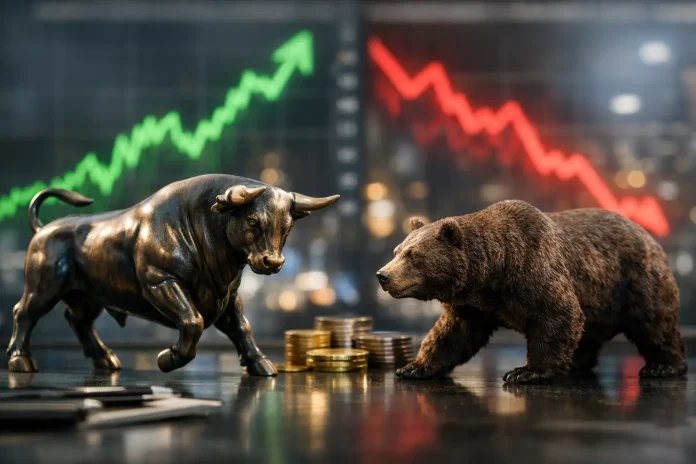
A portfolio can feel brilliant in a rising market and broken in a falling one, even when the underlying strategy has not changed. That is why understanding bull market vs bear market matters. These labels are more than stock market slang. They shape investor behavior, risk tolerance, portfolio returns, and the kinds of mistakes people are most likely to make.
For newer investors, the terms often seem simple at first. A bull market means prices are going up. A bear market means prices are going down. That basic definition is useful, but it leaves out the part that actually affects decisions: how these environments develop, how they feel while you are living through them, and how disciplined investors adjust without overreacting.
Bull market vs bear market: the core difference
A bull market is a period when stock prices trend higher over time, often supported by economic growth, improving earnings, strong business confidence, and investor optimism. A bear market is the opposite. Prices trend lower over a sustained period, often alongside economic weakness, declining profits, tighter financial conditions, and broader fear.
You will often hear a rule of thumb that a 20% rise from a recent low signals a bull market, while a 20% decline from a recent high signals a bear market. That benchmark is common, but it is not the whole story. Markets do not become easier to understand just because they cross a percentage threshold. A short bounce in a weak market does not always mean a new bull market has begun, and a sharp drop does not always mean a full bear market is underway.
The more useful distinction is this: a bull market is generally a favorable trend supported by improving conditions, while a bear market is generally a downward trend shaped by deterioration and uncertainty.
What a bull market usually looks like
In a bull market, optimism tends to build gradually and then spread. Company earnings often improve. Consumers spend more freely. Businesses invest in expansion. Unemployment may be relatively low, and access to credit may be easier. Investors become more willing to take risk because recent results reinforce confidence.
This is the stage when strong companies can keep climbing even if their valuations start to look expensive. Investors often focus on opportunity rather than protection. Growth stocks may outperform. Initial public offerings attract attention. Financial media coverage becomes more enthusiastic, and people who ignored investing during a downturn may suddenly want in.
That last detail matters. Bull markets can create good returns, but they also create complacency. Investors may begin to believe that buying almost anything will work. Risk controls weaken. Diversification starts to feel unnecessary. Speculation can creep in under the label of confidence.
What a bear market usually looks like
A bear market tends to feel more emotional because losses usually arrive faster than gains. Prices decline, but just as important, expectations decline too. Investors begin to question earnings forecasts, economic growth, interest rate policy, and the strength of consumer demand. What looked manageable in a bull market starts to look fragile.
In these periods, correlations can rise as many assets fall together. Even solid companies may decline because investors are reducing exposure broadly, not just selling weak businesses. Volatility increases. Short-term rallies appear and disappear. Headlines become more dramatic, and fear can push investors into decisions they would not make under calmer conditions.
Bear markets are uncomfortable, but they are not unusual. They are part of how markets reset valuations, reprice risk, and test investor discipline. For long-term investors, the challenge is not avoiding every decline. It is learning how to respond without damaging a sound plan.
Why bull and bear markets happen
Markets do not move in cycles for one reason alone. A bull market can be driven by rising corporate earnings, lower interest rates, improving productivity, stronger economic data, or a recovery after a previous downturn. Sometimes several of these forces work together.
Bear markets also have different triggers. Inflation may force central banks to raise interest rates. A recession may reduce business profits. Financial stress, geopolitical shocks, overvalued markets, or a sudden change in investor expectations can all contribute. In some cases, the market falls before the economy clearly weakens because investors are pricing in future trouble.
That is why investors should be careful with simple explanations. If someone says the market is down because of one news event, that may only be part of the story. Markets are forward-looking. Prices often reflect a combination of current data, future expectations, and investor psychology.
Bull market vs bear market in investor behavior
The largest difference between these market phases may be behavioral rather than technical. In a bull market, investors often become less sensitive to risk. They may chase performance, ignore valuation, or confuse a favorable environment with personal skill. Gains feel normal, and caution can look unnecessary.
In a bear market, the opposite happens. Investors focus more on protecting capital than growing it. They may sell quality holdings after large declines because the emotional pressure becomes too strong. They may hold cash for too long, waiting for certainty that never fully arrives.
Neither extreme is helpful. Overconfidence in a bull market and panic in a bear market both lead to poor decisions. A disciplined investor tries to stay grounded in process rather than mood. That means having position sizes, diversification rules, and time horizons that still make sense when markets become uncomfortable.
How to invest during a bull market
A bull market is not a signal to abandon discipline. It is a time to check whether strong returns are pulling your portfolio away from its intended risk level. Rebalancing may feel boring when everything is rising, but it helps prevent a portfolio from becoming too concentrated in the best recent performers.
It also helps to watch your assumptions. If you are buying stocks mainly because they have already gone up, that is momentum chasing, not analysis. A rising market can hide weak fundamentals for a while, but eventually valuations matter again.
For long-term investors, a bull market is often best used to keep contributing, review asset allocation, and resist the urge to turn investing into speculation. Good markets are useful, but they can encourage bad habits.
How to invest during a bear market
A bear market usually demands more emotional control than analytical brilliance. If your investment time horizon is long and your portfolio is properly diversified, lower prices are not automatically a reason to exit. In many cases, continuing to invest through downturns can improve long-term results because new money buys more shares at lower prices.
That said, context matters. If you need cash soon, if your portfolio risk was too aggressive from the start, or if your financial situation has changed, a bear market may expose problems that require adjustment. Staying invested is not the same as ignoring reality.
This is where a plan becomes practical. Investors who decide their asset allocation, contribution schedule, and risk limits in advance are less likely to make emotional decisions under pressure. Bear markets punish weak preparation more than they punish imperfect forecasts.
Common mistakes in both markets
In bull markets, investors often overpay, overtrade, and overestimate their tolerance for risk. In bear markets, they often sell after losses, stop investing, and assume recent pain will continue indefinitely. Both mistakes come from recency bias, the tendency to treat the latest market behavior as if it will last forever.
Another common mistake is trying to call every turn. Investors want to know the exact bottom of a bear market and the exact top of a bull market. In practice, those turning points are only obvious in hindsight. Waiting for perfect clarity often means missing much of the recovery, while trying to trade every swing can increase taxes, costs, and emotional stress.
A steadier approach is usually more effective. Focus on what you can control: your savings rate, diversification, costs, time horizon, and investment behavior.
Which market is better for investors?
The easy answer is that bull markets are better because portfolios grow. The more complete answer is that both phases play a role. Bull markets build wealth, but bear markets often create the valuations and future return opportunities that disciplined investors benefit from later.
This does not mean downturns are good in a casual sense. Losses are real, and bear markets can be financially and emotionally difficult. But if you are building long-term investing skill, you need to understand both environments. One rewards patience. The other tests it.
At Greek Shares, that is where investor education matters most. Anyone can feel confident when markets rise. The real progress comes when you can recognize the cycle, manage risk, and keep making informed decisions without being pulled around by headlines.
The market will not stay bullish forever, and it will not stay bearish forever either. Your advantage comes from building habits that can survive both.