


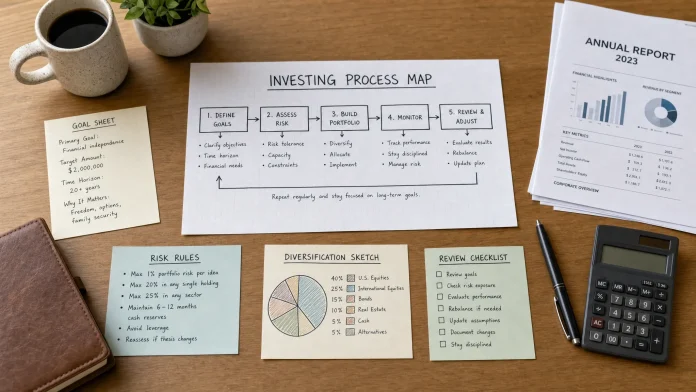
Confidence in stock investing does not come from knowing exactly what the market will do next. No one has that kind of certainty. Real confidence comes from having a process you trust, understanding why you own each investment, and knowing what you will do when prices move against you.
That matters because stocks can be rewarding, but they are never risk-free. The S&P 500 has delivered strong long-term returns over many decades, yet investors have also lived through bear markets, crashes, inflation shocks, and long periods of uncertainty. The goal is not to remove volatility. The goal is to make decisions that are prepared for it.
Below are seven practical tips for investing in stocks with more confidence, especially if you want to build long-term habits instead of relying on guesses, hype, or fear.
1. Start With a Clear Reason for Investing
Before choosing a stock, index fund, or sector, ask a simpler question: what is this money for?
A person investing for retirement 25 years from now can usually accept more short-term volatility than someone saving for a home deposit in three years. The same stock market decline can feel manageable for one investor and disastrous for another, depending on the purpose of the money.
Clear goals help you define:
- How long you can stay invested
- How much risk you can reasonably take
- How often you should contribute
- Whether individual stocks, funds, or a mix makes sense
- When you might need to sell
For money you may need soon, stocks may not be appropriate at all. For long-term goals, stocks can play an important role because businesses have time to grow, reinvest, and compound value.
If you are still setting your foundation, Greek Shares has a practical beginner guide on how to invest in stocks with a simple starter plan. It can help you think through readiness, goals, and first steps before buying.
2. Build a Financial Base Before Taking Market Risk
Confidence is much easier when your daily financial life is stable. If every market dip threatens your rent, loan payments, or emergency savings, you are more likely to panic sell at the wrong time.
Before investing heavily in stocks, consider the basics:
- Keep an emergency fund for unexpected expenses
- Pay attention to high-interest debt
- Avoid investing money needed for short-term obligations
- Decide how much you can invest regularly without stress
This may sound less exciting than picking winners, but it is one of the strongest forms of risk management. A solid financial base gives you the patience to let long-term investments work.
The U.S. Securities and Exchange Commission also encourages investors to review their financial situation, goals, and risk tolerance before investing through its investor education resources at Investor.gov. That guidance is simple, but it is often ignored when markets are rising quickly.
3. Learn the Business Before You Buy the Stock
A stock is not just a ticker symbol moving on a chart. It represents ownership in a real business. When you remember that, investing becomes less like gambling and more like analysis.
Before buying an individual stock, try to understand what the company does, how it makes money, what could help it grow, and what could hurt it. Read the company’s annual report, look at its revenue sources, review debt levels, and compare it with competitors.
A useful starting checklist includes:
| Question | Why it matters |
|---|---|
| What does the company sell? | You should understand the business model before risking money. |
| Is revenue growing sustainably? | Growth is stronger when it comes from real demand, not short-lived hype. |
| Is the company profitable? | Profits support reinvestment, dividends, and resilience. |
| How much debt does it carry? | High debt can become dangerous when rates rise or sales fall. |
| What price are you paying? | A great company can still be a poor investment if bought at an extreme valuation. |
This does not mean you must become a professional analyst. It means you should be able to explain, in plain language, why you own the stock. If your only reason is “everyone is talking about it,” you probably need more research.
For a deeper decision-making framework, this Greek Shares guide on tips that can improve your stock decisions covers investor type, valuation, financial health, and the business behind each stock.
4. Use Diversification to Reduce Single-Stock Pressure
One reason beginners lose confidence is that they put too much money into too few ideas. If one company disappoints, the whole portfolio suffers. Diversification helps reduce that pressure.
Diversification means spreading your investments across different companies, sectors, countries, or asset types. It does not guarantee profits or prevent losses, but it can reduce the damage caused by one bad outcome.
For many investors, diversified funds or exchange-traded funds can form a useful core because they provide exposure to many companies in a single investment. Individual stocks, if used, can then be added more selectively around that core.
Think of diversification as a way to admit uncertainty. Even strong businesses can face regulation, competition, management mistakes, technological disruption, or economic shocks. A diversified portfolio lets you participate in growth without depending entirely on one prediction.

5. Decide Your Risk Rules Before the Market Tests You
The hardest investing decisions usually happen when emotions are high. Prices fall, headlines get alarming, and investors feel pressure to act immediately. That is why risk rules should be written before the stressful moment arrives.
Your rules do not need to be complicated. They should answer questions like:
- What percentage of my portfolio can go into one stock?
- How much cash should I keep available?
- Will I add money regularly or only at certain valuations?
- What would make me sell a stock?
- How often will I review my portfolio?
The goal is to reduce impulsive decisions. If you already know that no single stock should exceed 5% or 10% of your portfolio, you are less likely to chase an idea too aggressively. If you already know you review holdings quarterly, you are less likely to react to every daily price swing.
Risk control is not about being fearful. It is about staying in the game long enough for good decisions to compound. Greek Shares also has a focused guide on how to invest in shares with better risk control if you want to build clearer rules around position sizing, diversification, and disciplined buying.
6. Keep Learning, Especially When You Feel Overconfident
Confidence and overconfidence are not the same. Confidence says, “I have a process.” Overconfidence says, “I cannot be wrong.” The second mindset can be expensive.
Markets change. Interest rates change. Industries change. Investor behavior changes. A strategy that worked in one market cycle may not work the same way in another. That is why ongoing education is part of investing discipline, not something you finish after reading one book or article.
You can learn through annual reports, investor letters, financial statements, books, reputable courses, and market history. Structured learning can also help if you prefer guided lessons. For investors who want to strengthen broader business, finance, and analytical skills, platforms offering expert-led upskilling paths, such as live online courses and microlearning programs, can support a more disciplined learning habit.
The key is to study before you need the knowledge. If you wait until a crisis to learn about valuation, diversification, or portfolio risk, emotions may already be in control.
7. Track Your Decisions, Not Just Your Returns
Many investors only check whether they made or lost money. That is useful, but incomplete. In the short term, a poor decision can make money and a good decision can lose money. Markets are noisy.
To build real confidence, track the quality of your decisions. Keep a simple investing journal with the reason for each purchase, your expected holding period, the risks you see, and what would change your mind.
A simple journal can include:
| Item to record | Example |
|---|---|
| Purchase reason | “Strong balance sheet, growing cash flow, reasonable valuation.” |
| Main risk | “Revenue depends heavily on one product line.” |
| Expected holding period | “At least five years unless the business weakens.” |
| Sell trigger | “Debt rises sharply or competitive position deteriorates.” |
| Review date | “Check after quarterly results and annual report.” |
This habit improves self-awareness. Over time, you may notice patterns. Maybe you buy after big price jumps. Maybe you sell too quickly during normal volatility. Maybe your best decisions come when you understand the business deeply.
A journal turns investing from a series of emotional reactions into a feedback system. That is one of the fastest ways to improve.
A Simple Confidence Framework for Stock Investors
If you want to bring these tips together, use a three-part framework: purpose, process, and patience.
Purpose means every investment connects to a real goal. Process means you follow rules for research, diversification, and risk. Patience means you give good investments enough time while still reviewing them intelligently.
Here is how that looks in practice:
| Confidence pillar | What it means | Practical habit |
|---|---|---|
| Purpose | You know why the money is invested. | Match investments to goals and time horizon. |
| Process | You have rules before emotions rise. | Use research checklists, position limits, and review dates. |
| Patience | You accept normal volatility. | Avoid reacting to every headline or daily price move. |
This framework does not promise perfect results. It helps you behave consistently, which is often more important than finding the perfect stock.
Common Confidence Traps to Avoid
Sometimes investors think they are becoming more confident when they are actually taking bigger risks without realizing it.
Be careful if you notice yourself saying things like:
- “This stock cannot go down much more.”
- “I will buy now and research later.”
- “Everyone online says this is the next big thing.”
- “I do not need diversification because I found a sure winner.”
- “I will sell only when I get back to break-even.”
These thoughts are common, but they can lead to poor decisions. Confidence should come from preparation, not from certainty. A prepared investor can say, “I may be wrong, so here is how I will manage the risk.”
Frequently Asked Questions
How much money do I need to start investing in stocks? You do not need a large amount to start learning, but you should first have money set aside for emergencies and short-term needs. Many investors begin with small, regular contributions while focusing on education and risk control.
Is it better to buy individual stocks or funds? It depends on your knowledge, time, goals, and risk tolerance. Diversified funds can be useful for broad exposure, while individual stocks require more research and ongoing monitoring.
How can I feel less nervous when stocks fall? Nervousness is normal. You can reduce panic by investing only money meant for long-term goals, diversifying, writing risk rules in advance, and reviewing your original investment reasons before acting.
Should beginners try to time the market? Most beginners are better served by building a consistent process than trying to predict short-term market moves. Timing the market requires being right about both when to sell and when to buy back, which is very difficult.
How often should I check my portfolio? Checking too often can increase emotional decision-making. Many long-term investors review their portfolios on a set schedule, such as monthly or quarterly, while also staying aware of major changes to the businesses they own.
Build Confidence One Decision at a Time
Stock investing confidence is earned through preparation. You do not need to know everything before you begin, but you do need a clear goal, a stable financial base, a learning mindset, and rules that protect you from emotional mistakes.
Start small if needed. Study the businesses you buy. Diversify. Track your decisions. Review your progress honestly. Over time, confidence becomes less about predicting the next market move and more about trusting the process you have built.
For more beginner-friendly stock market education, explore the guides and investing resources on Greek Shares.