

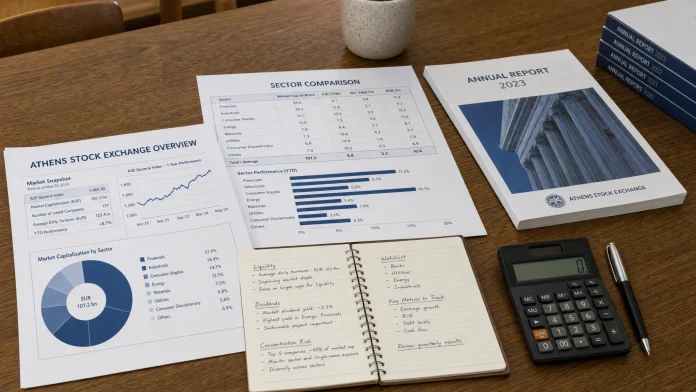
The Greek stock market can be attractive for patient investors, but it should be approached with a clear understanding of its structure, risks, and role inside a diversified portfolio. Greece is not a broad market like the United States, nor is it as deep as the largest European exchanges. It is smaller, more concentrated, and often more sensitive to changes in the domestic economy, interest rates, bank lending, tourism, energy prices, and investor sentiment toward Southern Europe.
That does not make it unsuitable for long-term investing. It simply means investors need a disciplined process. If you are new to stocks in general, it may help to first review the broader stock market basics for new investors before focusing on the Greek market specifically.
This guide explains the Greek stock market basics that matter most for long-term investors: how the market works, what makes Greek shares different, how to research companies, and how to manage risk without turning investing into constant speculation.
What Is the Greek Stock Market?
When people talk about the Greek stock market, they usually mean shares listed on the Athens Stock Exchange, often referred to internationally as ATHEX. The exchange includes listed companies from sectors such as banking, energy, telecommunications, infrastructure, real estate, consumer goods, industrials, and technology.
The main benchmark most investors follow is the Athens General Composite Index, which reflects the overall movement of the market. Other important indexes include large-cap and sector-specific indexes that help investors track parts of the market more precisely.
For long-term investors, the key point is simple: the Greek stock market is a place to buy ownership stakes in real businesses. A share is not just a ticker symbol moving up and down on a screen. It represents a claim on a company’s future earnings, cash flows, assets, and dividends.
The official Athens Exchange Group website is a useful starting point for company announcements, market data, and official information. Investors should also understand that Greece’s capital markets are regulated by the Hellenic Capital Market Commission, while listed companies must publish financial statements and shareholder updates.
Why Long-Term Investors Consider Greek Shares
Greek shares often attract attention because Greece is a smaller market where strong companies can sometimes be underfollowed compared with large global names. A company listed in Athens may not receive the same analyst coverage as a major US or German company, which can create opportunities for investors willing to do careful research.
There are several reasons long-term investors may look at Greece:
- Economic exposure: Greek-listed companies can benefit from domestic growth, tourism, infrastructure investment, energy projects, banking activity, and consumer recovery.
- Dividend potential: Some mature Greek companies have a history of distributing dividends, although dividends are never guaranteed.
- Valuation opportunities: Smaller markets can sometimes trade at lower valuations than larger developed markets, especially after periods of uncertainty.
- Portfolio diversification: Greek shares can offer exposure to a European economy with different sector dynamics than the US or broader global indexes.
However, long-term investors should avoid thinking of the Greek market as a shortcut to quick gains. A smaller market can rise sharply, but it can also fall sharply. The objective is not to predict every short-term move. The objective is to identify durable businesses, buy them at reasonable prices, and hold them as part of a balanced strategy.
How the Greek Market Differs From Larger Markets
The first major difference is size. The Athens Stock Exchange has fewer large companies than major exchanges such as the NYSE, Nasdaq, London Stock Exchange, or Euronext Paris. This makes concentration more important. A small number of large companies, especially banks and major industrial or energy names, can have a noticeable effect on the overall index.
The second difference is liquidity. Some Greek shares trade actively, while smaller companies may have low daily trading volume. Low liquidity matters because it can make buying and selling more expensive. The spread between the bid and ask price may be wider, and large orders can move the price more than expected.
The third difference is sensitivity to macroeconomic conditions. Greece has gone through major financial and economic changes over the past two decades. Long-term investors do not need to become economists, but they should understand how interest rates, government policy, bank credit, tourism trends, energy costs, and European Union developments can affect Greek companies.
The fourth difference is ownership structure. Some listed companies may have controlling shareholders, family ownership, or strategic investors. This is not automatically negative, but minority shareholders should pay close attention to corporate governance, related-party transactions, dividend policy, and management incentives.
Long-Term Investing Starts With the Right Mindset
A long-term investor should think in years, not days. This does not mean ignoring market news or refusing to sell under any circumstances. It means your decisions should be based on business fundamentals rather than short-term price noise.
Before buying Greek shares, define your investment goals. Are you investing for retirement, wealth building, dividend income, education expenses, or general capital growth? Your goal affects how much risk you can take and how much of your portfolio should be allocated to one market.
A useful starting rule is to avoid making the Greek stock market your entire portfolio unless you have a very specific reason and understand the risks. Many investors use Greek shares as one part of a broader portfolio that may also include global stocks, bonds, cash, or funds.
This is where discipline matters. Greek Shares has long emphasized the importance of patience, research, and diversification. If your goal is to build wealth steadily, it is worth learning how to focus your investments on the long term instead of reacting to every daily move.
Ways to Invest in the Greek Stock Market
There are three common ways to get exposure to Greek shares. The right choice depends on your experience, time, broker access, and risk tolerance.
| Method | Best for | Main advantage | Main risk |
|---|---|---|---|
| Individual Greek shares | Investors willing to research companies | Direct ownership and control | Company-specific risk |
| Greece-focused funds or ETFs | Investors who prefer diversification | Easier exposure to multiple companies | Less control over holdings |
| Broad global portfolio with Greek allocation | Long-term investors seeking balance | Reduced dependence on one country | Greek exposure may be small |
Buying individual shares gives you the most control, but it also requires the most work. You need to read financial statements, understand the business model, compare valuation, and monitor company updates.
Funds or ETFs can reduce single-company risk, but investors still need to understand what the fund owns, how concentrated it is, what fees it charges, and whether it fits their plan.
For beginners, the first practical step is usually opening an account with a broker that provides access to Greek-listed securities. If you are just getting started, this guide on investing in the Athens Stock Exchange for beginners explains the process in more detail.
What to Research Before Buying a Greek Stock
A long-term investor should never buy a stock only because it is popular, cheap compared with its past price, or mentioned in the news. The better approach is to build a repeatable research checklist.
Start with the business. What does the company actually sell? Who are its customers? Does it earn most of its revenue in Greece, or does it operate internationally? Is demand cyclical, regulated, seasonal, or relatively stable?
Then examine the financials. Revenue growth is useful, but it does not tell the whole story. Look at profit margins, debt, free cash flow, interest expenses, dividend coverage, and return on equity or invested capital. Banks require a different analysis than industrial companies, while real estate companies require attention to asset values, rental income, debt maturity, and interest rates.
You should also evaluate competitive advantage. Some businesses have strong brands, regulated assets, infrastructure networks, valuable licenses, or specialist expertise. Others may operate in highly competitive sectors where profits can disappear quickly. As a useful comparison outside the stock market, niche software businesses can build value by solving operational problems for specific industries. For example, an operations platform such as Dronedesk shows how specialized tools can become important to drone operators by organizing planning, logging, and compliance workflows. When studying a Greek-listed company, ask the same basic question: what problem does this business solve, and why would customers keep paying for it?
Finally, study management. Long-term investors depend on management teams to allocate capital wisely. Read annual reports, shareholder presentations, and company announcements. Look for consistency between what management says and what it does.
Key Risks Long-Term Investors Should Manage
Every stock market has risks, but the Greek market has a few that deserve special attention. The goal is not to avoid all risk, since that is impossible. The goal is to understand risks before they damage your portfolio.
| Risk | Why it matters | How to manage it |
|---|---|---|
| Concentration risk | A few sectors can dominate market performance | Diversify across sectors and asset classes |
| Liquidity risk | Smaller shares may be harder to buy or sell at fair prices | Use limit orders and avoid oversized positions |
| Economic cyclicality | Greek companies can be sensitive to tourism, rates, and domestic demand | Balance cyclical holdings with steadier businesses |
| Governance risk | Controlling shareholders may influence decisions | Review ownership, board structure, and related-party disclosures |
| Valuation risk | A good company can still be a bad investment if bought too expensively | Compare price with earnings, cash flow, assets, and growth prospects |
| Currency and tax considerations | International investors may face tax, reporting, or currency issues | Consult a qualified tax professional and understand broker rules |
One of the most common errors is confusing a low share price with a cheap stock. A stock trading at €2 is not automatically cheaper than a stock trading at €20. What matters is the value of the whole business compared with its profits, assets, cash flow, and future prospects.
Another mistake is chasing dividends without checking whether they are sustainable. A high dividend yield can be attractive, but it may also signal that investors expect the dividend to be reduced. Always compare dividends with earnings, free cash flow, debt obligations, and capital expenditure needs.
Building a Greek Stock Portfolio for the Long Term
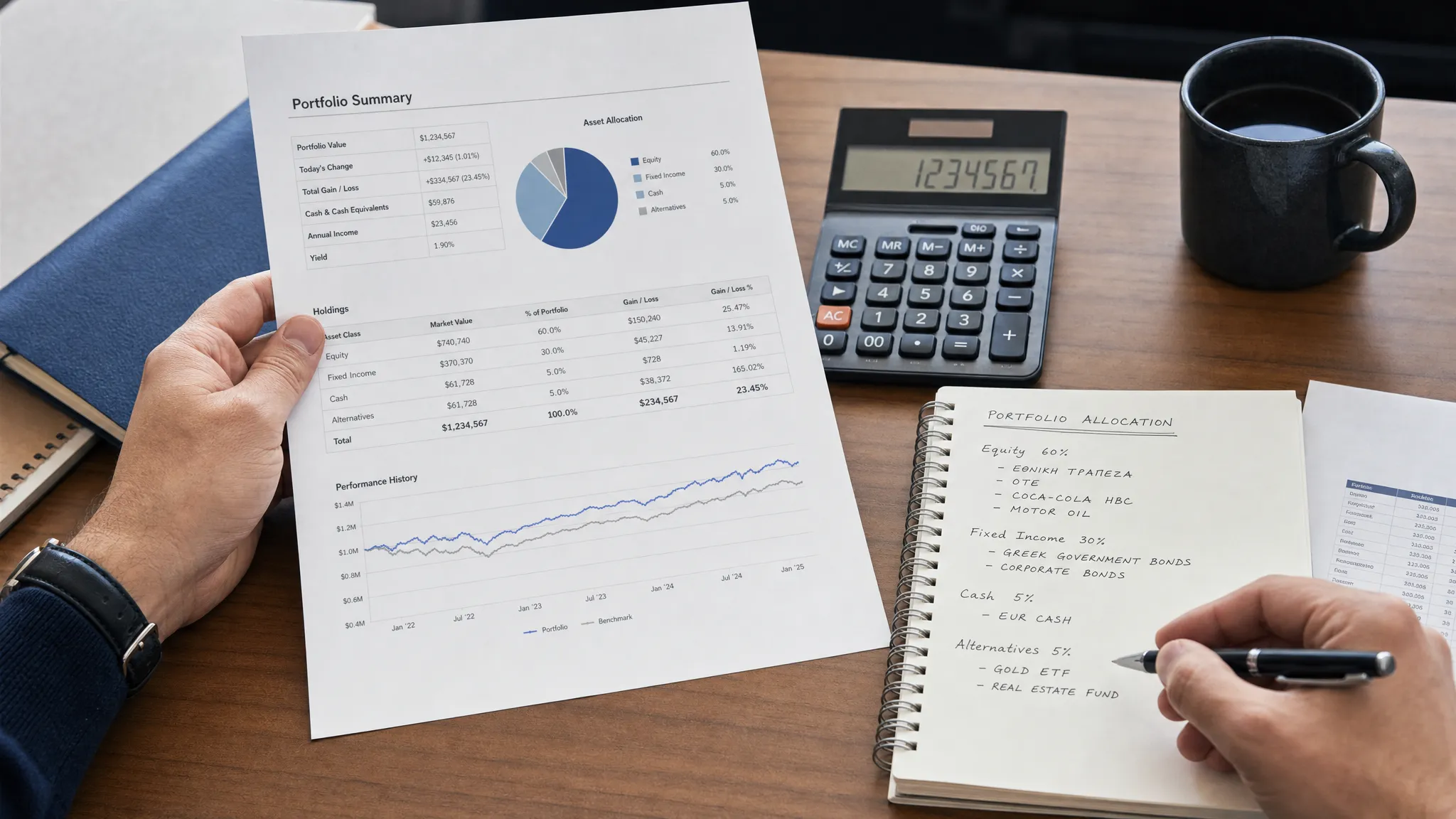
A sound portfolio begins with position sizing. Even if you strongly believe in a company, avoid putting too much of your capital into one stock. Concentrated portfolios can perform very well, but they also require greater skill, discipline, and emotional control.
For most investors, diversification is not a weakness. It is protection against being wrong. You can be right about the long-term potential of Greece and still choose the wrong company, pay too high a price, or underestimate a sector risk.
A practical Greek stock portfolio might include a mix of larger, more liquid companies and a smaller allocation to carefully researched mid-cap or smaller companies. Investors seeking income may pay closer attention to dividend policy, while growth-oriented investors may focus more on reinvestment, market share, and expansion opportunities.
Rebalancing is also important. If one Greek holding grows from 5% of your portfolio to 20%, your risk has changed even if the company is still strong. Rebalancing does not mean constantly trading. It means periodically checking whether your portfolio still matches your goals.
A Simple Routine for Long-Term Investors
You do not need to watch the market every minute to invest well. In fact, too much monitoring can lead to emotional decisions. A simple routine is often more effective.
A long-term investor might review company news monthly, read financial results quarterly, and perform a deeper portfolio review once or twice a year. During those reviews, ask whether the original investment thesis is still valid.
Useful questions include:
- Has the company’s competitive position improved or weakened?
- Are revenues, margins, and cash flows moving in the right direction?
- Is debt manageable under current interest rate conditions?
- Has management treated minority shareholders fairly?
- Is the valuation still reasonable compared with the company’s prospects?
If you want a deeper process, Greek Shares also has a dedicated guide on how to research stocks before buying, with a focus on understanding businesses rather than chasing tips.
Common Mistakes to Avoid
New investors often lose money not because they lack intelligence, but because they lack a process. In the Greek stock market, several mistakes are especially common.
One mistake is buying after a strong rally simply because everyone is optimistic. Momentum can continue for a while, but long-term returns depend on the price you pay relative to business value.
Another mistake is overexposure to one sector. Banks, for example, can be important in the Greek market, but banking stocks are influenced by interest rates, loan growth, credit quality, regulation, and investor confidence. Owning several banks is not the same as being truly diversified.
A third mistake is ignoring liquidity. A small company may look attractive on paper, but if few shares trade each day, you may not be able to exit easily when you need to.
Finally, avoid treating market forecasts as facts. Analysts, economists, and commentators can be useful, but no one knows the future with certainty. Long-term investors should prepare for different outcomes instead of relying on one prediction.
Frequently Asked Questions
Is the Greek stock market suitable for beginners? Yes, but beginners should start slowly, learn the basics, and avoid concentrating too much money in individual stocks. Education, diversification, and patience are more important than trying to find the next big winner.
Can foreign investors buy Greek stocks? In many cases, yes, through brokers that provide access to the Athens Stock Exchange or through funds with Greek exposure. Rules, fees, taxes, and account access vary by country and broker, so investors should verify details before investing.
Are Greek stocks good for dividend investors? Some Greek-listed companies pay dividends, but dividends can change based on profits, cash flow, regulation, and management decisions. Investors should analyze dividend sustainability rather than focusing only on yield.
How much of my portfolio should be in Greek shares? There is no universal answer. It depends on your goals, risk tolerance, income, time horizon, and existing exposure. Many long-term investors treat Greek shares as one part of a broader diversified portfolio.
What is the biggest risk in long-term Greek stock investing? The biggest risk is often not volatility itself, but poor selection combined with overconcentration. A disciplined process, reasonable valuation, and diversification can help reduce this risk.
Keep Learning Before You Invest
The Greek stock market offers real opportunities, but it rewards investors who think like business owners. Learn how the market works, study companies carefully, respect risk, and build a portfolio that can survive difficult periods.
Greek Shares is designed to help investors improve their financial knowledge through guides, tutorials, and practical investing education. Before making decisions, continue learning, compare sources, and remember that investing involves risk. This article is educational and should not be treated as personal financial advice.