



Buying shares should never feel like grabbing a product from a shelf because the price looks attractive. A share is a partial ownership stake in a real business, and before you buy it, you need to understand what you are buying, why you are buying it, and what could go wrong.
For beginners, the challenge is often knowing where to look. A stock chart is easy to find, but a chart alone does not tell you whether the company earns reliable profits, carries too much debt, faces shrinking demand, or is priced for unrealistic expectations. Experienced investors can also make mistakes when they skip the basics because a company is popular, familiar, or rising fast.
This guide gives you a practical pre-buy checklist. It is not a prediction system, and it cannot remove risk. Instead, it helps you slow down, ask better questions, and make investment decisions based on evidence rather than excitement.
Start with the business, not the stock price
The first thing to check is simple: do you understand how the company makes money?
A rising share price can hide a weak business, while a temporarily unpopular share can sometimes represent a strong company at a fair price. Before looking at valuation ratios or analyst targets, study the company as a business owner would.
Ask yourself what the company sells, who its customers are, why customers choose it, and whether demand is likely to remain durable. A supermarket, a cloud software provider, a pharmaceutical company, and a shipping business all make money in very different ways. Their risks, margins, capital needs, and growth patterns are not the same.
If you are new to ownership concepts, Greek Shares has a beginner-friendly explanation of what stock shares actually represent, which is worth understanding before analyzing individual companies.
A useful business review should cover three areas:
- Revenue sources: Check which products, services, countries, or customer groups generate most of the company’s sales.
- Competitive advantage: Look for reasons the company can defend its profits, such as brand strength, scale, patents, switching costs, network effects, or cost advantages.
- Customer demand: Consider whether demand is recurring, cyclical, seasonal, regulated, or dependent on a short-lived trend.
If you cannot explain the business in a few clear sentences, that is not automatically a reason to avoid it. But it is a reason to keep researching before buying.
Check the financial statements like an owner
Financial statements show whether a company’s story is supported by numbers. You do not need to become an accountant, but you should know the basic signals of quality, weakness, and risk.
Start with the annual report or regulatory filing. In the United States, public company filings can be found through the SEC’s EDGAR database. For companies listed in other markets, use the investor relations section of the company’s website and the relevant exchange or regulator.
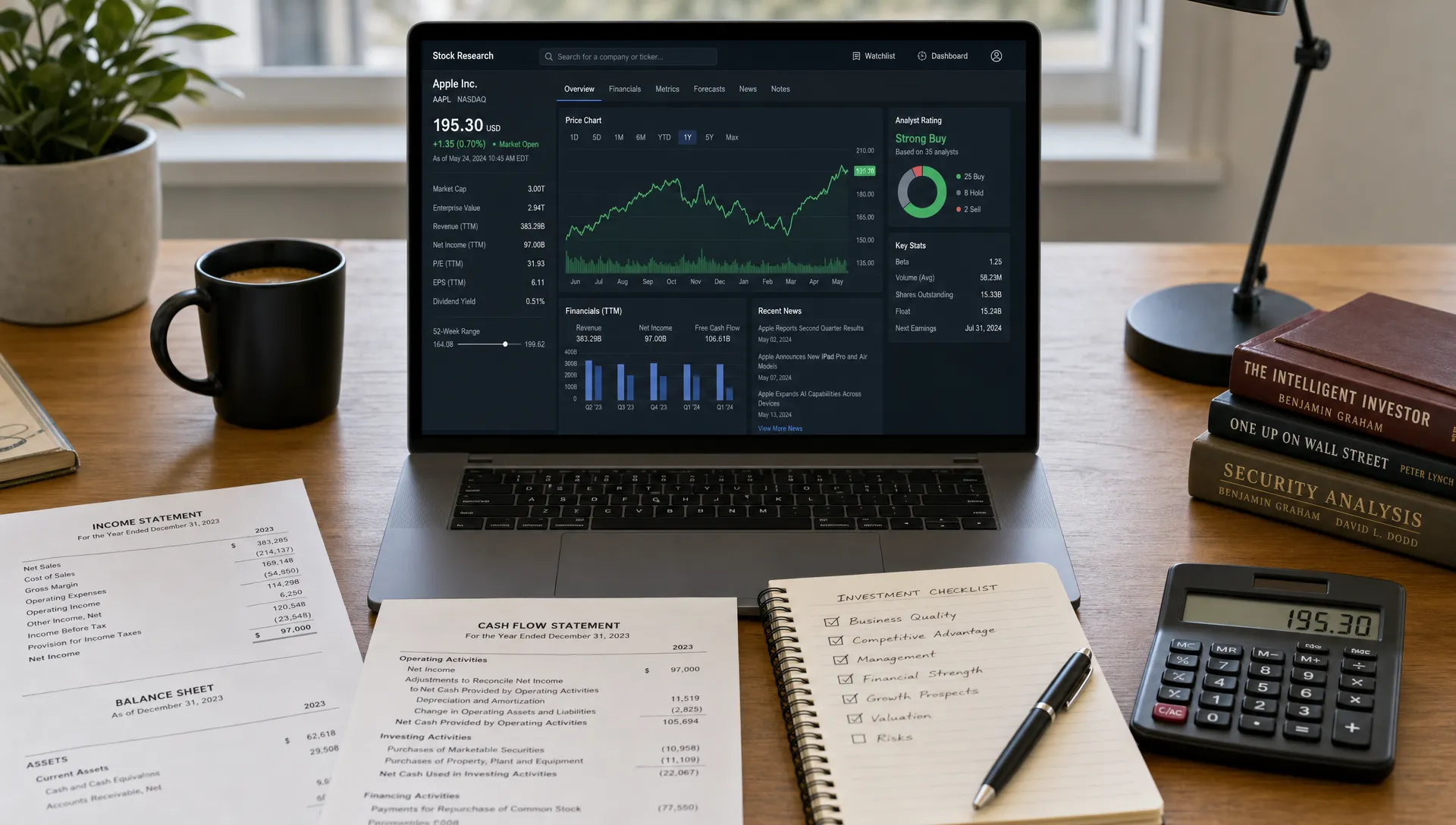
The three core statements matter in different ways. The income statement shows sales, costs, and profits. The balance sheet shows assets, liabilities, debt, and equity. The cash flow statement shows whether profits are turning into actual cash.
| What to check | Why it matters | Healthy sign | Warning sign |
|---|---|---|---|
| Revenue trend | Shows whether the business is growing, stable, or shrinking | Sales grow steadily or remain resilient | Sales depend on one temporary boom |
| Profit margins | Shows how much profit remains after costs | Margins are stable or improving | Margins fall without a clear reason |
| Free cash flow | Shows cash left after maintaining the business | Cash flow supports dividends, debt reduction, or reinvestment | Reported profits do not convert into cash |
| Debt levels | Shows financial pressure and flexibility | Debt is manageable relative to earnings and cash flow | Interest costs consume a large share of profit |
| Share count | Shows whether owners are being diluted | Share count stable or falling through sensible buybacks | Frequent dilution without strong value creation |
One mistake many investors make is focusing only on earnings per share. EPS can be affected by accounting choices, buybacks, one-time gains, or unusual expenses. Cash flow often gives a cleaner view of business strength.
You should also compare several years, not just the latest quarter. A single strong quarter may reflect timing, price increases, or temporary demand. A five-year view can reveal whether the company is becoming stronger or merely enjoying a short favorable cycle.
Understand valuation before deciding a share is “cheap”
A good company is not automatically a good investment at any price. Valuation matters because your future return depends not only on business performance, but also on the price you pay for that performance.
Common valuation tools include the price-to-earnings ratio, price-to-sales ratio, dividend yield, enterprise value to EBITDA, and free cash flow yield. None of these ratios should be used alone. A low P/E ratio may indicate a bargain, but it may also signal declining profits, high debt, or a business in structural trouble. A high P/E ratio may be justified for a company with exceptional growth, but only if the growth actually arrives.
Compare valuation against:
- The company’s own history
- Similar companies in the same industry
- Expected growth and profitability
- Interest rates and broader market conditions
- Your required margin of safety
A margin of safety means buying at a price that leaves room for error. Since forecasts are uncertain, investors should avoid paying a price that only works if everything goes perfectly.
For example, imagine two companies both trade at 25 times earnings. One has stable growth, high returns on capital, low debt, and recurring revenue. The other is cyclical, heavily indebted, and benefiting from peak conditions. The same P/E ratio does not mean the same risk.
Valuation is not about finding the lowest number. It is about judging whether the current price is reasonable given the quality, growth, risks, and durability of the business.
Review management and capital allocation
Management quality is difficult to measure, but it matters enormously. Leaders decide how profits are reinvested, how much debt is taken on, whether acquisitions are sensible, and how honestly shareholders are treated.
Look at management’s track record over several years. Did they meet realistic goals, or did they frequently overpromise? Did acquisitions create value, or did they lead to write-downs? Did buybacks happen when the share price was attractive, or mainly when the stock was expensive? Did executive compensation reward long-term performance, or short-term share price movement?
Annual letters, earnings call transcripts, and investor presentations can be useful, but read them critically. Management naturally presents the company in a positive light. Your job is to compare words with results.
A good sign is consistency between strategy and numbers. If management says it prioritizes disciplined growth, you should see evidence in margins, cash flow, debt control, and returns on capital. If management claims a turnaround is working, you should see measurable improvement rather than repeated promises.
Identify the risks before you imagine the rewards
Many investors spend too much time estimating upside and too little time understanding downside. Before buying, write down the main reasons your investment thesis could fail.
Risk can come from many directions. A company may face stronger competition, rising costs, regulatory pressure, currency movements, supply chain disruption, technological change, or falling demand. Some risks are obvious, while others only become clear when you read the risk factors in the annual report.
Pay special attention to concentration risk. If one customer, supplier, product, country, or commodity price drives most of the business, the company may be more fragile than it first appears.
You should also separate business risk from stock price volatility. A strong company can fall 20 percent in a market correction even if its long-term prospects remain intact. A weak company can rise quickly during speculation. Price movement alone does not tell you whether risk has increased or decreased.
This is where independent thinking matters. If you are considering a stock because of a tip, headline, or social media post, pause and verify the claim. Greek Shares has a helpful guide on why investors should question stock tips before acting, especially when a recommendation sounds urgent or guaranteed.
Check whether the share fits your portfolio
Even if a company looks attractive, it may not belong in your portfolio. A single investment should be judged in context with your goals, time horizon, risk tolerance, and existing holdings.
If you already own several technology companies, buying another technology share may increase concentration risk. If you need the money within one or two years, even a high-quality share may be too volatile. If you cannot tolerate large temporary declines, an individual stock portfolio may require more diversification or a different approach.
Before buying, ask how the position will affect your overall portfolio. Will it make you too dependent on one sector, one country, one currency, or one economic outcome? Will you still sleep well if the share falls sharply after purchase? Will you have enough cash for emergencies without selling investments at a bad time?
A practical rule is to decide position size before you buy. This prevents excitement from turning one idea into an oversized bet.
Look for red flags that justify waiting
Sometimes the best decision is not to buy. Patience is an investing skill, especially when the market is noisy.
Red flags do not always mean a company is uninvestable, but they do mean you should demand stronger evidence and a larger margin of safety.
| Red flag | Why it deserves caution |
|---|---|
| Unclear business model | If you cannot understand how money is made, you cannot judge durability |
| Heavy debt with weak cash flow | Debt can limit flexibility and magnify problems during downturns |
| Frequent accounting adjustments | Too many “one-time” exclusions can hide recurring weakness |
| Insider selling with poor disclosure | Insider activity needs context, but unexplained patterns deserve review |
| Extreme valuation based on hype | High expectations leave little room for disappointment |
| Dependence on one major customer | Losing that customer could damage revenue quickly |
| Constant share dilution | Existing shareholders may own less of the business over time |
There are also personal red flags. If you feel rushed, afraid of missing out, or unable to explain your thesis, step back. A genuine long-term opportunity should survive a few more days of research.
For a deeper decision framework, you can use the Greek Shares article on the best questions before buying stocks alongside your own checklist.
Verify information quality and protect your research process
The quality of your decision depends on the quality of your information. Prefer primary sources, such as annual reports, investor presentations, official filings, and audited statements. Analyst reports, news articles, podcasts, and forums can add perspective, but they should not replace primary research.
Be careful with screenshots, viral charts, and anonymous claims. A chart can be accurate but misleading if it uses the wrong time frame or excludes important context. A confident online opinion can still be wrong.
Your research environment matters too. Use secure accounts, strong passwords, two-factor authentication, and reliable devices when accessing brokerage platforms or storing financial documents. If your computer is unreliable or exposed to security issues, professional laptop security and maintenance support can be a practical part of protecting your investing workflow.
Good investing is not only about choosing shares. It is also about building a repeatable process that reduces avoidable mistakes.
Build a simple pre-buy checklist
Before placing an order, summarize your investment case in writing. This does not need to be long. One page can be enough if it forces clarity.
Your checklist should answer these questions:
- What does the company do, and how does it make money? If the answer is vague, keep studying.
- What evidence shows the business is financially healthy? Use revenue, margins, cash flow, debt, and share count.
- Why is the current valuation reasonable? Compare the price with realistic expectations, not best-case dreams.
- What could go wrong? List business, financial, regulatory, and market risks.
- How does this fit your portfolio? Consider diversification, position size, time horizon, and liquidity needs.
- What would make you sell? Define whether you would sell because the thesis breaks, valuation becomes excessive, or you need to rebalance.
Writing this down creates accountability. Months later, you can review whether your original thesis was right, wrong, or incomplete. This habit helps you improve as an investor because you learn from your own decisions rather than relying on memory.
Frequently Asked Questions
How long should I research a share before buying? There is no fixed time, but you should research long enough to understand the business, financials, valuation, major risks, and portfolio fit. If you are buying only because the price is rising, you probably have not done enough work.
What is the most important thing to check before buying shares? Business quality and financial health should come first. Valuation matters, but a low price does not help if the underlying company is weak, shrinking, or burdened by debt.
Should beginners buy individual shares or funds? Many beginners start with diversified funds because they reduce company-specific risk. Individual shares require more research, discipline, and ongoing monitoring. The right choice depends on your goals, knowledge, and risk tolerance.
Is a falling share price a buying opportunity? Not always. A lower price can create opportunity if the business remains strong and valuation becomes attractive. But a falling price can also signal real problems, such as declining profits, debt stress, or weakening demand.
How often should I review shares after buying? Review company results at least when quarterly or annual reports are released. You do not need to react to every price movement, but you should track whether the original investment thesis remains valid.
Final thoughts
Shares investors should check more than price momentum before buying. They should understand the business, verify financial strength, judge valuation carefully, identify risks, and make sure the investment fits their portfolio.
The goal is not to find perfect companies. Perfect investments do not exist. The goal is to make informed decisions where the potential reward is reasonable compared with the risk you are taking.
If you build a habit of checking the same core factors before every purchase, you will avoid many emotional decisions and improve your investing discipline over time. Keep learning, keep comparing evidence, and remember that in the stock market, patience and preparation are often more valuable than speed.