


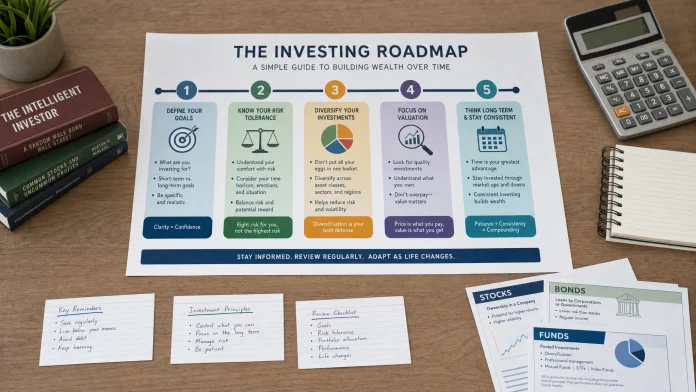
If you want to learn about investing, the most useful place to begin is not with hot stock tips, complex charts, or predictions about next month’s market. It is with principles.
Principles help you make decisions when markets are noisy. They help you avoid avoidable mistakes, compare opportunities more clearly, and stay calm when prices move against you. Products change, interest rates change, and market leadership changes, but the core ideas behind sensible investing remain surprisingly stable.
This guide walks through the investing principles every beginner should understand before buying stocks, funds, bonds, or any other asset. It is educational, not personal financial advice, but it can give you a practical framework for thinking more clearly about your money.
1. Start With the Difference Between Saving and Investing
Saving and investing are related, but they are not the same.
Saving is money you want to preserve for short-term needs. It usually belongs in cash, bank accounts, money market funds, or other relatively stable places. Investing is money you put at risk in search of higher long-term returns. That risk is the price you pay for the possibility of growth.
A common beginner mistake is investing money that may be needed soon. If you need funds for rent, taxes, medical expenses, or a home deposit in the next year or two, a sudden market decline can force you to sell at the worst possible time.
Before you invest, build a financial foundation. That usually means having an emergency fund, managing high-interest debt, and knowing which money is truly long-term capital. Only then does investing become a tool for wealth building rather than a source of stress.
2. Define the Goal Before Choosing the Investment
An investment is only “good” if it fits the job you need it to do. A stock, bond, index fund, real estate investment, or cash reserve can all be useful in the right context and unsuitable in the wrong one.
Start by asking: What is this money for?
| Goal | Time horizon | Main concern | Possible approach |
|---|---|---|---|
| Emergency fund | Immediate to 1 year | Safety and access | Cash or cash-like savings |
| Home deposit | 1 to 5 years | Avoiding large losses | Conservative mix, often mostly cash or short-term bonds |
| Retirement | 10+ years | Growth above inflation | Diversified stock and bond portfolio |
| Education funding | Varies by age | Matching risk to deadline | More growth early, more stability near withdrawal |
| Wealth building | Long term | Compounding and discipline | Broad diversification, regular contributions |
The same investment can be smart for one person and reckless for another. A young investor saving for retirement may tolerate stock market volatility. Someone who needs the money in 18 months probably should not.
This is why goal-setting comes before product selection. Without a goal, investors often chase whatever performed best recently. With a goal, you can judge whether an investment fits your time horizon, risk tolerance, and liquidity needs.
3. Understand What You Own
A stock is not just a ticker symbol moving up and down on a screen. It represents ownership in a business. A bond is not just a yield quote. It is a loan to an issuer that must be repaid under specific terms. A fund is not magic diversification. It is a collection of underlying holdings.
If you cannot explain what you own in plain language, you probably do not understand the risk well enough.
For stocks, ask basic business questions. What does the company sell? Who are its customers? How does it make money? Does it have competitors? Is demand growing, stable, cyclical, or declining? Does the company rely on debt, one product, one supplier, or one country?
A useful exercise is to study ordinary businesses, even private ones, and map their economics. For example, a professional workwear supplier can help you think through practical questions such as customer segments, repeat demand, product range, pricing, distribution, and operating costs. You are not analyzing it as a stock recommendation. You are training your mind to see businesses as systems.
This habit matters because markets often encourage abstraction. Prices change every second, but businesses develop over years. The more you understand the underlying asset, the less likely you are to make decisions based only on headlines or emotion.
4. Risk Is More Than Price Movement
Many investors define risk as volatility, meaning how much an investment’s price moves. Volatility matters, but it is not the only risk.
Real investing risk includes:
- Permanent loss of capital
- Buying at an unreasonable valuation
- Holding too much of one company, sector, or country
- Needing money before an investment has time to recover
- Inflation reducing purchasing power
- Emotional decisions during market stress
- Lack of liquidity when you need to sell
For long-term investors, short-term volatility can be uncomfortable but survivable. Permanent impairment is different. If a weak business loses competitiveness, takes on too much debt, or dilutes shareholders heavily, the stock may not recover simply because time passes.
This is why Greek Shares often emphasizes risk management as a core investing discipline. You do not need to avoid all risk. You need to understand which risks you are taking, why you are taking them, and whether you are being compensated for them.
5. Diversification Is Protection Against Being Wrong
No investor is right all the time. Diversification accepts this truth in advance.
Diversification means spreading investments across different assets, companies, industries, and sometimes countries. The goal is not to eliminate losses. That is impossible. The goal is to prevent one mistake or one bad outcome from damaging your entire financial plan.
A beginner may think diversification reduces returns because it limits exposure to the “best” idea. Sometimes it does. But the problem is that you rarely know the best idea beforehand. Concentration can create wealth for highly skilled or lucky investors, but it can also destroy capital quickly.
Broad index funds are popular partly because they offer instant diversification at low cost. Individual stocks can still have a place, but they require more research, patience, and position-size discipline.
A practical rule is simple: if one holding can ruin your plan, the position is probably too large.
6. Price and Value Are Not the Same
One of the most important investing principles is that price is what you pay, while value is what you receive.
A great business can be a poor investment if bought at an excessive price. A troubled business can sometimes be profitable if bought cheaply enough, although that approach usually requires experience and caution. Investors get into trouble when they confuse popularity with value.
Valuation is the discipline of asking whether the current price makes sense relative to future cash flows, earnings, assets, growth, risk, and alternatives. Metrics like the price-to-earnings ratio, dividend yield, free cash flow yield, and price-to-book ratio can help, but none of them works perfectly in isolation.
For example, a low P/E ratio might indicate a bargain, or it might signal that earnings are about to decline. A high dividend yield might offer attractive income, or it might warn that the dividend is at risk. A fast-growing company might deserve a higher valuation, but not an unlimited one.
Good investors do not ask, “Is this a good company?” only. They also ask, “Is this a good investment at this price?”
7. Time Is a Powerful Advantage
The longer your time horizon, the more powerful compounding can become. Compounding occurs when returns generate additional returns over time. It is one of the central reasons investing can build wealth.
But compounding requires patience. It also requires survival. You must avoid decisions that interrupt the process, such as panic selling during downturns, overtrading, using too much leverage, or chasing speculative investments that can cause permanent losses.
Short-term markets are unpredictable because prices react to news, expectations, liquidity, interest rates, and investor psychology. Over longer periods, business performance, earnings growth, dividends, and valuation tend to matter more.
This does not mean you should ignore your portfolio for decades. It means your process should be designed around your time horizon. If your goal is 20 years away, a bad week in the market should not automatically change your plan.

8. Your Behavior May Matter More Than Your IQ
Investing attracts intelligent people, but intelligence alone is not enough. Many mistakes come from behavior, not lack of information.
Common emotional traps include fear, greed, regret, overconfidence, impatience, and herd behavior. Investors often buy after prices have already risen because they fear missing out. They sell after prices have already fallen because they fear further losses. They look for information that confirms what they already believe and ignore evidence that challenges them.
A written investment plan helps protect you from yourself. It does not need to be complicated. It should explain your goals, asset allocation, contribution schedule, rules for buying and selling, and how you will respond to market declines.
When emotions rise, rules matter. A plan made during calm conditions is usually better than a decision made during panic.
9. Costs, Taxes, and Fees Quietly Shape Returns
Investors often focus on headline returns and ignore the costs that reduce what they keep. Over long periods, fees, taxes, commissions, bid-ask spreads, fund expense ratios, and unnecessary trading can make a meaningful difference.
Low costs do not guarantee success, but high costs create a higher hurdle. If two similar funds provide similar exposure, the lower-cost option often has an advantage. If frequent trading creates taxable gains and transaction costs, the investor must earn even more just to break even after expenses.
Taxes also matter. The difference between short-term and long-term capital gains, dividend taxation, tax-advantaged retirement accounts, and loss harvesting can affect after-tax results. Tax rules vary by country and situation, so professional advice can be worthwhile when decisions become complex.
The principle is simple: your real return is what remains after costs, taxes, and inflation.
10. Avoid Predictions as a Primary Strategy
Markets generate endless predictions. Interest rates will rise. A recession is coming. A sector will boom. A currency will collapse. A famous investor is buying. A chart pattern is forming.
Some predictions will be correct. The problem is that you rarely know which ones in advance, and even correct predictions do not always lead to profitable investment decisions. Markets may have already priced in the expectation. Timing may be wrong. The investment chosen may not respond as expected.
This does not mean economic knowledge is useless. Understanding inflation, interest rates, earnings, and business cycles can help you interpret risk. But relying entirely on forecasts can lead to constant portfolio changes and emotional trading.
A more durable approach is to build a portfolio that can survive multiple scenarios. Instead of asking, “What will happen next?” ask, “What happens to my plan if I am wrong?”
11. Learn the Language of Investing Gradually
Investing has its own vocabulary: earnings, dividends, yield, valuation, liquidity, asset allocation, beta, margin, cash flow, book value, duration, leverage, and more. At first, the language can feel intimidating.
Do not try to master everything at once. Learn terms as they become relevant to your decisions. If you are buying your first index fund, you do not need to understand every options strategy. If you are studying dividend stocks, focus on dividend yield, payout ratio, cash flow, debt, and dividend history.
A glossary can be useful, but definitions alone are not enough. Connect each term to a decision. For example, liquidity is not just a definition. It affects whether you can sell at a fair price when you need to. Valuation is not just a ratio. It affects the future return you might reasonably expect.
The best investing education turns vocabulary into judgment.
12. Build a Repeatable Process
Successful investing is not one brilliant decision. It is a repeatable process applied consistently over time.
A simple investing process may include:
- Setting financial goals and time horizons
- Deciding how much to invest regularly
- Choosing an asset allocation
- Diversifying across holdings
- Researching before buying
- Keeping position sizes reasonable
- Reviewing the portfolio periodically
- Rebalancing when needed
- Recording why you bought or sold
This process should match your personality. If you dislike researching individual businesses, broad funds may fit you better. If you enjoy company analysis and can handle volatility, a small allocation to individual stocks may be appropriate. If you panic during downturns, a more conservative allocation may help you stay invested.
The right process is not the most impressive one. It is the one you can follow.
Core Investing Principles at a Glance
| Principle | Why it matters | Beginner question to ask |
|---|---|---|
| Save before investing | Prevents forced selling | Do I have money set aside for emergencies? |
| Set goals first | Matches investments to purpose | What is this money for and when will I need it? |
| Understand what you own | Reduces blind speculation | Can I explain this investment simply? |
| Manage risk | Protects long-term survival | What could go wrong and how much could I lose? |
| Diversify | Limits damage from mistakes | Am I too dependent on one holding or sector? |
| Consider valuation | Avoids overpaying | Is the price reasonable for the quality and growth? |
| Control behavior | Prevents emotional decisions | What will I do if the market falls sharply? |
| Watch costs and taxes | Improves real returns | What do I keep after fees, taxes, and inflation? |
How to Keep Learning About Investing
Learning about investing is a long-term project. You do not need to become an expert before you begin, but you do need enough knowledge to avoid obvious mistakes.
Start with the basics: stocks, bonds, funds, diversification, risk, valuation, and investor psychology. Then go deeper into topics that fit your goals. A retirement investor may study asset allocation and withdrawal risk. A stock picker may study financial statements and competitive advantage. A trader may study probability, risk control, and execution.
The important point is to learn in the right order. Build the foundation before exploring advanced tools like options, leverage, short selling, or speculative trading. Complexity can be useful, but only after you understand the basics.
Frequently Asked Questions
What is the best way to learn about investing as a beginner? Start with core concepts such as saving versus investing, risk, diversification, asset allocation, and compounding. Then practice with small amounts or paper portfolios before committing larger sums.
How much money do I need to start investing? You do not need a large amount to begin learning. Many investors start with small regular contributions. The key is to invest only money that is appropriate for your time horizon and financial situation.
Are individual stocks better than index funds? Not necessarily. Index funds offer broad diversification and simplicity, which can suit many beginners. Individual stocks may offer higher potential rewards, but they require more research and carry more company-specific risk.
How do I know how much risk to take? Risk depends on your goals, time horizon, financial stability, and emotional tolerance. If a market decline would cause you to abandon your plan, your portfolio may be too aggressive.
Should I wait for the perfect time to invest? Perfect timing is rarely possible. Many long-term investors use regular contributions to reduce the pressure of choosing one entry point. The more important question is whether your financial foundation and plan are ready.
What is the biggest mistake new investors make? One of the biggest mistakes is investing without a plan. Without clear goals, risk limits, and buying or selling rules, beginners are more likely to chase performance, panic during declines, or take risks they do not understand.
Final Thoughts
To learn about investing well, focus less on finding the next winning idea and more on building sound judgment. Understand your goals. Respect risk. Diversify. Think in years, not days. Pay attention to valuation. Control your behavior. Keep costs low. Continue learning.
These principles will not protect you from every loss, and they will not make markets predictable. But they can help you become a more disciplined investor, which is far more valuable than a short-lived tip or lucky trade.
Greek Shares is built around that educational mindset: helping investors understand markets, avoid common mistakes, and develop better long-term habits. The earlier you build your foundation, the more useful every future lesson becomes.