


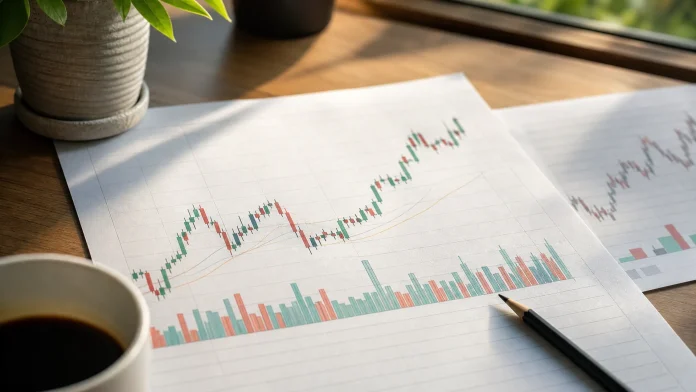
Learning how to read a stock price chart is one of the most practical skills a new investor can pick up. Charts look intimidating at first, grids, coloured bars, jagged lines, but each element tells a specific story about how buyers and sellers have behaved over time. Once you can decode that story, you stop seeing noise and start seeing information. This guide walks through the core building blocks, step by step, so you can approach any stock chart with confidence rather than confusion.
Stock Chart Reading Basics: What You’re Actually Looking At
Before diving into patterns or strategies, it helps to understand the basic architecture of a chart.
The axes: price, time, and volume
Every stock chart shares the same skeleton. The x-axis runs left to right and represents time, so older price data sits on the left, and the most recent data is on the right. The y-axis runs up and down and represents price. A point plotted high on the chart means the stock was trading at a high price at that moment in time.
Below the main chart, you’ll usually see a row of vertical bars. Those are volume bars, showing how many shares were traded during each time period. High volume means a lot of activity; low volume means the market was quieter. Volume is a useful confirmation signal, more on that shortly.
The main chart types: line, bar, and candlestick
The simplest chart type is the line chart. It connects each period’s closing price with a straight line, giving you a clean view of the overall price direction. It’s easy to read but strips out a lot of detail.
The candlestick chart shows far more. Instead of a single dot per period, it plots four data points: the opening price, the closing price, the highest price reached, and the lowest price reached. Most beginners find that switching from a line chart to a candlestick chart is the single biggest step-up in their chart-reading ability.
Bar charts do the same job as candlestick charts but use a different visual format, T-shaped bars rather than coloured rectangles. Candlesticks have largely replaced bar charts for retail investors because they’re easier to scan at a glance.
Candlestick Chart Patterns Explained
Candlestick charting originated in 18th-century Japan, where rice trader Munehisa Homma is credited with developing a method of tracking price behaviour over time. It remains one of the oldest visual tools in market analysis still in active use.
Anatomy of a single candle
Each candlestick has two parts:
- The body: the wide rectangle, which shows the range between the opening price and the closing price for that period.
- The wicks (also called shadows): the thin lines extending above and below the body, showing the highest and lowest prices reached during the period.
Colour tells you the direction. A green (or white) candle means the price closed higher than it opened, a net up period. A red (or black) candle means it closed lower than it opened, a net down period. A very long body signals strong directional movement. A very short body signals indecision.
Common beginner patterns: doji, hammer, engulfing
Three patterns are worth knowing early on.
Doji: The opening and closing prices are almost identical, leaving a tiny or invisible body with wicks on both sides. It signals indecision, neither buyers nor sellers won the period convincingly. When a doji appears after a run of same-direction candles, it can hint that momentum is fading.
Hammer: A short body sitting near the top of the candle, with a long lower wick. It suggests that sellers pushed the price down during the period, but buyers stepped in and pushed it back up by the close. Often appears at the bottom of a downward move.
Engulfing: A two-candle pattern. A large candle completely covers the body of the previous candle. A bullish engulfing, a large green candle swallowing a smaller red one, can hint at a shift in momentum from sellers to buyers.
The key word in all of that is hint. No single chart pattern is a reliable buy or sell signal on its own. Volume, broader market context, and the fundamental backdrop all need to be weighed alongside what the chart shows. Patterns are clues, not certainties.
Identifying Trends: What Do Stock Price Trends Tell You?
A price chart is a visual record of collective investor behaviour. Trends show which side, buyers or sellers, has held the upper hand over a given period.
Uptrends, downtrends, and sideways markets
An uptrend is a series of higher highs and higher lows. Each peak is higher than the last peak; each trough is higher than the last trough. Buyers are consistently willing to pay more, and dips are being bought before they fall too far.
A downtrend is the reverse: lower highs and lower lows. Sellers dominate, and each rally runs out of steam before recovering the previous peak.
A sideways market (also called consolidation or a ranging market) sees price bouncing between a relatively stable ceiling and floor. Neither buyers nor sellers are winning decisively. Sideways phases often precede a stronger move in one direction, though which direction is the question.
Understanding what stock volatility means for your investments helps explain why these moves can sometimes be sharp and sudden rather than gradual.
Drawing a basic trend line
To draw an uptrend line, connect at least two successive higher lows with a straight line and extend it to the right. That line acts as a visual guide, when price stays above it, the uptrend is intact; when price breaks below it, the trend may be shifting.
For a downtrend, connect two successive lower highs instead. The line slopes downward and shows where selling pressure has consistently appeared.
Trends reflect sentiment, not fundamentals alone. No trend lasts forever. When one ends, support and resistance levels are often the first place to look for what happens next.
Support and Resistance Levels for Beginners
Support and resistance are among the most practical concepts in stock chart reading basics.
Think of a support level as a floor. It’s a price zone where buying interest has repeatedly emerged in the past, enough to stop the price falling further and push it back up. Each time price approaches that level and bounces, it reinforces the floor in investors’ minds.
Resistance is the ceiling equivalent. It’s a zone where selling pressure has repeatedly appeared, preventing the price from breaking higher. A useful illustration: when a major stock index repeatedly fails to close above a certain level over several weeks, analysts mark that level as resistance, and experienced investors watch closely to see whether the price breaks through on high volume or retreats again.
These levels are identified visually: look for zones where price has stalled, reversed, or spent time consolidating on multiple separate occasions. The more times a level has held, the more significant it tends to be.
One important nuance: when a support level breaks, it often flips into resistance, and vice versa. If a stock falls through a price floor that previously held firm, that former floor frequently becomes a ceiling on any subsequent recovery, because investors who bought at support and got caught in the drop may sell to break even when price returns to that level.
Understanding the bid-ask spread on the Athens Stock Exchange adds further context here, the mechanics of how prices move between buyers and sellers are directly visible in chart behaviour around these levels.
Stock Chart Symbols and Tools Explained
Free charting tools such as TradingView and the chart interfaces built into most online brokers give retail investors access to the same candlestick charts, trend lines, and moving averages that professional traders use.
Here are the key controls worth knowing first:
Time-frame selectors (usually labelled 1D, 1W, 1M, etc.) control how much history each candle represents. A 1D chart shows one candle per day; a 1W chart shows one candle per week. Beginners often start with a daily chart to get a clear picture of recent price behaviour without the noise of intraday swings.
Moving averages are lines that smooth out price data by averaging the closing price over a set number of periods, commonly 50 or 200 days. They make it easier to see the underlying direction without being distracted by short-term spikes. When price is consistently above its moving average, the trend is generally considered positive; below it, negative.
Volume (the bar chart beneath the main chart) acts as a confirmation tool. A price move on high volume carries more weight than the same move on thin volume. A breakout above resistance on heavy volume is more convincing than one on low volume.
For readers beginning to explore the Greek market, candlestick charts and volume data for stocks listed on the Athens Stock Exchange are available through most Greek broker platforms and the ATHEX public market interface. If you’re getting started on the Athens Stock Exchange, these tools are accessible from day one.
How to Use Stock Charts Safely as a Beginner
Charts show you what prices have done, they do not tell you what prices will do. That distinction matters more than any pattern or indicator.
Price history is useful context, but markets are driven by events, earnings, sentiment shifts, and macro conditions that charts cannot anticipate. A beautifully formed hammer candle at support means very little if the company reports a profit warning the next morning.
The right way to use charts as a beginner is as one input among several. Knowing how to research stocks before buying, studying a company’s financials, competitive position, and sector conditions, gives the chart context it cannot provide itself. A stock forming a technical breakout pattern is more interesting if the underlying business is also in good shape.
Be cautious about treating chart signals as trading triggers. New investors who act on patterns alone, without checking fundamentals or considering position size and risk, tend to learn expensive lessons quickly. Think about your risk tolerance as a beginner investor before any chart signal leads you to a decision.
Practical order mechanics matter too, understanding limit orders vs market orders helps you act on what you see in a chart without accidentally paying more than you intended.
Start by reading charts regularly without placing trades. Observe how price behaves around support and resistance, how candlestick patterns form and resolve, and how volume relates to price moves. Building visual pattern recognition through observation is lower-risk than learning it with real money on the line.
When you feel ready to go further, the getting started on the Athens Stock Exchange guide and the stock research walkthrough are natural next steps, combining the visual skills you’ve built here with the fundamental groundwork that makes chart reading genuinely useful.