


Investing in stocks can sound like a world full of charts, jargon, and fast decisions. For most beginners, that is exactly the wrong starting point. A better approach is to keep the first version of your investing life simple: understand what stocks are, decide why you are investing, spread your risk, and build habits you can repeat for years.
This investing for beginners stocks guide is designed to remove the noise. It will not try to turn you into a trader overnight. Instead, it will help you understand the few decisions that matter most when you are starting out.
This article is for educational purposes only and is not personal financial advice. Your goals, income, taxes, and risk tolerance matter, so consider speaking with a qualified financial professional before making major decisions.
What a stock actually is
A stock is a small ownership stake in a company. When you buy shares, you become a partial owner of that business. If the company grows, earns more profit, and investors become willing to pay more for its future, the stock price may rise. Some companies also pay dividends, which are cash distributions to shareholders.
But stocks do not move in a straight line. Prices change daily because investors react to earnings, interest rates, economic data, news, expectations, and emotions. That short-term movement is normal. The beginner mistake is assuming every price change requires action.
The simple idea is this: investing is not about predicting every market move. It is about owning productive assets over time and managing risk well enough that you can stay invested.
If you want an even simpler explanation of how markets work, Greek Shares has a helpful overview showing why the stock market is simpler than you think.
Investing is not the same as trading
Beginners often mix up investing and trading, but they are different activities.
Investing usually means buying assets with a long-term goal. You may hold a diversified portfolio for years or decades, adding money regularly and letting time do much of the work.
Trading usually means buying and selling more frequently, often based on price patterns, news, or short-term market moves. Trading can be exciting, but it is also harder than it looks. It requires time, discipline, risk controls, and the ability to handle losses.
For most beginners, long-term investing is the cleaner starting point. It requires fewer decisions, lower stress, and less dependence on guessing what happens this week.
The three checks before you buy your first stock
Before choosing stocks or funds, take a step back. The simplest investing plan can fail if your financial foundation is weak.
Emergency cash
Money you may need soon should not be in stocks. Markets can fall sharply at the exact time you need cash. A basic emergency fund helps you avoid selling investments during a downturn.
The right amount depends on your situation, but the purpose is clear: keep short-term safety separate from long-term investing.
High-interest debt
If you are paying very high interest on debt, investing may not be the first priority. A stock portfolio has uncertain returns, while high-interest debt is a guaranteed cost. Reducing expensive debt can improve your financial position before you take market risk.
Time horizon
Stocks are better suited for long-term goals. If you need the money in the next year or two, market volatility may be too risky. If your goal is 10, 20, or 30 years away, you have more time to recover from downturns.
For a broader first-step checklist, you can compare this article with Greek Shares' beginner stock investing guide, which covers the financial foundation in more detail.
The simplest stock investing framework
A beginner does not need dozens of strategies. You need a few decisions that fit together. The table below shows a simple way to think about them.
| Decision | Simple beginner approach | Why it helps |
|---|---|---|
| Goal | Invest for a specific long-term purpose | Gives your money a job |
| Time horizon | Match stocks with goals several years away | Reduces pressure from short-term volatility |
| Investment type | Consider diversified funds before individual stocks | Lowers single-company risk |
| Contribution habit | Add money on a schedule if possible | Removes the need to time every purchase |
| Risk level | Choose a mix you can hold during downturns | Helps prevent panic selling |
| Review schedule | Check your plan occasionally, not constantly | Keeps you focused on the long term |
This framework is not flashy, but that is the point. A simple plan that you actually follow is often more useful than a complicated plan you abandon when markets get uncomfortable.
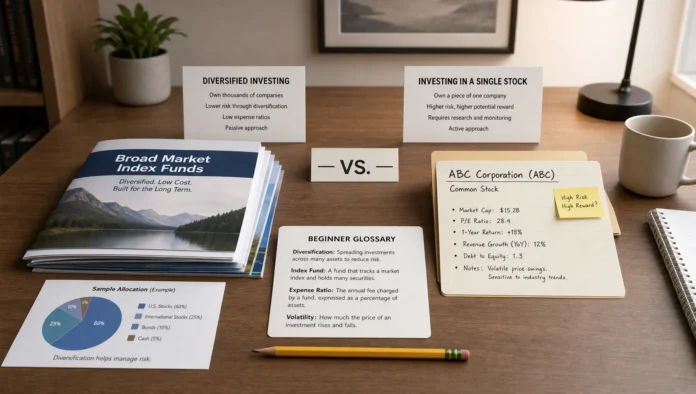
Individual stocks vs. funds: which is simpler?
One of the biggest beginner questions is whether to buy individual stocks or stock funds.
An individual stock gives you exposure to one company. That can be rewarding if the business performs well, but it also concentrates your risk. A company can disappoint investors, lose market share, face legal problems, cut dividends, or fall for reasons outside your control.
A stock fund, such as a mutual fund or exchange-traded fund, can hold many companies in one investment. Some funds track broad market indexes. Others focus on specific sectors, countries, or strategies. Broad diversified funds are often simpler because one purchase can spread your money across many businesses.
The U.S. Securities and Exchange Commission explains that diversification can help reduce risk, although it does not eliminate losses. That is an important distinction. Diversification is not a guarantee. It is a way to avoid depending too heavily on one company or one idea.
For many beginners, a diversified core comes first. Individual stocks, if used at all, can be a smaller learning portion of the portfolio rather than the entire plan.
A simple way to think about risk
Risk is not only the chance that an investment goes down. Risk is also the chance that you react badly when it does.
A portfolio that looks perfect on paper is not useful if you sell everything during the first major decline. This is why risk tolerance matters. It is not just about math. It is about your income stability, savings, experience, personality, and time horizon.
A beginner-friendly question is: if my portfolio fell 20 percent, would I still be able to follow my plan?
If the honest answer is no, you may need a more conservative mix, a larger cash reserve, or a smaller starting amount. The goal is not to avoid all risk. The goal is to take a level of risk you can live with.
How to start with a small amount
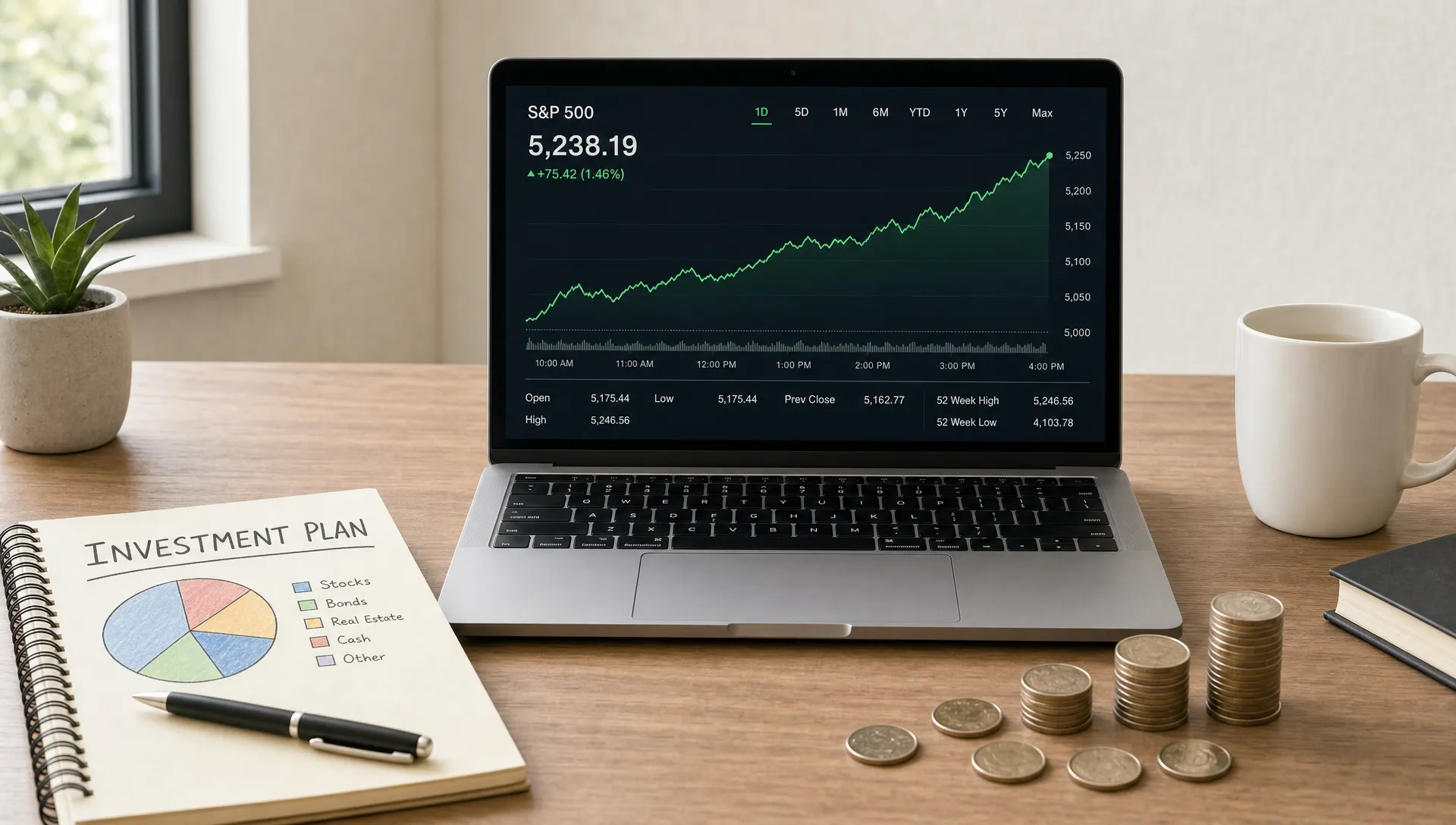
You do not need to wait until you feel like an expert. You can start by learning the process with a small amount, as long as the money is truly available for long-term investing.
A simple starting path can look like this:
- Choose a long-term goal for the money.
- Decide how much you can invest without touching emergency savings.
- Open an appropriate investment account with a reputable broker.
- Start with a diversified investment you understand.
- Set a review date so you are not checking every day.
The key is to keep the first version boring. Boring is not bad in investing. Boring often means low maintenance, easier to understand, and easier to repeat.
Be careful with the idea that a small account needs big risks to grow. Many beginners lose money because they try to make a small amount grow too quickly. A better use of a small account is learning good habits: reading fund information, understanding fees, placing orders carefully, and staying calm during volatility.
What to research before buying an individual stock
If you decide to buy individual stocks, treat each purchase like buying part of a business, not like betting on a ticker symbol.
You do not need to become a professional analyst, but you should understand the basics:
- What does the company sell, and how does it make money?
- Is revenue growing, shrinking, or unstable?
- Does the company earn profits, or is it still relying on future expectations?
- How much debt does it carry?
- Who are its competitors?
- What could go wrong with the investment idea?
Public companies file financial reports, and investors can research them through official filings. In the United States, the SEC's EDGAR database is a common source for company filings. Even if you do not read every page, learning where official information comes from is better than relying only on social media opinions.
A simple rule: if you cannot explain why you own a stock in a few clear sentences, you may not understand it well enough yet.
Dollar-cost averaging and why it helps beginners
Dollar-cost averaging means investing a set amount at regular intervals, regardless of whether the market is up or down. For example, an investor might contribute monthly instead of waiting for the perfect entry point.
This method does not guarantee a profit, and it does not protect you from losses. Its main benefit is behavioral. It reduces the pressure to guess the best day to invest. It also helps beginners turn investing into a routine rather than an emotional decision.
The opposite approach, trying to time the market perfectly, sounds attractive but is difficult. You must be right twice: when to get out and when to get back in. Many investors miss strong recovery days because they wait too long after selling.
Fees, taxes, and account types matter
Beginners often focus only on returns, but costs matter too. A fund with high fees must overcome those costs before you benefit. Trading frequently can also create costs and tax consequences, depending on your country and account type.
Before investing, learn the basics of your account:
| Item to understand | Why it matters |
|---|---|
| Trading commissions | Can reduce returns, especially on small purchases |
| Fund expense ratios | Ongoing fees can compound over time |
| Account rules | Different account types may have tax or withdrawal rules |
| Currency exposure | International investments may be affected by exchange rates |
| Dividend treatment | Dividends may be reinvested, paid out, or taxed differently |
Taxes vary by location, so do not rely on generic online advice for tax decisions. If taxes are a major concern, ask a qualified tax professional.
Common mistakes that make stocks feel complicated
Stock investing becomes stressful when beginners try to do too much too soon. The market already has uncertainty. You do not need to add unnecessary complexity.
Some common mistakes include chasing viral stock tips, buying a company only because its price has fallen, checking prices several times a day, using borrowed money before understanding risk, and putting too much money into one stock.
Another mistake is changing strategies constantly. A beginner might start with long-term investing, then switch to day trading, then buy speculative stocks, then sell everything after bad news. This creates confusion because there is no stable plan to evaluate.
Instead, define your strategy before emotions take over. Write down what you own, why you own it, how long you expect to hold it, and what would make you reconsider.
A simple review routine
You do not need to monitor your portfolio every hour. In fact, constant checking can make normal volatility feel like a crisis.
A simple review routine might include checking whether your investments still match your goals, confirming that fees remain reasonable, reviewing your allocation, and increasing contributions if your income allows. Many long-term investors review quarterly, semiannually, or annually rather than daily.
If your portfolio grows beyond a few basic holdings, you may need to think more carefully about allocation. Greek Shares' beginner portfolio building guide can help you understand how goals, time horizon, and risk tolerance fit together.
Keep it simple, but keep learning
Simple does not mean careless. It means you understand your plan well enough to follow it.
A beginner stock investing plan can be as clear as this: keep emergency money out of the market, invest only for long-term goals, use diversification, contribute consistently, avoid hype, and review your plan on a schedule.
Over time, you can learn more about valuation, financial statements, market cycles, taxes, and portfolio construction. But you do not need to master everything before taking the first educational step. The best beginner plan is one that protects you from major mistakes while helping you build confidence gradually.
Frequently Asked Questions
How much money do I need to start investing in stocks? You can often start with a small amount, depending on your broker and available investment options. The more important question is whether the money is truly for long-term goals and separate from emergency savings.
Are stocks safe for beginners? Stocks can be appropriate for beginners who understand the risks, invest for the long term, and diversify. They are not risk-free. Prices can fall, and individual companies can perform poorly.
Should beginners buy individual stocks or index funds? Many beginners find broad diversified funds simpler because they spread risk across many companies. Individual stocks require more research and can be riskier if they make up too much of a portfolio.
How often should I check my stock portfolio? Long-term investors usually do not need to check daily. A scheduled review, such as quarterly or annually, can help you stay focused on goals instead of reacting to every market move.
Can I lose all my money in stocks? With one individual stock, a severe loss is possible if the company fails. A diversified fund reduces single-company risk, but it can still decline in value during market downturns.
Build your investing knowledge one step at a time
The easiest way to make progress is to keep learning without rushing. Greek Shares was created to help beginners and growing investors understand stocks, risk, portfolios, and market basics in plain language.
Explore more educational guides on Greek Shares and build a stock investing approach that is simple enough to follow, but strong enough to grow with you.