


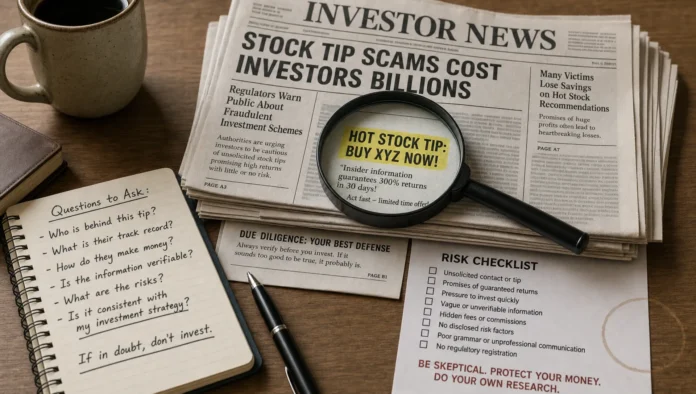
Beginner investors often look for stock tips because they want direction. That is understandable. The stock market can feel noisy, technical, and intimidating when you are just starting out.
The problem is not that every tip is bad. The problem is that a tip is usually a conclusion without the reasoning. Someone says a stock is “about to take off,” “undervalued,” or “a once-in-a-decade opportunity,” but they may not explain the risks, the valuation, their time horizon, or whether the idea fits your financial goals.
Good investing starts with curiosity, not obedience. Before acting on stock tips, beginners should learn how to question them, verify them, and decide whether they deserve a place in a portfolio at all.
Why beginners should be careful with stock tips
A stock tip can come from anywhere: a friend, a social media post, a newsletter, a financial influencer, a forum, or a news headline. Some tips are based on thoughtful analysis. Others are based on excitement, rumor, or someone else’s attempt to sell before the crowd loses interest.
For a beginner, the danger is that the tip can create urgency. Urgency pushes you to skip the slow work that protects you: understanding the business, checking the numbers, comparing valuation, and deciding how much risk you can afford.
The U.S. Securities and Exchange Commission warns investors to be alert to fraud, exaggerated claims, and high-pressure promotions through its educational site, Investor.gov. That does not mean every enthusiastic stock idea is a scam. It means you should treat dramatic claims as a reason to slow down, not speed up.
A useful rule is simple: if you cannot explain why you own a stock without repeating someone else’s words, you are probably not ready to buy it.
Stock tips that sound exciting but need extra questioning
Some tips are especially tempting because they appeal to common beginner emotions: fear of missing out, hope for fast profits, and the desire for certainty. These are the tips that deserve the most scrutiny.
“This stock is guaranteed to go up”
No stock is guaranteed to go up. Even excellent companies can fall because of valuation, interest rates, competition, regulation, weak earnings, or broad market declines.
When someone uses the word “guaranteed,” ask what they are really claiming. Are they talking about long-term business quality, a short-term price move, or pure speculation? The stock market rewards probabilities, not promises.
A better question is: “What would prove this idea wrong?” If the person giving the tip cannot answer that, the tip is incomplete.
“Everyone is buying it”
Popularity is not the same as quality. A stock can rise because investors are excited, but excitement can fade quickly. If the price has already increased sharply, the future return may depend on even more buyers showing up later.
Beginners often hear “everyone is buying” as a sign of safety. It can actually be a sign of crowding. When expectations become too optimistic, even a small disappointment can cause a sharp decline.
Before acting, ask whether the business results justify the price move. Are sales, profits, margins, and cash flow improving, or is the stock mainly moving because of attention?
“It is cheap because the price fell”
A stock that fell from $100 to $20 may look cheap, but the lower price alone tells you almost nothing. It may be a bargain, or it may be a company with shrinking revenue, too much debt, weakening demand, or a broken business model.
Price and value are different. A stock is not cheap because it is down. It is cheap only if the market price is low compared with the company’s future cash flows, assets, earnings power, and risk.
This is why beginners should learn basic valuation before relying on price charts alone. If you need a structured starting point, Greek Shares has a practical guide on the questions to ask before buying stocks that can help you slow down and think like an owner.
“A big announcement is coming”
Rumors about upcoming news can be risky. The market often reacts before official announcements, and prices can fall even after good news if expectations were too high.
This is especially important with small-cap stocks, biotech companies, turnaround stories, and highly speculative sectors. A single announcement can move the stock dramatically in either direction.
Before buying on a rumored catalyst, ask yourself whether you would still want to own the company if the announcement disappoints or never happens.
A quick filter for questionable stock tips
You do not need to be a professional analyst to ask better questions. You need a repeatable filter that turns a vague tip into something you can test.
| Stock tip claim | Question to ask before acting | Why it matters |
|---|---|---|
| “This stock will double soon” | What specific evidence supports that upside? | Big claims require strong reasoning, not just confidence. |
| “It is undervalued” | Undervalued compared with what: earnings, cash flow, assets, or peers? | Valuation needs a benchmark. |
| “The company is growing fast” | Is growth profitable, sustainable, and funded responsibly? | Growth can destroy value if it depends on excessive spending or debt. |
| “A famous investor owns it” | Do they have the same time horizon and risk tolerance as you? | Their strategy may not match your situation. |
| “The dividend is huge” | Is the dividend covered by earnings and cash flow? | A high yield can signal risk, not safety. |
| “The chart looks bullish” | What happens if the price breaks below your risk level? | Technical signals need a risk plan. |
The goal of this table is not to reject every idea. It is to avoid buying first and researching later.

Questions beginners should ask about the source
The quality of a tip depends partly on the quality and incentives of the person sharing it. A thoughtful investor might share an idea with clear assumptions, risks, and a long-term thesis. A promoter might share only the upside because attention benefits them.
Ask these questions about the source before you consider the stock itself:
- Does the person explain both the bullish case and the risks?
- Do they disclose whether they own the stock or receive compensation?
- Are they focused on business fundamentals or only price predictions?
- Do they have a track record of changing their mind when facts change?
- Are they pressuring you to act immediately?
If the tip comes from a broker, adviser, or financial professional in the United States, you can research their background through FINRA BrokerCheck. If the idea involves a public company, you can also review official filings through the SEC’s EDGAR company search.
Official filings may feel intimidating at first, but even beginners can learn to look for basic information: how the company makes money, whether revenue is growing, whether it is profitable, how much debt it has, and what risks management describes.
Questions beginners should ask about the stock itself
Once the source passes your first filter, look at the business. A stock is not just a ticker symbol. It represents ownership in a company.
Start with the business model. Can you explain how the company earns money in one or two sentences? If not, keep learning before you invest. Complex companies are not automatically bad, but complexity increases the chance that you misunderstand the risk.
Next, look at financial health. A company with rising revenue but heavy losses may still be risky. A company with strong profits but too much debt may struggle if conditions worsen. A company with a great product may still be a poor investment if the stock price already assumes perfect execution.
Then consider valuation. Beginners do not need to master every ratio immediately, but they should understand that price matters. A wonderful company can become a disappointing investment if bought at an unrealistic price.
Finally, consider your own fit. Even if a stock is attractive, it may not match your time horizon, risk tolerance, or portfolio needs. If you are still learning the basics, it may help to review what beginners should learn first about stocks before acting on individual ideas.
Stock tips that involve leverage or options deserve a longer pause
Some tips are not simply “buy this stock.” They may involve options, margin, short-term trading, or leveraged ETFs. These can magnify gains, but they can also magnify losses.
For beginners, the main issue is not intelligence. It is experience. Leveraged strategies require a clear understanding of position sizing, volatility, liquidity, timing, and downside risk. If the tip sounds like a shortcut to fast money, it may actually be a shortcut to fast losses.
Before using any leveraged strategy, ask what the maximum loss could be, what event could trigger that loss, and whether you can emotionally and financially handle the outcome. If you cannot answer those questions clearly, the trade is too advanced for now.
How to act when a stock tip seems interesting
Questioning a tip does not mean ignoring it. Some tips can become useful research leads. The key is to separate the idea from the action.
Instead of buying immediately, place the stock on a watchlist. Read the company’s latest annual or quarterly report. Compare it with competitors. Write down the investment thesis in your own words. Decide what price would make the stock attractive and what facts would make you walk away.
You can also start with a paper portfolio, which lets you track your decision without risking real money. This helps you learn whether your reasoning was sound or whether you were mainly reacting to hype.
If you eventually invest, position size matters. A speculative idea should not receive the same allocation as a diversified core holding. One of the most common stock market investing mistakes to avoid early on is risking too much money before you understand how losses feel in real time.
A simple checklist before acting on any stock tip
Before you buy, sell, or trade based on a tip, pause and answer these questions in writing:
- What exactly is the claim?
- What evidence supports it?
- What are the biggest risks?
- How does the company make money?
- Is the stock reasonably valued?
- What is my time horizon?
- How much could I lose if I am wrong?
- Does this fit my broader portfolio and goals?
Writing your answers matters. It forces you to turn excitement into reasoning. It also gives you something to review later, which is how investors improve.
Frequently Asked Questions
Are stock tips always bad for beginners? No. A stock tip can be a useful starting point for research, but it should not be treated as a complete investment decision. Beginners should verify the claim, understand the company, and consider whether the idea fits their goals and risk tolerance.
What is the biggest red flag in a stock tip? The biggest red flag is certainty. Phrases like “guaranteed,” “can’t lose,” or “buy before it’s too late” should make you pause. Serious investing involves uncertainty, risk, and multiple possible outcomes.
Should beginners buy stocks mentioned on social media? Not without independent research. Social media can surface interesting companies, but it can also amplify hype, rumors, and promotional campaigns. Treat social media ideas as research leads, not instructions.
How much research should I do before buying a stock? At minimum, you should understand how the company makes money, its financial condition, its valuation, the main risks, and why the stock fits your portfolio. If you cannot explain the investment in your own words, keep learning first.
What should I do if I already bought a stock based on a tip? Review the position calmly. Write down why you own it, what risks you missed, and whether it still fits your plan. If you are unsure, avoid adding more money until you have done the research.
Build a better habit than chasing tips
Stock tips will always be part of investing culture. Some will be thoughtful. Many will be incomplete. A few may be dangerous.
Your job as a beginner is not to find the loudest opinion. It is to build a process that helps you think clearly before money is at risk.
Greek Shares is designed to help investors improve financial literacy step by step, from beginner concepts to portfolio risk management and mistake avoidance. Keep learning, keep questioning, and let every stock tip earn your trust before it earns your money.