



The phrase “most profitable shares” can be tempting because it sounds like there is a single list of stocks that will outperform everything else. In reality, spotting profitable shares responsibly is less about finding a secret ticker and more about building a disciplined process.
A share can look profitable because the company earns strong margins, because the stock price has recently risen, or because analysts expect fast growth. Those are very different things. Responsible investors separate business profitability from stock market excitement, then decide whether the price, risks, and time horizon make sense.
This guide will show you how to identify shares with genuine profit potential without relying on hype, tips, or short-term speculation.
Start by defining what “profitable” means
Before looking for the most profitable shares, clarify what you are trying to achieve. A day trader, dividend investor, and long-term growth investor may all use the word “profitable,” but they are not looking for the same thing.
For responsible investing, profitability usually means a combination of three factors: the company can generate sustainable profits, the share price offers a reasonable opportunity for return, and the risk is acceptable for your financial situation.
A company may be profitable, but its stock may still be overpriced. Another company may be temporarily unprofitable, yet priced for a credible turnaround. This is why the best investors do not ask only, “Is this business making money?” They also ask, “What am I paying for that money, and how reliable is it?”
If you are still building your process, Greek Shares has a useful guide on how to find profitable shares without chasing hype that complements the framework below.
Look for durable business profitability, not one lucky year
The first sign of a potentially profitable share is a business that makes money consistently. One strong year can happen because of temporary demand, currency effects, cost cuts, asset sales, or unusual market conditions. Durable profitability shows up over multiple reporting periods.
Focus on how the company earns its profits. Does it sell essential products or services? Does it have repeat customers? Can it raise prices without losing demand? Does it operate in an industry with high barriers to entry? A company with a clear business model is easier to evaluate than one that depends mainly on promises.
Key profitability metrics include:
| Metric | What it tells you | Why it matters |
|---|---|---|
| Gross margin | Profit after direct production costs | Shows pricing power and cost control |
| Operating margin | Profit from core operations | Helps separate real business performance from accounting noise |
| Net margin | Profit after all expenses | Shows what remains for shareholders |
| Return on equity | Profit generated from shareholder capital | Useful for comparing companies in similar industries |
| Return on invested capital | Profit generated from all capital used | Often a strong measure of business quality |
| Free cash flow | Cash left after operating and capital spending needs | Shows whether accounting profits turn into usable cash |
No single metric is enough. For example, a high return on equity can look impressive because the company uses too much debt. A high net margin may be temporary if competitors are entering the market. Free cash flow may fall for good reasons if the company is investing heavily in future growth.
The goal is to see the whole picture, not to fall in love with one number.
Check revenue quality and cash flow
Profits are important, but cash flow often reveals the truth. A company can report accounting earnings while struggling to collect payments, funding operations with debt, or delaying necessary spending. Over time, strong businesses usually turn a meaningful portion of earnings into operating cash flow and free cash flow.
When studying financial statements, compare net income with cash from operations. If net income rises but cash flow stays weak for several years, investigate why. It may be normal in some industries, but it can also signal poor earnings quality.
Revenue quality matters too. A company with recurring subscriptions, long-term contracts, or loyal repeat customers may have more predictable earnings than a company dependent on one-time sales. Predictability does not guarantee success, but it can reduce uncertainty.
For U.S.-listed companies, official filings are available through the SEC’s EDGAR company search. For other markets, use the relevant exchange filings, annual reports, and audited financial statements. Do not rely only on social media summaries.
Evaluate the balance sheet before the growth story
Many investors focus on revenue growth first. Responsible investors check financial strength early. A company with heavy debt can look attractive during good times but become fragile when interest rates rise, sales decline, or credit markets tighten.
A strong balance sheet gives management flexibility. It allows a company to invest, survive downturns, and avoid raising capital at unfavorable prices. A weak balance sheet can force even a promising business into painful decisions.
Watch these areas carefully:
- Debt relative to earnings and cash flow
- Interest coverage, meaning whether operating profit comfortably covers interest expense
- Short-term liabilities compared with cash and liquid assets
- Share dilution from frequent equity issuance
- Pension obligations, leases, or off-balance-sheet commitments where applicable
Debt is not automatically bad. Utilities, telecoms, banks, and real estate companies often use more leverage than software or consumer brands. The question is whether the debt is appropriate for the industry, stable under stress, and supported by reliable cash flows.
Compare profitability with valuation
The most profitable company is not always the most profitable stock. If expectations are already too high, even a great business can produce disappointing returns. Responsible investors compare quality with price.
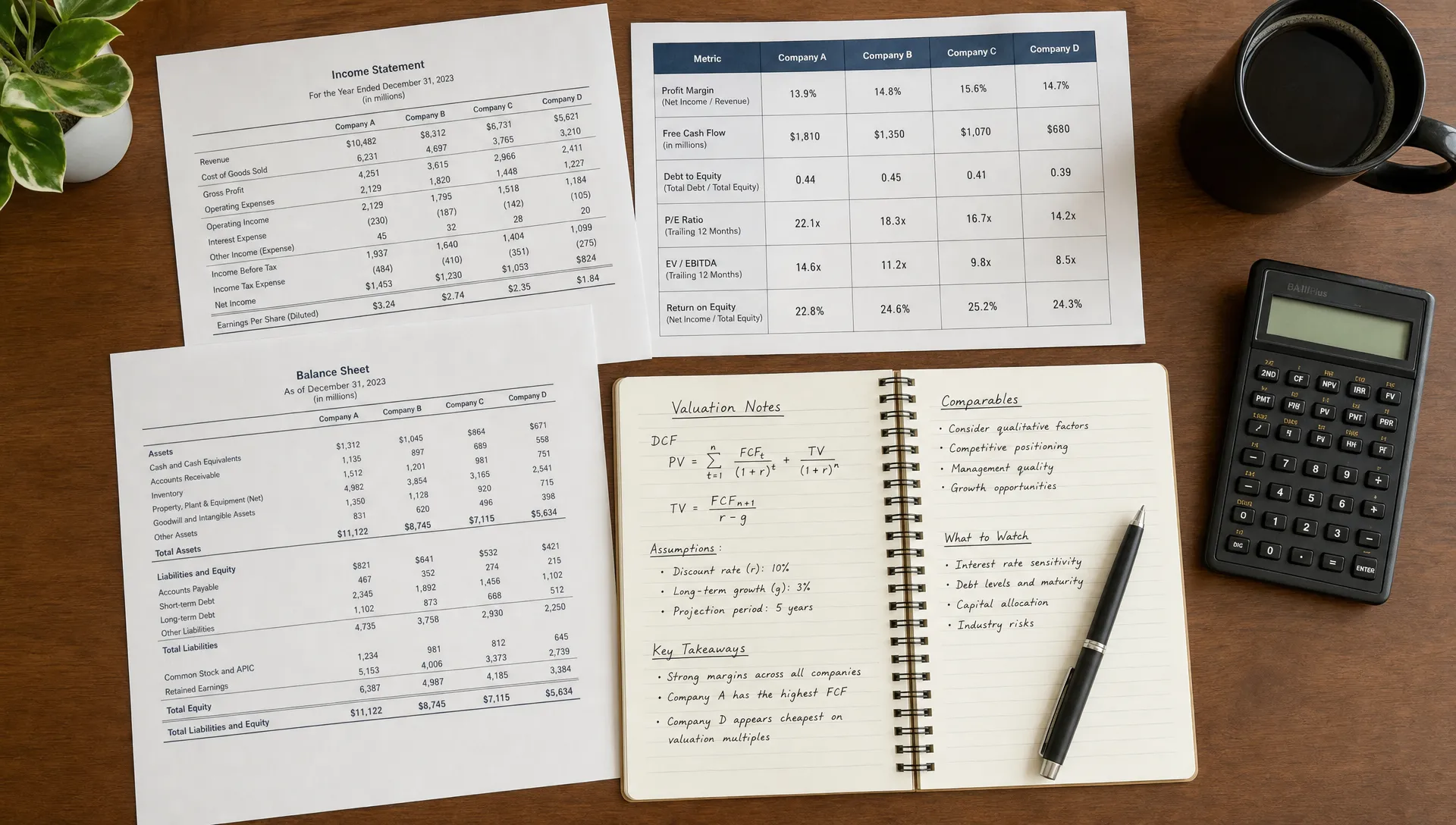
Common valuation measures include price-to-earnings, price-to-sales, enterprise value-to-EBITDA, price-to-free-cash-flow, and dividend yield. Each has limitations. Price-to-sales can be useful for early growth companies but says little about eventual profitability. Price-to-earnings can be misleading if earnings are temporarily high or low. Dividend yield can be a warning sign if the payout is unsustainable.
A practical approach is to compare valuation against three reference points: the company’s own history, similar companies, and your estimate of future earnings power. If a share trades at a premium, ask what must happen for that premium to be justified.
Searches for the “top most profitable shares” often produce lists based on recent performance. Those lists can be useful starting points, but they should never replace valuation work. A stock that has already doubled may still be attractive, or it may already reflect years of perfect execution.
Study competitive advantage and reinvestment potential
A profitable company becomes more interesting when it can reinvest earnings at attractive rates. This is where competitive advantage matters. Businesses with strong brands, network effects, scale advantages, patents, regulatory licenses, cost leadership, or high switching costs may protect their profits better than businesses with easily copied products.
Ask whether today’s profitability is likely to last. High profits attract competitors. If competitors can enter easily, margins may decline. If the company needs constant heavy spending just to maintain its position, reported profits may overstate economic strength.
Reinvestment is also important. A mature company with limited growth may return cash through dividends and buybacks. A younger company may reinvest aggressively. Neither is automatically better. What matters is whether management allocates capital wisely.
For a broader way to evaluate business quality, valuation, and investment fit, you may find Greek Shares’ guide on how to find the stock market’s best investments helpful.
Identify red flags that can destroy returns
Spotting profitable shares responsibly also means knowing when to walk away. The best stock pick can sometimes be the one you avoid.
Some warning signs are obvious, such as collapsing sales, rising losses, or excessive debt. Others are more subtle. Management may present adjusted earnings that exclude recurring costs. A company may grow revenue through acquisitions while organic demand weakens. Insiders may sell heavily while promoting optimistic forecasts.
Use this checklist when a stock looks almost too good:
| Red flag | Why it matters | What to check |
|---|---|---|
| Profits rise but cash flow falls | Earnings quality may be weak | Cash flow statement and receivables |
| Debt grows faster than operating profit | Financial risk may be increasing | Debt maturity schedule and interest expense |
| Margins are far above competitors | Could be unsustainable | Industry structure and new entrants |
| Constant “one-time” adjustments | Real costs may be hidden | Reconciliation of adjusted earnings |
| Frequent share issuance | Existing shareholders may be diluted | Share count over several years |
| Management avoids clear answers | Governance risk may be high | Earnings calls, reports, and voting structure |
A red flag does not always mean “sell” or “avoid.” It means slow down and demand a larger margin of safety.
Think about market direction without trying to predict perfectly
Even excellent shares can fall in a bear market. Market direction, interest rates, liquidity, and investor sentiment can affect short-term returns. However, trying to predict every top and bottom is unrealistic for most investors.
A responsible approach is to combine company analysis with position sizing and patience. If the market is overheated and valuations are stretched, you may require a higher margin of safety. If markets are fearful but the business remains strong, opportunities may appear.
This does not mean timing the market perfectly. It means recognizing that price matters, mood matters, and your personal risk tolerance matters.
Build a margin of safety
Margin of safety is the gap between what you believe a share is worth and the price you pay. It protects you from errors in forecasts, unexpected events, and market volatility. The more uncertain the business, the larger the margin of safety should be.
For stable, high-quality companies, investors may accept a smaller discount because cash flows are more predictable. For cyclical, leveraged, or fast-changing companies, a wider discount is usually prudent.
A margin of safety can come from several sources: buying at a reasonable valuation, choosing companies with strong balance sheets, diversifying across sectors, and avoiding oversized positions. It is not only a valuation concept. It is a risk management mindset.
Consider legal, tax, and jurisdiction risks
Investing responsibly also means understanding the rules around the assets you buy. Shareholder rights, tax treatment, reporting standards, currency controls, and legal protections vary by country. This matters even more if you invest internationally.
For example, a company may look attractive on financial metrics but operate in a jurisdiction where minority shareholders have weaker protections or where regulatory uncertainty is high. If you are investing across borders, it can be worth reviewing local legal resources or consulting qualified professionals. In matters involving Jamaica or Caribbean business law, for instance, a firm such as Henlin Gibson Henlin is an example of the type of jurisdiction-specific legal expertise investors may need when evaluating complex situations.
This does not mean every retail investor needs a lawyer before buying a share. It means legal and regulatory context should not be ignored, especially for large positions, private deals, foreign holdings, or companies facing litigation.
Turn research into a responsible decision process
The final step is to create a repeatable process. Without process, investors often buy because a stock feels exciting and sell because it feels scary. A written checklist reduces emotional decision-making.
Before buying, write down your investment thesis. Explain how the company makes money, why profits can grow or remain durable, what valuation you consider reasonable, what could go wrong, and when you would reconsider. If you cannot explain the idea in plain language, you may not understand it well enough.
Greek Shares also offers a practical article on the best questions before buying stocks that can help you turn research into a clearer checklist.
A responsible decision process should include:
- Your investment goal and time horizon
- The company’s main profit drivers
- The valuation range you consider reasonable
- The biggest risks to your thesis
- Your maximum position size
- A plan for reviewing results after earnings reports
Avoid making the decision only about buying. Responsible investing also includes knowing when to trim, hold, add, or exit. If the thesis breaks, reassess. If the price rises far beyond reasonable value, consider whether expected returns still justify the risk.
Avoid the biggest mistake: confusing confidence with certainty
The stock market rewards preparation, but it does not reward arrogance. Even careful analysis can be wrong. Competitors appear, regulations change, currencies move, management teams make mistakes, and recessions arrive unexpectedly.
That is why diversification matters. Investor.gov, a website from the U.S. Securities and Exchange Commission, explains that diversification can help reduce investment risk. It will not eliminate losses, but it can prevent one mistake from damaging your entire portfolio.
Responsible investors do not need to know everything. They need a process that helps them avoid obvious mistakes, recognize uncertainty, and act with discipline.
Frequently Asked Questions
What are the most profitable shares to buy now? There is no universal answer because profitability depends on your goals, risk tolerance, valuation, and time horizon. Instead of looking for a simple list, study companies with durable earnings, strong cash flow, reasonable debt, and valuations that leave room for future returns.
Is a profitable company always a good stock investment? No. A profitable company can still be a poor investment if the share price is too expensive or if future growth expectations are unrealistic. Always compare business quality with valuation.
Which metric is best for finding profitable shares? No single metric is best. Return on invested capital, operating margin, free cash flow, earnings growth, and balance sheet strength are all useful. The most reliable analysis combines several metrics and considers the industry context.
How can beginners avoid chasing hype? Beginners should write down a clear investment thesis before buying, avoid decisions based only on recent price movements, and compare the company’s financials with its valuation. If the reason to buy is simply “everyone is talking about it,” that is usually not enough.
How many shares should I own? The right number depends on your knowledge, portfolio size, and risk tolerance. Holding too few stocks can increase company-specific risk, while holding too many can make research difficult. Many investors use diversified funds for broad exposure and individual shares only where they have done deeper research.
Keep learning before you commit capital
Spotting the most profitable shares responsibly is not about predicting the next market winner with perfect accuracy. It is about stacking the odds in your favor through business analysis, valuation discipline, risk management, and patience.
Use profitable share ideas as starting points, not final answers. Read annual reports, compare competitors, check cash flow, understand the balance sheet, and decide whether the price gives you a fair opportunity. The more disciplined your process, the less likely you are to be pulled into emotional decisions.
Greek Shares is built to help investors strengthen that process through educational guides, market concepts, and practical investing frameworks. Keep learning, keep questioning, and never risk money you cannot afford to lose.