


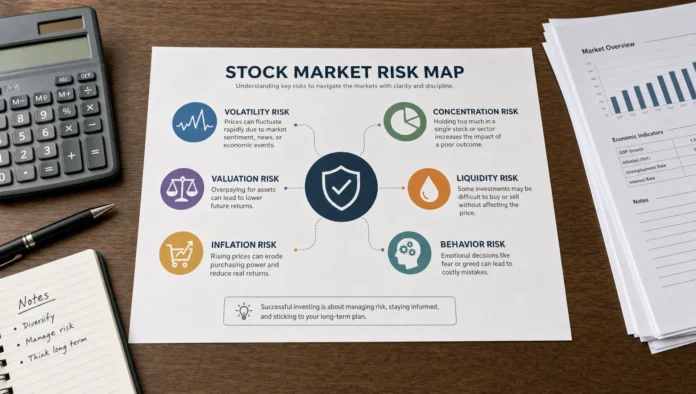
Investing in stocks can be one of the most effective ways to build wealth over time, but it is never risk-free. The key is not to avoid risk entirely. The key is to understand the risks of investing in the stock market clearly enough to make better decisions before your money is exposed.
For beginners, risk often means “prices might fall.” That is true, but it is only part of the picture. Stock market risk can also come from buying an overvalued company, holding too few stocks, using borrowed money, reacting emotionally, or investing money you may need soon.
A thoughtful investor accepts that uncertainty is part of the process, then builds a plan to manage it.
What Stock Market Risk Really Means
In investing, risk is not just day-to-day price movement. A stock can move up and down sharply and still become a strong long-term investment. A quieter stock can also be risky if the business is deteriorating, the balance sheet is weak, or the valuation is too high.
A useful definition of risk is the possibility that your investment outcome fails to meet your financial goal. That might mean losing money permanently, earning less than inflation, needing to sell during a downturn, or concentrating too much wealth in one company or sector.
The U.S. Securities and Exchange Commission’s investor education site explains that risk and return are closely connected. In general, investors demand the possibility of higher returns because they are taking uncertainty. The challenge is deciding which risks are worth taking and which risks are unnecessary.
Greek Shares has also covered the broader idea of defining risk in investing and stock markets, which is a useful starting point before comparing individual risks.
1. Market Volatility Risk
Market volatility is the risk that stock prices rise and fall sharply over short periods. This can happen because of interest rate changes, inflation data, earnings reports, political events, recessions, banking stress, or investor sentiment.
Volatility is uncomfortable because it tests patience. A portfolio can lose value even when the underlying companies remain healthy. During broad market sell-offs, even high-quality stocks often decline because investors reduce risk across the board.
The mistake is assuming that volatility always equals danger. Sometimes it does. Other times, it is simply the price investors pay for long-term growth potential. The real danger appears when investors sell strong assets in panic without considering their original time horizon.
2. Company-Specific Risk
Company-specific risk is the risk that something goes wrong with an individual business you own. Examples include weak earnings, poor management decisions, excessive debt, legal problems, product failures, accounting issues, or loss of competitive advantage.
This risk matters because a single company can perform badly even when the overall market is doing well. A popular stock can fall if its growth slows. A profitable company can struggle if costs rise faster than revenue. A dividend-paying business can cut its dividend if cash flow weakens.
Good research reduces this risk but does not eliminate it. Investors should look at revenue trends, profit margins, debt levels, cash flow, competitive position, and management quality. For industrial or manufacturing companies, it can also help to understand supply chains and operational dependencies. For example, a business may rely on specialized component providers, and reviewing a real industrial supplier such as Jakom, a specialist in shafts and rollers, can make those operational links more concrete when thinking about supplier risk.
3. Valuation Risk
A good company is not automatically a good investment at any price. Valuation risk is the danger of paying too much for future earnings, dividends, or growth.
When expectations are extremely high, even a small disappointment can cause a large price drop. This is common in fast-growing sectors where investors project years of strong expansion into the future. If the company grows, but not as fast as the market expected, the stock can still fall.
Valuation does not require perfect precision. No one knows the exact fair value of a business. But investors should compare price with fundamentals such as earnings, revenue growth, free cash flow, debt, and industry averages. Buying without considering valuation turns investing into speculation.
4. Liquidity and Time Horizon Risk
Liquidity risk is the risk that you cannot sell an investment quickly at a reasonable price. Large, widely traded stocks are usually more liquid than small companies with low trading volume. In thinly traded stocks, the gap between the buying price and selling price can be wide, especially during stressful markets.
Time horizon risk is closely related. If you invest money you need in the near future, a temporary market decline can become a real financial problem. You may be forced to sell at a bad time, not because the investment thesis changed, but because your personal cash needs changed.
That is why stock market investing is generally more suitable for long-term goals than short-term expenses. Before buying stocks, consider whether the money is needed for rent, taxes, tuition, a home purchase, or emergency savings. If the answer is yes, it may not belong in the stock market. Greek Shares explores this idea further in its guide on when not to invest in stocks.
5. Concentration Risk
Concentration risk happens when too much of your portfolio depends on one stock, one industry, one country, or one investment theme. Concentration can increase returns when you are right, but it can also magnify losses when conditions change.
A portfolio made mostly of technology stocks may suffer when interest rates rise. A portfolio focused on banks may struggle during credit stress. A portfolio built around one country may be vulnerable to local political, currency, or economic shocks.
Diversification is not about owning random investments. It is about reducing the impact of being wrong in any single area. According to FINRA, diversification can help manage investment risk, although it cannot guarantee profits or prevent losses.
| Risk type | What it looks like | Common warning sign | Possible risk control |
|---|---|---|---|
| Market volatility | Broad market declines | Panic selling after price drops | Long-term plan and rebalancing |
| Company-specific risk | One stock falls due to business problems | Weak earnings, high debt, poor cash flow | Diversification and research |
| Valuation risk | Paying too much for expected growth | Extreme optimism and high multiples | Compare price with fundamentals |
| Liquidity risk | Difficulty selling at a fair price | Low trading volume | Avoid oversized positions in illiquid stocks |
| Concentration risk | Too much exposure to one area | Portfolio depends on one stock or sector | Spread exposure across assets and sectors |
| Behavioral risk | Emotional decisions | Frequent trading or panic selling | Written rules and patience |
6. Inflation and Interest Rate Risk
Inflation reduces purchasing power. If your investments grow more slowly than the cost of living, your real wealth may decline even if your account balance rises.
Stocks can sometimes help investors outpace inflation over long periods because companies may raise prices and grow earnings. However, inflation can also hurt stocks in the short term. Higher input costs can reduce profit margins, and central banks may raise interest rates to control inflation.
Interest rates affect stock valuations because they influence borrowing costs and the attractiveness of alternatives such as bonds or cash. When rates rise, future profits may be valued less highly, especially for companies expected to earn most of their profits far in the future.
7. Currency, Political, and Geopolitical Risk
Investors who buy international stocks face currency risk. If a foreign stock rises in its local currency but that currency weakens against your home currency, your return may be reduced.
Political and geopolitical risks include elections, regulation, taxes, trade restrictions, sanctions, wars, and policy changes. These risks can affect entire markets or specific sectors such as energy, banking, defense, shipping, and technology.
This does not mean investors should avoid international exposure. It means they should understand what drives returns. A foreign stock investment may depend not only on the company’s earnings, but also on exchange rates, local law, and regional stability.
8. Behavioral Risk
Behavioral risk is one of the most underestimated risks in stock investing. It comes from the investor, not the market.
Common behavioral mistakes include buying after a stock has already surged, selling after a sharp decline, chasing trends, refusing to admit mistakes, overtrading, or becoming attached to a company because it once performed well.
The market often rewards discipline more than intelligence. A simple plan followed consistently can outperform a complex strategy abandoned during stress. This is why many investors benefit from writing down their reasons for buying a stock before they buy it. If the facts change later, the decision can be reviewed calmly.
For a practical companion to this topic, Greek Shares has a guide to stock market investing mistakes to avoid early on.
9. Leverage and Margin Risk
Leverage means using borrowed money to invest. It can increase gains, but it can also increase losses quickly. Margin investing is especially risky because a broker can require additional funds if your investments decline. If you cannot meet the margin call, positions may be sold automatically at unfavorable prices.
Leverage changes the psychology of investing. A normal market decline can become urgent when borrowed money is involved. Even if your long-term analysis is correct, you may not survive the short-term volatility.
For most beginners, avoiding leverage is one of the simplest ways to reduce catastrophic risk.
10. Information and Misinformation Risk
Investors have access to more information than ever, but more information does not always mean better decisions. Social media posts, rumors, promotional newsletters, and short-term predictions can create false confidence.
Information risk appears when investors rely on incomplete, biased, or low-quality sources. It also appears when they mistake a convincing story for a strong investment case.
A healthier approach is to separate facts from opinions. Facts include financial statements, dividend history, debt levels, cash flow, and official company announcements. Opinions include price targets, hype, and predictions. Both can be useful, but they should not carry the same weight.
How to Manage Stock Market Risk
Risk management does not mean eliminating all uncertainty. That is impossible. It means building a process that gives you a better chance of staying invested through different market conditions.
Here are practical ways to reduce avoidable risk:
- Keep an emergency fund outside the stock market.
- Invest with a time horizon that matches the nature of stocks.
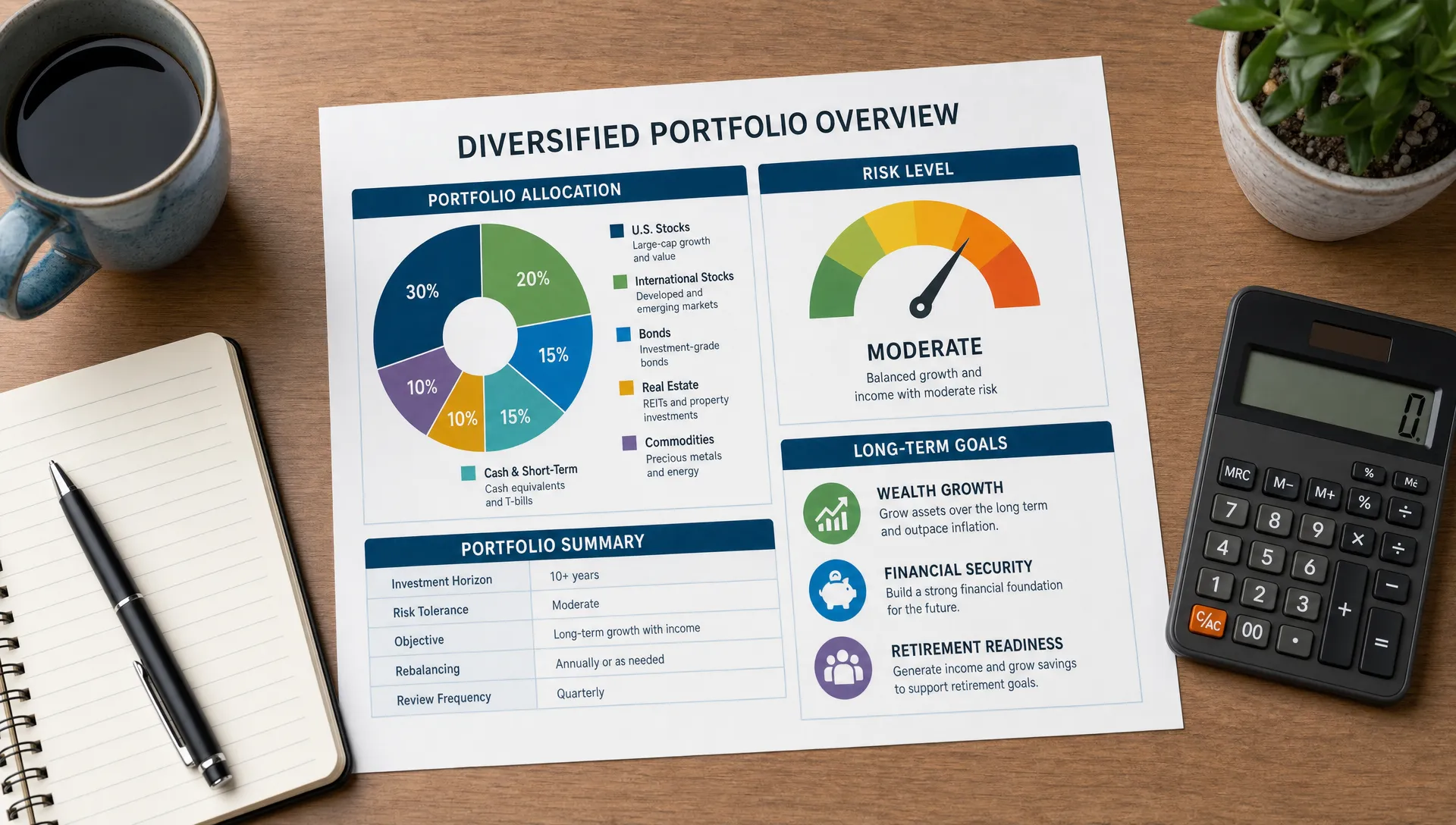
- Diversify across companies, sectors, and asset classes.
- Avoid putting too much money into one stock idea.
- Review valuation before buying, not only the company story.
- Avoid leverage unless you fully understand the consequences.
- Rebalance your portfolio when it drifts far from your plan.
- Write down your investment thesis and review it when facts change.
Risk management should be part of the investment process before you buy, not something you think about after a decline. Greek Shares discusses this more directly in its article on managing investing risks.
A Simple Risk Checklist Before Buying a Stock
Before investing in any stock, pause and ask a few questions. This can prevent impulsive decisions and reveal risks you may have ignored.
| Question | Why it matters |
|---|---|
| Do I understand how the company makes money? | If you cannot explain the business, you may not understand the risk. |
| Is the company financially strong? | High debt and weak cash flow can increase downside risk. |
| Am I paying a reasonable price? | Great businesses can disappoint if bought at excessive valuations. |
| How much of my portfolio will this position represent? | Position size determines how much damage one mistake can cause. |
| What would make me sell? | Clear rules reduce emotional decision-making. |
| Can I hold through a market decline? | If not, the position may be too large or unsuitable. |
This checklist is not a guarantee. It is a discipline tool. Its purpose is to slow the decision down and make risk visible before money is committed.
Risk Is Not the Enemy, Unmanaged Risk Is
The stock market has always involved uncertainty. Prices move, economies change, companies disappoint, and investors make mistakes. Yet stocks remain important for many long-term wealth-building plans because they offer ownership in real businesses.
The goal is not to find investments with no risk. Those do not exist. The goal is to take risks you understand, avoid risks you do not need, and build a portfolio that can survive both good and bad market conditions.
A strong investor does not ask, “Can this stock go down?” The answer is always yes. A stronger question is, “If this investment goes wrong, can my overall plan still survive?”
Frequently Asked Questions
What is the biggest risk of investing in the stock market? The biggest risk is permanent loss of capital, especially when investors buy weak companies, overpay for stocks, concentrate too heavily, or sell in panic during downturns.
Can diversification remove all stock market risk? No. Diversification can reduce company-specific and concentration risk, but it cannot eliminate broad market declines, inflation, interest rate changes, or investor behavior mistakes.
Are stocks too risky for beginners? Stocks can be suitable for beginners if they invest money they do not need soon, diversify properly, avoid leverage, and learn the basics before making decisions.
How much can I lose in the stock market? In an individual stock, losses can be severe and may reach 100 percent if a company fails. A diversified portfolio can also decline significantly during bear markets, although diversification may reduce the damage from any single holding.
Is volatility the same as risk? Not exactly. Volatility is price movement. Risk is the possibility that your investment fails to meet your goal. Volatility can create risk if it forces you to sell at the wrong time.
Keep Learning Before You Invest
Understanding stock market risk is a major step toward investing with more confidence. Continue building your knowledge, compare risks before chasing returns, and use Greek Shares as an educational resource to strengthen your investing process over time.