


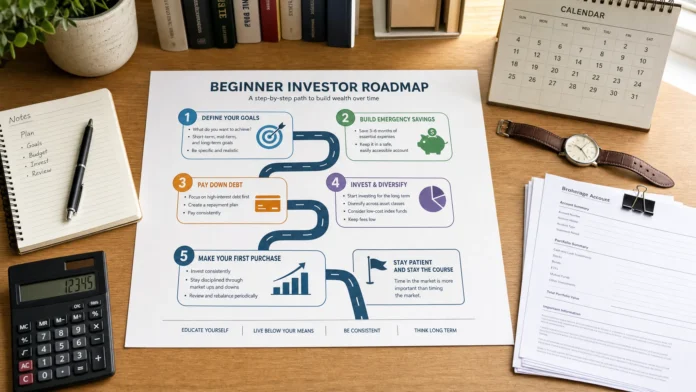
If you are new to investing, the stock market can feel like a place where everyone else knows a secret language. Prices move every second, people debate companies you may never have heard of, and social media can make investing look like a game of fast decisions.
A better starting point is simpler: the stock market is a place where people buy and sell ownership in businesses. As a new investor, your goal is not to predict every price move. Your goal is to build a sensible process, protect yourself from avoidable mistakes, and give your money a chance to grow over time.
This guide gives you a clear first framework: what the stock market is, how investing works, what to prepare before buying, and how to make your first decisions with confidence.
What the stock market actually is
The stock market is a network of exchanges and trading systems where shares of publicly listed companies are bought and sold. When a company goes public, investors can buy shares, which represent partial ownership in that company.
If the company grows, earns more, and becomes more valuable, its share price may rise. Some companies also pay dividends, which are cash payments to shareholders. But if the company performs poorly or investors become less optimistic, the share price can fall.
A stock exchange, such as the New York Stock Exchange or Nasdaq in the United States, helps organize this buying and selling. You do not usually buy directly from the exchange. Instead, you use a brokerage account, which acts as your access point to the market.
If you want a deeper explanation of what you actually own when you buy a share, Greek Shares has a beginner-friendly breakdown of stock market shares for first-time buyers.
Investing is not the same as trading
New investors often confuse investing with trading. They both involve buying and selling securities, but the mindset is different.
Investing usually means buying assets with the intention of holding them for years. The investor focuses on long-term business growth, diversification, compounding, and risk management.
Trading usually means trying to profit from shorter-term price movements. Traders may hold positions for days, hours, or even minutes. This requires more time, more technical knowledge, and a higher tolerance for losses.
For most new investors, long-term investing is the better place to begin. It gives you time to learn, reduces the pressure to react to every headline, and aligns better with goals such as retirement, buying a home, or building long-term wealth.
The U.S. Securities and Exchange Commission’s investor education site, Investor.gov, also emphasizes understanding goals, risk, and time horizon before choosing investments.
The first rule: get your financial foundation ready
Before you buy your first stock, make sure investing fits your current financial situation. The stock market can reward patience, but it can punish people who invest money they may need next month.
A practical foundation includes three things.
First, you should have a basic emergency fund. This is money set aside for unexpected expenses, such as a medical bill, car repair, or job interruption. If all your money is invested, you may be forced to sell during a market decline.
Second, you should understand your debt. High-interest debt, such as credit card debt, can work against you faster than many investments can realistically grow. Paying it down may be a better first move than buying stocks.
Third, you should know your monthly cash flow. Investing works best when you can contribute consistently without stress. Even small amounts can matter if you invest regularly and avoid emotional decisions.
Think of this step like preparing for a trip. Before you pack, you check the rules so you do not face problems at the airport. Travelers can use tools like Liquid Limits to check airport liquid rules before a flight, and investors should do the same kind of preparation by checking account rules, fees, tax considerations, and risk before putting money into the market.
Key stock market terms new investors should know
You do not need to memorize every financial term before you start. But you should understand the basic vocabulary you will see again and again.
| Term | Simple meaning | Why it matters |
|---|---|---|
| Stock | Ownership in a company | Stocks are the main building blocks of equity investing |
| Share | One unit of stock | This is what you buy through a brokerage account |
| Dividend | Cash paid to shareholders | Dividends can provide income, but they are not guaranteed |
| Index | A group of stocks used to track a market | Indexes help investors understand broad market performance |
| ETF | A fund that trades like a stock | ETFs can offer instant diversification |
| Broker | A company that lets you buy and sell investments | Your broker affects fees, tools, access, and account experience |
| Volatility | Price movement up and down | Volatility is normal, but it can feel uncomfortable |
| Diversification | Spreading money across investments | Diversification helps reduce dependence on one company |
These terms are the foundation. As you learn more, you will encounter others such as market capitalization, price-to-earnings ratio, earnings per share, bond yields, and asset allocation. Do not rush. Learning gradually is part of becoming a better investor.
How stock prices move
Stock prices move because buyers and sellers constantly update what they believe a company is worth. In the short term, prices can react to news, interest rates, earnings reports, investor sentiment, economic data, and even rumors.
In the long term, stock prices tend to be influenced by more durable factors: revenue growth, profits, competitive advantage, debt levels, management quality, industry trends, and the overall economy.
This is why a good company is not always a good investment at any price. If expectations are already very high, the stock may fall even after the company reports decent results. Likewise, an unpopular company can rise if its results are better than expected.
For a new investor, the key lesson is this: price and value are related, but they are not identical. A stock price tells you what buyers and sellers agree on right now. Value is your estimate of what the business may be worth over time.
Choose an investing approach before choosing stocks
Many beginners start by asking, “Which stock should I buy?” A better question is, “What approach fits my goals, time horizon, and risk tolerance?”
There are several common approaches for new investors.
A broad index fund approach focuses on buying funds that track large parts of the market, such as the S&P 500 or a total market index. This is popular because it is diversified, relatively simple, and does not require choosing individual winners.
An ETF-based portfolio can combine different asset classes, regions, and sectors. For example, an investor might use stock ETFs for growth and bond ETFs for stability. The exact mix depends on goals and risk tolerance.
An individual stock approach means selecting specific companies. This can be rewarding, but it requires more research and greater emotional discipline. A single company can fall sharply, even if the overall market performs well.
A hybrid approach uses diversified funds as the core and individual stocks as a smaller learning portion. This can help new investors gain experience without making their entire future depend on a few stock picks.

If you want help thinking through allocation, risk, and beginner-friendly portfolio structure, the Beginner Portfolio Building Guide is a useful next step.
How to think about risk without becoming afraid of it
Risk is not a reason to avoid investing. It is something to understand and manage.
The biggest risk beginners notice is market risk, which is the possibility that investments lose value because the overall market declines. This is normal. Even strong markets experience corrections.
Company-specific risk is the risk that one company performs badly. Maybe its product fails, management makes poor decisions, competition increases, or debt becomes a problem. Diversification helps reduce this risk.
Liquidity risk means you may not be able to sell an investment quickly at a fair price. This is less common with large, heavily traded stocks and ETFs, but it matters more with thinly traded securities.
Behavioral risk may be the most dangerous for new investors. This is the risk that you make poor decisions because of fear, greed, impatience, or overconfidence. Selling everything in a panic during a downturn or chasing a stock after it has already surged are common examples.
The best defense is having a written plan before emotions take over.
A simple first investing plan
A first investing plan does not need to be complicated. In fact, simple plans are often easier to follow.
Start with your goal. Are you investing for retirement, a future home purchase, education, financial independence, or general wealth building? The goal affects the time horizon and risk level.
Next, decide how much you can invest regularly. This could be monthly, every paycheck, or another schedule that fits your finances. Consistency matters more than trying to invest at the perfect moment.
Then choose your core investment type. Many beginners start with diversified funds because they reduce the need to analyze every company. If you want to buy individual stocks, consider keeping them as a smaller part of your portfolio until you gain experience.
Finally, set rules for reviewing your portfolio. Checking every hour is usually not helpful. A monthly or quarterly review is often enough for long-term investors.
Here is a simple starter framework:
| Decision | Beginner-friendly choice | Why it helps |
|---|---|---|
| Goal | Long-term wealth building | Encourages patience and reduces short-term pressure |
| Contribution | Fixed monthly amount | Builds discipline and avoids market timing stress |
| Core holding | Diversified ETF or index fund | Spreads risk across many companies |
| Learning portion | Small allocation to individual stocks | Allows practice without excessive concentration |
| Review schedule | Monthly or quarterly | Prevents overreaction to daily price moves |
This is not a personal recommendation, but a practical structure for thinking. Your best plan depends on your income, time horizon, risk tolerance, tax situation, and goals.
How to buy your first stock or fund
Once you have a plan, the mechanics are fairly straightforward. You open a brokerage account, deposit money, choose an investment, select an order type, and place the order.
But “straightforward” does not mean “automatic.” Take time to understand what you are buying. Read the fund description, company filings, expense ratio, dividend policy, historical performance, and risk information.
New investors should also understand basic order types. A market order buys or sells at the best available current price. A limit order lets you set the maximum price you are willing to pay or the minimum price you are willing to accept when selling. Limit orders can give you more control, especially when prices are moving quickly.
If you are ready for a step-by-step walkthrough, Greek Shares explains how to buy your first stock the right way in more detail.
Common mistakes new investors should avoid
Most investing mistakes are not caused by a lack of intelligence. They are caused by impatience, confusion, or emotional pressure.
One common mistake is investing without a goal. If you do not know why you are investing, it is difficult to decide what to buy, when to add money, or when to sell.
Another mistake is chasing hype. A stock that everyone is talking about may already reflect very high expectations. Buying only because the price has gone up can lead to disappointment.
A third mistake is putting too much money into one company. Even famous companies can go through long periods of poor performance. Diversification is not exciting, but it is powerful.
Some beginners also ignore fees. Trading commissions are lower than they used to be at many brokers, but fund expense ratios, currency conversion costs, spreads, and account fees can still affect returns.
Finally, many investors underestimate taxes. Selling investments can create taxable gains in some accounts. Dividend income may also have tax consequences. Tax rules vary by country and personal situation, so consider speaking with a qualified tax professional if you are unsure.
What to read before investing in a company
If you plan to buy individual stocks, learn to research companies like a part-owner, not like a gambler.
Start with the business model. How does the company make money? Is revenue recurring or one-time? Are customers loyal? Does the company have competitors that can easily copy what it does?
Then review financial statements. Revenue shows how much the company sells. Net income shows profit after expenses. Free cash flow can show how much cash remains after maintaining and growing the business. Debt levels matter because too much debt can become dangerous when rates rise or business slows.
You should also understand valuation. A great company can still be overpriced if investors expect too much. Common valuation tools include the price-to-earnings ratio, price-to-sales ratio, and free cash flow yield. These are not perfect, but they help you compare expectations.
Finally, read management commentary. Annual reports, quarterly earnings calls, and shareholder letters can reveal how leaders think about strategy, risks, capital allocation, and competition.
How long should a new investor hold stocks?
There is no single correct holding period, but beginners should usually think in years, not days.
The stock market can be unpredictable in the short term. A strong company can fall because of temporary news, broad market weakness, or changing interest rate expectations. If your time horizon is too short, normal volatility can feel like failure.
Longer holding periods give compounding more time to work. Compounding happens when investment gains begin generating their own gains. Over decades, this can be powerful, but it requires patience.
That does not mean you should never sell. You might sell if your goals change, the company’s fundamentals deteriorate, your portfolio becomes too concentrated, or you need to rebalance. The important point is to sell because of a reasoned plan, not because of panic.
A beginner checklist before you invest
Before placing your first order, pause and answer these questions honestly:
- Do I have an emergency fund or other cash buffer?
- Am I investing money I can leave alone for several years?
- Do I understand what I am buying?
- Have I considered diversification instead of relying on one stock?
- Do I know the main fees and tax issues that may apply?
- Have I written down why I am making this investment?
- Do I know what would make me sell?
If you cannot answer these questions yet, that is not a failure. It simply means you are still in the learning stage. Taking time now can prevent expensive lessons later.
Frequently Asked Questions
How much money do I need to start investing in the stock market? You do not need to be wealthy to start. Many brokers allow small deposits, and some offer fractional shares. The more important question is whether your emergency savings, debt, and monthly budget are ready for investing.
Is the stock market safe for new investors? The stock market always involves risk, including the possibility of losing money. New investors can reduce risk by diversifying, using long time horizons, avoiding borrowed money, and learning before making concentrated bets.
Should beginners buy individual stocks or index funds? Many beginners start with diversified index funds or ETFs because they spread risk across many companies. Individual stocks can be useful for learning, but they require more research and should usually be approached carefully.
What is the biggest mistake new investors make? One of the biggest mistakes is reacting emotionally to short-term price movements. A written plan can help you avoid panic selling during declines or chasing overvalued investments during hype cycles.
How often should I check my investments? Long-term investors usually do not need to check prices constantly. Reviewing monthly or quarterly can be enough, unless your financial situation or investment goals change.
Start with clarity, not urgency
The stock market rewards preparation more than excitement. New investors do not need perfect timing, secret tips, or complicated strategies to begin. They need a clear goal, a realistic plan, basic risk management, and the patience to keep learning.
Start small if needed. Focus on understanding what you own. Build habits before chasing returns. Over time, the combination of education, discipline, and consistency can do more for your investing journey than any single stock pick.
Greek Shares is built to help investors learn step by step, from basic stock market concepts to practical portfolio decisions. Use the guides, keep asking better questions, and make your first investing moves with a calm, informed mindset.