


Buying your first share can feel more complicated than it really is. Financial news uses fast-moving charts, acronyms, and confident opinions, which can make a beginner think they need to master everything before starting. In reality, the foundation is simple: when you buy stock market shares, you are buying a small ownership interest in a company or a fund.
That does not mean you control the business, receive guaranteed income, or avoid losses. It means your financial result is tied to what other buyers and sellers are willing to pay for that ownership over time, plus any dividends the investment may distribute.
This guide explains stock market shares from the point of view of a first-time buyer. You will learn what you actually own, how a purchase works, what can move the price, and how to avoid common beginner mistakes before placing an order.
What stock market shares actually represent
A share is one unit of ownership in a company. If a company has 100 million shares outstanding and you own 10 shares, you own a tiny fraction of that business. Your ownership is small, but the principle is the same: shareholders participate in the company’s value through share price changes and, in some cases, dividends.
The word stock often refers to ownership in a company as a whole, while share refers to a specific unit of that ownership. In everyday conversation, people use the terms almost interchangeably. For example, someone might say they bought Apple stock or they bought 5 shares of Apple.
Most first-time buyers purchase common shares. Common shareholders may benefit if the company grows and its share price rises, but they are also exposed to losses if the price falls. Some common shares include voting rights, although large institutions usually have far more influence than small individual investors. Not every share class has the same voting power, so it is worth checking the details before buying.
Shares can also exist in funds. When you buy shares of an exchange-traded fund, usually called an ETF, you are not buying one company directly. You are buying shares of a fund that holds a basket of investments, such as many stocks in a particular index, sector, or country.
If you want a broader foundation before buying, Greek Shares has a beginner-friendly stock market basics guide that explains how exchanges, brokers, indexes, and investors fit together.
What happens when you buy a share
You do not usually buy shares directly from another person in a private conversation. Most first-time investors use a brokerage account. The broker provides the platform, routes your order, and helps handle the recordkeeping needed after the trade is executed.
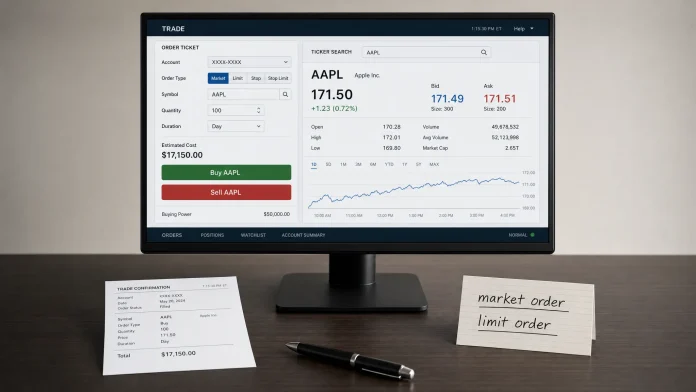
Here is the simplified process. You open and fund a brokerage account, search for the stock or ETF by ticker symbol, choose an order type, enter the number of shares or dollar amount, review the estimated cost, and submit the order. If the order is filled, you become the owner of those shares in your brokerage account.
Behind the scenes, the stock exchange and market infrastructure match buyers and sellers. The price you see on your screen is not fixed forever. It is the current market’s best available information, and it can change quickly as new orders arrive.
One important point for beginners is that placing an order and getting the exact price you expected are not always the same thing. If you use a market order, you are asking to buy as soon as possible at the best available price. If the stock is very liquid and stable, the result may be close to the price you saw. If the stock is volatile or thinly traded, the final fill price may differ.
A limit order lets you set the maximum price you are willing to pay. The trade will only execute if the market can meet your limit price or better. This can protect you from overpaying in a fast-moving market, but it also means your order may not fill.
| Term | What it means for a buyer | Beginner note |
|---|---|---|
| Ticker symbol | Short code used to identify a stock or ETF | Always verify the ticker before ordering |
| Bid price | Highest price buyers are currently offering | You usually sell near the bid |
| Ask price | Lowest price sellers are currently asking | You usually buy near the ask |
| Market order | Order to buy or sell immediately at the best available price | Fast, but less price control |
| Limit order | Order with a maximum buy price or minimum sell price | More control, but not guaranteed to execute |
| Settlement | Final transfer of shares and cash after the trade | Your broker handles this process |
For a deeper glossary of investing language, you can review these essential stock market terms before placing real trades.
Why share prices move
A share price moves because buyers and sellers disagree about what that ownership is worth at a given moment. If more buyers want the share than sellers are willing to supply at the current price, the price tends to rise. If sellers are more eager than buyers, the price tends to fall.
Over the long term, company performance matters. Revenue growth, profits, cash flow, debt, competition, and management quality can all influence investor expectations. A business that steadily grows earnings may attract more buyers, while a company with declining sales or excessive debt may lose investor confidence.
In the short term, prices can move for many other reasons. Earnings announcements, interest rate changes, inflation data, geopolitical events, analyst opinions, and market sentiment can all affect prices. Sometimes a stock rises even after good news was expected, and sometimes it falls because the news was good but not good enough.
This is why first-time buyers should avoid thinking of stock market shares as lottery tickets. A share is a claim on a real business or investment fund, but its market price can be emotional, especially over days or weeks. Your goal is not to predict every short-term move. It is to buy investments that make sense for your goals, risk tolerance, and time horizon.
The main ways beginners buy shares
First-time buyers usually choose between individual stocks, ETFs, mutual funds, and sometimes fractional shares. Each option has a different balance of control, simplicity, and risk.
Individual stocks give you direct exposure to one company. This can be exciting because you can follow the business closely and understand what you own. The tradeoff is concentration risk. If that one company performs badly, your investment can fall sharply even if the broader market is doing well.
ETFs and mutual funds provide diversification in a single purchase. An ETF might hold hundreds or thousands of stocks, which reduces the damage if one company struggles. Diversification does not eliminate risk, but it can make the journey less dependent on one company’s outcome.
Fractional shares allow you to invest a dollar amount instead of buying a full share. If one share of a company costs hundreds or thousands of dollars, fractional investing may let you start with a smaller amount. Availability depends on the broker and investment.
| Buying method | Best suited for | Main advantage | Main caution |
|---|---|---|---|
| Individual stock | Investors who want to research specific companies | Direct ownership in one business | Higher company-specific risk |
| ETF | Beginners seeking broad exposure | Easy diversification | Still affected by market declines |
| Mutual fund | Investors who prefer pooled management | Can offer diversified portfolios | Fees and trading rules vary |
| Fractional share | Buyers starting with smaller amounts | Lower starting amount | Not available everywhere |
A sensible beginner approach is often to learn with small amounts and avoid placing a large portion of savings into one stock. The right mix depends on your goals, timeline, and financial situation.
A first-time buyer checklist before placing an order
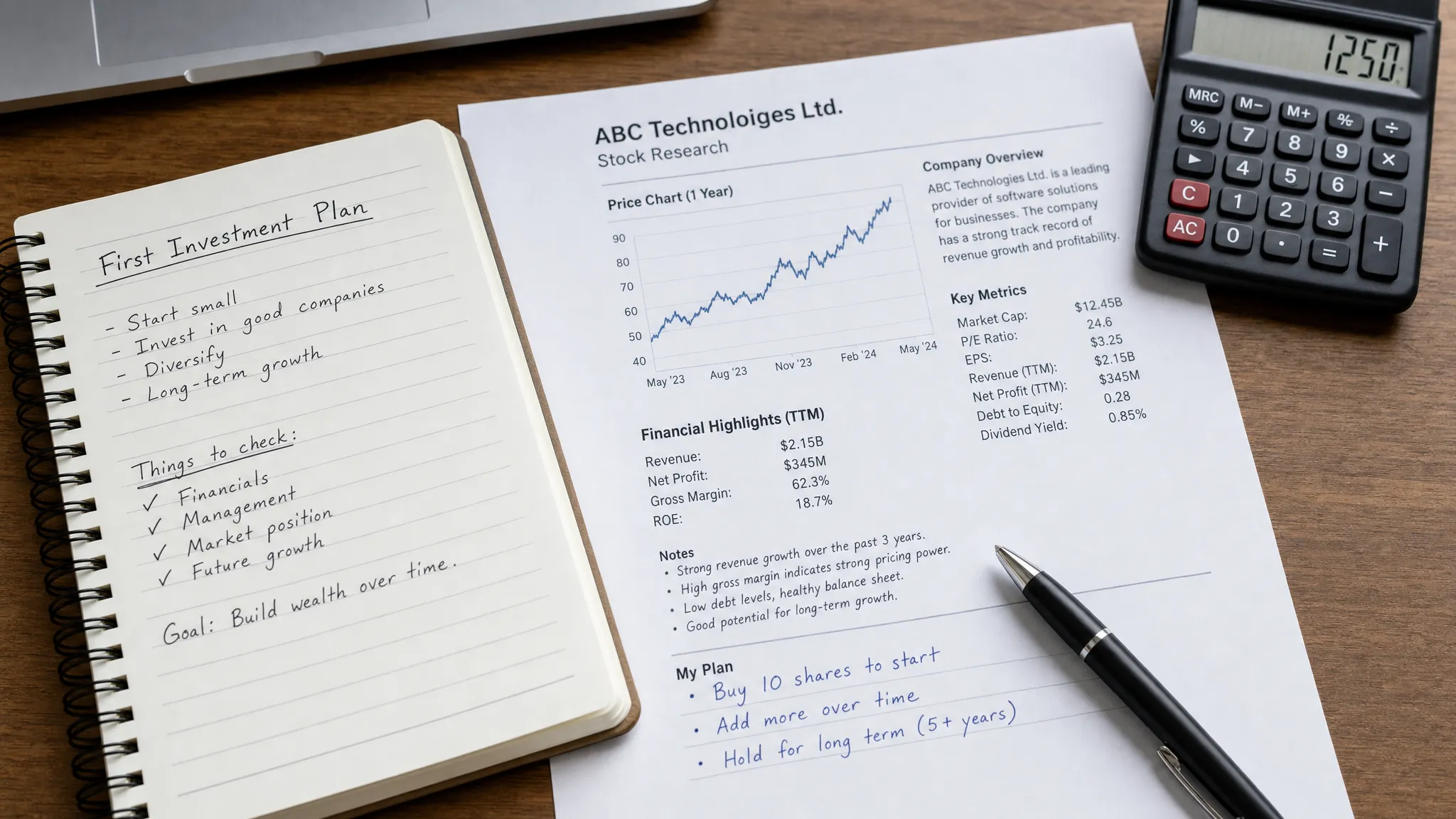
Before buying stock market shares, take a moment to slow down. The easiest mistake is not choosing the wrong stock. It is buying without a plan.
Start with your financial foundation. If you need the money for rent, debt payments, tuition, medical expenses, or an emergency fund, it may not belong in the stock market. Share prices can fall at the wrong time, and being forced to sell during a decline can turn temporary volatility into a permanent loss.
Then define your goal. Are you investing for retirement, a home purchase many years away, long-term wealth building, or education? A long time horizon can make stock market volatility easier to tolerate. A short time horizon usually calls for more caution.
Research the investment before buying. For an individual company, look at what it sells, how it makes money, whether revenue and profits are growing, how much debt it carries, and whether the share price already reflects high expectations. For a fund, check what it owns, how diversified it is, what index or strategy it follows, and what fees it charges.
For modern businesses, research may also include how the company reaches customers online. For example, if you are studying a brand whose growth depends on digital discovery, you might consider whether it is visible in AI-driven search environments using tools such as CapstonAI, alongside traditional business measures like revenue, margins, and customer retention.
A simple checklist can help you stay disciplined:
- I understand what the company or fund owns and how it makes money.
- I know why I want to buy it, not just why it is popular.
- I can explain the main risks in plain English.
- I have decided how much of my portfolio I am willing to allocate.
- I know whether I am using a market order or a limit order.
- I would still be financially stable if the investment fell significantly.
If you are ready for the practical order process, Greek Shares also explains how to buy your first stock responsibly step by step.
How much risk are you really taking?
Risk is not just the possibility that a share price goes down tomorrow. It is the possibility that the investment does not help you reach your goal, or that your own behavior leads you to buy high and sell low.
A single stock can lose value because the company disappoints investors, faces new competition, makes poor strategic decisions, or operates in a weakening industry. Even excellent companies can see their shares fall when the overall market declines.
Funds reduce company-specific risk by spreading money across many holdings, but they still carry market risk. If the broad stock market falls, most stock funds will likely fall too. The question is not whether volatility will happen. It is whether your plan can survive it.
| Risk type | What it means | Beginner response |
|---|---|---|
| Company risk | A single business performs worse than expected | Avoid overconcentration in one stock |
| Market risk | Many stocks fall together | Keep a long-term view and diversify |
| Valuation risk | You pay too much for future growth | Compare price with realistic expectations |
| Liquidity risk | It is hard to buy or sell at a fair price | Be careful with thinly traded stocks |
| Behavior risk | Emotions drive poor decisions | Write down your plan before buying |
Risk management does not mean avoiding all risk. Investing involves risk by nature. The goal is to take risks you understand, size them appropriately, and avoid decisions that could damage your financial life.
A simple example of buying shares
Imagine you decide to invest $500 in a company trading at $50 per share. If your broker allows full-share purchases only, you could buy 10 shares, not including any fees. If the broker supports fractional shares, you may be able to invest exactly $500 even if the share price does not divide evenly.
If the price later rises to $60, your 10 shares would be worth $600 before taxes and fees. That is an unrealized gain unless you sell. If the price falls to $40, your 10 shares would be worth $400. That is an unrealized loss unless you sell.
Now imagine the company pays a dividend of $1 per share during the year. If you own 10 shares, you may receive $10 in dividends, subject to applicable taxes and broker processing. Dividends are not guaranteed. Companies can increase, reduce, suspend, or eliminate them.
This example is intentionally simple. Real investing includes spreads, taxes, possible fees, currency effects for international investments, and changing business conditions. Still, the basic idea remains: your return comes from price changes, income distributions, or both.
Common first-time buyer mistakes to avoid
The first mistake is buying because everyone is talking about a stock. Popularity does not equal value. By the time a story reaches social media or the headlines, the price may already include very optimistic expectations.
The second mistake is ignoring position size. A great company can still be a bad portfolio decision if you put too much money into it. Beginners often underestimate how painful a 30 percent or 50 percent decline feels when too much capital is concentrated in one place.
The third mistake is confusing a low share price with a cheap investment. A $5 stock is not automatically cheaper than a $500 stock. What matters is the value of the business relative to its profits, assets, growth prospects, and risks. Share count matters, which is why investors look at market capitalization, not just the price per share.
The fourth mistake is trading too often. Buying and selling constantly can increase costs, taxes, and emotional pressure. Many successful investors focus more on consistent process than constant action.
Finally, avoid investing money you cannot afford to leave alone. The stock market can reward patience, but it does not follow your personal schedule. If you need the cash soon, market volatility can become a serious problem.
Frequently Asked Questions
Are stock market shares the same as stocks? In casual conversation, people often use stock and shares interchangeably. More precisely, stock refers to ownership in a company, while shares are the individual units of that ownership.
How many shares should a beginner buy first? There is no universal number. The better question is how much money you can invest without harming your financial stability, and how that purchase fits into a diversified plan.
Can I lose more than I invest when buying shares? If you buy ordinary shares without using borrowed money or complex products, your loss is generally limited to the amount invested. Using margin or derivatives can create additional risks.
Is it better to buy individual stocks or ETFs first? Many beginners find ETFs simpler because they provide diversification in one purchase. Individual stocks can be useful for learning, but they require more research and carry more company-specific risk.
Do shares always pay dividends? No. Some companies pay dividends, some do not, and dividends can change. Growth companies often reinvest profits instead of distributing them to shareholders.
Should I wait for the perfect time to buy? Perfect timing is extremely difficult. Many beginners focus instead on having a sound plan, investing gradually, diversifying, and avoiding emotional decisions.
Keep learning before you commit more money
Buying your first share is an important milestone, but it should be the beginning of your investing education, not the end. Learn the basics, understand your risk, start with a plan, and review your decisions honestly.
Greek Shares is built to help investors improve financial literacy step by step, from beginner concepts to portfolio risk management and market analysis. Continue exploring the guides on Greek Shares as you build the knowledge and confidence to make better long-term investing decisions.
This article is for educational purposes only and is not personalized financial advice. Consider speaking with a qualified financial professional before making investment decisions based on your personal circumstances.