



Buying your first stock can feel more complicated than it really is. Financial media talks about tickers, earnings, indexes, dividends, valuations, and daily market moves as if everyone already understands the language. But the foundation is simple: when you buy stock shares, you are buying ownership units in a business.
That does not mean every stock is a good investment. It means you should look at a share as a claim on a real company, not just a number moving up and down on a screen. This guide explains stock shares in plain English so first-time investors can understand what they are buying, how shares can make or lose money, and what to check before placing an order.
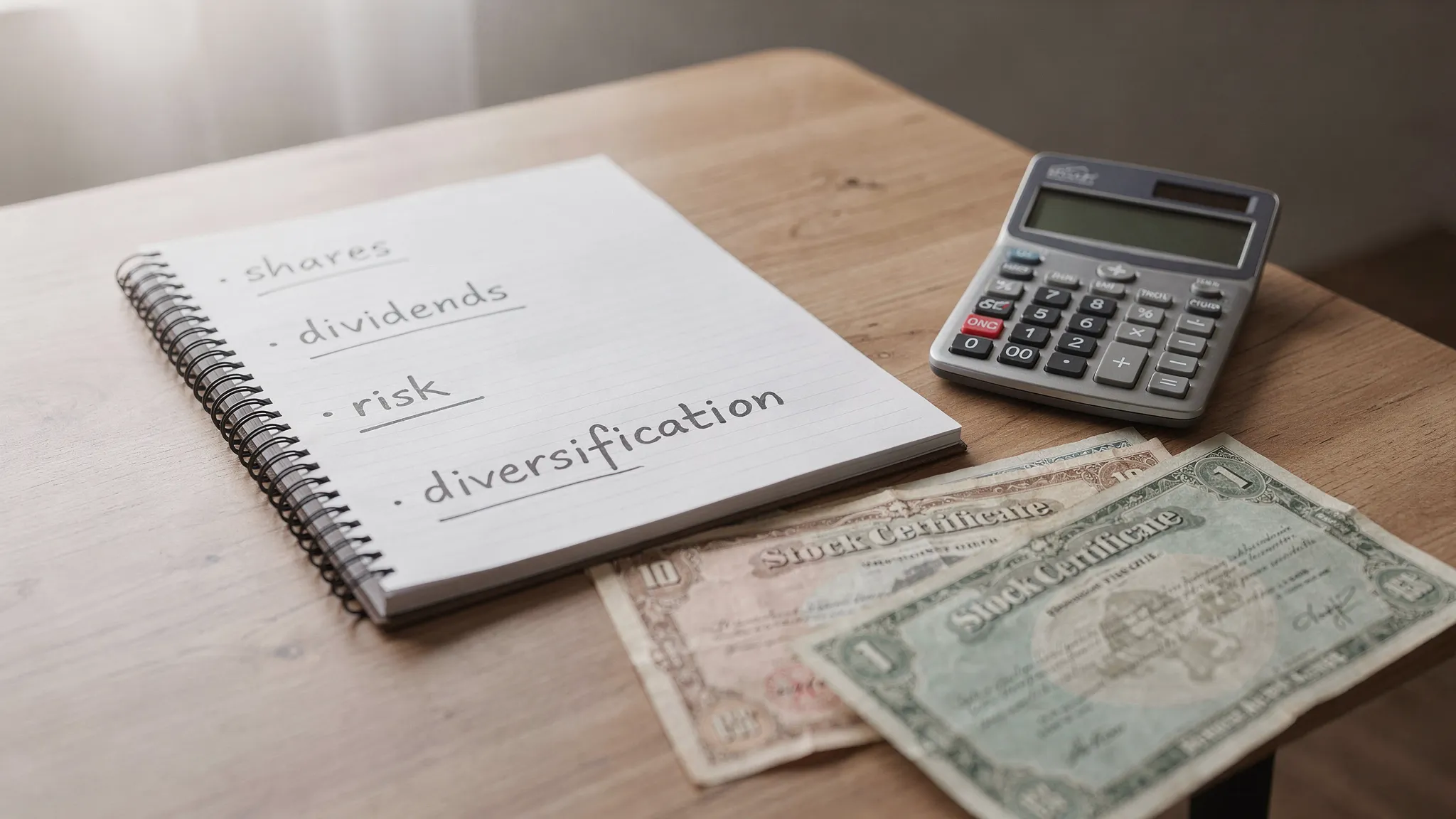
Stock Shares Explained in Plain English
A stock represents ownership in a company. A share is one unit of that ownership. People often use the words “stock” and “shares” interchangeably, but there is a small difference.
If someone says, “I own Apple stock,” they mean they own part of Apple as an investment. If they say, “I own 10 shares of Apple,” they are describing the number of ownership units they hold.
Imagine a company is divided into 1,000,000 shares. If you own 100 shares, you own 100 out of 1,000,000 units of that company. Your ownership percentage is very small, but it is still ownership. If the business becomes more valuable over time, your shares may become more valuable too. If the business performs poorly or investors lose confidence, the share price may fall.
Public companies list their shares on stock exchanges so investors can buy and sell them. If you need a broader introduction to exchanges, brokers, and market participants, start with Greek Shares’ guide to what the stock market is and how it works.
Key Stock Share Terms First-Time Investors Should Know
Before buying shares, learn the basic language. You do not need to become a Wall Street analyst overnight, but you should understand what common terms mean.
| Term | Plain meaning | Why it matters |
|---|---|---|
| Stock | Ownership in a company | Shows you are buying part of a business, not a lottery ticket |
| Share | One unit of stock ownership | Tells you how much of the company you own |
| Share price | Current market price for one share | Determines what you pay or receive when buying or selling |
| Market capitalization | Share price multiplied by shares outstanding | Helps compare company size more meaningfully than share price alone |
| Dividend | Cash payment some companies make to shareholders | Can provide income, but it is not guaranteed |
| Earnings per share | Company profit divided by shares outstanding | Helps investors evaluate profitability per share |
One important beginner lesson: a lower share price does not automatically mean a stock is cheaper. A $20 stock can be expensive if the business is weak or overvalued. A $200 stock can be reasonable if the company has strong earnings, cash flow, and growth prospects. Price only matters when compared with value.
What Do You Actually Own When You Buy Shares?
When you buy common shares, you usually receive three broad things: economic participation, limited rights, and exposure to risk.
Economic participation means you may benefit if the company grows, earns more money, or distributes cash to shareholders through dividends. If the market becomes willing to pay more for the company, your shares may rise in value.
Limited rights often include the ability to vote on certain corporate matters, such as board elections. In practice, small shareholders rarely control company decisions, but voting rights are still part of the ownership structure.
Exposure to risk means your investment can decline. Shareholders are not first in line if a company gets into financial trouble. Creditors and bondholders usually have priority over common shareholders. If a company fails, common stock investors can lose most or all of their investment.
This is why owning shares should be treated seriously. You are participating in the future results of a business, including the good and the bad.
Common Stock, Preferred Stock, and Fractional Shares
Most first-time investors buy common stock, but it helps to know the main share types.
| Type of share | What it means | Typical beginner relevance |
|---|---|---|
| Common stock | Standard ownership shares with potential voting rights | Most individual stock investing involves common shares |
| Preferred stock | Shares with features closer to income securities, often with preferred dividends | Useful to understand later, especially for income investing |
| Fractional shares | A portion of one share, such as 0.25 shares | Helpful when a full share price is high and you want to invest smaller amounts |
Fractional shares have made investing more accessible. If a company’s share price is high, some brokers allow you to buy a fraction of a share instead of buying a full one. This does not remove risk, but it can help beginners start with smaller amounts and diversify more easily.
If you are ready to learn the mechanics of placing an order, read Greek Shares’ practical guide on how to buy stocks.
How Stock Share Prices Move
A stock price moves because buyers and sellers disagree about value. Every trade has two sides: one investor is willing to sell at a certain price, and another is willing to buy at that price.
In the short term, share prices can move because of news, emotions, interest rates, inflation data, earnings announcements, analyst opinions, or broad market sentiment. In the long term, prices tend to follow business performance more closely, especially profits, cash flows, competitive strength, and future expectations.
Several forces can move a stock price:
- Company results, such as revenue growth, profit margins, debt levels, and cash flow.
- Expectations, because a good company can still fall if results are worse than investors expected.
- Interest rates, since higher rates can make future profits less valuable and bonds more competitive.
- Investor psychology, including fear, greed, overconfidence, and panic selling.
- Liquidity, because thinly traded shares can move sharply when relatively few buyers or sellers appear.
Beginners often ask, “Why did my stock fall if the company is still profitable?” The answer is usually expectations. If investors expected faster growth, higher margins, or better guidance, a profitable company can still disappoint the market.
For a deeper look at downside moves, see why stocks fall and what drives prices down.
How Investors Make Money From Shares
Stock investors generally make money in two ways: capital gains and dividends.
A capital gain occurs when you sell shares for more than you paid. If you buy 10 shares at $50 and later sell them at $70, your gain before costs and taxes is $200. The calculation is simple: 10 shares multiplied by a $20 gain per share.
A dividend is a payment a company may send to shareholders. Not all companies pay dividends. Younger or faster-growing companies may reinvest profits back into the business instead. Mature companies with steady cash flows are more likely to distribute part of their profits as dividends, although dividends can be reduced or suspended.
Here is a basic example before taxes and fees:
| Scenario | What happens | Result for 10 shares |
|---|---|---|
| Buy at $50 and sell at $60 | Share price rises by $10 | $100 capital gain |
| Buy at $50 and sell at $40 | Share price falls by $10 | $100 capital loss |
| Company pays $1 dividend per share | You receive cash for each share owned | $10 dividend income |
| Reinvest dividends | Dividends buy more shares or fractions | Potential compounding over time |
The most powerful results in stock investing often come from compounding. If a business grows over many years and dividends are reinvested, investors may benefit from both price appreciation and an increasing number of shares. Compounding requires patience, and patience is difficult when markets are volatile.
The Main Risks of Buying Stock Shares
Every investor wants returns, but risk is the price of admission. If you buy shares, you must accept that outcomes are uncertain.
Market risk is the risk that the entire market falls. Even high-quality companies can decline during recessions, financial stress, or broad sell-offs.
Business risk is the risk that a specific company performs poorly. It may lose customers, face stronger competition, mismanage debt, suffer legal problems, or fail to adapt to new technology.
Valuation risk is the risk of paying too much. A great company can be a poor investment if you buy at an unrealistic price. This is why valuation tools matter. The P/E ratio is one common starting point, although it should never be used alone.
Concentration risk appears when too much of your money is in one stock, one sector, or one country. If that single bet goes wrong, your portfolio may suffer more than expected.
Emotional risk may be the most underestimated. Many beginners buy after prices have already risen because they fear missing out. Then they sell after a decline because they cannot tolerate losses. This pattern is common, but it is destructive.
Individual Stocks vs Funds
You do not have to buy individual company shares to participate in the stock market. You can also buy funds, such as mutual funds or exchange traded funds, that hold many stocks inside one investment.
A share of an individual stock gives you exposure to one company. A share of a stock fund may give you exposure to dozens, hundreds, or even thousands of companies. This diversification can reduce company-specific risk, although it does not remove market risk.
For many first-time investors, diversified funds are a simpler starting point than picking individual stocks. Individual stock investing requires more research, more monitoring, and more emotional discipline. Funds can help beginners build a foundation while they continue learning.
If you are unsure which path fits your personality and goals, compare the trade-offs in Index Funds vs Stocks.
How to Research Stock Shares Before Buying
Good investing begins before the buy button. A stock is not attractive just because a friend mentioned it, a headline praised it, or its price recently jumped.
Start with the business. What does the company sell? Who are its customers? How does it make money? Does it have competitors? Is revenue growing? Is it profitable? Does it carry too much debt? Has management explained a clear strategy?
Then look at valuation. You are not only asking, “Is this a good company?” You are asking, “Is this company attractive at this price?” Those are different questions.
Also check the quality of information. Annual reports, quarterly reports, and official company filings are more reliable than social media rumors. In the United States, investors can research public company filings through the SEC’s EDGAR database. Educational resources from regulators, such as Investor.gov, can also help beginners understand the basics.
Online research is useful, but polished writing is not proof of expertise. With more market commentary being produced or rewritten by AI tools, it is wise to verify sources, compare claims, and understand how AI-generated content can appear persuasive. Resources that track AI writing and detection tools can help readers become more aware of how online content is produced, but investment decisions should still be based on evidence, filings, and careful analysis.
A Simple First-Share Checklist
Before buying your first stock shares, slow down and answer a few practical questions. If you cannot answer them, you may need more research or a simpler investment approach.
- Do I understand what the company does and how it makes money?
- Am I investing for years, not days or weeks?
- Can I afford to see this investment fall without panic selling?
- Is this position small enough that one mistake will not damage my financial future?
- Have I compared this stock with diversified alternatives, such as index funds?
- Do I have a clear reason to buy and a clear reason that would make me sell?
This checklist will not guarantee profits. Its purpose is to reduce avoidable mistakes. Beginners often lose money not because the market is impossible, but because they act without a plan.
When Should First-Time Investors Avoid Buying Shares?
Sometimes the smartest investment decision is to wait. You may not be ready to buy stock shares if you need the money soon, have high-interest debt, lack emergency savings, or do not yet understand basic risk.
Stocks are best suited for money that can remain invested long enough to survive volatility. If you need cash for rent, tuition, medical expenses, or a near-term purchase, the stock market may be too unpredictable for that money.
You should also avoid buying shares simply because everyone else seems to be making money. Markets can create social pressure. A rising stock can make caution feel foolish, and a falling market can make patience feel dangerous. Long-term investors must learn to resist both emotions.
For a wider asset allocation perspective, compare stocks vs bonds and think about how each fits your goals, time horizon, and risk tolerance.
What Happens After You Buy?
Buying shares is only the beginning. After that, you need a monitoring process.
This does not mean checking the price every hour. In fact, constant checking can make investing harder. Instead, follow the company’s earnings reports, major business updates, debt changes, competitive position, and valuation. Ask whether your original reason for buying remains valid.
If the business improves and the valuation remains reasonable, holding may make sense. If the business deteriorates, the valuation becomes extreme, or your position grows too large for your risk tolerance, selling may be reasonable. A disciplined investor does not sell only because the price moved. A disciplined investor sells because the facts or the risk-reward balance changed.
Greek Shares covers this decision in more detail in when to sell stocks and when to hold.
Frequently Asked Questions
Are stocks and shares the same thing? They are closely related, but not exactly the same. Stock refers to ownership in a company, while shares are the individual units of that ownership. In everyday conversation, investors often use the terms interchangeably.
How many shares should a beginner buy? There is no universal number. The better question is how much of your portfolio should be exposed to one company. Beginners should usually keep individual positions modest and avoid putting too much money into a single stock.
Can I lose more than I invest in stock shares? If you buy ordinary shares without borrowing money or using leverage, your maximum loss is generally the amount you invested. If you use margin, options, or short selling, losses can become more complex and potentially larger.
Do all stocks pay dividends? No. Some companies pay dividends, while others reinvest profits into growth. A stock can be a good or bad investment with or without a dividend, depending on the company’s quality, valuation, and future results.
Is it better to buy individual stocks or index funds first? Many beginners find index funds easier because they provide instant diversification and require less company-specific research. Individual stocks may be suitable for investors willing to study businesses, accept higher concentration risk, and build a disciplined process.
Continue Learning Before You Invest
Stock shares are simple in concept, but successful investing requires patience, humility, and continuous education. A share is a piece of a business. Treat it that way, and you will already be ahead of many beginners who only chase price movements.
Greek Shares offers investing education articles, stock market guides, financial terms, and beginner-friendly tutorials to help you build that foundation. Keep learning, compare investment choices carefully, and make each decision with a plan rather than emotion.