


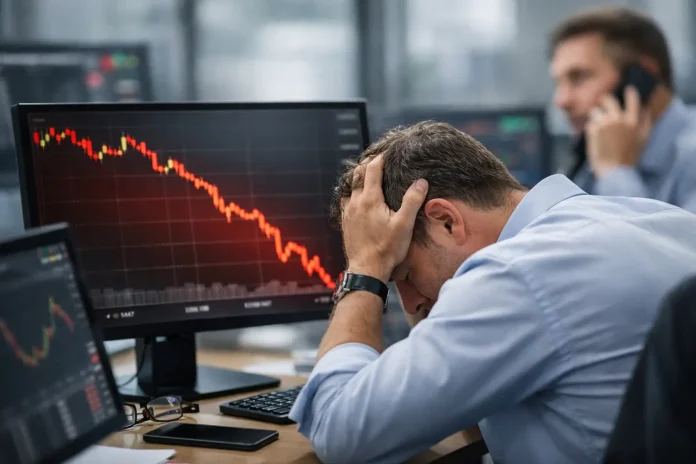
A stock drops 12% in a week, financial headlines turn dramatic, and suddenly a long-term investment can feel like an emergency. That moment helps explain why do investors panic sell: the decision usually starts as an emotional reaction before it becomes a financial one.
Panic selling is not just about fear. It is about how people process uncertainty, losses, and fast-moving information under pressure. For newer investors, this matters because one emotional decision during a market decline can undo months or years of disciplined planning.
Why do investors panic sell during market declines?
Most investors do not panic sell because they carefully reviewed a company’s intrinsic value and decided it had permanently changed. They panic sell because falling prices create stress, and stress narrows decision-making.
When portfolio values decline quickly, the brain often treats the event like a threat that requires immediate action. Selling feels like regaining control. Even if the decision hurts long-term returns, it can provide short-term emotional relief.
This is one reason market declines often feed on themselves. As prices fall, more investors become uncomfortable. Some sell to stop the pain, their selling pressures prices further, and that larger drop frightens the next group of investors.
The key point is that panic selling is usually less about deep analysis and more about human behavior under uncertainty.
The psychology behind panic selling
Investor psychology plays a central role in market behavior. Price movements are not driven only by earnings, interest rates, or economic data. They are also shaped by how people interpret those events.
Loss aversion makes declines feel bigger than gains
One of the strongest behavioral forces is loss aversion. In simple terms, people tend to feel the pain of losing money more intensely than the satisfaction of gaining the same amount.
A portfolio that rises 10% over six months may feel good. A portfolio that falls 10% in two weeks can feel unbearable. That imbalance matters because it pushes investors to act defensively, even when the smartest response may be patience.
Uncertainty is harder to tolerate than bad news
Investors can often handle negative news better than unclear news. A recession warning, an inflation surprise, or a sharp interest rate move can all hurt markets. But the real trigger for panic is often not knowing what comes next.
When future outcomes feel wide open, many investors assume the worst. They stop thinking in probabilities and start thinking in headlines. That shift makes selling feel safer than waiting.
Herd behavior amplifies fear
People take cues from other people, especially in uncertain situations. If everyone seems worried, sitting still becomes psychologically difficult.
This is why market fear can spread quickly. Investors see others selling, hear commentators using crisis language, and begin to believe that staying invested is reckless. In reality, the crowd is not always right. It is often simply emotional at the same time.
Common triggers that cause investors to panic sell
While fear is the underlying force, panic selling usually starts with a trigger. Some triggers are market-wide, while others are personal.
Sharp price drops
Fast declines are more unsettling than slow ones. A gradual 15% decline may still be uncomfortable, but a sudden 5% or 7% drop in a day can create urgency. Speed changes perception. Investors begin to think something must be terribly wrong, even when volatility is a normal part of markets.
Negative news cycles
Financial media can intensify market anxiety. During downturns, the same risks are repeated across television, social media, newsletters, and market apps. Constant exposure makes the threat feel larger and more immediate.
This does not mean investors should ignore news. It means they should recognize that heavy news consumption during volatility can distort judgment.
Using too much risk
A portfolio that is too aggressive for an investor’s real risk tolerance is one of the most common causes of panic selling. It is easy to believe you can handle volatility when markets are rising. It is much harder when your account is down sharply.
If an investor owns concentrated positions, speculative stocks, or money they may need soon, a downturn becomes more than uncomfortable. It becomes destabilizing.
Leverage and margin
Borrowed money makes declines more dangerous. A normal market pullback can become a forced selling event if margin calls are involved. Investors who use leverage often have less flexibility to wait out volatility, which increases the chance of panic-driven decisions.
Lack of a clear plan
Investors without a time horizon, asset allocation framework, or exit rules are more vulnerable when markets fall. If you do not know why you bought an investment, it becomes much easier to sell it for the wrong reason.
Why panic selling is so costly
Selling during a decline can protect capital if the original investment case is broken. That is a rational sale. Panic selling is different. It is usually driven by fear after prices have already fallen.
That timing creates two problems.
First, investors lock in losses. A temporary decline becomes a permanent capital loss the moment the position is sold.
Second, many investors struggle to get back in. Selling is emotionally easy during panic. Rebuying is much harder because markets often recover while the news still looks negative. Investors wait for certainty, and by the time certainty returns, prices are often much higher.
This is one of the biggest hidden costs of panic selling. It is not just the sale itself. It is missing the recovery that follows.
Why do investors panic sell even when they know better?
Experience and knowledge help, but they do not eliminate emotion. Even disciplined investors can feel pressure during severe drawdowns.
Knowing that markets recover over time is different from watching your own money decline in real time. The gap between theory and behavior is where many mistakes happen.
There is also a false belief that action is always better than inaction. During volatile periods, doing something can feel intelligent and responsible. But in investing, activity is not the same as good judgment. Sometimes the best decision is to review the facts, make no immediate move, and let the situation develop.
How investors can reduce the risk of panic selling
The best defense starts before the market drops. Panic is less likely when a portfolio and process are built for real-world volatility.
Match your portfolio to your actual risk tolerance
Do not build a portfolio based on what sounds impressive. Build one you can hold through a difficult year. If a 20% decline would push you to sell everything, your allocation may be too aggressive.
A balanced mix of assets will not remove losses, but it can make them more manageable. Manageable losses are easier to live through than extreme ones.
Keep a time horizon for each goal
Money needed in the near term should not be exposed to the same level of stock market risk as money meant for long-term growth. Investors often panic when short-term needs and long-term investments get mixed together.
Separating those goals creates breathing room. It allows long-term capital to remain invested without every market swing feeling personal.
Write down your investment process
A simple written plan helps when emotions rise. It can include your asset allocation, rebalancing rules, position size limits, and the reasons you own certain investments.
When markets fall, the plan gives you something more reliable than mood or headlines. It turns investing from reaction into process.
Limit emotional decision windows
If you feel the urge to sell during a volatile session, pause. Review earnings, valuation, balance sheet strength, and your original thesis before acting. A 24-hour delay will not fix every mistake, but it can prevent impulsive ones.
Expect volatility in advance
Many investors panic because they treat market declines as abnormal. They are not. Corrections, bear markets, and periods of fear are part of investing.
Accepting this does not make losses pleasant. It makes them less surprising. And what is less surprising is often easier to manage.
For readers building their investing knowledge through resources like Greek Shares, this is one of the most useful mindset shifts: volatility is not proof that investing is broken. It is part of the price paid for long-term return potential.
The real lesson behind panic selling
Panic selling is rarely about one bad day in the market. It is usually the result of a weak process meeting a stressful moment. Investors who understand their own behavior, size risk appropriately, and invest with a plan are far less likely to make fear-based decisions when prices fall.
The market will test your discipline at some point. Your goal is not to feel no fear. Your goal is to build habits strong enough that fear does not get to make the decision for you.