


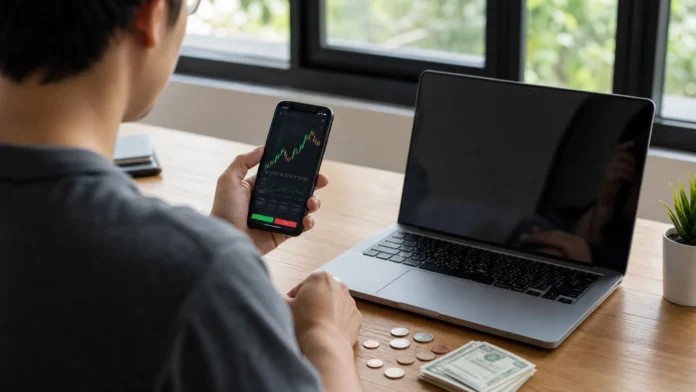
Most people delay investing because they think they need a large sum to begin. That assumption is outdated. In 2026, you can open an account, buy a slice of a real company, and start building a portfolio with less money than a weekly grocery run. This guide walks through how to start investing with little money, step by step, without the guesswork or the hype.
How Much Money Do You Need to Start Investing in 2026?
The honest answer: you need less than you think, and possibly nothing at all. Many leading online brokers now offer $0 account minimums and commission-free trading on US-listed stocks and ETFs. That shift removed the dollar-amount barrier that used to keep new investors on the sidelines.
The real requirement isn’t a specific balance. It’s a plan. You need a clear goal, a broker that fits your budget, and a habit of adding money on a schedule. The amount you start with matters far less than whether you keep showing up month after month.
Why $0 Minimums and Fractional Shares Changed the Rules
A decade ago, buying a single share of a high-priced company could cost hundreds of dollars. That priced out most beginners. Fractional share investing changed that.
Fractional shares let you buy a slice of a high-priced stock. You could own $10 worth of a $300 share instead of needing the full amount. Portfolio building no longer requires hundreds of dollars per position.
Combine that with $0 minimums and no-commission trades, and the old excuse of “I don’t have enough money to invest” no longer holds up. The barrier now is behavioral, not financial.
Step-by-Step: How to Start Investing With Little Money
Investing on a budget works best when you follow a repeatable process instead of guessing. Here’s the sequence to follow, in order.
Step 1: Set a Clear, Small Starting Goal
Before you open an account, decide what your first goal actually is. It might be investing $25 a week, or putting $100 into your first stock this month. Keep it small and specific.
A concrete number gives you something to act on immediately. It also removes the temptation to wait until you have “enough,” which for many people never arrives.
Step 2: Choose a Low-Fee Broker That Supports Fractional Shares
Not every broker treats small investors equally. Look for a platform with no account minimum, no monthly fees, and commission-free trading on stocks and ETFs. Confirm it supports fractional shares. That feature is what makes small-dollar investing practical.
Once you’ve picked a broker, open the account and link a bank account for transfers. Set an amount you’re comfortable investing right away, even if it’s modest. Then automate future contributions so investing becomes routine rather than a decision you make every week.
Best Way to Invest $100 (or Less) Right Now
If you have $100 and want to put it to work today, you have two realistic paths: buy a fractional share of a single company, or buy into a diversified ETF. Both are valid. The right choice depends on how much research you’re willing to do, and how much risk you’re comfortable holding in one place.
A single fractional share concentrates your money in one business. That can work if you’ve researched the company and understand what you own. For a broader starting point, many beginners research options like the best stocks for beginners in 2026 before choosing where that first $100 goes.
Fractional Shares vs. ETFs for Small Budgets
A fractional share of one company gives you concentrated exposure. If that company performs well, your return reflects that directly. If it struggles, so does your entire position.
An ETF spreads your $100 across dozens or hundreds of companies in a single purchase. That instantly reduces the impact of any one company underperforming. For a first investment, especially with a small amount of money, an ETF is often the steadier choice.
Neither approach is wrong. Many new investors start with a broad ETF for stability, then add individual fractional shares as they learn more and their balance grows.
Investing on a Budget: Building the Habit Before the Balance
When you’re starting with small amounts of money, the habit matters more than the dollar amount. A $50 contribution won’t change your financial life on its own. But fifty $50 contributions, made consistently, will.
Automate Contributions With Dollar-Cost Averaging
Dollar-cost averaging means investing a fixed amount on a regular schedule, regardless of what the market is doing that week. An investor who commits $50 a month through automatic transfers builds the habit of consistent investing long before the dollar amount itself becomes meaningful.
This approach also removes emotion from the process. You’re not trying to time the market or guess the best entry point. You’re showing up on schedule, and that habit compounds alongside your money.
Most brokers let you automate this in a few minutes. Set a recurring transfer, choose the investment, and let the schedule run in the background.
Avoid Common Mistakes New Investors Make With Small Amounts
New investors with limited capital tend to repeat the same few mistakes. Watch for these:
- Chasing hot tips instead of research. A small budget is not a reason to skip due diligence.
- Trading too frequently. Fees and taxes can erode small balances faster than you’d expect, even with commission-free trades.
- Putting everything into one stock. Concentration risk hits harder when you have little room to absorb a loss.
- Stopping contributions after a market dip. This is often when consistent investors benefit most from lower prices.
- Waiting for a “better time” to start. There isn’t one. The habit matters more than the timing.
Greek Shares’ own beginner content keeps coming back to the same point: start with structured, small, repeatable actions instead of waiting for a large lump sum. That principle applies directly here. Action beats hesitation.
Managing Risk When You’re Starting Small
A small starting balance doesn’t mean risk doesn’t matter. If anything, protecting a small portfolio from unnecessary losses early on helps you stay invested long enough for compounding to work.
The basics are straightforward. Don’t put all your money into one stock. Favor diversified options like ETFs when you’re still learning. Avoid borrowing money or using leverage to invest, especially in the early stages.
If you want to go deeper on this, a practical framework for managing investment risk covers the specifics beyond what a beginner needs on day one. For now, the goal is simple: don’t take risks you don’t understand, and don’t concentrate your entire budget in a single bet.
Diversification doesn’t have to be complicated even with a small account. You can learn how to diversify your portfolio without overcomplicating it using just a handful of ETFs or fractional positions.
Your Next Step After Your First Small Investment
The earlier you start investing, even with small amounts, the more time compounding has to work. That matters more than the size of your initial deposit. Once you’ve opened your account, made your first fractional share or ETF purchase, and set up an automatic contribution, you’ve already done the hard part: starting.
What comes next is consistency and continued learning. Understanding the habits that separate good investors from the rest will help you avoid the mistakes that derail new investors before their strategy has time to work.
Investing with little money isn’t a lesser version of investing. It’s the same discipline, applied at a smaller scale, while you build both your balance and your knowledge. If you want structured guidance as you grow from your first $100 into a full portfolio, subscribing to Greek Shares’ free investing newsletter gives you the next steps without the guesswork.