


Main shares often attract the most attention because they are visible, liquid, and widely discussed. They may include large companies in major indices, sector leaders, dividend payers, or fast-growing businesses that dominate financial headlines.
But “popular” is not the same as “safe,” and “well-known” is not the same as “undervalued.” A strong investing process starts by turning a list of main shares to watch into a disciplined research plan. The goal is not to guess which stock will rise next week. The goal is to understand the business, compare the risks, and decide whether the current price offers a reasonable opportunity for your own goals.
This guide explains what makes a share worth watching, how to build a research list, and which checks beginner and intermediate investors should complete before making any decision.
What “main shares” really means
The phrase “main shares” usually refers to stocks that are central to a market, sector, or investor watchlist. These are often companies with large market capitalizations, high trading volume, strong brand recognition, or major index membership.
For example, in global markets, investors often study mega-cap technology, financial, healthcare, consumer, and energy companies because they influence major indices and economic sentiment. In Greece, investors may pay close attention to large Athens Stock Exchange companies in banking, telecoms, energy, infrastructure, consumer goods, and industrial sectors.
A main share can be worth watching for several reasons:
- It represents an important sector of the economy.
- It has enough liquidity for investors to enter and exit more easily.
- It publishes regular financial information and analyst coverage.
- It can reveal trends in consumer demand, interest rates, energy prices, or technology spending.
- It may be a benchmark for comparing smaller companies in the same industry.
However, a main share can still be overpriced, overhyped, cyclical, poorly managed, or exposed to risks that are not obvious at first glance. That is why research matters more than recognition.
If you are still learning the basics of ownership, dividends, and market value, Greek Shares has a beginner-friendly explanation of what stock shares represent for first-time investors.
Main types of shares worth watching
Instead of chasing random tips, build a watchlist by category. This helps you compare similar companies and avoid mixing completely different risk profiles.
| Type of share | Why investors watch it | What to research first |
|---|---|---|
| Large-cap index leaders | They often move major indices and attract institutional investors. | Revenue growth, margins, valuation, competitive position, index weight. |
| Dividend shares | They may appeal to income-focused investors. | Dividend history, payout ratio, free cash flow, debt levels. |
| Growth shares | They can compound quickly if earnings expand. | Addressable market, revenue growth, profitability path, valuation assumptions. |
| Cyclical shares | They can benefit from economic recoveries but suffer in downturns. | Industry cycle, balance sheet strength, commodity or demand exposure. |
| Banking and financial shares | They are sensitive to interest rates, credit quality, and regulation. | Capital ratios, loan quality, net interest margin, provisions. |
| Energy and infrastructure shares | They may be tied to long-term projects and macro trends. | Regulation, leverage, cash flow stability, commodity exposure. |
| Defensive consumer shares | They may hold up better when the economy slows. | Pricing power, brand strength, margins, dividend sustainability. |
This table is not a buy list. It is a research map. A share becomes interesting only after you understand the business and the price you are being asked to pay.
How to build a watchlist without following hype
A good watchlist is small enough to follow properly and broad enough to compare opportunities. For most individual investors, 10 to 30 shares is more useful than hundreds of names you never research deeply.
Start with companies you can explain in plain English. If you cannot describe how a company earns money, who its customers are, and what could damage its profits, you are not ready to evaluate the share.
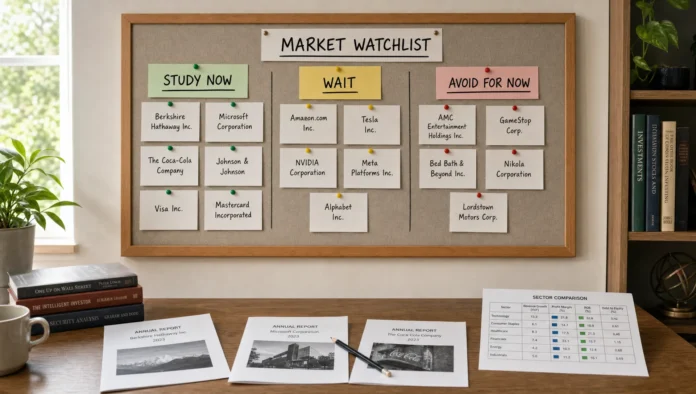
Then separate your list into three groups:
| Watchlist group | What it means | Example action |
|---|---|---|
| Study now | The business is understandable and current valuation may be worth analyzing. | Read the latest annual report and compare peers. |
| Wait for price or data | The business is attractive, but valuation or uncertainty is too high. | Set a target valuation range or monitor upcoming results. |
| Avoid for now | Risks are too unclear or fundamentals are weak. | Revisit only if new information changes the case. |
This approach keeps you from buying only because a share is trending. It also helps you prepare before market volatility creates opportunities. For a broader watchlist process, you can also review Greek Shares’ guide to building an updated stock watchlist for the year.
The research process: from name recognition to informed decision
Once a share reaches your “study now” list, research it in layers. Each layer should either strengthen your confidence or reveal a reason to slow down.
1. Understand the business model
Ask the simplest question first: how does this company make money?
A bank earns through lending, deposits, fees, and investment activities. A retailer earns by selling products at a margin. A software company may earn through subscriptions, licenses, or usage fees. An energy company may earn through production, refining, distribution, infrastructure, or regulated activities.
You should also identify what drives growth. Is it more customers, higher prices, new products, acquisitions, international expansion, or cost savings? Growth that depends on one temporary factor is riskier than growth supported by multiple durable drivers.
2. Read official company documents
Do not rely only on social media, forums, or headlines. Start with primary sources:
- Annual reports and quarterly results.
- Investor presentations.
- Regulatory filings.
- Company announcements.
- Exchange notices.
For U.S.-listed companies, the SEC EDGAR database is a key source for filings. For Greek-listed companies, the Athens Exchange and company investor relations pages are important starting points.
Official documents are not perfect, but they show management’s explanation of results, risk factors, debt, cash flow, and strategy. They also let you compare what management promised in previous years with what actually happened.
3. Analyze financial statements
The income statement shows revenue, expenses, and profit. The balance sheet shows assets, liabilities, and equity. The cash flow statement shows how much cash the company generated or consumed.
Many beginners focus only on net profit, but cash flow often tells a clearer story. A company can report accounting profits while struggling to collect cash, fund operations, or reduce debt.
If you want a step-by-step beginner framework, Greek Shares’ guide on how to research stocks before buying walks through the process in more detail.

Key metrics to check before watching a share seriously
No single metric proves that a share is attractive. The right numbers depend on the industry, the company’s maturity, and the economic cycle. Still, the following metrics can help you move beyond opinions.
| Metric | What it helps you understand | What to watch for |
|---|---|---|
| Revenue growth | Whether the company is expanding sales. | Growth that is consistent and not only acquisition-driven. |
| Operating margin | How efficiently the company turns sales into operating profit. | Stable or improving margins compared with peers. |
| Free cash flow | Cash left after operating costs and capital spending. | Positive cash flow that supports dividends, debt reduction, or reinvestment. |
| Return on equity or invested capital | How effectively management uses capital. | Strong returns that are not caused only by excessive debt. |
| Net debt and interest coverage | Balance sheet risk. | Debt levels the company can handle in weaker conditions. |
| P/E ratio | Price compared with earnings. | A valuation that makes sense relative to growth and quality. |
| EV/EBITDA | Valuation before capital structure differences. | Useful for comparing companies with different debt levels. |
| Dividend payout ratio | Dividend sustainability. | Payouts supported by earnings and cash flow, not borrowing. |
Use these metrics to ask better questions, not to create automatic buy signals. A low P/E ratio may indicate value, but it may also signal declining profits. A high P/E ratio may be justified by strong growth, but only if future expectations are realistic.
Compare the share against its peers
A share should rarely be analyzed alone. Peer comparison helps you understand whether a company is genuinely strong or simply benefiting from a favorable sector trend.
Compare companies in the same industry on growth, profitability, debt, valuation, and shareholder returns. If one company trades at a premium, ask why. It may have better margins, stronger growth, superior management, lower debt, or a more predictable business. If no clear reason exists, the premium may be driven by hype.
For example, when comparing banks, focus on credit quality, capital strength, deposit base, loan growth, and sensitivity to interest rates. When comparing retailers, study store productivity, online growth, inventory, gross margins, and consumer demand. When comparing energy companies, examine commodity exposure, regulation, capital expenditure needs, and balance sheet resilience.
The goal is not to find the cheapest share. The goal is to find the best balance between business quality, risk, and price.
Study valuation with humility
Valuation is where many investors become overconfident. A spreadsheet can look precise, but its output depends heavily on assumptions about growth, margins, interest rates, and future risk.
Use valuation as a range, not a single number. A sensible investor might estimate a conservative case, a base case, and an optimistic case. If a share only looks attractive under perfect assumptions, it may not offer enough margin of safety.
Common valuation tools include P/E ratios, dividend yield, discounted cash flow, price-to-book for financials, and EV/EBITDA for capital-intensive companies. Each tool has limitations. For example, price-to-book can be useful for banks but less meaningful for asset-light technology companies. Dividend yield can be attractive, but a high yield may signal that the market expects a dividend cut.
This is why valuation should always connect back to business quality. A weak company is not automatically a bargain because it looks cheap. A strong company is not automatically worth buying at any price.
Red flags to avoid in main shares
Large, famous companies can still disappoint investors. Watch for warning signs before adding any share to your serious research list.
- Profits are rising, but operating cash flow is weak.
- Debt is increasing faster than earnings.
- Management relies heavily on “adjusted” numbers while reported results deteriorate.
- The company depends on one product, customer, market, or regulator.
- Dividends are paid despite weak free cash flow.
- Shareholders are repeatedly diluted through new share issuance.
- Valuation assumes growth that is much faster than the company’s realistic market opportunity.
A red flag does not always mean you must avoid a company forever. It means you need a stronger reason, a lower valuation, or clearer evidence before taking the idea seriously.
A simple scoring framework for your watchlist
To stay objective, give each share a research score. This does not need to be complicated. The purpose is to slow down emotional decisions and document your reasoning.
| Research area | Score from 1 to 5 | Question to answer |
|---|---|---|
| Business clarity | 1-5 | Can I explain how the company makes money? |
| Financial strength | 1-5 | Are profits, cash flow, and debt levels healthy? |
| Competitive position | 1-5 | Does the company have durable advantages? |
| Management quality | 1-5 | Has management allocated capital responsibly? |
| Valuation | 1-5 | Does the current price offer a reasonable risk-reward balance? |
| Risk awareness | 1-5 | Do I understand what could go wrong? |
After scoring, write a short investment note in your own words. Include what you like, what worries you, what data you still need, and what price or event would make you reconsider. This habit can protect you from buying only because a share is popular.
How often should you review main shares?
A watchlist is not static. Review it after earnings reports, major company announcements, interest rate changes, sector disruptions, or large price moves.
For long-term investors, quarterly updates are usually enough for stable companies. More cyclical or highly leveraged companies may require closer monitoring. The key is to review new information, not daily price noise.
You should also remove shares from your list when the original reason for watching them no longer applies. If the business becomes too hard to understand, debt risk rises, management credibility weakens, or valuation becomes unrealistic, it may be better to focus your time elsewhere.
Frequently Asked Questions
Are main shares safer than smaller shares? Not always. Main shares are often more liquid and better covered by analysts, but they can still fall sharply if earnings disappoint, valuation is too high, or the sector faces pressure.
How many shares should a beginner watch? A focused list of 10 to 20 shares is usually more useful than a huge list. Beginners should prioritize understanding businesses deeply rather than collecting stock names.
Should I buy a share just because it is in a major index? No. Index membership can indicate size and liquidity, but it does not prove that the share is attractively valued or suitable for your goals.
What is the most important document to read before buying? The annual report is often the best starting point because it includes financial statements, management discussion, business details, and risk factors.
How do I know if a main share is overvalued? Compare valuation ratios with growth, margins, cash flow, peers, and the company’s own history. If the price requires very optimistic assumptions, the risk of overvaluation may be higher.
Final thoughts: watch carefully before you invest
Main shares can be excellent learning tools because they are visible, well-documented, and often central to market trends. But they should be researched, not followed blindly.
Build a watchlist by category, read official documents, compare financial strength, study valuation, and write down your reasoning before acting. The best investors are not the ones who react fastest to headlines. They are the ones who understand what they own, why they own it, and what would change their mind.
For more educational investing guides, market learning resources, and practical stock research articles, explore Greek Shares and keep improving your process one company at a time.